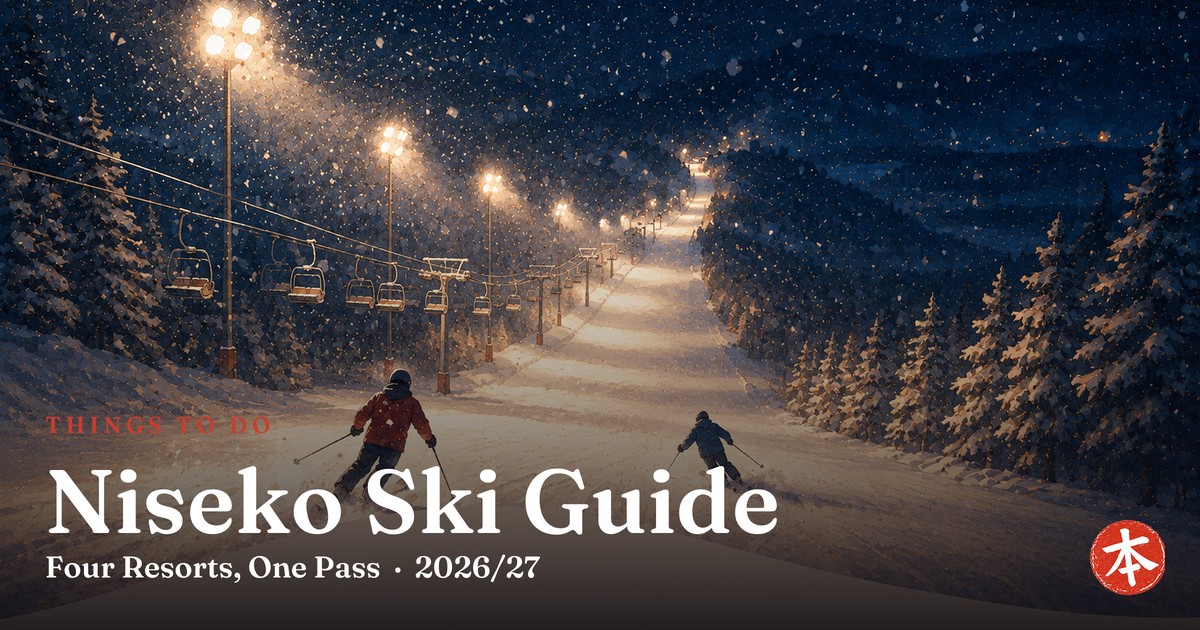
Niseko is four resorts on one mountain in Hokkaido, on one lift ticket, with the snow that made Japan famous among skiers and — unusually for Japan — an English-speaking infrastructure that actually works.
This guide is published in August on purpose: Niseko's 2026/27 season dates and all-mountain prices are already out, which is rare this early. Below, everything confirmed for the coming season is separated cleanly from everything that is still last season's figure — and the resorts' own pages disagree with each other in four places, so those are flagged rather than smoothed over.
Niseko at a glance
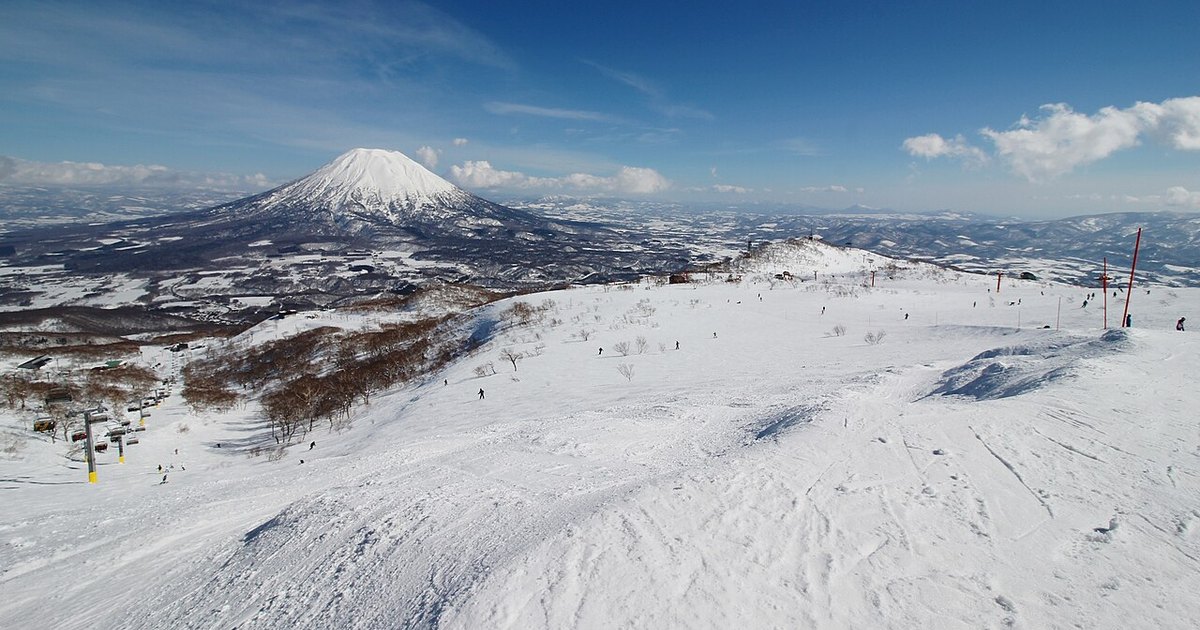
| What it is | Four resorts on one mountain — Annupuri, Niseko Village, Grand Hirafu, Hanazono · over 2,000 acres |
|---|---|
| 2026/27 season | Opens November 28, 2026 · Hirafu and Annupuri run to May 5, 2027 |
| Day pass (peak) | ¥13,500 adult · ¥8,100 child (4–12) · ¥11,500 teen (13–15) and senior (65+) |
| Day pass (other) | ¥12,600 regular · ¥8,800 early and spring |
| Season pass | ¥184,400 adult · breaks even around 14 peak days |
| Night skiing | All four resorts · December 12, 2026 – March 22, 2027 · night pass is per resort |
| Inter-resort shuttle | Free with the All Mountain Pass |
| 🚨 Backcountry | Gates only. Ducking ropes = pass confiscated. Rescue charged from ¥100,000 |
The 2026/27 prices, and what they buy
The All Mountain Pass is priced by season band, and the bands are published for 2026/27: Early runs November 28 to December 11, Regular covers December 12–23 and March 1–22, Peak is December 24 to February 28, Spring is March 23 to April 4, and a Final band runs April 5 to May 5.
| Peak season (Dec 24 – Feb 28) | Adult · Child 4–12 · Teen 13–15 · Senior 65+ |
|---|---|
| 1 day | ¥13,500 · ¥8,100 · ¥11,500 · ¥11,500 |
| 2 days | ¥26,500 · ¥15,900 · ¥22,500 · ¥22,500 |
| 3 days | ¥39,500 · ¥23,700 · ¥33,600 · ¥33,600 |
| 5 days | ¥65,500 · ¥39,300 · ¥55,700 · ¥55,700 |
| 7 days | ¥91,500 · ¥54,900 · ¥77,800 · ¥77,800 |
| Regular season, 1 day | ¥12,600 adult · 7 days ¥85,200 |
| Early / Spring, 1 day | ¥8,800 adult · 7 days ¥59,600 |
| Season pass | ¥184,400 adult · ¥110,600 child · ¥156,700 teen and senior |
- The shuttle is included. The pass lets you ride the Niseko United shuttle between the four resorts free — which is the whole argument for buying it over a single-resort ticket.
- 🚨 Multi-day passes are consecutive-day only. A weather day in the middle is a day you paid for and didn't use.
- A day ticket already covers night skiing until the end of the session on its final day, during the night-ski period.
- Season passes are non-transferable — the official terms state a pass used by anyone other than the original owner will be canceled.
- A lost pass costs ¥3,500 to reissue, card fee included.
One table on the page carries no heading at all and shows a single ¥6,300 day rate. It probably belongs to the Final season band, but the page never says so — so we won't tell you it does.
A "50-hour" row is malformed in the page's HTML, with six cells against a five-column header, and reads as ¥121,200 for an adult — more than the seven-day peak pass. That is almost certainly a display error rather than a price. Ask at the counter.
And a genuine contradiction: the season pass page states a ¥1,000 deposit for the key card, while the online pass page says the opposite — "500JPY for the keycard is not refundable as it is to purchase the card and not the deposit." They may be two different products; no official page reconciles them. Budget for a card fee and don't be surprised by either figure.
Night skiing: the thing Niseko actually wins on
Rider’s-eye footage from Grand Hirafu after dark, with the floodlit piste lit up and snow still falling — the clearest picture of what night skiing here actually looks like, no Japanese needed.
Most Japanese resorts light one or two runs. Niseko lights all four resorts, which Niseko United describes as the largest night skiing area in Japan. Skiing powder under floodlights with almost nobody around is the memory people come back for, and it is genuinely difficult to get anywhere else.
- 2026/27 dates are published: December 12, 2026 to March 22, 2027.
- Hours for 2026/27 were not published when we checked. Last season they ran 16:00–19:00 at Hirafu, Hanazono and Niseko Village, and 16:30–19:30 at Annupuri — treat those as indicative. (Two official pages disagree on Niseko Village, one giving 16:30–19:00.)
- Night passes are sold per resort, not across all four, and are cheaper than a day pass if the evening is all you want. Annupuri's was ¥3,300 last season; 2026/27 pricing isn't out.
- Hanazono runs fireworks every Saturday night during the season.
- The official caveat, worth heeding: night skiing runs depending on snow and weather, and you should always check the current season's timetable.
🚨 The Niseko Rules — read these before you follow anyone into the trees
Niseko has a formal, published backcountry system, and the official page opens by explaining why in one sentence: "Niseko used to have the highest number of fatal avalanche accidents in all of Japan." The rules are quoted here verbatim because paraphrasing them would soften them.
"Do not duck boundary ropes."
"Everyone skiing/snowboarding in backcountry areas should wear a helmet and carry an avalanche beacon."
"Backcountry skiing/snowboarding is prohibited when gates are closed."
"Never enter off-limits areas at any time."
"Elementary school children are not allowed in backcountry areas unless accompanied by an elder companion."
And the two consequences, also published:
🚨 "A minimum of ¥100,000 will be charged for search and rescue operations in backcountry areas."
🚨 "Rules violators may be banned from using the resort facilities by having their lift-pass confiscated and/or refused to reissue a new pass."
- There are 11 backcountry gates across Niseko United and neighboring Moiwa. They open and close according to conditions, and the patrol decides.
- Two areas are named as strictly off limits at any time in the official materials, with lift-pass confiscation stated as the consequence.
- Outside the boundary is national forest and park land, not patrolled or supervised by the resorts.
- The official avalanche information is published by the Niseko Avalanche Institute and posted at lift stations, at the gates and online.
- Carry a beacon, probe and shovel. The official wording is that this equipment may save not only your life but your buddy's.
None of this should scare you off the in-bounds skiing, which is patrolled and superb. It should scare you off the specific idea that a rope is a suggestion.
Getting there
Niseko is a flight plus a bus, and the bus is the part to get right. Chuo Bus runs direct services from New Chitose Airport and Sapporo. Official journey times: about 2 hours 56 minutes to Annupuri, 3 hours 16 minutes to Niseko Village and 3 hours 33 minutes to the Hirafu Welcome Center.
Reservations are required — this is not a turn-up-and-board service.
🚨 Ski and snowboard boots are not permitted on board. The operator states it plainly and asks that skis and boards go in a case. Wear normal shoes and pack the boots.
And the timing note for anyone booking now: this season's timetable and fares are not published yet. The operator's page says outright that the information shown is from last season and that reservations are scheduled to open around October. Last season the fare was ¥6,000 one way and ¥10,000 return for an adult — a last-season figure, not a quote for your trip.
Train is possible and awkward. JR Hokkaido states that passengers heading for Kutchan or Niseko must transfer at Otaru, and — the detail that strands people — IC cards such as Suica cannot be used beyond Otaru, so buy a paper ticket at your departure station. The airport is 33 minutes from Sapporo and 73 minutes from Otaru at the fastest; JR publishes no fare or timing beyond Otaru, so we don't quote one. If you have a rail pass, check whether this leg is even covered before planning around it.
English, and which resort to base yourself at
Niseko is the most foreigner-ready ski area in Japan, but that is not uniform across the four resorts and the difference is officially documented. Niseko Village's school advertises internationally certified multilingual instructors, and two large international schools operate across the resorts. 🚨 Annupuri's own snow school is described officially as using only Japanese staff — framed as a strength (they know the mountain), but it is the one to avoid if you need an English lesson.
New for this season: Niseko Village is opening the first section of a new gondola for 2026/27, reaching 670m, with a second section to about 930m expected in 2027. If you've skied Niseko before, that changes the shape of that side of the mountain.
Niseko or Hakuba?
The honest comparison, on published 2026/27 numbers:
| Niseko · Hakuba | |
| Day pass 2026/27 | ¥13,500 peak · ¥11,100 |
| Resorts covered | 4 · 10 |
| From Tokyo | Flight + about 3 hours by bus · as little as 2h50m by train and bus |
| Night skiing | All four resorts · not the draw |
| Multi-day flexibility | Consecutive days only · 3-day pass usable across 6 days |
Hakuba is the easy add-on to a Tokyo trip and the better deal on paper — cheaper, more mountains, and a multi-day pass with real slack in it. Niseko is the destination you fly to: better snow reputation, night skiing across the whole valley, and the least friction of anywhere in Japan if you don't speak Japanese. Both are worth it; they answer different questions.
If you're building the wider trip, see the seasonal guide for how the ski window overlaps with everything else, and the ryokan guide — a night in one after a day on the snow is the best pairing in Japanese travel. Have a data connection live from landing: lift status, gate status and the avalanche report are all things you will read standing outside.
(Planning the logistics? The 2026–27 airport bus is already on sale — see Niseko from Tokyo — and our Niseko map guide untangles the four resorts, two towns and the new season's pass prices.)
(For the Hakuba-vs-Niseko decision and the wider season logistics, see our skiing-in-Japan guide.)
(For a night in the city before or after the mountain, our Sapporo map guide covers the subway lines and the blocks around Susukino most visitors actually walk.)
FAQ
How much is a Niseko lift ticket for 2026/27?
Which resorts does the Niseko pass cover?
Does Niseko have night skiing?
What are the Niseko Rules?
How do you get to Niseko from the airport?
Niseko or Hakuba?
Bottom line (2026) — Niseko’s 2026/27 All Mountain Pass is ¥13,500 for a peak-season day across four resorts, with night skiing at all four. Break the published backcountry rules and it costs you your lift pass — plus a ¥100,000 rescue rule. English support is not uniform across the four resorts, and the difference is officially documented.
Sources
Checked August 5, 2026: Niseko United's official lift page for the four-resort list, the published 2026/27 season dates and season bands, the full 2026/27 All Mountain Pass price tables, the consecutive-days rule, the day-ticket-covers-night-skiing note, the non-transferability of season passes and the 2026/27 night-ski period; the official season pass page for the ¥184,400 pricing and the ¥1,000 key-card deposit; the online lift pass page for the ¥3,500 lost-pass fee and its conflicting ¥500 non-refundable keycard statement; the official guide to Niseko United passes for the free inter-resort shuttle and the per-resort night pass rule; the official night skiing article for all four resorts being lit, the last-season hours, the Hanazono Saturday fireworks and the snow-and-weather caveat; the official Niseko Rules page for every backcountry rule quoted above, the ¥100,000 minimum rescue charge and the lift-pass confiscation penalty, plus the backcountry system page for the 11 gates and the off-limits areas, and the official avalanche information page; Chuo Bus for the journey times, the reservation requirement, the ski-boot rule, last season's fares and the statement that this season's information is not yet published; JR Hokkaido for the Otaru transfer and the IC card limitation; Niseko United's ski school page for the multilingual and Japanese-only school statements; and the official news post on the new Niseko Village gondola. Deliberately not stated: vertical drop (no official source publishes base elevations), total course count for Niseko United, average annual snowfall (the only official average is one resort's own claim, and a single-season total is not an average), the ¥121,200 fifty-hour rate (the table row is malformed), the label on the ¥6,300 table (the page gives none), 2026/27 night skiing hours and night pass prices, this season's bus fares and timetable, rail fares beyond Otaru, and English-signage claims for any resort. Where official pages disagreed — the keycard fee, Niseko Village's night hours and the season dates on the central versus per-resort pages — both versions are reported rather than resolved.
Some links on this page may be affiliate links, which means we may earn a commission if you book or buy through them — at no extra cost to you. See our affiliate disclosure.
Tokyo to Osaka, Tokyo to Kyushu, Tokyo to Hokkaido — day by day — plus seven places most visitors never reach.
- 12 pages, 80 photographs, every stop linked to its guide
- Every price and opening hour read from the official page
- Re-issued monthly, so it does not go stale in your inbox
Free. One email a month, plus the rare change that matters. Unsubscribe with one click in any email. By subscribing you agree to our privacy policy.