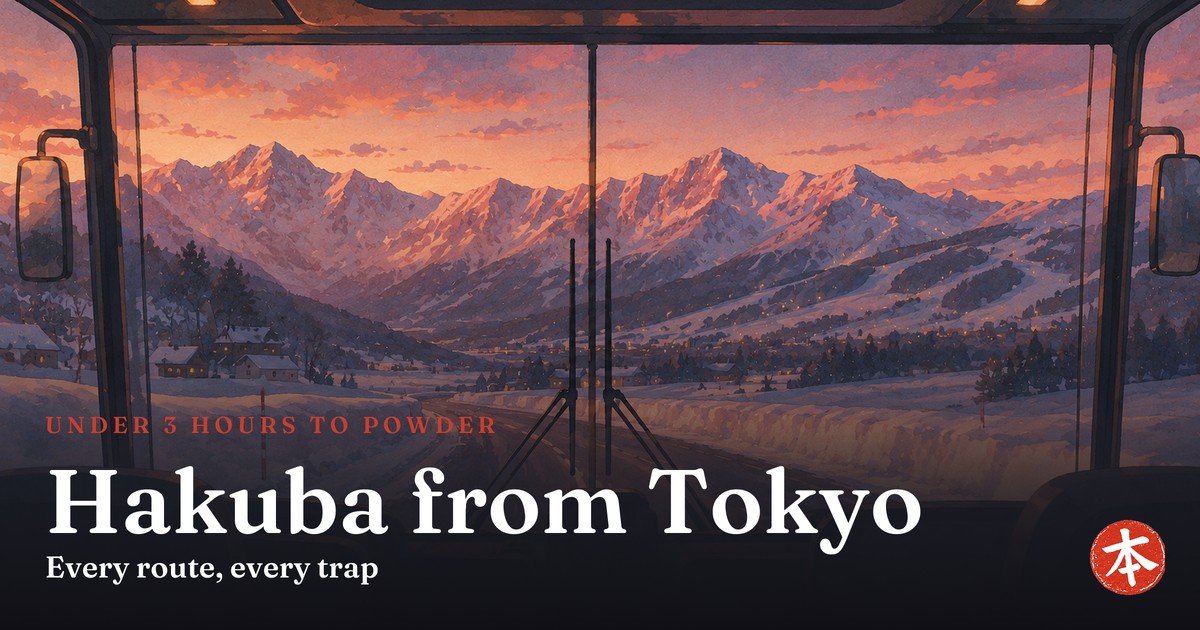
Hakuba — the 1998 Olympic valley and the Honshu heavyweight of Japanese skiing — is officially "as fast as about 2 hours 50 minutes" from Tokyo. That number is real, but the route around it is full of 2026-specific booby traps: the airport direct buses aren't currently running, the night bus won't carry your skis, the valley shuttle isn't free unless you hold a lift pass, and the winter bus timetable hasn't been announced yet. Here's every route in its honest August-2026 state — what's bookable now, and what to watch for.
Tokyo to Hakuba at a glance (August 2026 state)
| Route | Time | Status / official fare |
|---|---|---|
| Shinkansen → Nagano → Alpico express bus | ~2h50m fastest (bus leg 1h10m–2h05m) | Bus ¥2,900 to Happo (¥3,200 Tsugaike) · walk-up in green season · 🚨 winter timetable TBA |
| Azusa express via Matsumoto + Oito line | ~4h riding | Scenic; direct-train claims unverified · JR fare: check official |
| Shinjuku highway bus (day) | 5h13m | from ¥5,200 web-variable (fixed ¥5,800–7,000) · skis OK with cover |
| Shinjuku highway bus (night) | 7h23m | +¥2,000 surcharge · 🚨 no skis/boards allowed |
| Narita / Haneda direct bus | 6h30m / 5h35m | 🚨 currently not operating — 2026–27 winter TBA |
The three main routes compared on camera — train, bus and car:
The main event: shinkansen + Alpico bus
How does the 2h50m actually break down?
Two legs, one truth: the shinkansen does the distance, the bus does the mountains — and the connection at Nagano's East Exit is a five-minute walk, not a sprint.
Hokuriku Shinkansen to Nagano, then Alpico's express bus from the station's East Exit into the valley — officially 1 hour 10 minutes to Happo Bus Terminal (the central drop for most lodging), stretching toward two hours for the far stops at Tsugaike and Norikura. The official green-season fare table (valid April 1 – November 30, 2026): ¥2,900 to Happo, Hakuba Station or Goryu, ¥3,200 to Tsugaike/Norikura — and in these seasons the bus is officially reservation-free: buy at the window or on board. Winter flips it: the cold-season timetable runs reserved services, adds capacity, and — crucially — hadn't been published for 2026–27 at our checking date, so don't trust any winter times or fares you read until Alpico posts them. On the shinkansen leg we quote nothing: JR East blocks machine verification and revised fares in March 2026 — check the official app. One official winter quirk to know: the express bus can't be used for short hops between Goryu and Cortina inside the valley; that's shuttle territory.
The budget routes: Shinjuku buses and the ski-bag trap
How much cheaper is the bus, really?
Officially: the day bus starts at ¥5,200 web-variable against roughly double for the rail combo once the unquoted shinkansen fare lands — the trade is about 2.5 extra hours each way. For a group with time, that's two lift-ticket days funded by patience; for a one-week trip, the rail combo's extra half-day on snow usually wins the math.
Why shouldn't I night-bus with skis?
Because Alpico's official baggage rules forbid it: skis and snowboards travel free (covered) in the trunk on express and daytime highway buses, but night highway buses take no ski gear at all — the trunks are smaller — with the single exception of the Osaka/Kyoto–Hakuba overnight. The Shinjuku line itself is solid value: daytime 5h13m from ¥5,200 (web-variable; fixed fares ¥5,800 Monday–Thursday up to ¥7,000 on peak days), overnight 7h23m plus a ¥2,000 surcharge, all reserved via the official Highwaybus site from a month out. Ski-trip arithmetic: night bus + courier your gear ahead, or day bus with the board bag beside you in the hold — never night bus with gear and hope.
Airports, shuttles and the other 2026 gaps
What should I re-check before the 2026–27 season?
Two more places where old guides mislead. Airport directs: Alpico's Narita–Hakuba (6h30m) and Haneda–Hakuba (5h35m) routes both officially show "no current service" — they're winter-seasonal, and the 2026–27 announcement was still pending at our check; until it lands, an airport arrival means connecting through Tokyo or Nagano. Valley shuttles: the official 2025–26 scheme — the latest published — prices the all-resort Line V at ¥800 for adults, online tickets only (no cash on board), free only for holders of valid Hakuba Valley lift or season passes, and full buses simply don't board. Calling it "the free shuttle" is a guidebook fossil. For what those lift passes cost — the 2026–27 valley prices are already out, unusually early — see our Hakuba lift-pass guide; for the mountains themselves, the Hakuba ski guide covers the resorts; and if your Nagano plan includes the other icon, the snow monkeys are reachable from the same Nagano hub.
The Azusa alternative: four hours of scenery
The rail-only route — the Azusa limited express from Shinjuku via Matsumoto, then the single-track Oito line up the valley — takes about four hours of riding time by the village's own description, and rewards it with the North Alps filling the right-hand windows. Book it as a scenic choice, not a shortcut; and treat any claim of a seasonal direct Azusa to Hakuba as unverified until JR East's official pages say so.
(Access is one piece — the skiing-in-Japan guide covers passes, seasons and how Hakuba compares to the competition.)
FAQ
What’s the fastest way from Tokyo to Hakuba?
How much is the shinkansen to Nagano?
Is there a direct train to Hakuba?
What about the cheap highway bus from Shinjuku?
Can I take skis on the night bus?
Is there a direct bus from Narita or Haneda?
How do I get around the valley once I’m there?
When should I book for the 2026–27 ski season?
Is driving worth it?
Bottom line (2026) — Hakuba is officially about 2 hours 50 minutes from Tokyo: shinkansen to Nagano, then an Alpico express bus at ¥2,900 (¥3,200 on some segments, table dated to November 30, 2026), no reservations. Airport direct buses aren’t running, night buses won’t carry skis, and the scenic Azusa rail route runs about four hours via Matsumoto.
Sources
The "about 2 hours 50 minutes" fastest figure: Hakuba Valley's official access page. The ~2.5-hour riding description and the 4-hour Azusa-route description: Hakuba Village tourism's official access page. Express-bus times (1h10m–2h05m), green-season fares (¥2,900/¥3,200, table dated to November 30, 2026), the no-reservation policy, the winter Goryu–Cortina restriction and the reserved-service note: Alpico Kotsu's official Nagano–Hakuba page and its timetable/fare PDFs. Shinjuku highway-bus times, variable and fixed fares, the night surcharge and booking rules: Alpico's official Shinjuku–Hakuba page. The ski-baggage rules (day OK with cover; night buses excluded except Osaka/Kyoto line): Alpico's official baggage notice. The Narita/Haneda "no current service" status and route times: Alpico's official airport-route pages. Shuttle pricing (Line V ¥800, online-only, pass-holders free, 2025–26 scheme): Hakuba Valley's official shuttle page and timetable PDF. All read on August 12, 2026. The embedded video is by its creator.
Some links on this page may be affiliate links, which means we may earn a commission if you book or buy through them — at no extra cost to you. See our affiliate disclosure.
Tokyo to Osaka, Tokyo to Kyushu, Tokyo to Hokkaido — day by day — plus seven places most visitors never reach.
- 12 pages, 80 photographs, every stop linked to its guide
- Every price and opening hour read from the official page
- Re-issued monthly, so it does not go stale in your inbox
Free. One email a month, plus the rare change that matters. Unsubscribe with one click in any email. By subscribing you agree to our privacy policy.