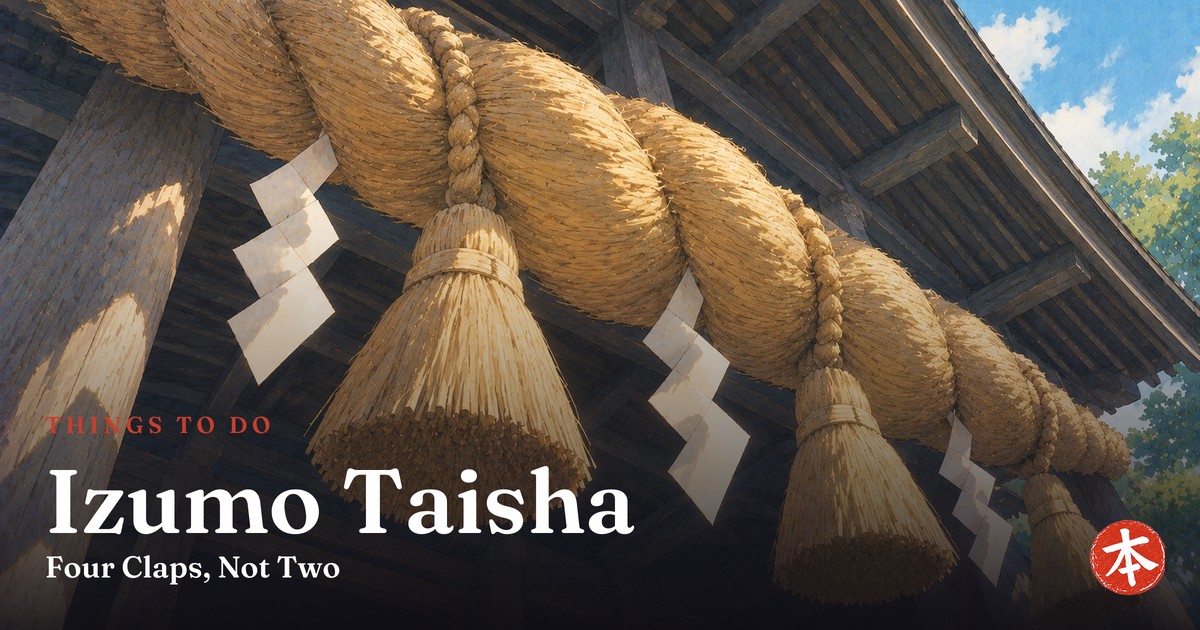
Most shrine guides tell you three things about Izumo Taisha: bring a five-yen coin, try to lodge a coin in the great straw rope, and walk round the bronze gate touching it for money luck.
The shrine denies all three, on its own FAQ page, in language sharper than shrines usually use. The bronze gate story is an invention made up by guides. Throwing coins at the rope is disrespectful and therefore not lucky at all. The coin puns have no basis whatsoever. Nobody translates this, so the folklore keeps circulating in English while the shrine keeps rebutting it in Japanese.
And the thing everyone should know is the one detail that changes what you do with your hands: Izumo Taisha is clapped four times, not twice.
Four claps: how to pray at Izumo Taisha
Seventy-five seconds, filmed by an Izumo Taisha lay association, showing the form done properly: the two deep bows at ninety degrees, the four claps, the final bow. There is nothing to read. If you only watch one thing before going, watch this one, because getting the count wrong is the single most visible mistake a visitor makes here.
The standard form at Japanese shrines is two bows, two claps, one bow. At Izumo Taisha the correct form is two bows, four claps, one bow, and the shrine asks you to use it at every hall in the precinct, not just at the main sanctuary.
Why four?
Because eight would be the full number, and four is deliberately half of it. The shrine’s greatest observance is the imperial rite held on May 14, and at that rite it claps eight times — eight being, in the shrine’s own explanation, an ancient figure for the limitless, so eight claps are limitless praise. Eight is reserved for that one day a year. The rest of the time you give half. The shrine adds a line worth keeping: the feeling behind the prayer is no different for it.
In what order do I visit the halls?
Pay your respects to the main sanctuary from the Yatsuashi gate in front of it. Then follow the mizugaki, the fence enclosing the sanctuary, counterclockwise — the shrine says explicitly, counter to the clock — visiting each hall as you come to it. Same two bows, four claps, one bow at every one.
And what is the shrine actually called?
Almost everyone, including most Japanese people, says Izumo Taisha. The shrine notes that the correct reading is Izumo Oyashiro. Both are the same characters; the formal reading is simply the older one. It is not a correction you need to make out loud, but it tells you something about a place that also keeps its ranking of left and right the way it was before the rest of the country changed.
Three things Izumo Taisha says are not true
Why does the shrine bother rebutting this?
Because these stories are told at the shrine, by guides, to visitors standing in front of the object in question. The FAQ answers are worded as replies to something the shrine keeps hearing, and the repeated phrase — made up to be entertaining — is aimed squarely at the tour-commentary industry rather than at visitors. You are not in trouble for having believed it. You are simply being told, by the only body with standing to say so, that it is not their tradition.
So what should I actually do at the rope?
Look at it, and notice which end is thick. The kagura hall rope is 13.5 meters long and weighs 4.7 tons; the one at the worship hall is 6.5 meters and one ton. And it is twisted the opposite way round from the ropes at other shrines, which is not a quirk of manufacture but a statement about rank.
Why Izumo Taisha reverses left and right
What is the usual rule?
At Shinto shrines generally, the right as you face the deity is the superior side and the left the inferior one. That governs a lot of small things, including which end of a sacred rope is begun first: the superior right end is where the twisting starts.
And what does Izumo do?
The reverse, and it has done since ancient times: left is superior, right is inferior. The shrine gives two pieces of evidence rather than asserting it. Inside the main sanctuary sit five guest deities, and the most exalted of them, Ame-no-Minakanushi, is enshrined in the furthest left position. And Edo-period ritual records show that when offerings were presented, the higher ones went to the left and the lower to the right. Because left outranks right here, the rope is begun on the left — which is why it looks backwards.
Is there anything else that looks wrong on purpose?
The curtains. When you see black-and-white drapes in the precinct, that is not mourning: the shrine explains that black was originally the most noble color, and white the next, which is why the highest-ranking priests wear black robes with white hakama. Red-and-white for joy and black-and-white for grief is the modern convention; Izumo follows the older one.
How tall was the ancient sanctuary?
Taller than the flagpole, which is the point of the flagpole. The shrine’s flag tower is 47 meters, built deliberately just under the 48 meters the Heian-period main sanctuary is said to have reached. The flag itself is 13.6 by 9 meters — the area of 75 tatami mats. And in spring 2000, excavation ahead of work under the worship hall brought up the pillars of the ancient sanctuary in front of the Yatsuashi gate; the central pillar is displayed in the treasure hall.
The sand ritual, the prayer desk and the rules at Izumo Taisha
How does the sand from Soga-no-yashiro work?
What people do with it: keep it as a charm, or scatter it over their land or fields for protection. And there is a hard prohibition attached — selling that sand is banned, including proxy sales, collection services, commercial use, use as a prize, and listing it on flea-market apps or auction sites. That the shrine had to write that down tells you what has been happening.
Can I book a prayer?
No. Formal prayers run 9:00 to 16:00 every day, with the desk opening at 8:30, and they are conducted as people arrive rather than in timed slots — so reservations are not accepted. The offering is 5,000 yen, 8,000 yen, or 10,000 yen and above, described as a matter of your own feeling. Groups are charged differently and should phone first. If you cannot travel at all, the shrine accepts postal applications by registered cash mail with five details and returns a talisman.
What is banned in the precinct?
Drones, to protect National Treasure and Important Cultural Property buildings, visitor safety and privacy. GPS game apps — the shrine names Pokemon GO — across the precinct and the surrounding shrine-owned land. And, unusually, handheld fans that do not meet Japanese electrical safety standards: imported counterfeits are prohibited, while a fan bought from a legitimate domestic retailer is fine. Phones are fine to bring and photograph with, but charging from a power bank inside the precinct is asked against, as is using any device that is running hot.
Pets and wheelchairs?
Pets may come into the precinct under the owner’s responsibility and without disturbing other visitors, but not inside the mizugaki, and not into the worship hall, the kagura hall or the treasure hall. Wheelchairs are lent free of charge from the shrine office, 8:30 to 16:30, for use within the precinct only, and numbers are limited.
When to go, and how to get to Izumo Taisha
What are the 2026 Kamiari-sai dates?
| Rite | 2026 date and time |
|---|---|
| Kamimukae-shinji / Kamimukae-sai | November 18, 19:00 |
| Kamiari-sai | November 19, 9:00 |
| Kenkoku-sai, Kamiari-sai, Enmusubi-taisai | November 23, 10:00 |
| Kamiari-sai, Enmusubi-taisai | November 25, 10:00 |
| Karasade-sai | November 25, 16:00 |
This is the period Izumo is famous for — the month the rest of the country calls the godless month and Izumo calls the month with the gods. The dates above are the shrine’s own published schedule for 2026, and they move year to year, so do not carry them forward.
How do I get there?
Fly to Izumo Enmusubi Airport, take the airport bus 25 minutes to JR Izumoshi Station, then the Ichibata bus 25 minutes to the shrine. The shrine lists the flights: five a day from Tokyo (80 minutes), four from Osaka Itami (50 minutes), two each from Fukuoka and Nagoya Komaki, and one each from Nagoya Chubu, Shizuoka and Oki. For a trip built around the San-in coast rather than the usual corridor, our Osaka to Hiroshima guide covers the route along the other side of the same region.
How big is the site, and how old are the trees?
The precinct is about 180,000 square meters, and with the outlying subordinate shrines and forest it comes to about 381,000. The pine avenue along the approach was laid out at the beginning of the Edo period; the oldest trees in it are estimated at 350 to 400 years. The present main sanctuary and the surrounding halls date from the rebuilding of 1744; since then the cycle has been carried out by restoration rather than reconstruction, because the buildings are now designated National Treasures.
Where does it fit in a trip?
Nowhere convenient, which is most of its appeal — Izumo is a destination rather than a stop. If you want the contrast, Ise Jingu is the other great shrine complex and does almost everything differently, Meiji Jingu is the city version of the same tradition, and Sensoji is the Buddhist counterpart where you do not clap at all. For fitting a San-in detour into a longer route, see our ten-day itinerary.
Izumo Taisha FAQ
How do you pray at Izumo Taisha?
Does touching the bronze torii bring money?
Is it lucky to throw coins into the sacred rope?
Do I need a five-yen coin?
Why is the rope hung the opposite way round?
How do I take home sand from Soga-no-yashiro?
When is Kamiari-sai in 2026?
Can I book a formal prayer in advance?
Bottom line (as of September 8, 2026) — At Izumo Taisha the form is two bows, four claps, one bow, at every hall, because the May 14 imperial rite uses eight and four is half of it. The shrine explicitly rejects the bronze gate money story, throwing coins into the rope and the five-yen coin puns as inventions. Sand from Soga-no-yashiro requires you to bring beach sand from Inasa-no-hama first. Prayers run 9:00–16:00 daily with no reservations, and the 2026 Kamiari-sai rites fall on November 18, 19, 23 and 25.
Sources & what we deliberately did not state
The prayer form and its explanation, the three rebuttals, the left-right reversal and its evidence, the rope dimensions, the sand procedure, the prayer desk hours and offerings, the prohibitions, the 2026 festival dates and the access routes all come from the official Izumo Oyashiro website — its FAQ page, its precinct prohibitions page and its access page — read on September 8, 2026. Festival dates change every year; check the shrine before traveling for a specific rite.
Deliberately not stated: precinct opening and closing times, because we found none published and will not invent them; whether the main sanctuary can be entered, because we verified no special viewing; whether the kagura hall rope is the largest in Japan, because the shrine makes no such claim and we are not going to make it on its behalf; and the restaurants and soba shops around the approach, which are not part of the shrine.
Tokyo to Osaka, Tokyo to Kyushu, Tokyo to Hokkaido — day by day — plus seven places most visitors never reach.
- 12 pages, 80 photographs, every stop linked to its guide
- Every price and opening hour read from the official page
- Re-issued monthly, so it does not go stale in your inbox
Free. One email a month, plus the rare change that matters. Unsubscribe with one click in any email. By subscribing you agree to our privacy policy.