Every English guide to this castle calls it Crow Castle. The castle’s own website carries a permanent notice, on the side of every page, saying that the name is incorrect.
That is the first thing worth knowing, and the second is nearly as odd: the online ticket is cheaper than the paper one — 1,200 yen against 1,300 — and it is the one that lets you pick a time slot. Almost everywhere else in Japan, booking ahead costs you a convenience fee. Here it saves you money and buys you a reservation.
| Adult admission | 1,200 yen e-ticket (timed) / 1,300 yen paper (same-day, no time slot) |
|---|---|
| Children | 400 yen (elementary and junior high) · preschool free |
| Hours | 8:30–17:00, last entry 16:30. Closed only December 29–31 |
| Time inside the keep | 45–60 minutes on average |
| The stairs | About 140 steps, up to 61 degrees. Stairs only — no other way between floors |
| Entrance | Kuromon gate only. The Uzumi gate by the red bridge is closed |
| The nickname | The official site states that “Crow Castle” is incorrect |
See English-guided Matsumoto tours → Affiliate link — affiliate disclosure.
Matsumoto Castle is not called Crow Castle
Japanese broadcast television takes this castle seriously enough to send an investigative team inside it. This segment from Yomiuri TV goes through the black keep complex and the history behind it — it is in Japanese, but the footage from inside the donjon shows you the timber, the loopholes and the stairs long before you climb them yourself.
What the official site actually says
On the side of every page of the castle’s official website sits a standing notice. Translated, it reads: regarding the alternative name of Matsumoto Castle, “Karasu-jo” — Crow Castle — is incorrect. Not “less common”. Not “disputed”. Incorrect.
Why we are not explaining the reasoning
Because we could not find it. The notice appears sitewide, but the pages we were able to read state the correction without giving the argument behind it. We would rather tell you the operator has taken a public position than invent a folk etymology to fill the gap. If you want the reason, ask at the castle — there are volunteer guides on site.
Why this matters more than a naming quibble
It is a reliable test of a source. A guide that leads with “Crow Castle, so called for its black walls” is repeating something the castle itself has publicly corrected, which tells you the writer has not read the official site. That is worth knowing before you trust the same page’s opening hours or ticket prices.
What to call it instead
Matsumoto Castle, or Matsumoto-jo. The formal designation used throughout the official material is National Treasure Matsumoto Castle, and the “national treasure” part is not decoration — it is the legal designation that governs how the building is maintained and what you can do inside it.
Tickets: the online one is cheaper, and it is timed
The two prices
1,200 yen for an adult e-ticket. 1,300 yen for an adult paper ticket. Children of elementary and junior high school age pay 400 yen either way, and preschool children are free. Groups of twenty or more pay 1,080 and 360.
The difference that is not about money
The e-ticket is described as a timed-entry ticket. The paper ticket is a same-day ticket with no time slot. So the cheaper option is also the one that holds a place for you. On a normal weekday that is a small advantage. During Golden Week or Obon, when the site says entry restrictions are applied for safety, it is the difference between walking in and standing outside.
The catch, stated by the castle
The e-ticket cannot be canceled or changed after purchase. The official page says so twice, once under the ticket table and once under the combination tickets. So the timed ticket is worth buying when your date is fixed, and worth avoiding when it is not — which is the honest trade rather than a reason to skip it.
Combination tickets, and their limits
Four combinations exist, all e-ticket only: with the former Kaichi School at 1,600 yen (600 for children, valid two days), with the city museum at 1,500 yen, with the art museum at 1,700 yen, and a four-venue pass at 2,600 yen, valid three days. Two limits the site names itself: they cover permanent exhibitions only, and each venue sets its own prices and opening days, so a combination ticket does not guarantee the partner venue is open.
Free entry, and one unusual case
Visitors with a disability certificate enter free with one carer, on presentation at the window. Matsumoto residents aged 70 and over enter free. And there is a genuinely unusual one: during the summer extension period, the site says that visitors arriving in traditional Japanese dress enter the garden and the keep free of charge.
Check guided options and prices → Affiliate link — affiliate disclosure.
The stairs are the whole visit
The numbers the castle publishes
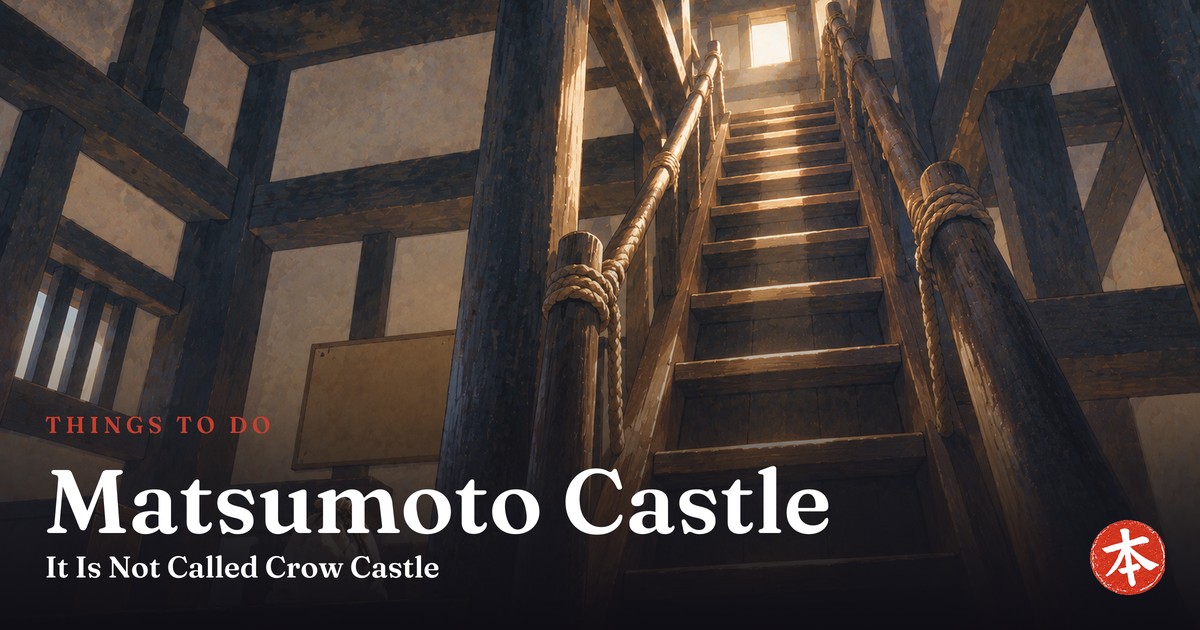
This is the oldest surviving five-tier, six-story wooden keep in Japan, and the official site is unusually direct about what that means for your legs. Movement between floors is by stairs only. There are roughly 140 steps, and the maximum gradient is about 61 degrees.
What 61 degrees feels like
Steeper than a domestic staircase by a wide margin — closer to a ladder with deep treads. You will be using your hands. The queue moves at the speed of the slowest person on the flight, which is why the official estimate of 45 to 60 minutes inside is longer than the building’s size suggests.
The rules that follow from it
Photography is banned near the stairs for safety. Shoes come off at the entrance and you carry them in a bag the staff hand you — so wear socks you are happy to be seen in, and think about whether your bag has a free hand available. There is no lift and no alternative route.
See castle town walking tours → Affiliate link — affiliate disclosure.
Who should think twice
Anyone with knees, balance or vertigo issues, and anyone carrying a small child. The grounds and the outer gates are flat and free to walk, so a split plan works: some of the group goes up, the rest stays in the garden. That is a better answer than discovering the gradient on the third floor.
Hours, seasons and the entrance you have to use
The one entrance
Kuromon gate is the only way in. The Uzumi gate on the side with the red bridge is closed, and the official site states it plainly. That red bridge is the most photographed angle of the castle, so it is a natural place to end up — and it is not an entrance. Walk round.
Standard hours, and the two extensions
8:30 to 17:00, last entry 16:30, every day except December 29 to 31. Golden Week extends this — in 2026, April 25 to May 6 at 8:00 to 18:00 with last entry 17:30. There is a summer extension too, August 8 to 16 in 2026. Those dates are for 2026; the pattern repeats but the exact days are announced each year.
New Year is the short one
The first three days of January run 10:00 to 15:30, with last entry at 15:00. That is five and a half hours instead of eight and a half, on days when a lot of people in Japan are visiting shrines and castles. If January 1 to 3 is your window, arrive early rather than after lunch.
The live queue counter
The official site displays the current wait time to the keep entrance as a live figure. It is the single most useful thing on the page and almost nobody links to it. Check it the morning you go, not the week before — and note that a zero on a Tuesday in February tells you nothing about a Saturday in May.
Getting to Matsumoto, and the bus ticket worth knowing
From the three big cities
From Tokyo: about two and a half hours on the limited express Azusa, via the JR Chuo and Shinonoi lines. From Nagoya: about two hours on the Shinano. From Osaka: roughly three and a half hours, Shinkansen to Nagoya and then the Shinano. Matsumoto is not on a Shinkansen line, which is the fact that reshapes most itineraries — our Shinkansen price guide covers how limited express legs price differently from bullet train legs.
Whether a rail pass helps
It depends entirely on the rest of your route, and the Azusa and Shinano are limited express services rather than Shinkansen, which changes the calculation. Our JR Pass guide covers what the nationwide pass does and does not cover. Do the arithmetic on your actual legs rather than assuming a pass wins.
From Matsumoto Station
About a 20-minute walk, or about 10 minutes on the Town Sneaker loop bus, north course, from the Oshiro exit to the Matsumoto-jo / City Hall stop. Several regular bus routes stop there too.
Town Sneaker PLUS, which bundles the admission
The official access page names a ticket called Town Sneaker PLUS: a 24-hour bus pass bundled with a castle admission voucher. If you are moving around Matsumoto rather than going straight to the castle and straight back, that is the combination to price up. We are not quoting a figure because the access page does not give one.
What else is on the grounds
The greeting party
Between 8:30 and 16:00, staff in period costume — including ninja — are in the Honmaru garden as the Matsumoto Castle Omotenashi-tai. They will take your camera and photograph you, or pose with you. It is free, it is official, and it is the easiest photo you will get all trip.
The shop, and what is actually exclusive
There is a shop inside the Honmaru garden — that is, inside the paid area — and the official page notes it carries original goods sold nowhere else. Worth a minute on the way out rather than a detour back in, since re-entry on a timed ticket is not something the site offers.
Pets
Not permitted in the Honmaru garden or the keep, and the site is explicit that carrying them in a bag or a cage does not change that. Assistance dogs are allowed but the castle asks you to contact the management office in advance.
How it compares with the other big castles
Matsumoto and Himeji are the two that people weigh against each other, and they are different buildings doing different things — our Himeji Castle guide covers that one. Nagoya Castle is the counterexample worth knowing about: there, you cannot go inside the keep at all. At Matsumoto you can, and the stairs are the price of admission.
Matsumoto Castle FAQ
How much does Matsumoto Castle cost?
Why is the online ticket cheaper than the paper one?
Is Matsumoto Castle called Crow Castle?
How long do you need at Matsumoto Castle?
What are the stairs like?
What time does it open?
Is there a combination ticket?
How do I get there from Tokyo?
Bottom line. Buy the 1,200 yen e-ticket — it is 100 yen cheaper than the paper one and it reserves a time slot, which is backwards from how most attractions work, and the only catch is that it cannot be canceled. Go in through Kuromon; the gate by the red bridge is closed. Allow 45 to 60 minutes inside and treat the 140 steps at up to 61 degrees as the real constraint on who in your group goes up. Check the live wait counter on the official site the morning you go. And whatever else you call it, the castle says “Crow Castle” is wrong.
Sources & what we deliberately did not state
Checked on September 3, 2026. Researched in Japanese from the official National Treasure Matsumoto Castle website, visitor information and access pages. From those pages: adult admission at 1,200 yen for a timed e-ticket and 1,300 yen for a same-day paper ticket with no time slot, 400 yen for elementary and junior high school children, free for preschool children, and group rates of 1,080 and 360 yen for parties of twenty or more; free entry for Matsumoto residents aged 70 and over, and for visitors presenting a disability certificate together with one carer; the statement that e-tickets cannot be canceled or changed after purchase; the four e-ticket combinations with the former Kaichi School at 1,600 yen and 600 yen valid two days, the museum at 1,500 yen, the art museum at 1,700 yen and the four-venue pass at 2,600 yen valid three days, covering permanent exhibitions only with each venue setting its own terms; opening hours of 8:30 to 17:00 with last entry 16:30, closed December 29 to 31; the Golden Week extension of April 25 to May 6, 2026 at 8:00 to 18:00 with last entry 17:30; the summer extension of August 8 to 16, 2026 with free entry to the garden and keep for visitors in traditional dress; New Year hours of 10:00 to 15:30 with last entry 15:00 for the first three days of January; an average of 45 to 60 minutes inside the keep; the description of the oldest surviving five-tier six-story wooden keep with stairs only, about 140 steps and a maximum gradient of about 61 degrees, no photography near the stairs and no outdoor shoes inside with bags provided; the closure of the Uzumi gate leaving Kuromon as the only entrance; the ban on pets including in bags and cages, with assistance dogs by prior arrangement; the Omotenashi-tai in period costume in the Honmaru garden between 8:30 and 16:00; the shop inside the paid area; the live wait-time display for the keep entrance; the standing sitewide notice that the alternative name Karasu-jo is incorrect; and the access details covering the 20-minute walk from Matsumoto Station, the Town Sneaker north course at about 10 minutes, the Town Sneaker PLUS 24-hour pass bundled with a castle admission voucher, and journey times of about two and a half hours from Tokyo by Azusa, about two hours from Nagoya by Shinano and about three and a half hours from Osaka. Klook product details for the guided tour are from that listing on the same date. More on how we work: how we research.
Deliberately not stated. Why the castle considers the Crow Castle name incorrect, because the pages we could read state the correction without the reasoning and we are not going to invent one. The price of Town Sneaker PLUS, because the access page does not give it. Opening days and prices for the partner venues on the combination tickets, because the castle explicitly directs you to contact each venue. Any figure for the queue, because the official display is live and a number quoted here would be wrong by the time you read it. And the 2027 extension periods, which are announced each year and had not been published. This reflects what those sources said on September 3, 2026; the official site carries the current position for your dates.
Compare guided Matsumoto tours → Affiliate link — affiliate disclosure.
in English
Every week we read the Japanese sources English-language media never touches — new openings, price changes, limited releases, rule changes, the seasonal things that come and go in three weeks — and send you a three-minute read of what actually matters. Hit reply with a question about your trip and a human answers.
Free. Unsubscribe anytime. We never share your address.