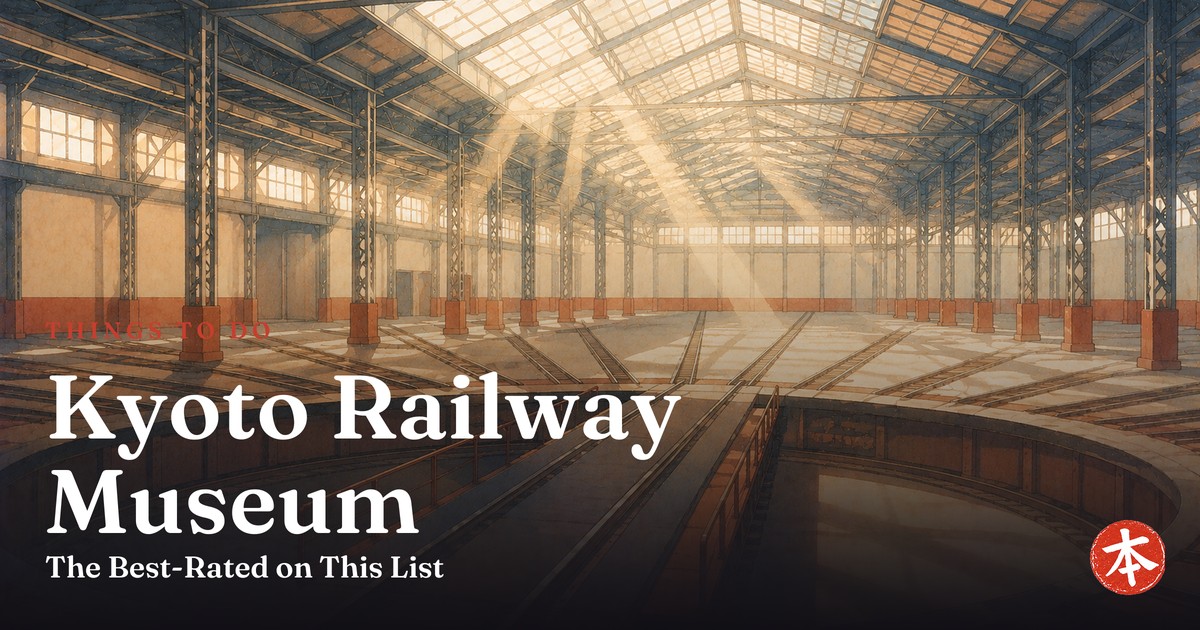
Across every attraction listing in this series, this one carries the highest rating: 4.8 out of 5 across 1,000 reviews. It also carries the joint lowest price, at a listed US$3.15. That combination is unusual enough to be worth a closer look than a railway museum would normally get.
| Rating | 4.8/5 across 1,000 reviews — the highest in this series |
|---|---|
| Price | Listed at US$3.15 |
| How long | 2–3 hours, per the listing |
| Where | Shimogyo Ward, near the Kyoto Station side of the city |
| The collection | Steam locomotives to Shinkansen |
| Working exhibits | Train models on replica tracks |
| The one to do first | The driver training simulator |
| Hours | Not shown on the listing. We are not guessing |
A 4.8 across a thousand reviews is a real signal
We have been careful in this series about ratings built on thin samples. This is the opposite situation and it deserves saying so.
The numbers, and why the sample matters
4.8 out of 5, from 1,000 reviews, across 40,000+ bookings. Compare that with the small attractions in the same series, where a similar score sits on fewer than fifty opinions. A thousand reviews is enough that the number stops moving with individual moods, which makes it evidence rather than an impression.
What a rating cannot tell you
It cannot tell you whether you will enjoy it, and a high score at a specialist museum partly reflects that the people who go are the people who wanted to. Some of that 4.8 is self-selection. That is not a reason to discount it — it is a reason to read the description and decide whether you are in the audience.
Cheap and indoors is a combination that rates well
There is a pattern worth naming. Attractions that are inexpensive, weather-proof, clearly organized and aimed at a defined audience tend to beat expectations, because expectations were modest going in. At a listed US$3.15 for two to three hours, this is squarely in that category, and it is a fair explanation for a score this high.
Check Kyoto Railway Museum tickets → Affiliate link — affiliate disclosure.
Indoors, in a city that is mostly outdoors
This is the practical argument for the museum, and it has nothing to do with trains.
The Kyoto problem nobody plans for
Almost everything on a Kyoto itinerary is outdoors and involves walking: shrines, gardens, hills, bamboo, streets. That is the city’s enormous strength for about eight months of the year and a genuine problem in August heat and in autumn rain. Most visitors build a list of outdoor sights and have no plan for the day the weather removes all of them at once.
This is the contingency ticket
Two to three hours, indoors, near the station, at a price that does not hurt if you never use it. That is what makes this worth booking before you need it rather than after. A wet morning in Kyoto is exactly when you do not want to be researching alternatives on a phone under an umbrella.
The other reason: itinerary fatigue
By the fourth day of temples, a certain flatness sets in even for people who love them, and it arrives sooner for anyone traveling with children or with a partner who did not choose this trip. A building full of locomotives is a hard reset. Our guide to how many days in Kyoto covers pacing a longer stay, and this is the kind of attraction that makes a longer stay work.
Steam locomotives to Shinkansen, in one building
The listing describes the collection by its span rather than its inventory, and the span is the thing worth knowing.
The whole arc of Japanese rail
From steam locomotives to Shinkansen bullet trains. Those two ends of the collection are separated by the entire modernization of the country, and standing between them in one hall is a more direct way to understand that story than most museums manage. Japanese rail is also the thing visitors touch most on a trip — you have been riding the end of this timeline all week.
Working models on replica tracks
The listing describes seeing the railway system in action, with train models running along replica tracks. Operating models are the exhibits that hold mixed groups: they reward close attention from anyone interested and they are simply satisfying to watch for anyone who is not. If you are visiting with people of very different ages, this is the room to find.
The driver simulator, and do it first
The listing says you can step into the shoes of professional train conductors with a training simulator. This is the single most popular kind of exhibit at any transport museum, and it has an obvious structural constraint: a simulator takes one person at a time. Whatever the access arrangement is, throughput is limited by physics. Go there first and ask how it works, rather than arriving at it with forty minutes left.
See ticket options → Affiliate link — affiliate disclosure.
Its location is doing more work than it looks
The museum is in Shimogyo Ward, on the station side of the city rather than out among the sights. That geography changes what this attraction is for.
Near the hub, not among the temples
Kyoto’s famous sights are scattered around the edges — east, north, west — and moving between them eats time. Being near the Kyoto Station side means this fits the parts of a trip that are otherwise dead: an arrival afternoon before check-in, a departure morning with luggage, a gap you did not plan for.
It pairs with the other station-side attraction
Kyoto Tower is directly opposite the station and takes about an hour. Combined with two to three hours here, that is a complete half day on the station side of the city without going near a shrine — useful as a first afternoon, when you have arrived, cannot check in yet, and do not want to start the real sightseeing tired.
Or as the anchor of a departure day
If you are moving on, our guides to Osaka to Kyoto and the shinkansen network cover the connections. A museum about trains, on the day you are taking one, near the station you are taking it from, has a certain symmetry — and more usefully, it means you are never far from your bags.
Check availability → Affiliate link — affiliate disclosure.
Who this is for, honestly
A high rating is not the same as universal appeal, and we would rather set the expectation than sell the score.
Two days in Kyoto is the wrong trip for this
If Kyoto is a two-day stop on a first visit to Japan, spend those days on the things that only exist here. The museum is excellent and it is not what you came for. On a longer stay the calculation inverts, because pacing becomes the problem rather than coverage.
The price makes it a low-risk experiment
This is the part that resolves most of the hesitation. At a listed US$3.15, the cost of being wrong about whether you will enjoy a railway museum is negligible. Very few decisions on a Japan itinerary are that cheap to get wrong, and it is a reasonable argument for simply trying it.
What to do with the rest of the day
Nishiki Market is the obvious follow-on if you want to stay central and eat, and it is covered rather than open to the sky — which matters if the weather is why you are here in the first place.
Deliberately not stated here
| What we are not saying | Why |
|---|---|
| Opening and closing hours | The field was blank on the listing, and last entry is always earlier than closing |
| Closing days | Not stated. Japanese museums commonly close one weekday, which is exactly the kind of thing that ruins a contingency plan |
| The yen gate price | Not verified. US$3.15 is the reseller listing’s figure, labeled as such |
| How simulator access is managed | Not stated. Queue, timed session or same-day draw are all plausible and we did not confirm which |
| Which specific vehicles are on display | The listing gives the span, not an inventory, and collections rotate |
| Whether anything runs outdoors | We describe it as an indoor attraction based on the exhibits named. We did not verify the site layout |
Kyoto Railway Museum FAQ
How much are Kyoto Railway Museum tickets?
How long do you need there?
What is actually in the collection?
Can you use the train driver simulator?
Is it good for children?
Where is it, and can I walk from Kyoto Station?
Is it interesting if I do not care about trains?
Why is it rated so highly?
Check Kyoto Railway Museum tickets → Affiliate link — affiliate disclosure.
Bottom line (2026) — this listing carried the highest rating in this series, 4.8 across 1,000 reviews, at a listed US$3.15 for a suggested two to three hours. The collection runs from steam locomotives to Shinkansen, with working train models on replica tracks and a driver training simulator — do the simulator first, since it takes one person at a time. Its real value in a Kyoto itinerary is that it is indoors and near the station in a city where nearly everything else is outdoors and scattered, which makes it the plan for a wet day or a tired one. No hours or closing days were shown, so confirm those before relying on it.
Sources
Written on September 2, 2026 from the Klook listing for the Kyoto Railway Museum ticket: the description of the museum covering the train and railway history of Japan; the railway vehicle collection spanning steam locomotives to Shinkansen bullet trains; the train models running along replica tracks; the training simulator described as stepping into the shoes of professional train conductors; the address in Kankijicho, Shimogyo Ward, Kyoto; the suggested duration of two to three hours; and the listed price of US$3.15 with a 4.8/5 rating across 1,000 reviews and 40,000+ bookings. The comparison with other ratings is against the other listings covered in this series, read on the same day. The opening hours field was empty, which is why no hours appear here. More on how we work: how we research.
Museum hours, closing days and exhibit access arrangements change, and a simulator in particular is the kind of thing an operator reorganizes. This reflects what that source said on September 2, 2026, and the operator publishes its own current times that are worth a glance the week you go.
in English
Every week we read the Japanese sources English-language media never touches — new openings, price changes, limited releases, rule changes, the seasonal things that come and go in three weeks — and send you a three-minute read of what actually matters. Hit reply with a question about your trip and a human answers.
Free. Unsubscribe anytime. We never share your address.