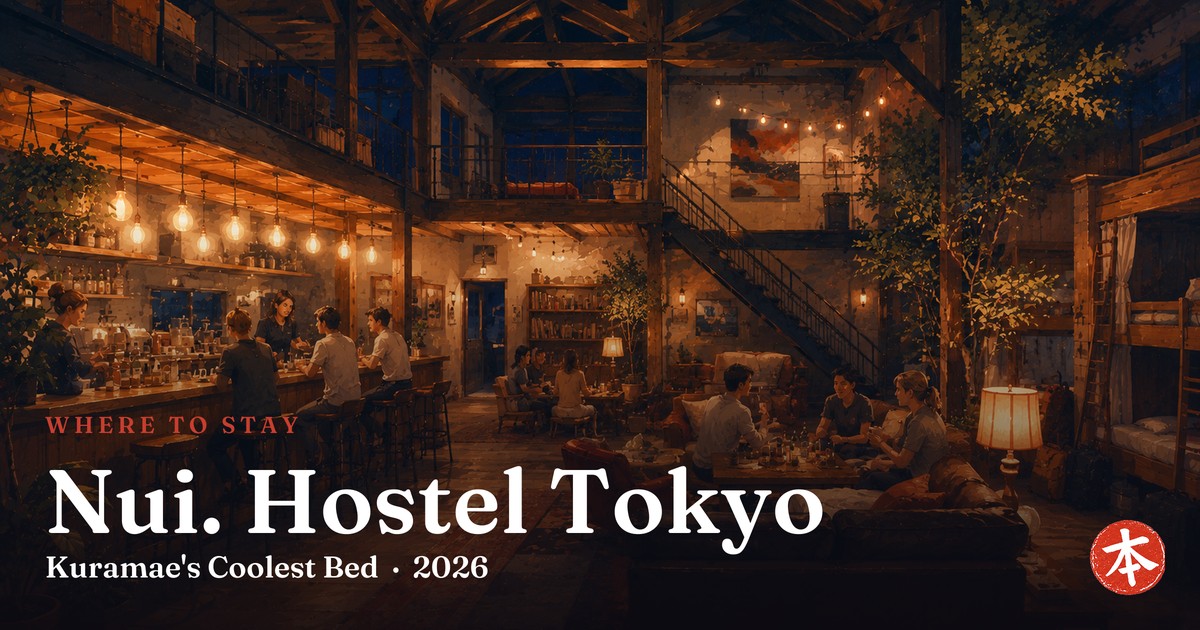
Some hostels are places to sleep; a few are reasons to visit a neighborhood. Nui. HOSTEL & BAR LOUNGE is the second kind. The building is a former warehouse of Masudaya, a toy company founded in 1724 — three hundred years old — which a young team called Backpackers' Japan spent four months converting with fourteen carpenters into the space that arguably kick-started Kuramae's reputation as Tokyo's craft district. The name means "hand-sewing" (縫い), and the official story is explicit about why: handwork over manuals, human warmth over machine precision.
That philosophy built a ground-floor lounge — 4.5-meter ceilings, timber beams, a tree in the middle of the bar — that neighborhood locals treat as their own. Here's what staying there is actually like, fact-checked against the official site.
Nui. at a glance
| What it is | Converted 1724-founded toy company's warehouse · opened 2012 · by Backpackers' Japan (toco., Len Kyoto, CITAN) |
|---|---|
| Location | Kuramae — 4 min walk from Kuramae Station, 10 min walk to Asakusa's Kaminarimon |
| Beds | 8-bed dorms (mixed / female-only, custom iron bunks) + 4 tiny private doubles/twins (6.5–7.8 m²) incl. a Sumida River view |
| Check-in | 16:00–23:00 — no arrivals after 23:00 · checkout 11:00 |
| Curfew | None (front door locks 1:00–8:00; rear door code for guests) |
| The lounge | Café 8:00–18:00 → bar 18:00–24:30, open to non-guests |
| Rules to know | Kids 6+ only (adult fare) · groups max 10 · book under your passport name |
The building is the amenity
A licensed Japanese architect walks through Nui.'s ground-floor bar lounge and picks apart how the timber and industrial fittings are put together. The commentary is Japanese, but this is the clearest look you will get at the warehouse interior the whole place is built around.
Most hostel "design stories" are marketing; this one is documented in loving detail on the official Story page. The team found the disused Masudaya warehouse in 2011 — 160 m² per floor, ceilings four and a half meters high — and fell for it on sight. The renovation brief, inspired by drinking outdoors in Niseko, was "a bar that feels like drinking in nature": stump-like stools, a pentagonal table, curved sofas, and the symbol tree rising in the middle of the room. Fourteen carpenters and a designer worked it out night by night over four months. Even the dorm bunks are custom — welded iron frames, each bed with its own single-flower vase. It opened in September 2012 and the blueprint (great building, great bar, beds upstairs) went on to shape the company's Len Kyoto and CITAN, and honestly half of Japan's modern hostel scene.
Sleeping there: dorms, tiny doubles, one river view
The dorms are the core product: eight beds, mixed or female-only, with the privacy basics done right (curtains, lockers, reading lights) inside those custom iron frames. The four private rooms are honest about what they are — 6.5–7.8 m² boxes for two — with one genuine prize among them: the River View Double at the floor's eastern end, looking out over the Sumida. Couples wanting space should read those square-meter numbers twice; couples wanting location, atmosphere and a bar downstairs will do fine. Showers and bathrooms are shared and open 24 hours, there's a guest kitchen and a small library, and laundry runs ¥200 a wash (as of July 2026).
The rules that catch people out
The neighborhood: why Kuramae
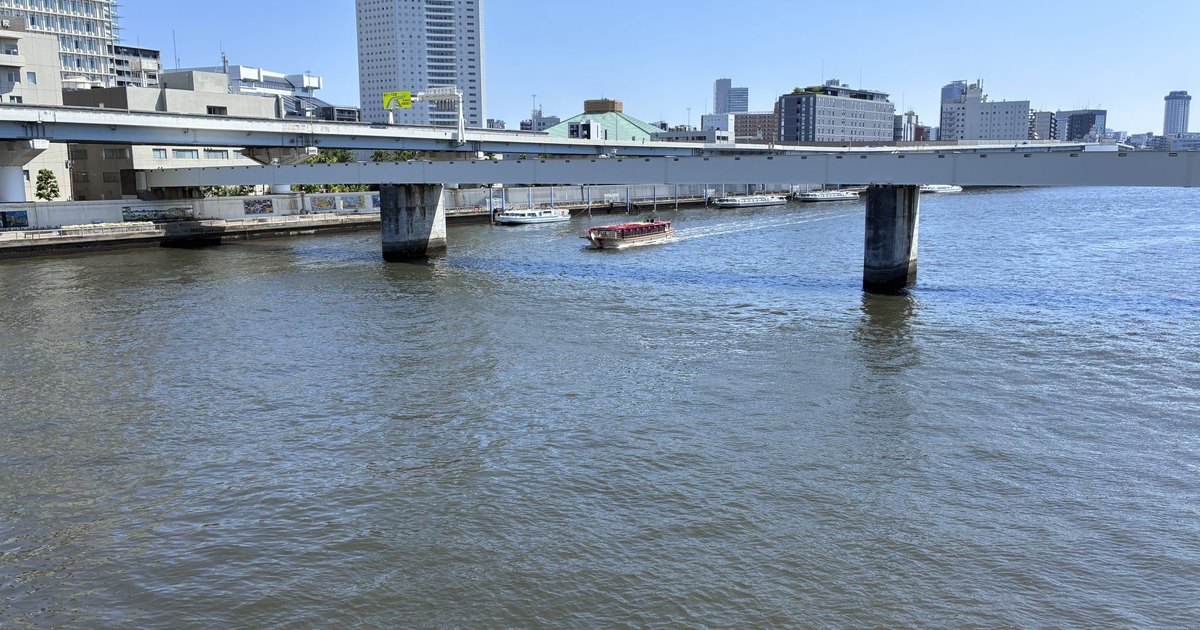
Kuramae is what happens when warehouses meet makers: leather studios, stationery ateliers, specialty coffee roasters, all walkable and low-key. You're ten minutes on foot from Asakusa's Kaminarimon — close enough to do the temple at 7am before the crowds, with the street-snack gauntlet of Nakamise covered in our street food guide — and the Toei Asakusa line at Kuramae Station runs direct trains from both airports. As a budget base for a first Tokyo visit (the kind our 10-day itinerary assumes), the location is quietly excellent. For the other end of Tokyo's stylish-hostel spectrum, compare UNPLAN in Kagurazaka — different neighborhood energy, same "hostels got good" thesis.
FAQ
What kind of rooms does Nui. Hostel have?
Is there a curfew at Nui. Hostel?
Can anyone drink at the Nui. bar, or just guests?
Can children stay at Nui. Hostel?
How do I get to Nui. from the airport, and is Asakusa close?
How much does Nui. Hostel cost?
Bottom line (2026) — Nui. is the Masudaya toy warehouse in Kuramae, rebuilt by fourteen carpenters around a 4.5 m ceiling ground-floor bar that locals actually drink at. It’s 4 minutes from Kuramae and 10 from Kaminarimon, but note the hard 23:00 check-in cutoff and the passport-name booking rule before you commit to a dorm or private room.
Sources
Official Nui. pages at backpackersjapan.co.jp (EN/JA) — hostel/rooms (dorm and private specs, shared facilities, paid amenities), access (Kuramae 4 min, Kaminarimon 10 min), café and bar&dining (hours, open-to-all policy), booking rules (check-in window, child and group policies, passport-name rule) and the Story page (Masudaya warehouse history, renovation, the name's meaning) — checked July 30, 2026. Rates are deliberately not quoted: the official site itself directs pricing to its live booking page.
Some links on this page may be affiliate links, which means we may earn a commission if you book or buy through them — at no extra cost to you. See our affiliate disclosure.
Tokyo to Osaka, Tokyo to Kyushu, Tokyo to Hokkaido — day by day — plus seven places most visitors never reach.
- 12 pages, 80 photographs, every stop linked to its guide
- Every price and opening hour read from the official page
- Re-issued monthly, so it does not go stale in your inbox
Free. One email a month, plus the rare change that matters. Unsubscribe with one click in any email. By subscribing you agree to our privacy policy.