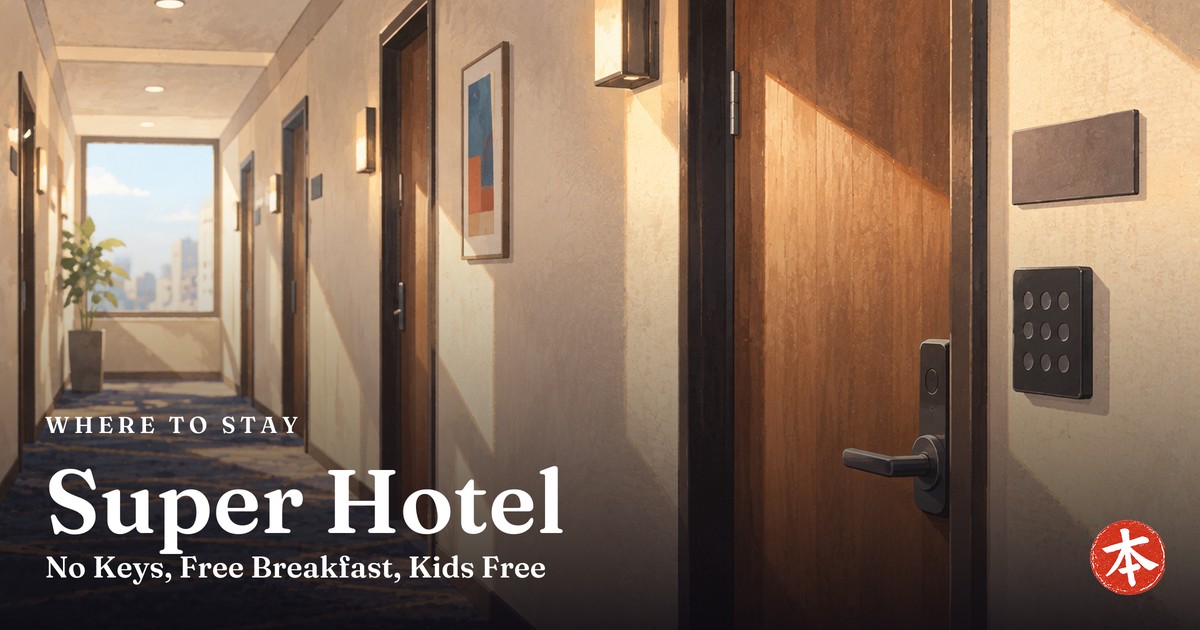
Super Hotel is the chain you will see on every Japanese “cheapest decent hotel” list, and it runs on a few rules that surprise first-timers: there is no room key, only a PIN code; the front desk closes from midnight to 7:00; check-in shuts at 24:00 and a no-show after that costs the whole night; and on a multi-night stay you are out of the room from 10:00 to 15:00 unless you opt out of cleaning. In return you get a free organic breakfast at most branches, a bath at many, a pillow menu, and children up to six free in your bed.
Everything below is from the official Japanese FAQ, the accommodation terms and the English site, plus six hotel pages we opened to show how much varies by branch. Room rates are not here; the official site sells six months ahead and guarantees the lowest price on its own pages.
Super Hotel at a glance
| Item | Chain standard (official FAQ and terms) |
|---|---|
| Check-in | 15:00 to 24:00. After midnight the booking is canceled and charged in full. Premier Yaesu and Premier Ginza: until 1:00. |
| Check-out | 10:00 at standard branches, 11:00 at the Premier hotels we checked. No late checkout as a rule. |
| Room key | None. PIN code on the door; also used to enter the building after 24:00. |
| Front desk | Closed 0:00 to 7:00. Intercom by the elevator, night phone line. |
| Cancellation (under 5 rooms) | No-show 100%, same day 100%, day before and earlier: free. Plans can differ. |
| Payment | At the front desk by check-in. Visa, JCB, Amex, UC, MasterCard, Diners. No gift vouchers. |
| Children | Age 0 to 6 free in an adult’s bed at every branch; still counted as guests. |
| Breakfast | Free at most branches; charged at Premier Yaesu (2,000 yen) and Premier Ginza. |
| Cleaning on long stays | None by default; magnet on the door by 10:00 to request it. Room off-limits 10:00 to 15:00 on cleaning days. |
| Public bath | Many branches. Tattoos not permitted. Some run a men/women timetable. |
| Passport | Copy taken from every guest without a Japanese address. |
Chain-wide rules from the official FAQ and terms, read September 16, 2026. Hours for breakfast, bath and bar are set per hotel.
What is Super Hotel, and why is there no key?
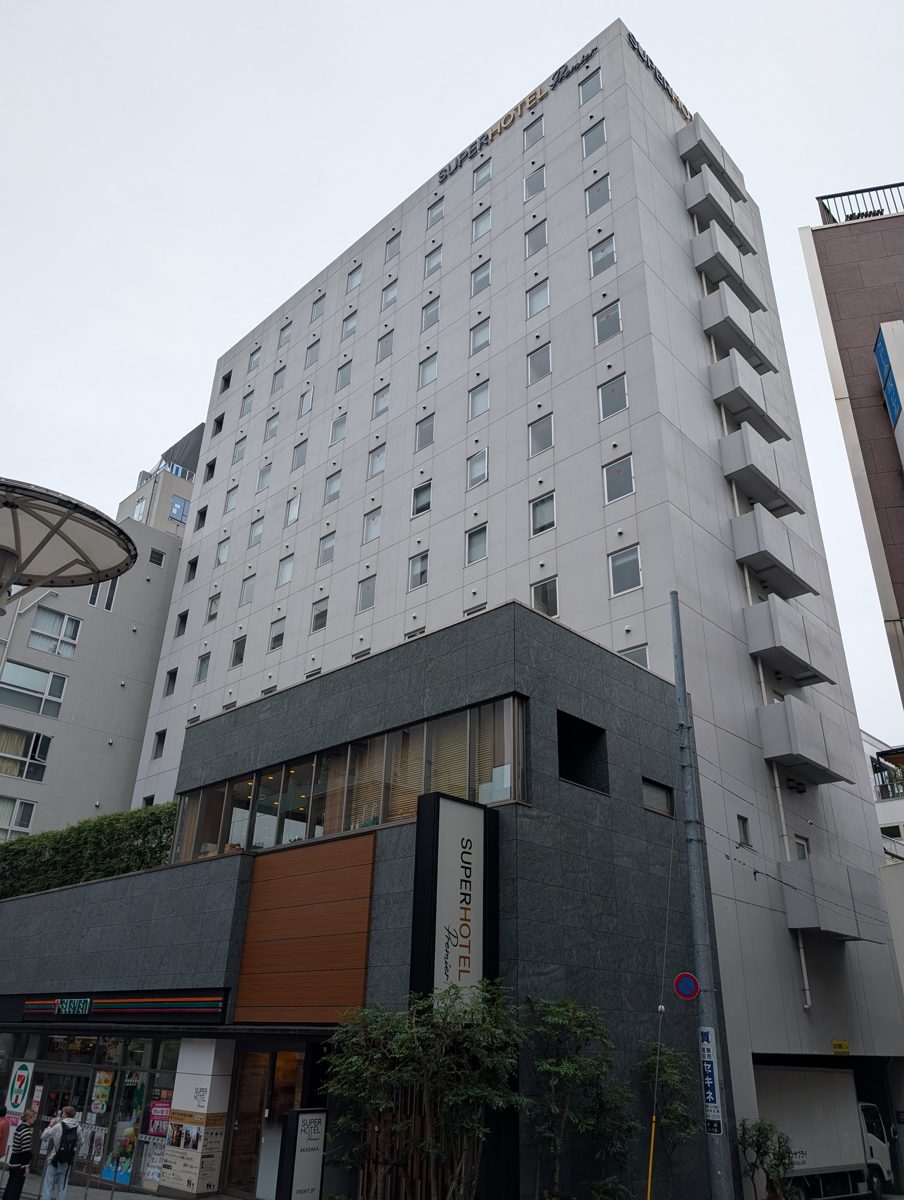
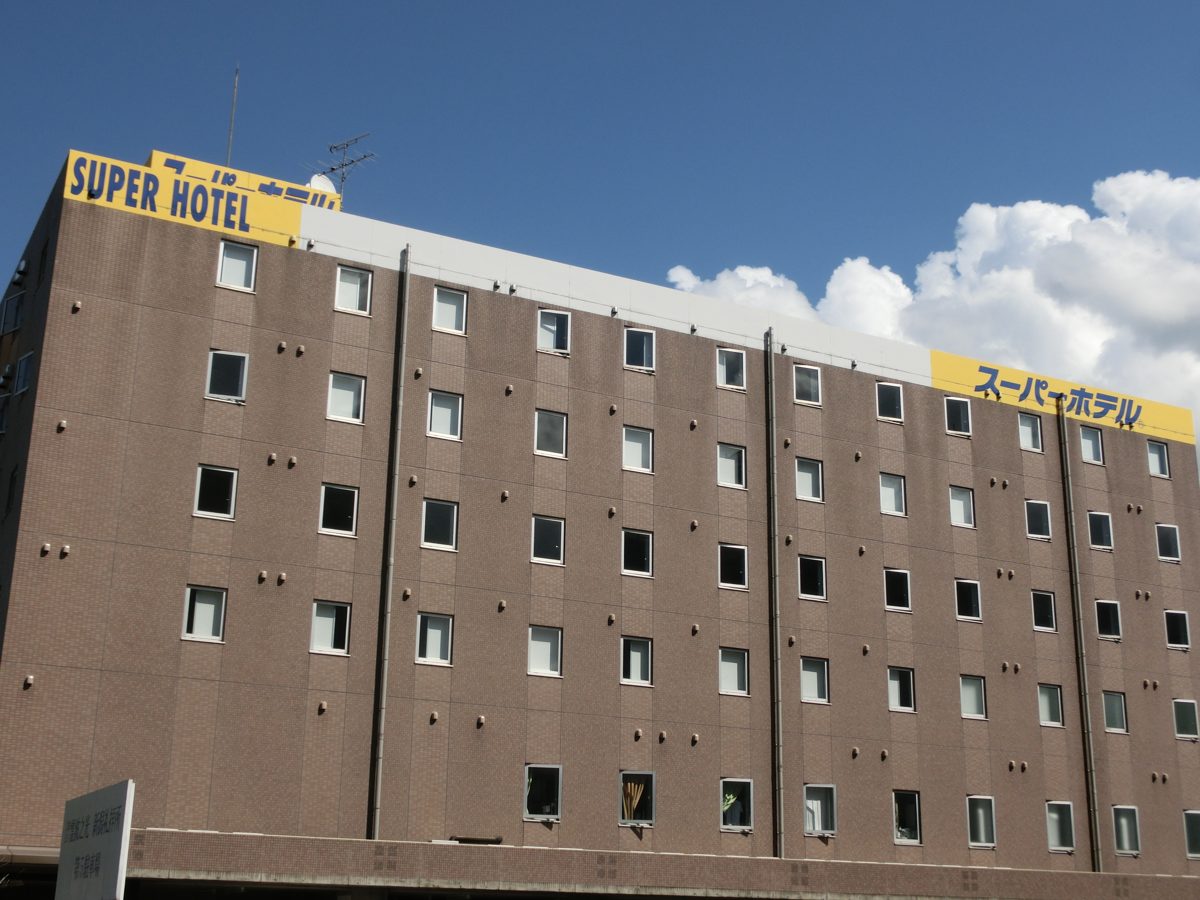
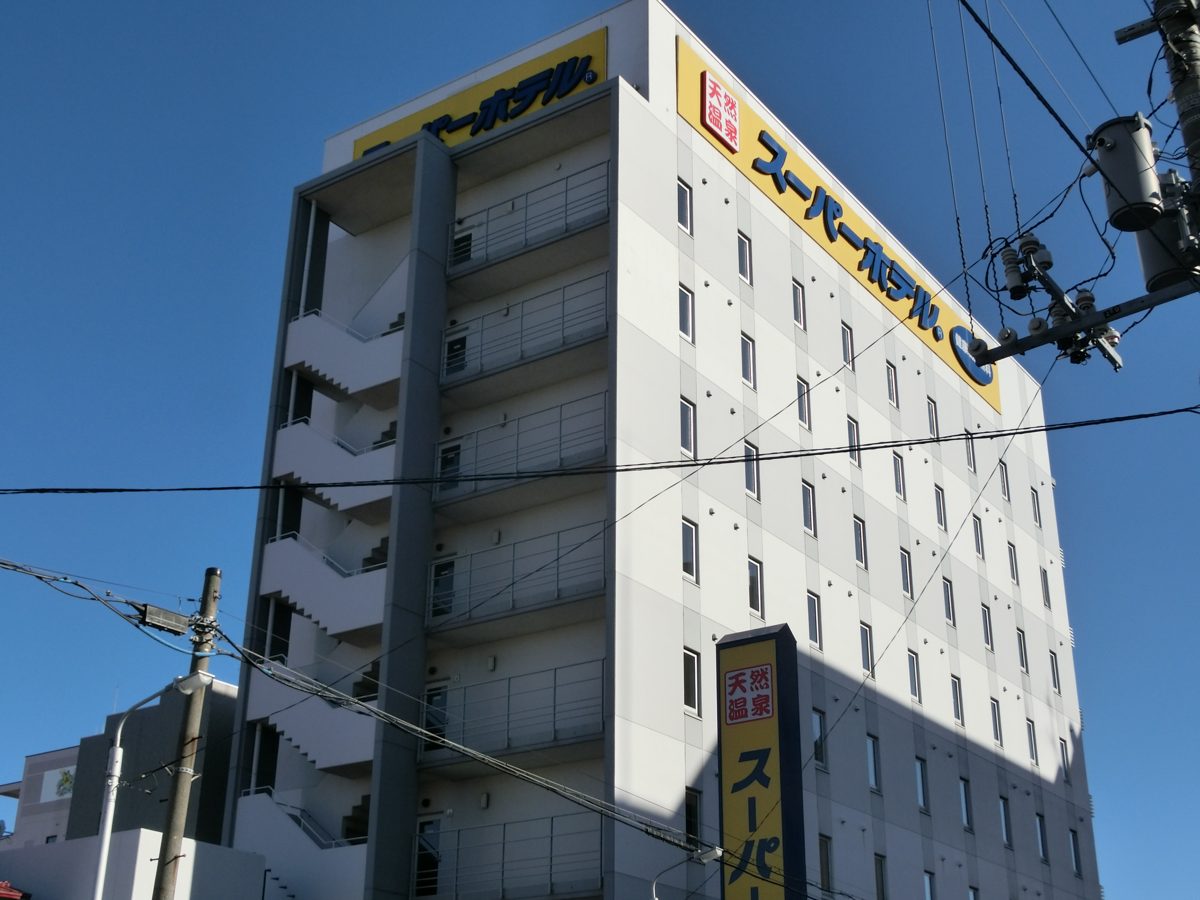
Super Hotel is an Osaka-based budget chain that sells itself on sleep: an in-house mattress, dimmer lighting, mineral-treated “healthy ion water” in the taps and a pillow corner. It has more than a hundred branches from Sapporo to Okinawa, most of them a short walk from a station, and it is the chain Japanese business travelers book when the company is paying the minimum. The English site is at superhoteljapan.com; the Japanese one carries the FAQ and the terms this page is built on.
How does the PIN-code door work?
At check-in you are given a code for your room instead of a key card. The official family page says the point is speed: “Super Hotel room keys use PIN number system, so checking out is fast and easy”. There is nothing to hand back, so on your last morning you simply walk out. The same code opens the building door after 24:00, when the front desk is closed. If you forget it, the FAQ says the phone in the lobby reaches a 24-hour line.
Is the front desk really closed at night?
Yes, from 0:00 to 7:00. That is the trade-off behind the price. In an emergency you use the intercom next to the elevator or the night phone line to a call center. It also means there is nobody to let you in if you arrive after midnight without checking in, which is why the check-in window matters more here than at a full-service hotel.
What does a room come with?
From the hotel pages: a hair dryer, kettle, refrigerator, humidifier-air purifier, wired LAN plus Wi-Fi, USB charging and a multi-charger, alarm clock, deodorizing spray, a TV, and shampoo, conditioner, body soap, bath and hand towels and a toothbrush. That is deliberately all that sits in the room. Everything else is in the lobby.
Check-in until 24:00: the rule that cancels your room
What time can I check in?
From 15:00. The FAQ’s exact wording is that check-in is 15:00 to 24:00 and “past 24:00 it is treated as a cancellation”, with the same-day cancellation fee, which is 100 percent. If you told the hotel an arrival time when booking and will be later, the FAQ asks you to phone. Two branches stretch this: Premier Tokyo Station Yaesu Central Exit and Premier Ginza accept check-in until 1:00.
What if my flight lands late at Haneda or Narita?
Count backwards. A 22:30 arrival at Haneda plus immigration, bags and the train can pass midnight in Tokyo, and Narita is worse. If there is any doubt, book a night at the airport instead, or phone the branch before you take off. Super Hotel’s phones now run a Japanese voice menu at some branches; the Yaesu page says to press 2 for English.
What time is checkout, and can I extend?
10:00 at standard branches; the Premier hotels we checked in Yaesu and Ginza say 11:00. The accommodation terms are blunt: as a rule the hotel does not extend checkout past 10:00, and a guest still in the room after checkout time on the departure day is charged 100 percent of the rate. If you want to stay on, ask the desk before checkout time; extension is at the hotel’s discretion and priced when it is agreed.
Can I check in online?
At some branches. “Super Check-in” works for official-site bookings paid online, and for Jalan or Rakuten bookings paid online, which trigger an e-mail or SMS with a link to complete the details and a QR code you hold to the check-in machine. The rollout is branch by branch, so treat it as a bonus rather than a plan.
What do children cost at Super Hotel?
| Child | Rule |
|---|---|
| Age 0 to 6 (before elementary school) | Free sharing an adult’s bed, at every branch. Counted in the headcount; enter them in the child field when booking. |
| Elementary school and up | Booked as a guest with their own bed. The search form has a separate field for elementary-age children. |
| Free child’s towels, toothbrush, pajamas | Not provided. Bring your own; pajamas and yukata come in adult sizes only. |
| Children traveling alone | Elementary and junior-high students cannot stay without an adult. Under 18 or high-school age: allowed with a parent’s consent. |
Official Super Hotel child rules, read September 16, 2026. The 0-to-6 rule applies to foreign children too.
Which rooms take a family?
The family page shows bunk-bed rooms, connecting rooms and “theater rooms” with a projector instead of a TV at some branches, and a free welcome bar where adults get local sake or a cocktail and children get a mocktail or shaved ice. All of it is branch-specific. Rooms for three are few and sometimes not bookable online; the FAQ says to phone the hotel for those.
How does this compare with Dormy Inn and Tokyu Stay?
Super Hotel and Tokyu Stay both let a preschooler sleep free in your bed; Dormy Inn charges from age 3. Super Hotel is the only one of the three that also throws in breakfast at most branches. Our family hotels in Tokyo guide lines the chains up.
Breakfast: free at most branches, not at Premier
What is in the free breakfast?
A buffet the chain builds around organic produce: a salad of organic vegetables (served since November 2012, at participating hotels), five house dressings made without preservatives or any of the 28 listed allergens, rice from Komatsu in Ishikawa grown with half the usual pesticide, and at some branches bread baked in the breakfast room. Since May 2023 some hotels also serve a “BIO roll” whose only allergen is wheat and which contains no animal ingredients, which is as close as a Japanese business hotel gets to a labeled vegan item. Regional dishes appear by area: the pages list whitebait bread in Shonan, senbei soup in Aomori, tea porridge in Nara and soup curry in Hokkaido.
Which branches charge for it?
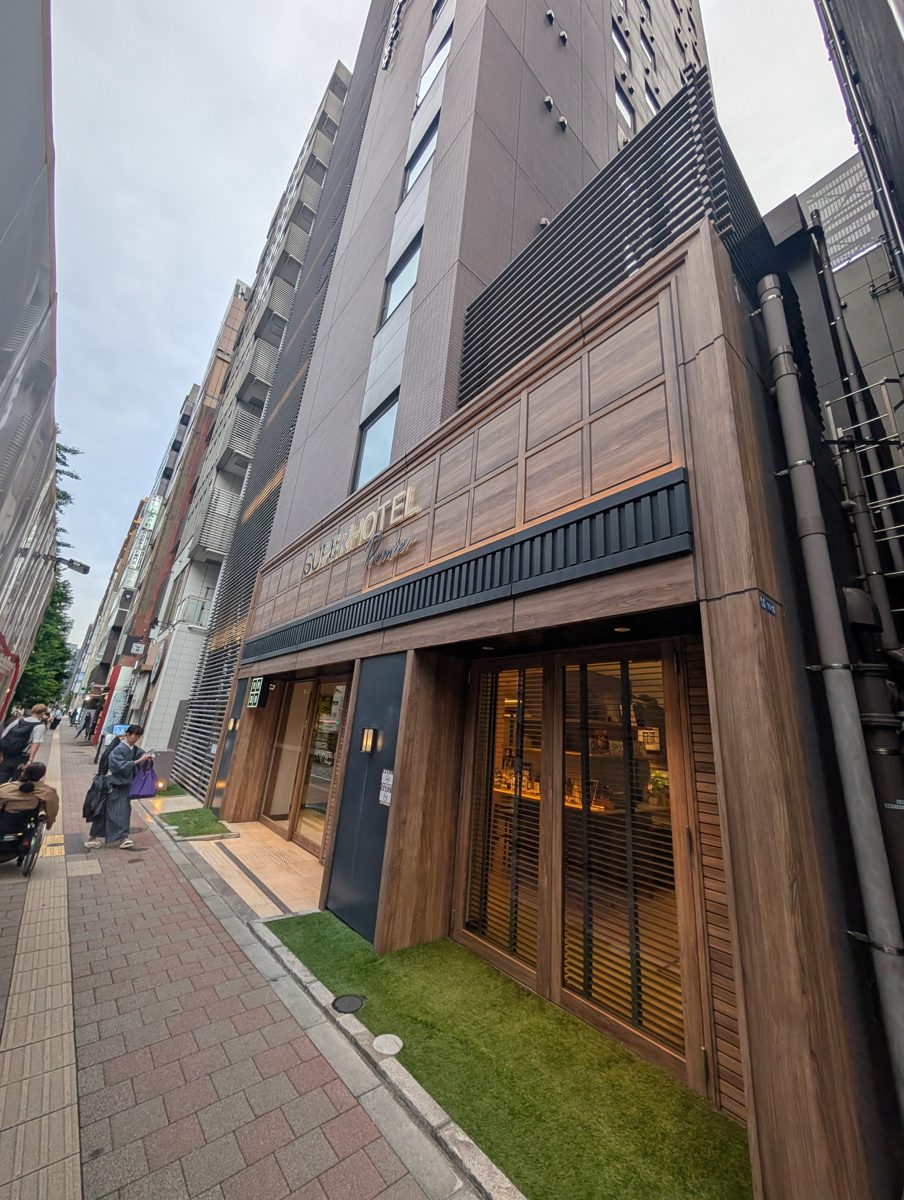
The Premier sub-brand. Premier Tokyo Station Yaesu Central Exit charges 2,000 yen for its buffet, a price it raised on August 1, 2025, and Premier Ginza lists breakfast as an additional charge. The four standard Tokyo branches we opened, Asakusa, Shinjuku Kabukicho, JR Ueno Station Iriya Exit and Akihabara Suehirocho, all say “free breakfast”. The label sits at the top of every hotel page, so check it before you assume.
What are the hours?
Set per hotel and early. Examples from the pages: Asakusa 6:30 to 8:30 on weekdays and to 9:00 on Sundays and holidays; Kabukicho 7:00 to 9:00 with the room closing at 9:30; Ueno and Akihabara 7:00 to 9:30; Yaesu 6:30 to 10:00. One dress rule from the FAQ: separate-style pajamas are fine in the breakfast room, a yukata is not.
The bath: tattoos, timetables and the daily code
Can I use the public bath with a tattoo?
No. The official English onsen page says “guests who have tattoos are not permitted to use the public bath”, with no cover-sticker exception like Dormy Inn’s. Every room has its own bathroom, so the stay still works. Our tattoos and onsen guide has the chains and towns that do allow them.
Is it a real onsen?
Sometimes. Premier Ginza pipes natural hot-spring water from Okuyugawara and opens the bath from 15:00 to 9:00; Akihabara and Kabukicho have a high-concentration artificial carbonated bath; Yaesu has an ionized-water bath and a carbonated one, 15:00 to 10:00. Many branches, including Asakusa and Ueno in our sample, list no large bath at all. Shampoo and body soap are provided in the bath, and you may walk there in the hotel pajamas or yukata and slippers.
Why are the bath hours split?
Because several branches have one bath and alternate it between men and women. Akihabara, for example, gives men 17:00 to 18:50 and 22:00 to 6:20, and women 15:00 to 16:50, 19:00 to 21:50 and 6:30 to 9:30. Miss your slot and you wait for the next one. At branches with a ladies’ floor the women’s bath door has a PIN that changes daily; timetable-style baths sometimes have no code. The FAQ also says the bath cannot be used by non-guests, with one exception, the Osaka natural hot spring branch, which sells bath-only entry.
Cleaning, pillows and the lobby amenity bar
Why can’t I stay in my room from 10:00 to 15:00?
The terms make 10:00 to 15:00 the cleaning window and say guests on consecutive nights may not enter the room or the room floor during it, unless they have told the hotel they do not need cleaning. Since the chain now treats multi-night stays as “no cleaning” by default, most guests can simply stay in. If you do want the room made up, hang the cleaning-request magnet card on the door by 10:00; the FAQ says a shorter or scheduled clean cannot be arranged.
How does the pillow corner work?
The “Gussuri” sleep lab page offers eight kinds of pillow chosen for neck alignment, and ladies’ rooms add a seven-type range with a women’s pillow developed with the Jibun Makura brand. Pillows are first come, first served and cannot be reserved. Pajamas are separate-style in S and free size, or a yukata in free size, at every branch.
Where are the amenities?
Not in the room. As part of a plastic-reduction policy, the chain keeps its organic amenity range in the lobby and lets you pick five items per night: cleansing gel, face wash, lotion, all-in-one gel, oil serum, non-silicone shampoo and conditioner, leave-in treatment, a vitamin C serum and a hand and body cream, with a fragrance-free men’s set at Premier branches. Razors, hairbrushes and tea are there too. Some large branches hand out a pre-packed set instead.
Paying, canceling and the membership that pays you back
| When you cancel | Under 5 rooms | 5 to 9 rooms | 10 rooms or more |
|---|---|---|---|
| 14 days before | — | — | 10% |
| 7 days before | — | 20% | 50% |
| 3 days before | — | 50% | 80% |
| Day before | — | 80% | 80% |
| Same day | 100% | 100% | 100% |
| No-show | 100% | 100% | 100% |
Official penalty table (Appendix 1 of the terms, revised April 1, 2020). Individual plans may set their own policy.
How and when do I pay?
At the front desk by the time you check in, in cash or with Visa, JCB, American Express, UC, MasterCard or Diners Club; the Akihabara page adds QR payment. Gift vouchers are refused and some plans are cash only. Prepaying by card on the official site goes through JTB Book&Pay; once paid, the FAQ says the dates cannot be changed, extended or shortened and the payment cannot be switched to pay-at-hotel. You cancel and rebook. Prepaid bookings cancel online until the day before and by phone on the day, with the same-day fee.
Is the free membership worth it?
If you book on the official site or app, yes. There is no card; the QR code on your member page is the card. Each official-site night earns 500 points regardless of the room rate (600 at Silver, 700 at Gold), and points convert to cash at 1 yen each, in 1,000-yen units, at the lobby kiosk up to 10,000 yen a time or at the desk, with a ceiling of 30,000 yen within one night. Points arrive from 15:00 the next day and expire at the end of the same month a year later. They cannot be used as a discount, only as cash back, and bookings through other sites earn nothing, though you can still cash out existing points. The Japanese registration form rejects half-width Roman letters, so register on the English site.
What is the lotto game?
An app-only draw: hold the app’s QR member card to the kiosk at check-in and, between 15:00 and 10:00 the next morning, play once per night for a chance at 500 points. Any booking channel qualifies but only the named guest can play. Results show in the app until 10:30.
What is a “residents only” plan?
A discount of 1,000 yen per room for people who live in that hotel’s area, sold under plan names ending in a place name plus “-min gentei” (residents only). You must show a driver’s license, My Number card or residence card from the area at check-in; if nobody in the room qualifies, the hotel adds 1,000 yen. If a cheap plan on a booking site has that phrase in its name, it is not for you.
Luggage, smoking and the passport copy
Can I send a suitcase ahead or leave bags after checkout?
Bags are held on the day of your stay only, and after checkout only if you collect them the same day; some branches do not hold bags at all. The terms accept a suitcase sent ahead only if the hotel has agreed in advance. The desk will ship bags out during its opening hours and some branches sell boxes.
Can I use a heated tobacco device in a non-smoking room?
No. IQOS and similar devices are treated as smoking and belong in the branch’s smoking area. File-sharing software on the room network is also asked to be avoided.
Will they copy my passport?
Yes, from every guest without an address in Japan, including a foreign companion of a Japanese-resident booker. The FAQ frames it as a legal requirement, and it is the same at every Japanese hotel; have the passport out at check-in.
Who Super Hotel is for
A traveler who wants the lowest bed near a station with a decent breakfast and does not need a desk at 2 a.m. A family with children under six, who pay nothing extra. Anyone who can promise to arrive before midnight. It is not for late flights, tattooed bathers, or anyone who wants to linger past 10:00. How it fits among Tokyo’s options is in our where to stay in Tokyo guide.
Frequently asked questions
What time is check-in and check-out at Super Hotel?
Is breakfast free at Super Hotel?
Are children free at Super Hotel?
Does Super Hotel give you a room key?
What is the cancellation fee?
Can I use the public bath with a tattoo?
Can I check in and stay past 10:00 on a multi-night stay?
Do foreign guests need to show a passport?
Bottom line (2026). Arrive between 15:00 and 24:00 or the room is canceled and charged; leave by 10:00; expect a PIN code, not a key, and no staff from midnight to 7:00. Breakfast is free at most branches, 2,000 yen at Premier Yaesu; children up to six are free in your bed; canceling the day before costs nothing for under five rooms; and tattoos keep you out of the bath.
Sources
Rules and figures are from Super Hotel’s official Japanese FAQ (superhotel.co.jp/faq.html), the accommodation terms and penalty table (superhotel.co.jp/topct/yakkan.html), the official English site (superhoteljapan.com) and the pages for the Premier Tokyo Station Yaesu, Premier Ginza, Asakusa, Shinjuku Kabukicho, JR Ueno Station Iriya Exit and Akihabara Suehirocho hotels, all read on September 16, 2026. Breakfast, bath and bar hours are examples from those pages and differ by branch.
Some links on this page may be affiliate links, which means we may earn a commission if you book or buy through them — at no extra cost to you. See our affiliate disclosure.
Tokyo to Osaka, Tokyo to Kyushu, Tokyo to Hokkaido — day by day — plus seven places most visitors never reach.
- 12 pages, 80 photographs, every stop linked to its guide
- Every price and opening hour read from the official page
- Re-issued monthly, so it does not go stale in your inbox
Free. One email a month, plus the rare change that matters. Unsubscribe with one click in any email. By subscribing you agree to our privacy policy.