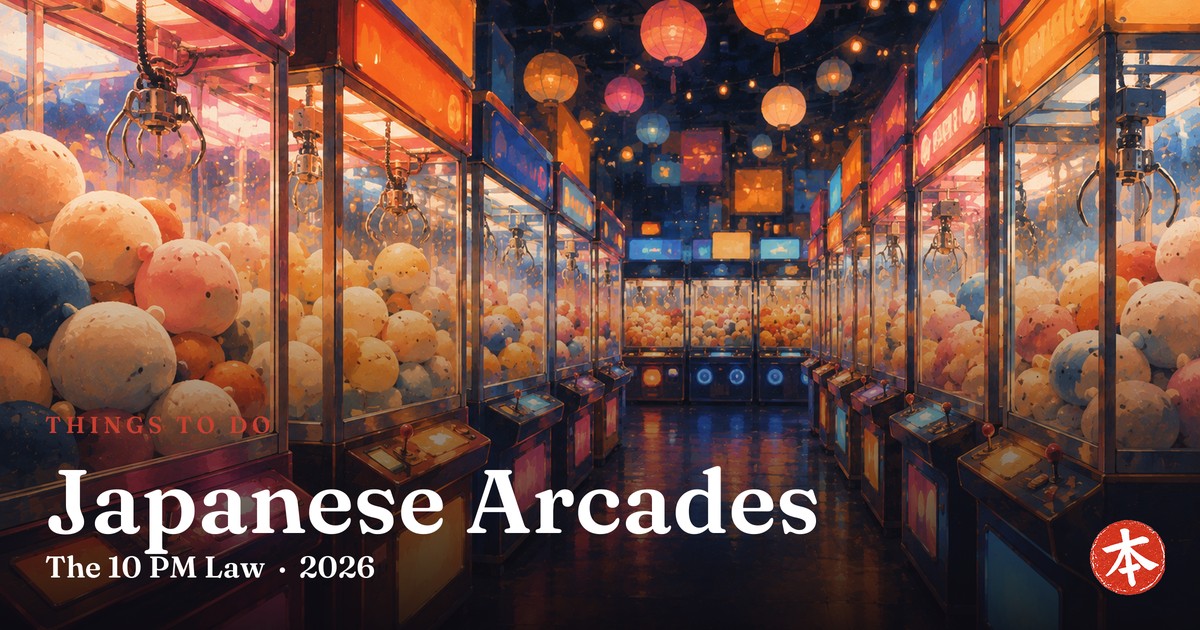
A Japanese game center is four or five floors of noise, and each floor is a different country. Crane machines at the entrance, photo booths upstairs, a floor of rhythm games where people are genuinely very good, a quiet medal-game floor that feels like a casino for pensioners, and somewhere near the top, cabinets nobody outside Japan has ever seen.
It costs almost nothing to walk in, and there is no ticket. What there is instead is a set of rules that English-language guides consistently get wrong — because they mix up a national law with a Tokyo ordinance. Here is what actually applies, from the statute, the police interpretive standards and the operators' own pages.
Japanese arcades at a glance
| 🚨 National curfew | Under 18: no entry 10 PM–6 AM. For arcades there is no guardian exception |
|---|---|
| Tokyo, additionally | Under 16: a guardian must accompany you 6 PM–10 PM |
| ID | Staff may ask for ID or passport. Rules differ by prefecture |
| Crane prizes | Capped at a retail value of roughly ¥1,000 (raised from about ¥800 in March 2022) |
| Price per play | Not published by any chain. Printed on each machine. One chain advertises ¥10 cranes at some branches |
| Staff help | Officially encouraged. Ask if a prize is stuck or unreachable |
| Medals | Cannot be cashed out, traded or refunded. Usable only in that store |
| Hours | Roughly 10:00 to 21:00–01:00 depending on the branch |
The 10 PM rule — and why most guides get it wrong
Almost every English article about Japanese arcades garbles this, because two separate rules are stacked on top of each other and they use different ages.
The Tokyo ordinance adds a second layer: anyone under 16 needs a guardian with them between 6 PM and 10 PM. That is a Tokyo rule, made possible by a clause in the national law letting prefectures add restrictions.
So the correct summary for Tokyo is: under 16, a guardian after 6 PM; under 18, out by 10 PM regardless of who you are with.
The industry association publishes this in English on its multilingual notice for visitors, and adds a detail that matters if you are traveling around Japan: four prefectures — Iwate, Tochigi, Ibaraki and Tottori — had not amended their ordinances and are outside the under-16 rule. One major chain says the same thing in its English guidance: the restriction details are different in every single prefecture, and staff may ask to see identification. Bring a passport copy if your teenager looks younger than they are.
Why every prize is a plush toy: the ¥1,000 ceiling
Here is a fact that reframes the whole crane-game floor. Japanese law prohibits game centers from providing prizes based on the result of play. Flat prohibition, written into the statute.
Crane games exist because the National Police Agency's interpretive standards create a carve-out: providing an item whose retail price is roughly ¥1,000 or less is not treated as the prohibited kind of prize-giving. The industry association's own guideline mirrors that ceiling — and note it rose from about ¥800 to about ¥1,000 on March 1, 2022, so anything you read quoting ¥800 is out of date. The same guideline requires that the prize must be identical to the one displayed, bans displaying a more expensive item as a demonstration, and rules out tobacco, alcohol and cash-equivalent vouchers as prizes.
Two practical consequences. First, nothing in the machine is worth more than about ¥1,000 retail, so treat the money you spend as the price of playing, not as an investment in the toy. Second, when someone tells you Japan has no gambling culture in arcades, this is the mechanism — and the police page on game centers says it plainly: gambling is a crime; play at law-abiding stores.
The rules that surprise foreign visitors
- Ask staff for help. Seriously. One major chain states in Japanese that staff will help if you get stuck and asks you to call one over, and repeats it in English for a prize that cannot be reached or is jammed. Repositioning a prize on request is normal service, not a favor.
- Swap the prize before you play, not after. The same chain states it cannot exchange the prize once you have won it — but you may ask staff to change it before you start.
- Prizes are not for sale. The chain says so in as many words. You cannot buy the toy you failed to win.
- Medals can never be cashed out. Trading, selling, refunding or transferring tokens is prohibited, and they only work in the store that issued them. Don't buy a big stack on your last day.
- Leftover credits transfer between crane machines at that chain — so unused plays on a machine you have given up on aren't wasted.
- Don't hog machines. Occupying several cabinets at once is asked against, as is bringing in your own alcohol.
- Photography differs by chain. One welcomes photos but asks you not to capture other customers or block walkways. Another allows photos and video unless it inconveniences others. A third bans live streaming, filming of back-of-house areas and the backs of machines, large equipment setups and organized photo shoots outright.
- Payment is not cash-only. One flagship accepts cash, e-money and QR payments in its amusement area — while stating that certain zones inside the same building do not accept cash at all. Another says transport IC cards such as Suica, PASMO and ICOCA work at its stores.
What a play actually costs (nobody will tell you)
The single official figure we could find: one chain advertises ¥10 crane machines running at a number of its branches. That is a promotion, not a standard rate — but it tells you the floor is lower than most visitors assume.
The number that is fixed and official is the one on the other side of the glass: roughly ¥1,000 retail, maximum, for whatever you are trying to win. Set your own stop-loss against that and the arcade becomes a cheap hour instead of an expensive one.
Where to go, and when
Filmed in June 2026, this Japanese tour walks store by store through around a dozen Akihabara arcades, with every stop timestamped in the description — so you can jump to a specific place and see the floors, the cabinets and the prize cases before committing an afternoon to it.
You are never far from one in central Tokyo — the chains cluster in Akihabara, Shinjuku, Shibuya and Ikebukuro, often several buildings within a block or two of each other. Opening hours as of August 2026 run from around 10:00, with closing times spread from 21:00 to 01:00 depending on the branch: several Akihabara and Shibuya stores close around 23:30, a Shinjuku Kabukicho branch runs to 1:00 AM, one Shinjuku store lists 25:00 (Japanese notation for 1:00 AM), and one Ikebukuro branch shuts at 21:00. A large Shinjuku complex runs 11:00–23:00 on weekdays and to 1:00 AM on Fridays, Saturdays, Sundays and the eve of public holidays.
Two practical notes. Weekday afternoons are the quiet window — the good rhythm-game cabinets are free, and the crane floor isn't shoulder to shoulder. And remember the curfew is a legal line, not a closing time: after 10 PM the building is adults only, whatever hour the doors shut.
Building an afternoon around it
Arcades pair naturally with the rest of the Akihabara ecosystem: Mandarake for secondhand everything (it opens at noon), a maid café for exactly one hour, card shops if you collect, and Don Quijote for the souvenir sweep. Somewhere in there, eat standing up — see Japanese street food.
(Shopping between games? The Akihabara shopping guide maps the specialist shops, floor by floor.)
FAQ
Can under-18s go to Japanese arcades?
How much does it cost to play in a Japanese arcade?
What is the ¥1,000 prize rule?
Will staff help you win a crane game?
Can you take photos in a Japanese arcade?
What time do Japanese arcades open and close?
Bottom line (2026) — Two stacked rules define Japanese arcades: under-18s are barred after 10 PM with no guardian exception, and crane-game prizes are legally capped at roughly ¥1,000 retail — which is why the floors are wall-to-wall plush. Asking staff for help is officially encouraged, not cheating.
Sources
Checked August 4, 2026: the Entertainment Business Act via the Japanese government's legal database — Article 22(1)(v) for the under-18 10 PM to 6 AM restriction on game centers, Article 22(2) for the prefectural power to add restrictions, Article 18 for the mandatory entrance signage, and Article 23(2) for the outright prohibition on prize-giving (we also checked that the guardian exception appears only in the provision covering late-night entertainment restaurants, and that the statute never mentions age 16); the Tokyo enforcement ordinance, Article 8, confirmed in both the Metropolitan Police PDF and the Tokyo ordinance database, for the under-16 guardian requirement between 6 PM and 10 PM; the National Police Agency's interpretive standards dated July 1, 2026 for the approximately ¥1,000 retail ceiling on crane-game prizes, and its public page on game-center businesses; the arcade industry association's official multilingual visitor notice for the English wording of the age rules and for the four prefectures outside them, and its unified prize guideline (revised March 1, 2022) for the ceiling, the identical-prize rule and the banned prize categories; and the chains' own pages for staff assistance, prize exchange, the non-sale and non-redemption rules, credit transfer, machine-hogging and alcohol, the differing photography policies, payment methods, and the branch opening hours quoted above. Deliberately not stated: any price per play for crane games, photo booths or video games (no chain publishes one), the widely repeated photo-booth entry restriction (we could not find it on any operator's official page), any official rule against shaking or hitting machines (it is not in the chains' published etiquette), smoking policies at chains that don't publish one, and tax-free shopping on arcade prizes — prizes are explicitly not for sale. Hours and rules change; check the branch page.
🚨 Traveling after October 2026? Japan's tax-free system changes on November 1, 2026. Instead of the tax being taken off at the register, you will pay the full price in store and claim the consumption tax back at customs when you leave, within 90 days of purchase — the retailer refunds it after that check. Until October 31, 2026 the system described here still applies. Our tax-free shopping guide has the detail.
Tokyo to Osaka, Tokyo to Kyushu, Tokyo to Hokkaido — day by day — plus seven places most visitors never reach.
- 12 pages, 80 photographs, every stop linked to its guide
- Every price and opening hour read from the official page
- Re-issued monthly, so it does not go stale in your inbox
Free. One email a month, plus the rare change that matters. Unsubscribe with one click in any email. By subscribing you agree to our privacy policy.