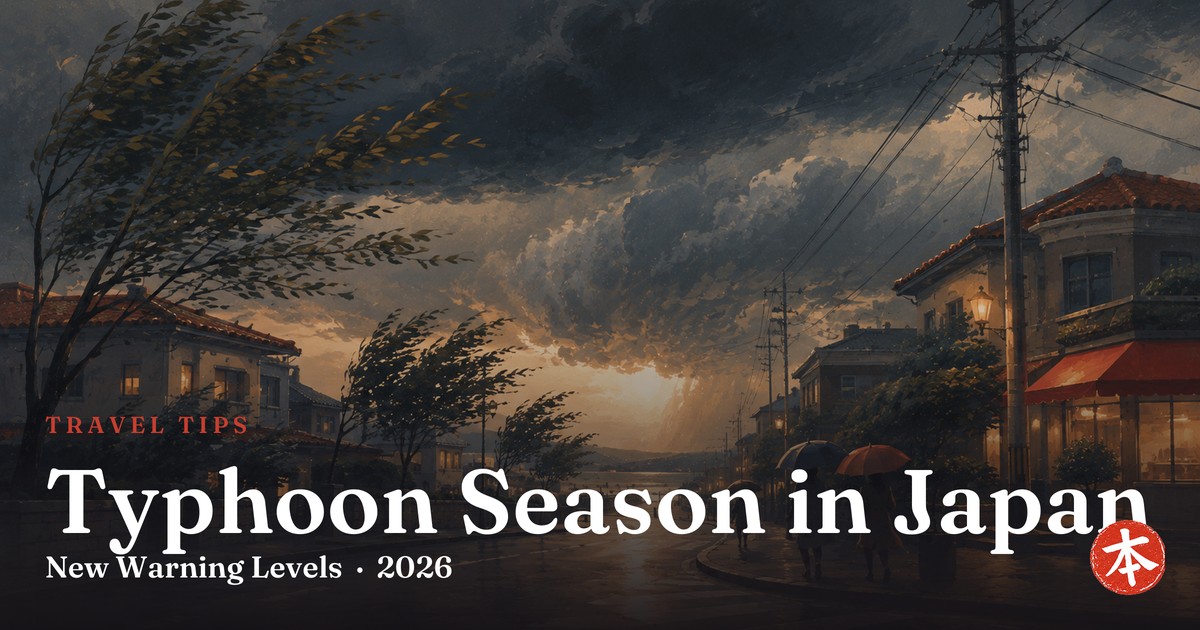
If you are traveling in Japan in August or September, you are traveling in the peak of typhoon season. That is far less alarming than it sounds — but there is something you genuinely need to know this year, and it is not in any English-language guide we can find.
On May 29, 2026, Japan changed the names of its weather warnings. The Meteorological Agency now puts level numbers on them, and it created a new Level 4 tier that did not exist last season, rendered in official English as "Urgent Warning". If you are working from an article written before this summer — and almost all of them were — the scale you have memorized is out of date.
Typhoon season at a glance
| Peak | August and September. July–October carries almost all of it |
|---|---|
| Per year (JMA normals, 1991–2020) | 25.1 form · 11.7 approach Japan · 3.0 make landfall |
| Busiest months | August: 5.7 form, 3.3 approach · September: 3.3 approach, 1.0 landfall |
| 🚨 New since May 29, 2026 | Level 4 "Urgent Warning" — a tier that did not exist last season |
| Level names apply to | Heavy rain, flood, landslide, storm surge only. Storm and high waves keep the old English names |
| Trains | Planned suspension is announced in advance — but no official source states how far ahead |
| Most exposed | Okinawa 7.7 approaches/year vs Tokyo area 3.3 · Hokkaido 1.9 |
| Help in English, Chinese, Korean | Japan Visitor Hotline 050-3816-2787, 24 hours, 365 days |
Choosing dates? Our Japan holiday and crowd calendar shows the public holidays, Golden Week, Obon, New Year and JR’s official busy and quiet days for the dates you enter.
The 2026 change, and why it matters to you
A Japanese TV news segment from late May 2026 covering the launch of the renamed warning system, built around an on-screen table lining up the five alert levels against river flooding, heavy rain, landslides and storm surge — 78 seconds showing you the exact Japanese terms described above, in the form you will actually meet them.
The JMA's own English terminology document is explicit: the English rendering of the new Level 4 tier is "Urgent Warning", and the naming format is "Level N Emergency Warning / Urgent Warning / Warning / Advisory (phenomenon)".
🚨 The catch: the same document states that warnings other than the level-corresponding ones keep their existing English names — it gives high-waves and thunderstorm warnings as examples. So in a typhoon you will see numbered levels for heavy rain, flood, landslide and storm surge, and un-numbered names for the wind and wave warnings. Both are live at once. Don't assume the absence of a number means the absence of danger.
One more honest caveat: the JMA's English-language pages we could reach still describe the pre-2026 framing. You may encounter both the old and new English labels this season depending on which page you land on.
The five levels, and what to actually do
| Level | What it means · what you do |
|---|---|
| 5 · Emergency Warning | Secure your safety immediately. The JMA describes Emergency Warnings as signaling a level of exceptional risk of a magnitude seen only once every few decades |
| 4 · Urgent Warning (new) | Corresponds to an evacuation instruction. The JMA says to judge for yourself using the risk map and river data even if no instruction has been issued |
| 3 · Warning | Older and vulnerable people evacuate. Everyone else starts suspending normal plans. For a traveler, this is the decision point |
| 2 · Advisory | Check your hazard map, where you would evacuate to and how you would get there |
| 1 | Early notice that warning-level conditions are possible. Raise your guard, watch the updates |
Two things make this usable for a visitor. The JMA publishes a real-time risk map in English — a color-coded live map where you can see your own location's rain, flood and landslide risk without reading a word of Japanese. And its warning portal runs in 16 languages. Bookmark both before you need them, not during.
The numbers, honestly
The JMA's 30-year normals for 1991–2020 are the cleanest way to think about risk. 25.1 typhoons form each year, 11.7 come within 300km of Japan, and 3.0 make landfall. Those definitions are precise: an approach means the center comes within 300km of a Japanese observation station; a landfall means the center reaches the coastline of Hokkaido, Honshu, Shikoku or Kyushu.
- August is the peak for formation — 5.7 — with 3.3 approaches and 0.9 landfalls.
- September ties on approaches at 3.3 and leads on landfalls at 1.0.
- July and October are the shoulders (2.1 and 1.7 approaches).
- Outside that window it drops away fast — by December the average approach count is 0.1.
And the regional spread is wider than most visitors realize. Annual approaches: Okinawa 7.7, Izu and Ogasawara islands 5.4, Amami 4.3, southern Kyushu 3.9, northern Kyushu 3.8, Tokai 3.5, Kinki 3.4, Shikoku and the Tokyo region both at 3.3, Chugoku 3.0, Hokuriku 2.8, Tohoku 2.7 and Hokkaido 1.9. Okinawa takes roughly 2.3 times what Tokyo does.
Planned suspension: the thing that actually disrupts your trip
For most travelers a typhoon is not a safety event. It is a transport event — and Japan handles it in a way that catches visitors off guard, because the trains stop before the weather arrives, not during it.
The practice is called keikaku unkyu, planned suspension. Since a government framework finalized in July 2019, rail operators are required to give advance notice of the possibility, to provide specific information at an appropriate timing, and to communicate through multiple channels and in multiple languages. Each operator builds its own information timeline.
The knock-on effects are the real problem — once services resume, everyone who didn't travel yesterday travels today. Reserved shinkansen seats sell out on the recovery day. If you can move a long-distance leg a day earlier, do it before the announcement rather than after.
What to actually do, in order
- Before you fly: leave a spare day before your international departure if you are traveling in August or September. This one habit converts most typhoon disasters into a wasted afternoon.
- Install the official app. Safety tips is supervised by the Japan Tourism Agency and pushes earthquake, tsunami and weather alerts in more than a dozen languages, with response flowcharts and communication cards.
- Save the hotline: the Japan Visitor Hotline, 050-3816-2787 (from abroad +81-50-3816-2787), runs 24 hours a day, 365 days a year in English, Chinese and Korean, for both emergencies and ordinary travel questions.
- Bookmark the JMA English risk map and its multilingual warning portal, and follow JNTO's Japan Safe Travel account, which posts weather warnings and transport updates for visitors.
- At Level 3, change your plans rather than waiting for Level 4. Move the travel day, not the sightseeing.
- Stay inside during the passage. It is a few hours. Japanese hotels are built for this; the danger is outdoors, from flying objects and swollen rivers.
- Ask your airline directly about rebooking. Both major Japanese carriers publish weather-disruption policies — we could not open their pages when checking, so ask them rather than trusting a summary.
Planning around it
If your dates are movable, our guide to the best time to visit Tokyo lays out the trade-offs month by month — and typhoon exposure is one of the reasons late October and November are so highly rated. If your dates are fixed, build the buffer into your itinerary instead, keep a data connection live so you can read alerts and rebook from a station platform, and check whether a rail pass still makes sense if a travel day may vanish. Where you sleep matters too — see where to stay in Tokyo.
(If you are timing an island trip around this, our how to get to Okinawa guide has the monthly approach figures, which do not peak in the month most people assume.)
(Wondering whether October is clear of all this? Our Japan in October guide has the JMA figure of 1.7 approaches and 0.3 landfalls for the month, and where the autumn leaves actually are by then.)
FAQ
When is typhoon season in Japan?
Did Japan’s weather warning names change?
What should I do at each warning level?
Will trains stop during a typhoon?
Should I cancel a trip to Japan because of typhoon season?
Which parts of Japan get the most typhoons?
Bottom line (2026) — Japan renamed its weather warnings on May 29, 2026, adding a Level 4 tier called Urgent Warning that didn’t exist last season. The JMA’s 1991–2020 normals are the cleanest way to think about risk in August and September. For most travelers the disruption isn’t the storm — it’s the planned suspension of transport.
Sources
Checked August 4, 2026: the Japan Meteorological Agency for the definitions of approach and landfall, the 1991–2020 normals quoted above (25.1 forming, 11.7 approaching, 3.0 making landfall, the monthly breakdown and the regional approach counts), the announcement that the new disaster weather information began operation on May 29, 2026, the official definitions of the Emergency Warning, Urgent Warning, Warning and Advisory tiers, the agency's English-terminology document specifying "Urgent Warning" and the "Level N …" naming format together with its statement that other warnings keep their existing English names, the five-level evacuation correspondence table and the actions listed at each level, the English real-time risk map and the multilingual warning portal; the Ministry of Land, Infrastructure, Transport and Tourism's July 2019 final report on planned suspension for the advance-notice, appropriate-timing and multilingual requirements; and JNTO and the Japan Tourism Agency for the Japan Visitor Hotline number and hours, the Japan Safe Travel service, and the Safety tips app and its government supervision. Deliberately not stated: ANA's and JAL's rebooking and refund policies and JR East's own planned-suspension explanation — all of those pages blocked or timed out when we checked, and we will not summarize a page we could not read; any specific advance-notice lead time for suspensions (no official source gives one); the Safety tips app's exact language count (official sources disagree); and typhoon intensity and size classifications. Warning names changed this year — confirm against the JMA page on the day.
Tokyo to Osaka, Tokyo to Kyushu, Tokyo to Hokkaido — day by day — plus seven places most visitors never reach.
- 12 pages, 80 photographs, every stop linked to its guide
- Every price and opening hour read from the official page
- Re-issued monthly, so it does not go stale in your inbox
Free. One email a month, plus the rare change that matters. Unsubscribe with one click in any email. By subscribing you agree to our privacy policy.