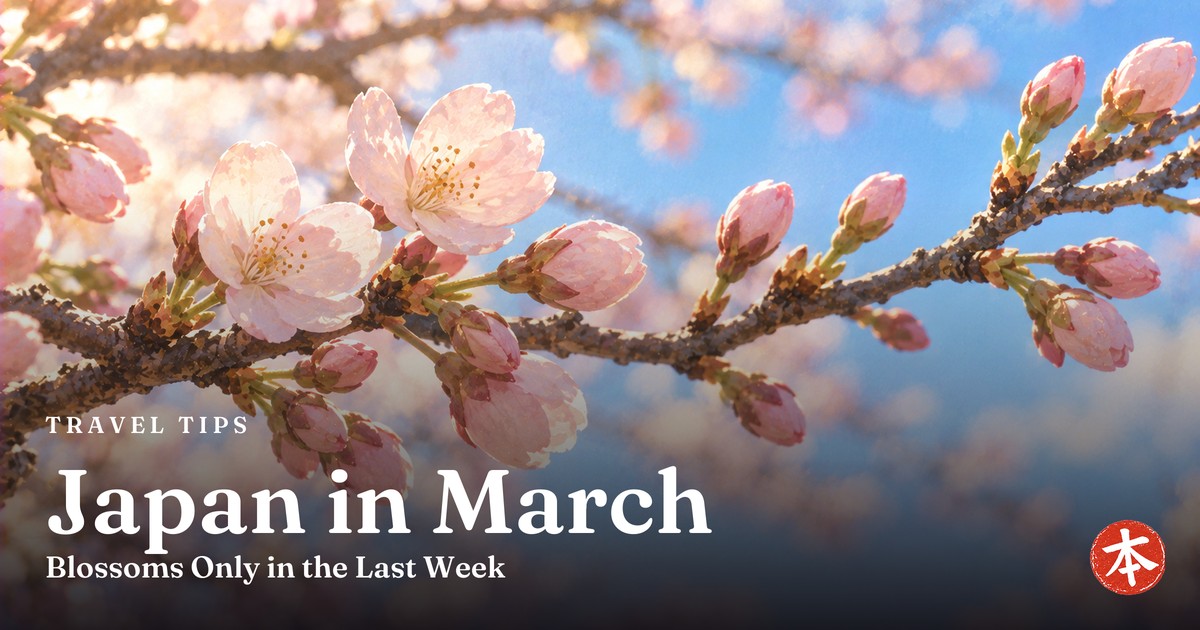
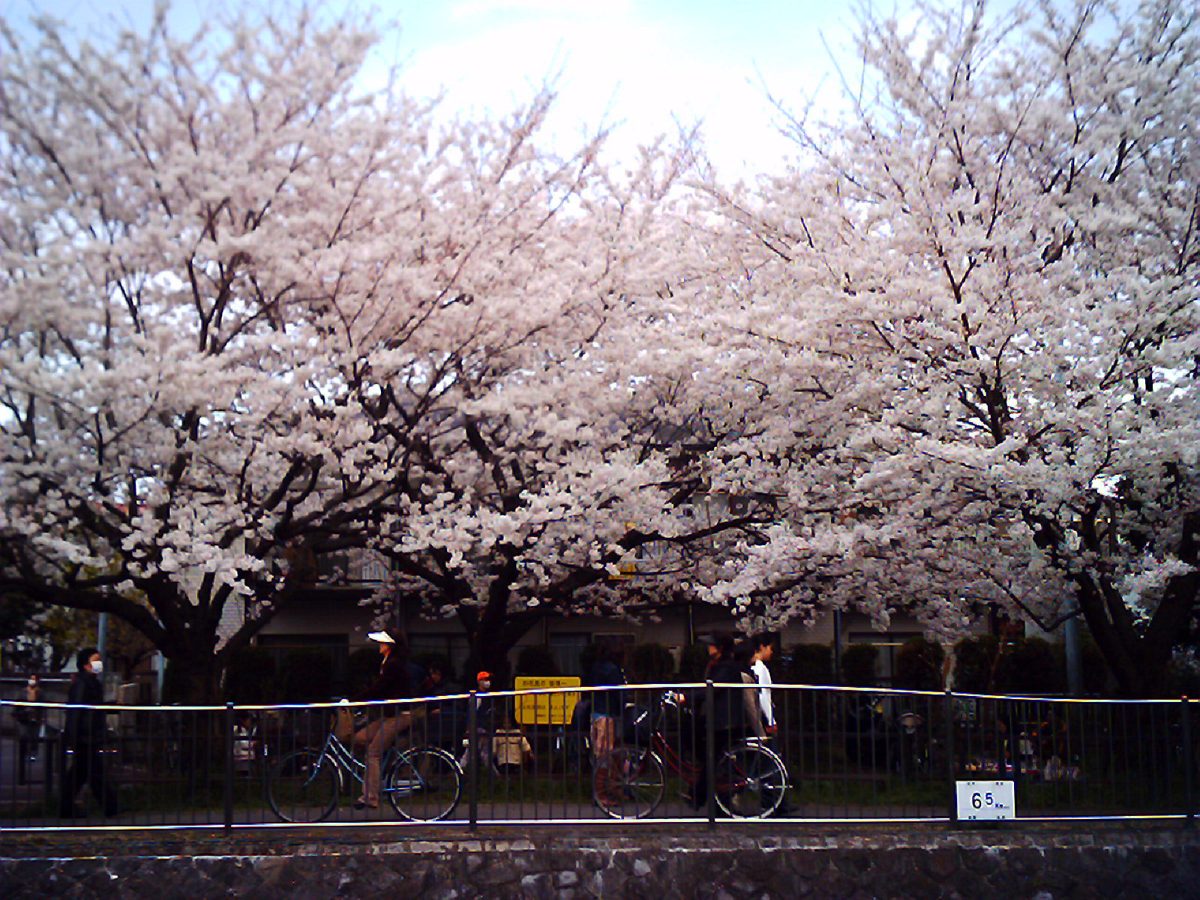
March in Japan is sold as cherry blossom month, and on the Japan Meteorological Agency’s own maps that is true for about seven days of it. The average flowering line for March 25 runs through Kyushu, Chugoku, Shikoku, Kinki, Tokai and Kanto; the average full-bloom line for March 31 touches northern Kyushu, the Pacific side of Shikoku and parts of Kanto. Before that week the trees are in bud, and north of that line they are bare until April. Hokkaido’s blossoms open in mid-May.
The rest of the month is winter loosening its grip. Tokyo averages 9.4 C and gets 116 mm of rain, twice February’s. Sapporo averages 1.1 C with nights below freezing. Naha is at 19.1 and its early cherries are already finished. Here is March across eight cities, with the flower calendar as the agency draws it.
Japan in March at a glance
| City | Avg temp (C) | Daily high / low (C) | Rain (mm) | Sunshine (h) |
|---|---|---|---|---|
| Sapporo | 1.1 | 4.5 / -2.4 | 78 | 145 |
| Tokyo | 9.4 | 14.2 / 5.0 | 116 | 175 |
| Nagoya | 9.2 | 14.5 / 4.6 | 116 | 200 |
| Kyoto | 8.8 | 14.1 / 4.3 | 106 | 155 |
| Osaka | 9.9 | 14.2 / 6.0 | 103 | 172 |
| Hiroshima | 9.5 | 14.5 / 5.1 | 118 | 177 |
| Fukuoka | 10.8 | 15.0 / 7.2 | 104 | 161 |
| Naha | 19.1 | 21.9 / 16.7 | 143 | 115 |
March: Japan Meteorological Agency 30-year normals (1991–2020), read on September 14, 2026.
Cherry blossoms in March: the JMA’s map, week by week
| Average date | Flowering reaches | Full bloom reaches |
|---|---|---|
| Mid-January | Okinawa and Amami (hikanzakura) | — |
| Early February | — | Okinawa and Amami (hikanzakura) |
| March 25 | Kyushu, Chugoku, Shikoku, Kinki, Tokai, Kanto | — |
| March 31 | — | Northern Kyushu, Pacific Shikoku, parts of Kanto |
| April 10 | Hokuriku, southern Tohoku | Kyushu, Chugoku, Shikoku, Kinki, Chubu, Tokai, Kanto, western Hokuriku |
| April 20 | Northern Tohoku (moving north) | Eastern Hokuriku, southern Tohoku |
| Mid-May | Northern Sea of Japan side and eastern Pacific side of Hokkaido | Okhotsk and eastern Pacific sides of Hokkaido |
JMA isochrone maps of average flowering and full-bloom dates, 1991–2020 normals.
So which March dates actually have blossoms?
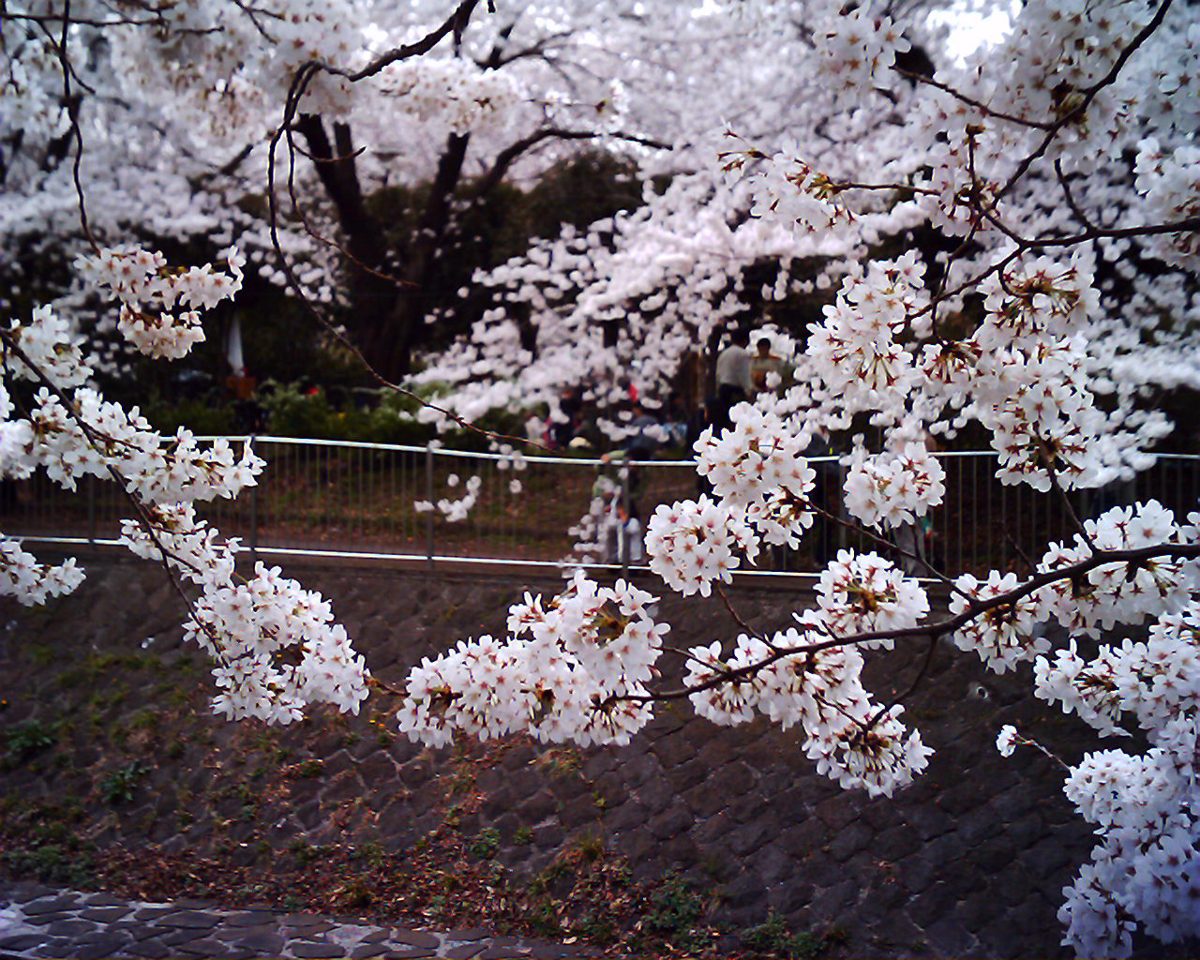
On the averages, the last week. A trip that lands on March 20 in Tokyo or Kyoto finds buds; one that lands on March 28 finds flowering trees heading toward full bloom in early April. The whole main island south of Hokuriku flowers within about a week either side of March 25, which is why the crowds are so concentrated. Our full-bloom guide explains how long the 80 percent stage lasts and how to read the forecasts that appear from February.
What if I come in early March?
Plums, not cherries. The JMA’s plum map puts the February 28 line from Sanyo through Kinki to western Hokuriku and the Kanto-Koshin region, and the March line at eastern Hokuriku and southern Tohoku. Early March in Tokyo and Kyoto is the end of plum season, and the beginning of the wait.
Is Okinawa a March blossom destination?
No. The JMA observes hikanzakura there rather than somei-yoshino, and its average flowering is mid-January with full bloom in early February. By March the islands are warm, 19.1 C in Naha, and the blossoms are gone.
And Hokkaido?
Mid-May for the northern Sea of Japan side and the eastern Pacific side, later than anywhere on the main island. Sapporo in March is 1.1 C on average with lows of minus 2.4; it is still winter, and the 77.6 mm of precipitation is largely snow.
Where does Mount Fuji fit?
Later than the cities, because the lakes sit higher. Our Fuji blossom guide covers the timing there; for March the mountain is a snow-capped backdrop to blossoms that have not opened yet.
The weather: winter letting go
Why does the rain double in March?
Because the dry winter pattern breaks. Tokyo goes from 56.5 mm in February to 116.0 in March; Kyoto from 65.1 to 106.2; Osaka from 60.5 to 103.1. It is still less than half of October’s total in Tokyo, but it is the first month since November with over 100 mm, and it arrives with the blossoms. A wet week in late March is unremarkable and is what knocks petals down.
Is it sunny?
Yes, unusually. Tokyo’s March sunshine normal of 175.3 hours is higher than August’s 174.2; Nagoya’s 199.7 and Osaka’s 172.2 are near their annual highs. Humidity is in the year’s driest band, 57 to 59 percent in Tokyo, Nagoya and Osaka. The combination of bright, dry days and cold mornings is the March signature.
How cold are the mornings?
Daily lows are 5.0 C in Tokyo, 4.3 in Kyoto, 4.6 in Nagoya, 5.1 in Hiroshima, 6.0 in Osaka, 7.2 in Fukuoka, and minus 2.4 in Sapporo. Highs are 14 to 15 on the main island. The daily range of nine to ten degrees is the widest of the year in several cities.
Does it snow in March?
In Sapporo, routinely: the 77.6 mm of precipitation falls at an average temperature of 1.1 C, and the city’s snow season runs into the month. On the Pacific side of the main island, snow in March is an event rather than a pattern; the normals give rain, not snow, for Tokyo, Nagoya, Kyoto and Osaka. The Sea of Japan coast between the two is where March can still deliver either.
Are there typhoons?
None. The JMA normals show 0.3 forming in the western Pacific in March and no approach or landfall in Japan across the 30-year record. March is one of the three months of the year, with January and February, in which that is true.
North to south: eight Marches
Sapporo
1.1 C, lows of minus 2.4, 77.6 mm, 144.7 hours of sun. The driest of the eight cities and the coldest by eight degrees. The season here is still the winter one.
Tokyo, Nagoya, Kyoto, Hiroshima
All between 8.8 and 9.5 C, rain between 106 and 118 mm, and the blossoms on the March 25 flowering line. Nagoya is the sunniest of the group at 199.7 hours. For the capital across the whole year, the best time to visit Tokyo page sets March beside its neighbors.
Osaka and Fukuoka
Slightly warmer at 9.9 and 10.8 C, both around 103 mm of rain. Fukuoka is on the northern-Kyushu full-bloom line of March 31, the earliest mainland full bloom on the map.
Naha
19.1 C, lows of 16.7, 142.8 mm and the wettest of the eight, humidity 71 percent. Spring in the mainland sense does not apply; the early cherries finished in February.
The March holiday and the three-day weekend of 2027
| Year | Vernal Equinox Day | Substitute holiday | Result |
|---|---|---|---|
| 2026 | Friday, March 20 | — | Three-day weekend (Fri–Sun) |
| 2027 | Sunday, March 21 | Monday, March 22 | Three-day weekend (Sat–Mon) |
Cabinet Office national holiday list. The equinox date is fixed each year by the astronomical calculation and can be March 20 or 21.
Does the holiday coincide with the blossoms?
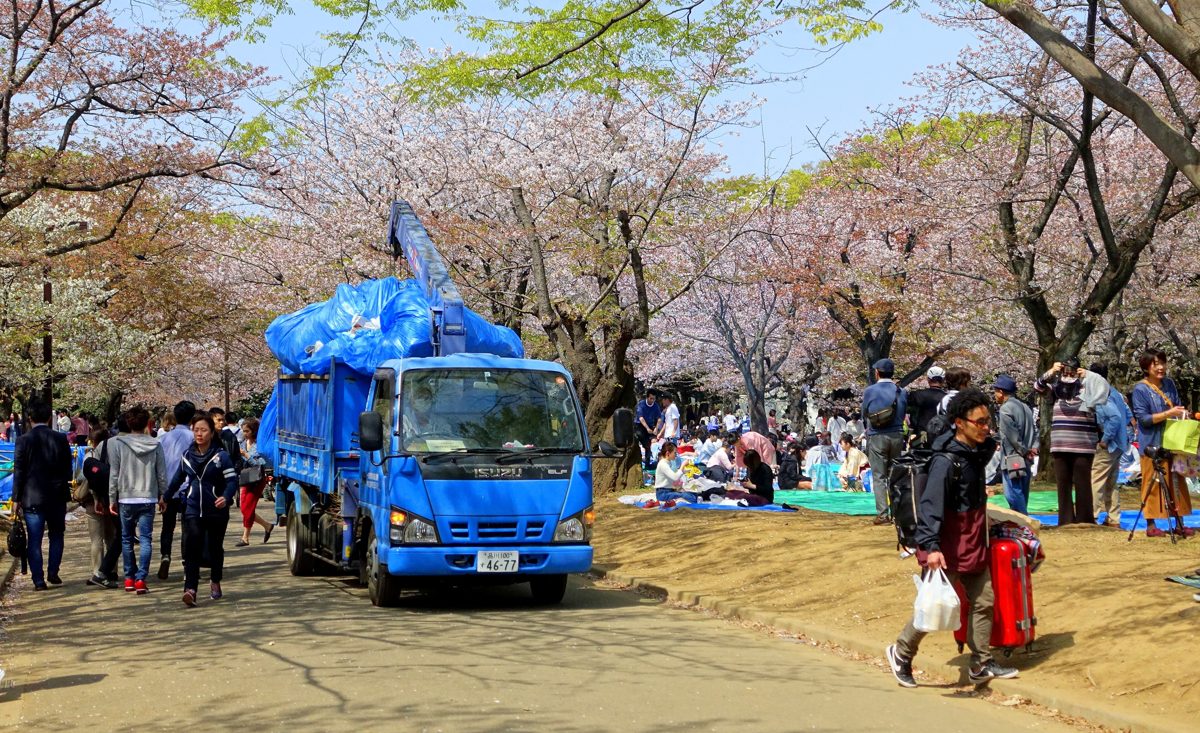
It comes a few days before the average flowering line for most of the main island, so on the normals it is a bud weekend rather than a blossom weekend in Tokyo and Kyoto, and a flowering weekend in a warm year. Fukuoka is the mainland city most likely to have open trees by then. The full calendar is in our holidays guide.
Is the end of March busy?
Late March is the end of Japan’s school and fiscal year, and the start of the blossom week. We have no official statistic on the resulting crowding and will not invent one; the calendar itself is the argument for booking the last week of the month early.
Planning a March week around the numbers
Which direction should the route run?
South to north, if the blossoms are the point. Fukuoka full-blooms on the March 31 line, Kyoto and Tokyo flower around March 25 and full-bloom into early April, and Hokuriku and Tohoku follow around April 10. A week that starts in Kyushu in the last days of March and ends in Kanto in the first days of April tracks the front on the averages.
What do the highs and lows mean for a day out?
A ten-degree swing: 14.2 to 5.0 in Tokyo, 14.1 to 4.3 in Kyoto. An early start at a temple is a winter morning; the afternoon under blossoms is a spring one. The dryness helps: the same 9 C feels lighter at 57 percent humidity than at the 75 percent of June.
What about the first half of the month?
It is the quieter, cheaper half by the logic of the calendar, and it has plums, bright skies and cold mornings. If the blossoms are not the reason for the trip, the first two weeks of March are winter’s clear weather without winter’s deepest cold on the main island.
How to check the current year yourself
Where do these numbers come from?
From the Japan Meteorological Agency, which publishes 30-year climatological normals for every observatory and updates them once a decade; the current set covers 1991 to 2020. The flower dates come from the same agency’s phenological observations, which use a designated sample tree at each station and a fixed definition of flowering and full bloom. Every figure on this page is the agency’s own number for the named station.
What does “average” hide?
The spread. A warm February pulls the flowering date forward by a week or more; a cold one pushes it back. The March 25 line is where the middle of thirty Marches landed, and the trees in any single year are somewhere on either side of it. It is the right tool for deciding which week of which month to aim at, and the wrong tool for promising a picnic under full bloom on a particular Saturday.
How do I read the forecasts that appear from February?
Private forecasters publish predicted dates city by city from late winter, and the JMA publishes its observed dates as each station’s sample tree flowers. We print neither the forecasts nor a guess of our own. In the two weeks before you travel, compare the current forecast with the average line above: if the forecast is ahead of the average, plan earlier in the week; if behind, later. The full-bloom guide walks through the stages between the first five blossoms and the 80 percent mark.
Three things travelers get wrong about March
“March is cherry blossom season”
The last week is. On the averages, a March 1 to March 21 trip to Tokyo or Kyoto sees no somei-yoshino in flower at all. The word “season” stretches to cover a month that, on the JMA’s map, delivers about seven days of it in the south and center and none in the north.
“It is spring, so it is warm”
Averages of 9 to 10 C with mornings near freezing on the main island, and 1.1 C in Sapporo. March is warmer than February by three degrees in Tokyo and no more. The sunshine makes it feel better than the thermometer says, which is the part the photographs capture.
“Okinawa in March means cherry blossoms in the warmth”
The warmth, yes: 19.1 C. The blossoms, no: the early cherry the JMA observes in Okinawa flowers in mid-January and is in full bloom by early February. A March visit to the islands is a beach-season preview, not a blossom trip.
Japan in March FAQ
Will I see cherry blossoms in Japan in March?
What is the weather like in Tokyo in March?
Is March cold in Japan?
Are there typhoons in March?
Is there a public holiday in March?
When do plum blossoms bloom?
What about Okinawa in March?
Which city is driest in March?
Bottom line (2027). On the JMA’s averages, cherry blossoms open across the main island from Kyushu to Kanto around March 25 and reach full bloom from March 31; Hokkaido waits until mid-May and Okinawa finished in February. Tokyo averages 9.4 C with 116 mm of rain, double February, and some of its sunniest hours. No typhoons. Vernal Equinox Day is March 21, 2027, with March 22 as a substitute holiday for a three-day weekend just before the blossoms.
Sources
Climate figures are Japan Meteorological Agency 30-year normals (1991–2020) for the Sapporo, Tokyo, Nagoya, Kyoto, Osaka, Hiroshima, Fukuoka and Naha observatories; cherry flowering, cherry full-bloom and plum flowering dates are read from the JMA’s official isochrone maps, which also define flowering as five or six open blossoms and full bloom as about 80 percent on the sample tree; typhoon counts are the JMA typhoon normals; holiday dates are from the Cabinet Office list for 2026 and 2027. All read on September 14, 2026.
Some links on this page may be affiliate links, which means we may earn a commission if you book or buy through them — at no extra cost to you. See our affiliate disclosure.
Tokyo to Osaka, Tokyo to Kyushu, Tokyo to Hokkaido — day by day — plus seven places most visitors never reach.
- 12 pages, 80 photographs, every stop linked to its guide
- Every price and opening hour read from the official page
- Re-issued monthly, so it does not go stale in your inbox
Free. One email a month, plus the rare change that matters. Unsubscribe with one click in any email. By subscribing you agree to our privacy policy.