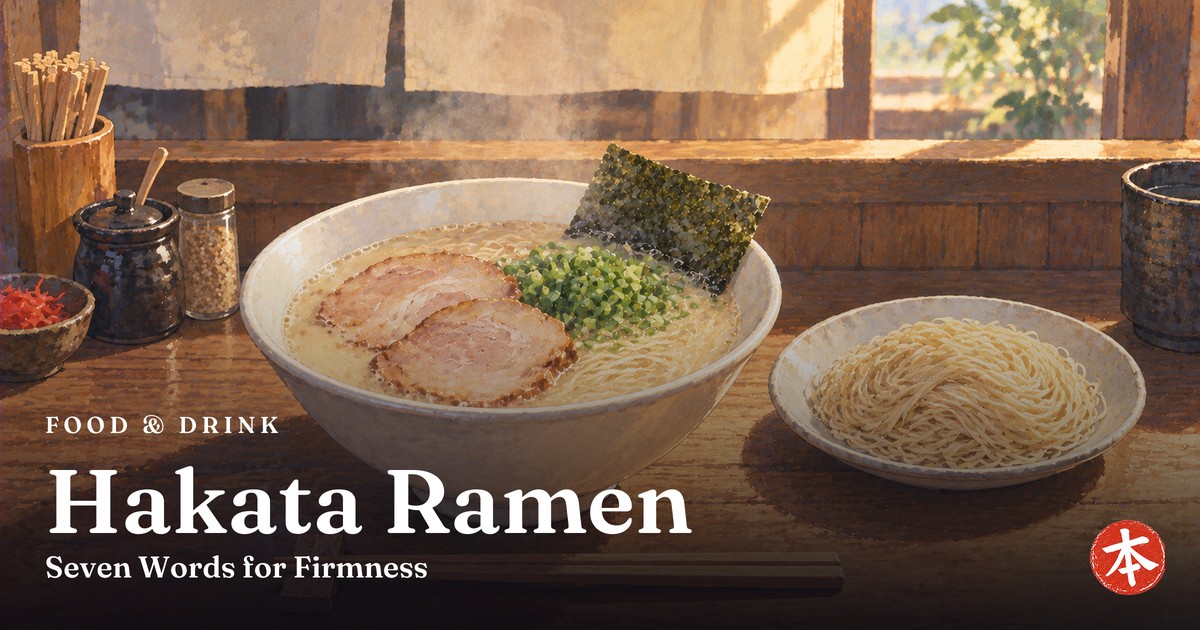
There are seven words for how done you want your noodles, and Fukuoka’s official tourism guide prints all of them. The hardest is nama — raw, wet only enough to wash the flour off. The softest is bariyawa. Most people who live there order somewhere above normal, because the noodles are thin enough that normal is already heading for soft.
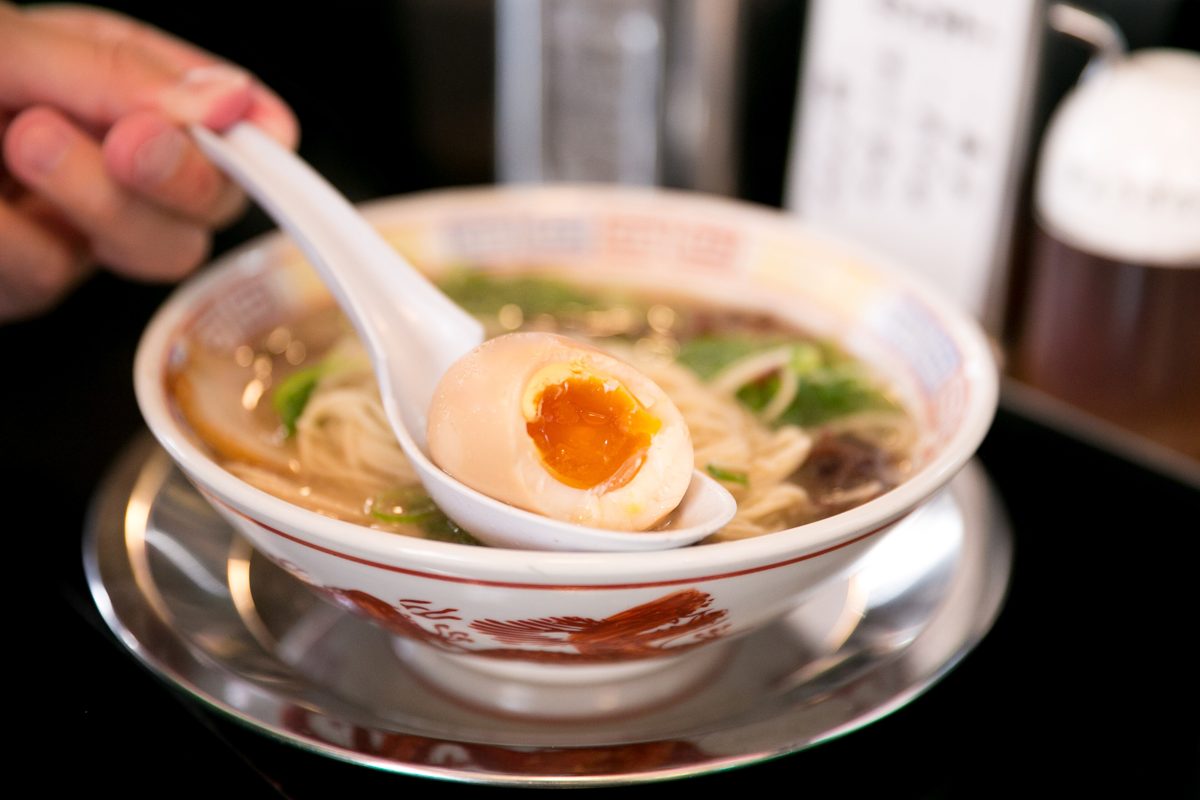
That thinness explains the other thing everyone knows about Hakata ramen without knowing why. Kaedama — a second helping of noodles dropped into the broth you already have — exists because a big bowl would not survive the walk from the kitchen. The official guide says so directly: the shops offer replacement noodles rather than large portions, because thin noodles go soggy.
And one more correction to the picture. Hakata, Nagahama and Kurume are three different ramens, and the one that invented seconds is not the one whose name got exported.
Hakata ramen at a glance
| Element | What the official guide says |
|---|---|
| Broth | Tonkotsu — pork bone. The established image is cloudy white |
| Noodles | Slim and straight. The original is said to have used flat thin noodles in a broth that was not very cloudy |
| Seconds | Kaedama — replacement noodles for the same bowl of soup |
| Firmness options | Seven, from nama to bariyawa |
| Where the custom started | Nagahama, to feed market workers quickly |
| Related styles | Nagahama (ultra-thin noodles) and Kurume (white, slightly thick noodles, nori on top) |
The seven firmness levels, in order
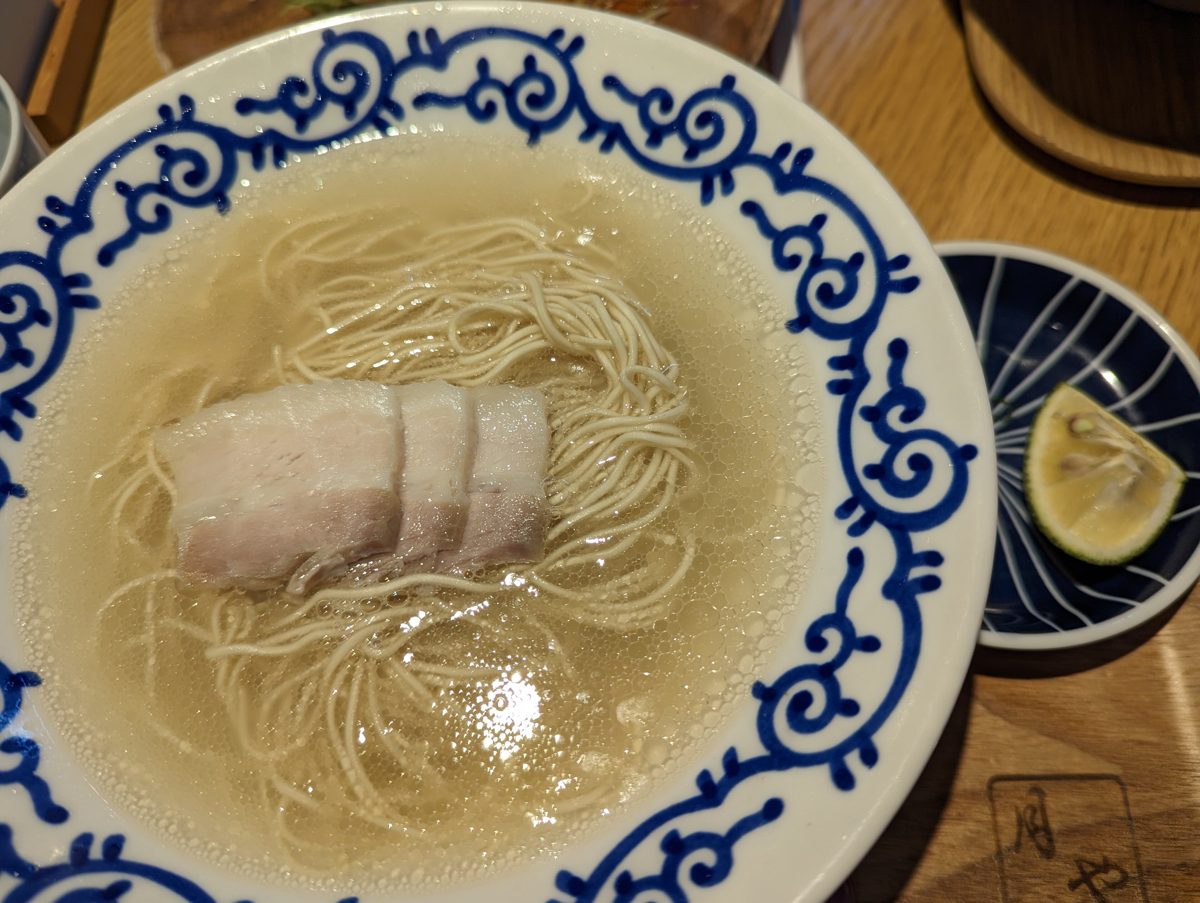
| Word | What it means | Who orders it |
|---|---|---|
| Nama | Raw — just wet enough to remove the powder | The deep end |
| Harigane | Japanese for “wire”. Boiled even shorter than barikata | Regulars in a hurry |
| Barikata | Very hard | Common local order |
| Kata | Hard | The safe step up from normal |
| Futsu | Normal | Fine. Order this first |
| Yawa | Soft | |
| Bariyawa | Very soft |
Why do locals order harder than normal?
Because the clock starts the moment the noodles hit the broth. The official guide puts it simply: the noodles are rather thin, so locals tend to order them slightly harder than normal. A bowl ordered kata arrives firm and is normal by the time you are halfway down. A bowl ordered futsu arrives normal and finishes soft.
Is ordering harigane showing off?
Only if you order it to be seen ordering it. Harigane means wire, and it is a real texture that some people genuinely prefer — but it is a texture, not a rank. There is no version of this where the staff are impressed. Order what you want to eat.
Can I ask for a firmness in English?
The words themselves are the English. Kata, barikata and futsu are what you say, and they are understood as ordering vocabulary rather than as Japanese you are expected to be fluent in. Some shops use a written order form for exactly this reason — Ichiran, for one, calls it an order form on its own site and pairs it with what it calls flavor concentration booths, the single-seat partitions it is known for.
Kaedama: what it is, and why it had to be invented
When do I ask for it?
While there is still broth in the bowl. The noodles go into the soup you have, so a finished bowl is a missed window. If you think you might want it, order it a little earlier than feels natural — the kitchen needs a moment, and you want soup left when it arrives.
How much does it cost?
The official guide describes it as usually a tiny fraction of the full meal price, which is as precise as we can honestly be. We looked for a figure on the chains’ own websites and did not find one, so we are not printing a number that we cannot source. Ichiran does at least name the mechanism on its site, calling it a noodle refill ordering system.
Where did the custom come from?
Nagahama. The official guide is specific: the stall used thin noodles in order to feed the workers at the market as quickly as possible, and the same thinking produced seconds. It is a working-hours invention, not a hospitality one.
Hakata, Nagahama, Kurume: three ramens, one prefecture
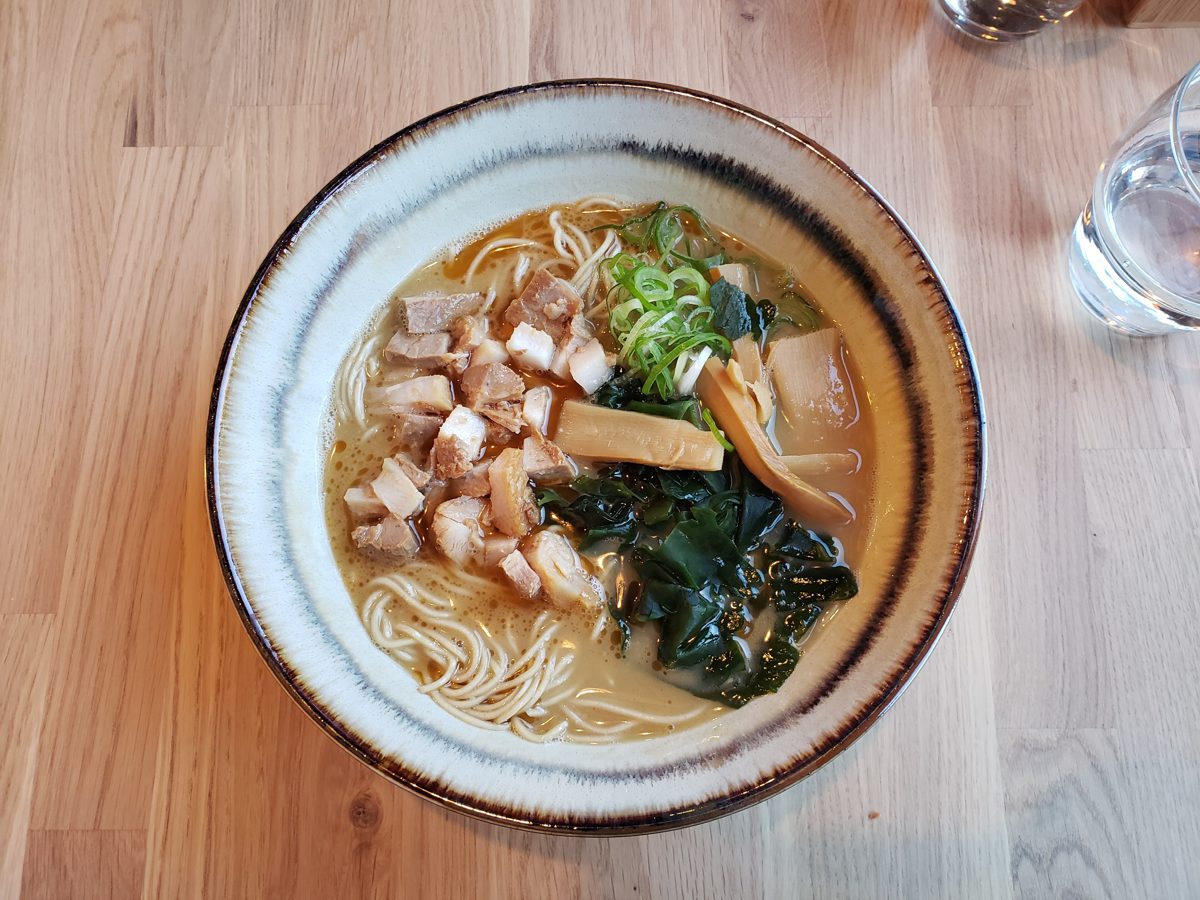
| Style | Broth | Noodles | Marker |
|---|---|---|---|
| Hakata | Cloudy white pork bone, in the established image | Slim. The original is said to have been flat and thin | The style that became the export |
| Nagahama | Pork bone | Ultra-thin | Originated the custom of second servings |
| Kurume | Strong aroma, relatively rich | Very white, slightly thick | Nori seaweed on top |
So which one am I eating in Fukuoka?
Probably Hakata by name and something in between by construction, because the three sit within the same prefecture and the shops have been borrowing from each other for decades. The useful thing is not to label your bowl but to notice the two variables the official guide flags: how cloudy the broth is and how thick the noodles are. Those two tell you where on the map you have landed. The Fukuoka map covers how the districts sit relative to each other.
How did the cloudy broth happen?
The official guide tells it as an accident in Kurume: the owner went out for an errand while the soup was simmering, his mother left it boiling, and the broth turned cloudy white. We are relaying the official version. It gives no date, and we are not going to attach one.
How is this different from ramen elsewhere in Japan?
Regional ramen in Japan diverges on broth base and noodle shape more than on technique. Sapporo is the miso counterweight to Fukuoka’s pork bone, and Tokyo is where every regional style is available at once and none of them is native.
The yatai question: should you eat ramen at a street stall?
Fukuoka is the one Japanese city where street stalls are a permanent, licensed institution rather than a festival that packs up. The city passed the Fukuoka City Yatai Basic Ordinance in 2013, described on its own pages as the first of its kind in Japan, and has awarded pitches by public application ever since.
How many yatai are there?
The city states that five rounds of public application since 2016 produced 56 yatai, of which 44 are still trading. That is the number created by the application system, not the city total — we did not find an official figure for the whole city, so we are not giving one. The sixth round covers 23 pitches across Nakasu, Tenjin and Nagahama.
Are the stalls permanent businesses?
They are time-limited on purpose. An operating period runs three years, and the city states that renewal can extend it to a maximum of ten years, after which the pitch goes back to open application. It is designed so that the same stalls cannot hold the same corners forever — which is unusual, and worth knowing when someone tells you a yatai is a century old.
Is the ramen better at a yatai?
No. It is different, and the setting is the product: a counter on a pavement, a curtain, a dozen seats. Yatai serve a lot more than ramen, and the same city has ordinary shops doing the noodles more carefully. Go for the street, not for the bowl. If street food generally is the draw, the wider street food guide covers what else turns up.
Practical: how a bowl actually goes
Do I need to reserve?
Not for ramen. This is counter food with turnover measured in minutes, and the queue moves. Where shops do control entry it is usually with a ticket machine at the door rather than a booking.
Is it cash only?
Assume it might be, especially at yatai. Street stalls operate on a pavement with limited infrastructure, and small independent shops in Japan still skew cash. Carry notes.
What else is worth eating in the same trip?
Fukuoka is a food city rather than a one-dish city, and it is also the gateway to the rest of Kyushu — the hot spring towns including Beppu are a short run away. Build the ramen into a route rather than treating it as the destination.
(For the chain that took this style to New York, our Ippudo guide explains why the two signature bowls use different flour and different noodle cuts, and why there is no reservation page to look for.)
Hakata ramen FAQ
What is Hakata ramen?
What are the noodle firmness levels, in order?
What should I order if it is my first bowl?
What is kaedama and how do I order it?
How much does kaedama cost?
Are Hakata, Nagahama and Kurume ramen the same thing?
Is it true that tonkotsu broth was invented by accident?
Do I have to eat it at a yatai?
Bottom line. Order futsu the first time and kata the second. Ask for kaedama while you still have broth, because that is the whole design — the noodles are too thin for a big bowl, which is why seconds were invented in Nagahama in the first place. And if the broth is thinner and the noodles thicker than you expected, you have probably wandered into Kurume territory rather than found a bad shop.
Sources
The firmness ladder, the explanation for kaedama, the differences between the Hakata, Nagahama and Kurume styles and the accidental-broth origin story were read off the official Fukuoka Prefecture travel guide in English on September 9, 2026. The yatai ordinance, the public application rounds, the 56 and 44 figures and the ten-year maximum come from Fukuoka City’s own website, checked the same day. The names of Ichiran’s order form, its flavor concentration booths and its noodle refill ordering system come from Ichiran’s own English site; that site does not publish prices, and neither do we.
Some links on this page may be affiliate links, which means we may earn a commission if you book or buy through them — at no extra cost to you. See our affiliate disclosure.
Tokyo to Osaka, Tokyo to Kyushu, Tokyo to Hokkaido — day by day — plus seven places most visitors never reach.
- 12 pages, 80 photographs, every stop linked to its guide
- Every price and opening hour read from the official page
- Re-issued monthly, so it does not go stale in your inbox
Free. One email a month, plus the rare change that matters. Unsubscribe with one click in any email. By subscribing you agree to our privacy policy.