On the prefecture’s own access table, sorted shortest first, the top entry is this: Kanazawa Station to Toyama Station, about 20 minutes by train.
Almost every English itinerary that includes Kanazawa goes straight past Toyama. Twenty minutes. For comparison, the same table puts Tokyo to Toyama at about 2 hours 5 minutes — so if you have already committed to the Hokuriku side of the country, the marginal cost of adding this prefecture is a short train ride.
| From Kanazawa | About 20 minutes by train (the shortest route on the official table) |
|---|---|
| From Tokyo | About 2 hours 5 minutes by train |
| From Osaka / Nagoya | About 2 hours 35 minutes each by train |
| From Haneda | About 1 hour 30 minutes to Toyama Station by air |
| Car needed? | No. The official site states the Alpine Route is reachable from Toyama Station without one |
| The signature view | Amaharashi Coast — the Tateyama range seen across the sea |
| World Heritage | Gokayama, where the gassho-zukuri houses are still lived in |
See Alpine Route day tours from Kanazawa → Affiliate link — affiliate disclosure.
Toyama is 20 minutes from Kanazawa
Toyama being overlooked is not only our observation. This news segment covers the New York Times listing Toyama as somewhere to go, and interviews the journalist who wrote it — the reaction from local businesses, who were as surprised as anyone, is the part worth watching. Japanese, but the footage of the city speaks without it.
What the official table actually shows
The prefecture publishes an access tool that sorts routes by journey time, shortest first. The entry at the top is rail, Kanazawa Station to Toyama Station, about 20 minutes. By road it gives about 40 minutes from Kanazawa-Higashi IC to Toyama IC. Nothing else on the list is close.
Why this changes an itinerary
Kanazawa is on almost every second-trip route through Japan, and it is treated as the western terminus — you go, you see the garden and the market, you come back. Toyama sits twenty minutes beyond it. That is a shorter hop than many people make inside a single city, and it opens a mountain range, a World Heritage village and a coastline that most visitors never reach.
The other approaches
Tokyo: about 2 hours 5 minutes by rail. Osaka and Nagoya: about 2 hours 35 minutes each. Takayama: about 1 hour 40 minutes by rail, which makes the Takayama–Toyama pairing a genuine two-stop plan rather than a stretch. And Haneda to Toyama Station is about an hour and a half by air, which is the option people forget exists.
Where this fits against the neighbours
If you are building the Hokuriku side, our guides to things to do in Kanazawa and the Kanazawa map cover the city everyone stops at, and the Takayama guide covers the other end of that 1 hour 40 minute line. Toyama is the gap between them.
You do not need a car, and the official site says so
The line that matters
On the first-time visitor page, the prefecture states that the Tateyama Kurobe Alpine Route can be reached from Toyama Station without a car. For a mountain crossing in a rural prefecture, that is not the default assumption, and it is the fact that makes Toyama possible on a rail trip.
What the Alpine Route is
A crossing of the Northern Alps by a chain of different vehicles, running between the Toyama side and the Nagano side. It is the reason most visitors come to the prefecture at all, and it is a traverse rather than a destination — you go in one end and out the other, which is why it interacts awkwardly with a plan that assumes you come back to where you started.
What we are deliberately not quoting
Fares and the operating season. The pages we read for this guide do not give them, and the pricing is sectional — different vehicles, different segments — rather than one ticket with one price. A single number quoted here would be wrong for most readers. Check the route operator for the year you are traveling.
The nine places the prefecture puts first
The official first-timer list is grouped by area. East: the Alpine Route, Unazuki Onsen, and the Kurobe Gorge railway. Central Toyama City: Fugan Canal Kansui Park, the Toyama Glass Art Museum, and the Iwase district. West: Amaharashi Coast, Gokayama, and the Uchikawa district. The middle three are walkable city attractions; the outer six are the reason to stay a night.
Compare guided crossings → Affiliate link — affiliate disclosure.
The views the prefecture leads with
Amaharashi Coast: the mountains across the sea
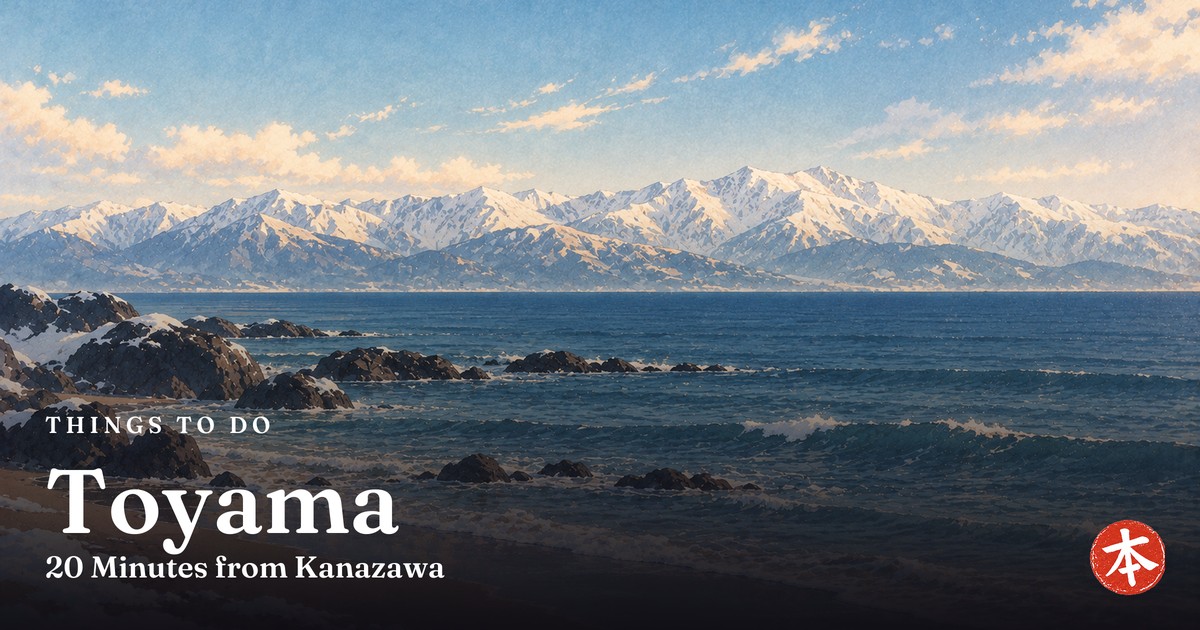
In Takaoka, on the western side. You stand on the coast and look at the Tateyama range across the water — the official description calls the landform that produces this genuinely rare within Japan. The version the prefecture leads with is winter into spring, with snow on the peaks beyond the sea. There is no ticket and no opening time; it is a place you stand.
Mikuriga-ike, which is two different things
A crater lake on the Alpine Route, and the official note about it is the useful kind: April to June it is covered in snow; July to October it is a blue lake surface. Same place, two entirely different photographs, and the month decides which one you get. If you have seen an image of it and want that image, check which half of the year it came from.
Kurobe Dam, and the discharge season
The tourist discharge runs June to October, at 10 tons per second by the prefecture’s figure. Outside those months the dam is still there and the water is not coming over it, which is a meaningful difference if the discharge is what you came for.
See round-trip Alpine Route options → Affiliate link — affiliate disclosure.
Gokayama, where people still live
A World Heritage site of gassho-zukuri farmhouses, and the detail the official page chooses to emphasize is that the houses are still lived in. It describes a landscape where daily life continues inside a tourist site. That is the distinction from an open-air museum, and it is also a request, implied but clear, about how to behave when you are there.
When to go to Toyama
The prefecture does not name a best season
It splits the year instead, which is more honest than most destination marketing. Spring: the Asahi Funakawa blossom stretch, and the Tonami tulip fair. Summer: Mikuriga-ike and Shomyo Falls. Autumn: the Kurobe Gorge railway and Gokayama. Winter: the Shogawa gorge cruise and Unazuki Onsen.
What that list is really telling you
Look at where each season’s entries are. Spring and summer are outdoors and high up. Winter is boats and hot springs at low altitude. That is a prefecture whose headline attraction is seasonal and whose winter offering is deliberately different — not a lesser version of the same trip, a different one.
The new route that is not open yet
The official site flags a Kurobe Unazuki Canyon Route, a new circuit linking the Kurobe Dam with Keyakidaira in the gorge, described as planned to open. We are not putting a date on it, because the page does not give one we would repeat. If it matters to your plan, that is a thing to verify directly.
And the dates everyone else is traveling
Toyama’s peak attractions are outdoor and weather-bound, which means they collide with the domestic holiday calendar in a way city attractions do not. Our Shinkansen price guide covers how fares move by season, and it is worth checking the national holiday weeks before fixing a date.
Toyama city itself, in one afternoon
The three central spots
The official list puts three things in the city center: Fugan Canal Kansui Park, the Toyama Glass Art Museum, and the Iwase district. That is a canal park, a museum and an old port quarter — the shape of an afternoon rather than a day, and all reachable without a car.
Why the glass museum is there
Toyama has built a civic identity around glass, and the museum is the visible end of it. It is the kind of attraction that exists because a city decided it should, rather than because something historic happened there — which makes it a better read on the place than the mountains do.
The food line the prefecture leads with
Toyama Bay sushi. The official site names it first when describing what the prefecture is, ahead of the mountains and the World Heritage village. The bay is deep and cold close to shore, which is the geography behind the claim. We are not naming restaurants, because the pages we read do not.
Whether a rail pass covers any of this
It depends which lines your route uses, and the Hokuriku side has a mix of JR and third-sector railways that passes treat differently. Our JR Pass guide covers what the nationwide pass does and does not include. Run it against your actual legs rather than assuming the pass covers a prefecture.
Toyama FAQ
How far is Toyama from Kanazawa?
How do I get to Toyama from Tokyo?
Do I need a car in Toyama?
What is the Tateyama Kurobe Alpine Route?
When is the best time to visit Toyama?
What is Amaharashi Coast?
Is Gokayama worth the trip?
What is the Kurobe Unazuki Canyon Route?
Bottom line. The prefecture’s own access table puts Kanazawa to Toyama at about 20 minutes and Tokyo to Toyama at about 2 hours 5 minutes, and the official site states that the Alpine Route is reachable from Toyama Station without a car. Those two facts together are the argument: if Kanazawa is already on your route, the mountains, a World Heritage village where people still live, and a coast where you see the Tateyama range across the sea are twenty minutes further on. Check the month before you commit to a picture — Mikuriga-ike is snow from April to June and a blue lake from July to October, and the Kurobe Dam discharge runs June to October.
Sources & what we deliberately did not state
Checked on September 3, 2026. Researched in Japanese from Toyama Prefecture’s official tourism site, the access page and the first-time visitor feature. From those pages: the access table sorted by journey time, giving rail Kanazawa to Toyama at about 20 minutes, road Kanazawa-Higashi IC to Toyama IC at about 40 minutes, rail Tokyo Station to Toyama Station at about 2 hours 5 minutes, Osaka and Nagoya to Toyama each at about 2 hours 35 minutes, Takayama to Toyama at about 1 hour 40 minutes, Wakura Onsen to Toyama at about 1 hour 30 minutes, air Haneda to Toyama Station at about 1 hour 30 minutes and New Chitose to Toyama Station at about 2 hours; the statement that the Tateyama Kurobe Alpine Route can be reached from Toyama Station without a car; the nine first-timer spots grouped east, central and west; the Kurobe Dam tourist discharge running June to October at 10 tons per second; Mikuriga-ike being snow-covered April to June and a blue lake July to October; Amaharashi Coast in Takaoka offering a view of the Tateyama range across the sea from a landform described as rare within Japan; Gokayama as a World Heritage site whose gassho-zukuri houses are still lived in; the seasonal recommendations of Asahi Funakawa and the Tonami tulip fair in spring, Mikuriga-ike and Shomyo Falls in summer, the Kurobe Gorge railway and Gokayama in autumn and the Shogawa gorge cruise and Unazuki Onsen in winter; Toyama Bay sushi named first in the description of the prefecture; and the Kurobe Unazuki Canyon Route linking the Kurobe Dam with Keyakidaira, described as planned to open. Tour details are from the Klook listing read the same day: a one-day Alpine Route tour departing from Kanazawa, English guided, rated 4.8 across 71 reviews with 1,000+ bookings. More on how we work: how we research.
Deliberately not stated. Alpine Route fares and operating season, because the pages we read do not give them and the pricing is sectional rather than a single ticket. The opening date of the Kurobe Unazuki Canyon Route, because the official page describes it as planned without a date we would repeat. The height and dates of the Yuki-no-Otani snow corridor, which move year to year. Opening hours for individual attractions, because we read the prefecture-level pages rather than each venue. Restaurant names for Toyama Bay sushi, for the same reason. And the ratings and prices of the other Alpine Route tours that appeared in the same search, because the order of the listings and the order of the product links were not verified against each other and we are not willing to attach a number to the wrong product. This reflects what those sources said on September 3, 2026.
Check Alpine Route tours and dates → Affiliate link — affiliate disclosure.
in English
Every week we read the Japanese sources English-language media never touches — new openings, price changes, limited releases, rule changes, the seasonal things that come and go in three weeks — and send you a three-minute read of what actually matters. Hit reply with a question about your trip and a human answers.
Free. Unsubscribe anytime. We never share your address.