The most photographed view in Japan costs nothing to see. The official listing for Arakurayama Sengen Park gives its opening hours as 24 hours and carries no admission price at all.
What it does price is parking — four lots, all paid, at 1,000 to 1,500 yen for six hours. And underneath the parking table sits a sentence you almost never see on an official tourism page: the site asks visitors to stop driving up to the plaza in front of the pagoda, because the number of tourists has become very large and the traffic has become dangerous.
| Opening hours | 24 hours. No admission price in the official listing |
|---|---|
| Parking | Four lots, all paid, 24 hours. 1,000–1,500 yen per six hours. No free lot |
| From the station | Shimoyoshida Station, then about 25 minutes on foot |
| From the highway bus stop | About 20 minutes on foot, route published step by step |
| Coaches | Cannot enter. Set-down at Shimoyoshida Station only; no parking there |
| Illumination | Ends 21:50 year-round; starts anywhere from 16:00 to 19:00 depending on the month |
| The official warning | Visitors asked not to drive to the plaza — too many tourists, too dangerous |
Check Tokyo to Mt. Fuji bus times → Affiliate link — affiliate disclosure.
The official site is asking people to stop driving up
The sentence itself
On the official spot page, under the notes, is this: regarding vehicle access to the plaza in front of the Chureito, the number of tourists is currently very large owing to inbound travel, it is extremely dangerous, and visitors are asked to refrain. That is a tourism board telling people not to come by car to the thing it is promoting.
Why that is the most useful line on the page
Crowding claims in travel writing are usually somebody’s impression from one visit. This one is the operator’s own standing notice, published on the page it controls, aimed at reducing traffic to its own attraction. When an official page works against its own interest like that, believe it.
What it means for your plan
Not that you should skip the pagoda — it means arrive on foot. Both walking routes are published by the same office, they take 20 to 25 minutes, and they remove you from the problem the notice is describing. If your group cannot walk it, that is a real constraint worth planning around rather than discovering in a queue of cars.
Parking at Chureito Pagoda: four lots, none of them free
The prices, from the official listing
P1: 88 spaces, 1,500 yen per six hours. P2: 38 spaces, 1,000 yen. P3: 35 spaces, 1,000 yen. P4: 21 car spaces at 1,500 yen, plus 10 motorcycle spaces at 750 yen. All four run 24 hours, and all four charge.
182 spaces for the most photographed view in the country
Add them up and the whole site has fewer than two hundred car spaces. That number, next to the official crowding notice, tells you the shape of a weekend morning here better than any description would. The lots are also spread across different addresses in the town rather than clustered at the entrance.
One thing that changed, and one we did not read
The official page notes that parking arrangements changed in April 2025 and points to a city government page for the details. We did not read that page, so we are not going to characterize what changed. If you are driving, that link is the one to follow — and its existence is a good reason not to trust parking figures in an older guide.
If you are on a coach tour
The official wording here is firm in a way that suggests it has been ignored before. Buses, including minibuses, cannot enter the parking areas because the roads are too narrow. Passengers may be set down at Shimoyoshida Station only, where parking is absolutely prohibited; the coach then moves to a dedicated lot elsewhere in the town. The site adds that stopping or setting down at Daishoji temple is firmly refused.
See the Tokyo to Mt. Fuji bus → Affiliate link — affiliate disclosure.
Getting to Chureito Pagoda on foot
This one is worth watching before you go: a 4K walk from the station up to the pagoda, titled in English as well as Japanese, covering the whole approach including the stairs. It is the single clearest answer to “how bad is the climb, really” — and you can see exactly where the famous viewpoint sits relative to the car parks.
From Shimoyoshida Station: about 25 minutes
The official access line gives about 25 minutes on foot from Shimoyoshida Station on the Fujikyu Railway line, and specifies that the timing is to the pagoda rather than to the park entrance. That distinction matters, because the last part of the approach is the climb.
From the highway bus stop: about 20 minutes
There is a second published route, from the Chuo Expressway Shimoyoshida bus stop, and the official site gives it turn by turn: down the steps by the stop and right, along the service road, right at the first junction, through the tunnel under the expressway, left at the end, then straight along the far service road to a junction, right, straight on, and right over a bridge when the park sign appears. About 20 minutes.
Why the walking directions are worth reading in advance
Because that route is a sequence of service roads and an underpass rather than a signposted tourist path. It is entirely walkable — the office would not publish it otherwise — but it is not somewhere you want to be working it out at dusk with a phone on 8% battery.
By car, if you are driving anyway
The official page lists interchange times: about 15 minutes from Kawaguchiko IC, about 12 from Fujiyoshida-Nishikatsura Smart IC, about 15 from Fujiyoshida IC, about 20 from Yamanakako IC, and about 20 from Fujiyoshida-Oshino Smart IC. Getting there is not the problem. The last two hundred meters and the parking are.
When to go: the illumination times move by three hours
The full official schedule
This is published as a month-by-month list and almost never reproduced. The end time is 21:50 all year. The start time moves:
| January–February | 16:00 – 21:50 |
|---|---|
| March–April | 17:00 – 21:50 |
| May | 18:00 – 21:50 |
| June–September | 19:00 – 21:50 |
| October–November | 17:00 – 21:50 |
| December | 16:00 – 21:50 |
What that does to a day trip
In midwinter the lights come on at 16:00, which is early enough to catch on the way back to Tokyo. In midsummer they do not start until 19:00, by which point the last convenient services out of the area are a live concern. The illumination is easy to add to a winter trip and awkward to add to a summer one, and that is the opposite of how most people assume it works.
The park does not close
Opening hours are given as 24 hours. So the illumination schedule is not an opening schedule — the site is accessible outside those windows, just unlit. Sunrise here is a real option, and it is the one time of day the parking notice is not describing.
Season, and what we are not going to promise
The cherry blossom framing is the reason most people have seen this view, and we are not putting dates on it. Blossom timing moves by a week or more year to year and the official page does not fix it. If your trip is built around it, watch the forecasts rather than a guide written last spring — and see our guide to Japan’s public holidays for the dates when the whole country is also traveling.
Getting there from Tokyo, and what the bus actually covers
The bus, and the connection people miss
Highway buses run from Tokyo Station’s expressway terminal to the Fuji area in under three hours. The important detail: the direct services terminate at Kawaguchiko Station, Fuji-Q Highland or Fujisan Station — not at Shimoyoshida. From Fujisan Station you continue on the Fujikyu line. The published 20-minute walking route is from a different, expressway-side bus stop.
Practical notes from the operator
Seats are assigned, and on some routes assigned randomly, so a group is not guaranteed to sit together. Children under 12 travel on a child fare. Booking opens more than 60 days out. And one that catches people: suitcases are not allowed in the cabin — they go in the compartment underneath, because a case at your feet stops the seat in front from reclining.
Compare the bus against the train → Affiliate link — affiliate disclosure.
Rail, and whether a pass helps
The Fujikyu Railway is a private line, which is the fact that decides the pass question — nationwide JR passes do not cover private railways. Our JR Pass guide covers what is and is not included, and our Shinkansen price guide covers how the fare structure works if you are combining legs.
Making a day of it
The pagoda is 20 minutes of looking and an hour of travel at each end, so most people pair it with something. The lake side is the obvious partner — our guide to Lake Kawaguchiko covers what is within reach. If you are weighing this against the other classic Fuji-view day trip, our Hakone Freepass guide covers that side.
What the pagoda is, underneath the photograph
A war memorial, not a temple
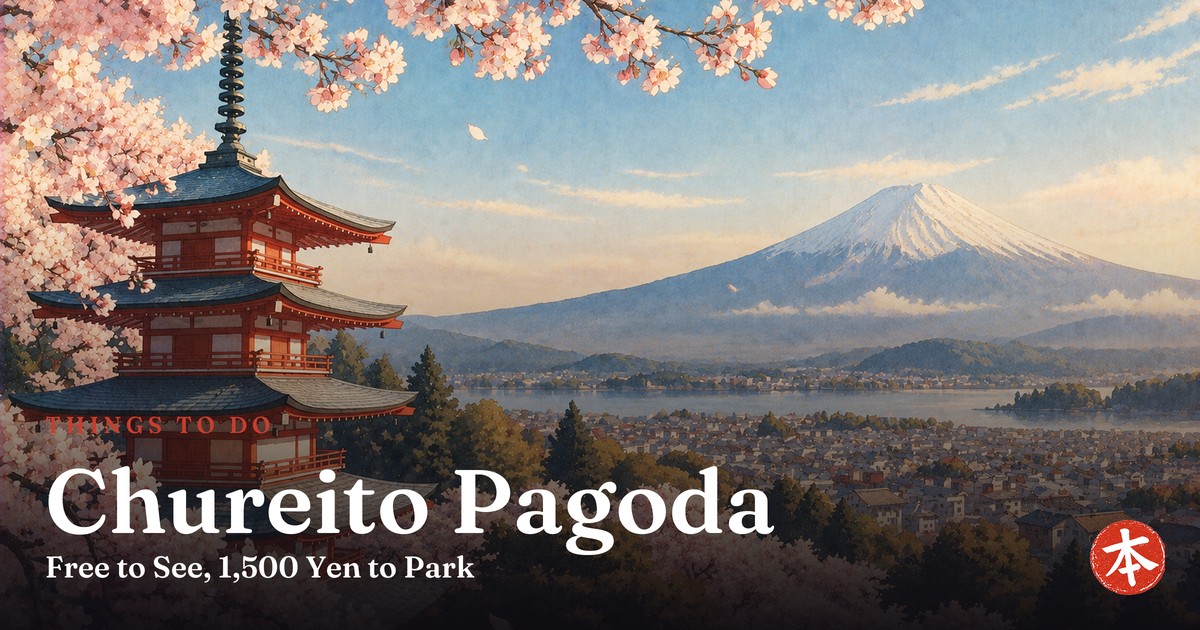
Chureito means a monument to the loyal dead. It stands in Arakurayama Sengen Park above Fujiyoshida, and it was built to commemorate the war dead of the local area. That is not visible in any of the photographs, and it is the single piece of context most English coverage leaves out.
Why it looks the way it does
The five-tiered form is why the image works — a pagoda silhouette, cherry trees and Mount Fuji stacked in one frame. But the building is a twentieth-century memorial rather than a historic temple, and knowing that changes how the place reads when you are standing in it rather than looking at it on a screen.
Facilities, briefly
The official listing confirms toilets on site, and the park is open around the clock. Beyond that the page lists nothing — no shop, no cafe, no visitor center. Bring what you need for the wait, because on a good morning there will be one.
Chureito Pagoda FAQ
Is Chureito Pagoda free?
How do I get to Chureito Pagoda without a car?
Can I park at Chureito Pagoda?
Can a tour bus go up to the pagoda?
Is it crowded?
What time is the pagoda lit up?
Can I get there from Tokyo in a day?
What is the pagoda actually for?
Bottom line. The pagoda is open 24 hours and the official listing shows no admission price. The money goes on parking — 1,000 to 1,500 yen for six hours, across four lots with fewer than 200 spaces between them, and none of them free. The operator itself asks visitors not to drive up to the plaza because of the crowds, which is the clearest crowding signal you will get anywhere. So walk it: about 25 minutes from Shimoyoshida Station, or about 20 from the expressway bus stop on a route the same office publishes turn by turn. And if you want it lit, check the month — the lights start at 16:00 in winter and 19:00 in summer, always ending at 21:50.
Sources & what we deliberately did not state
Checked on September 3, 2026. Researched in Japanese from the official Fujiyoshida tourism guide run by the Fujiyoshida Tourism Promotion Service Foundation, spot page for Arakurayama Sengen Park and Chureito and the published walking route from the Chuo Expressway Shimoyoshida bus stop. From those pages: the address in Asama, Fujiyoshida; opening hours of 24 hours; toilets on site; the illumination schedule of 16:00 to 21:50 in January and February, 17:00 to 21:50 in March and April, 18:00 to 21:50 in May, 19:00 to 21:50 from June to September, 17:00 to 21:50 in October and November and 16:00 to 21:50 in December; access of about 25 minutes on foot from Shimoyoshida Station to the pagoda, and by car about 15 minutes from Kawaguchiko IC, about 12 from Fujiyoshida-Nishikatsura Smart IC, about 15 from Fujiyoshida IC, about 20 from Yamanakako IC and about 20 from Fujiyoshida-Oshino Smart IC; the four paid 24-hour car parks, P1 with 88 spaces at 1,500 yen per six hours, P2 with 38 and P3 with 35 at 1,000 yen, and P4 with 21 car spaces at 1,500 yen and 10 motorcycle spaces at 750 yen, with a note that arrangements changed in April 2025 and a link to a city page; the statement that buses including minibuses cannot reach the car parks because the roads are narrow, that set-down is at Shimoyoshida Station only with parking there absolutely prohibited, that coaches must use a dedicated lot, and that stopping or setting down at Daishoji is firmly refused; the request that visitors refrain from driving to the plaza in front of the Chureito because tourist numbers are very large owing to inbound travel and it is extremely dangerous; and the turn-by-turn 20-minute walking route from the expressway bus stop. Bus product details are from the Klook listing read the same day: a rating of 4.3 across 832 reviews with 70,000+ bookings, direct services from the JR Bus Tokyo Station expressway terminal to Kawaguchiko Station, Fuji-Q Highland or Fujisan Station in under three hours, assigned seating, child fares under 12, booking more than 60 days ahead, and the rule that suitcases go in the underfloor compartment rather than the cabin. More on how we work: how we research.
Deliberately not stated. That admission is free — the official listing simply has no fee field, which is normal for a municipal park but is not a stated policy, so we have described what the page shows rather than drawing the conclusion. The number of steps up to the viewpoint, a figure repeated everywhere but absent from the official pages we read. Cherry blossom dates, which move year to year and which the official page does not fix. What exactly changed about parking in April 2025, because that is on a city page we did not read. And any claim that the Tokyo highway bus reaches Shimoyoshida — it does not; the published walking route is from a different, expressway-side stop, and conflating the two would send people to the wrong place. This reflects what those sources said on September 3, 2026.
Check bus times and fares → Affiliate link — affiliate disclosure.
in English
Every week we read the Japanese sources English-language media never touches — new openings, price changes, limited releases, rule changes, the seasonal things that come and go in three weeks — and send you a three-minute read of what actually matters. Hit reply with a question about your trip and a human answers.
Free. Unsubscribe anytime. We never share your address.