The number to start with is not the price. It is five to seven hours — the listing’s own suggested duration, and the longest of any attraction in this series. Combined with a location out on reclaimed land, that turns this from a ticket decision into a day decision.
| How long | 5–7 hours — the listing’s own suggestion |
|---|---|
| Where | Kinjofuto, in the Nagoya port area — not central Nagoya |
| Ticket tiers | Standard 1-day pass, or a VIP Experience with very different inclusions |
| Aquarium add-on | SEA LIFE Nagoya for an additional JPY 800 |
| Scale | 40+ attractions across 7 themed areas |
| MINILAND | 10 landmarks from four Japanese cities, over 10 million bricks |
| Also inside | The Big Shop and a LEGO Factory tour |
| Hours | Not shown on the listing. We are not guessing |
Five to seven hours, and a location that makes that binding
Most attractions in Japan can be compressed if your day runs short. This one resists it, and the geography is why.
What the listing actually suggests
Five to seven hours. Not two, not three. For comparison, the observation decks in this series suggest one to two hours and the aquariums about the same. A park with over 40 attractions across seven themed areas is being honest about what it takes to see.
Kinjofuto is not central Nagoya
The address is on reclaimed land in the port area. That is a real journey each way, and it means the day has a shape whether you like it or not: travel, park, travel. You cannot treat this as an afternoon inside a wider Nagoya itinerary, and trying to is the most common way people end up feeling they did not get their money’s worth.
What this means if Nagoya is a stopover
Many visitors pass through Nagoya on the main line between Tokyo and Kyoto with a few hours to spare. That is a good window for Nagoya Castle and a poor one for this. If LEGOLAND is the reason you are stopping, plan a night in the city rather than a gap between trains — our guides to shinkansen prices and Tokyo to Kyoto cover the leg either way.
Check LEGOLAND Japan tickets → Affiliate link — affiliate disclosure.
Two ticket tiers, and they are not small variations
This is the decision the booking page actually asks you to make, and most guides skip it entirely.
| Tier | What the listing describes |
|---|---|
| Standard 1-day pass | Park entry |
| VIP Experience | Skip-the-line access, a guided park tour, unlimited food and drinks, exclusive gifts, VIP parking and other premium perks |
Unlimited food is the line that changes the sum
Theme park food for a family across a five-to-seven hour day is not a rounding error. Whether the VIP tier is expensive or good value depends entirely on a comparison you can only do by reading both prices, and we did not verify either. What we can tell you is that the difference is substantive rather than cosmetic, which is a reason to read rather than default to the cheaper line.
Skip-the-line is a tier feature, not a booking feature
Worth being precise here. The listing attaches skip-the-line access to the VIP tier. It does not say that booking a standard ticket through a reseller lets you bypass anything. Buying online saves you the ticket window; it does not shorten a ride queue.
How to actually decide
Look at the two prices, estimate what your group would spend on food and drink in six hours inside a theme park, and see which side the difference falls on. That is a two-minute exercise on the booking page and it is the only version of this question that has a real answer.
The JPY 800 aquarium add-on
One number on this listing is given in yen, and it is the most useful figure on the page.
Why the framing matters
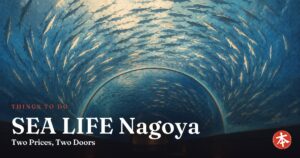
SEA LIFE Nagoya is a small aquarium next to the park — a themed indoor attraction rather than a major one. Visited on its own it is a modest afternoon at a modest price. Added to a ticket you were already buying, at JPY 800, it is something else: an hour of air conditioning and a change of pace inside a long day.
The case for taking it
A five-to-seven hour outdoor day with children has a natural slump in the middle. Having a small, indoor, sit-down-adjacent attraction available for a modest add-on is a genuinely useful piece of day planning, and that is a better reason to buy it than the aquarium itself.
The case against
If your day is already tight, adding another attraction to a schedule the listing says needs five to seven hours is how you end up rushing both. The add-on buys an option, not time. Take it if the day is long and the group is young; skip it if you are arriving after lunch.
See ticket options → Affiliate link — affiliate disclosure.
What is in the park
The listing gives the structure clearly, and the scale figures are worth having before you go.
Seven themed areas
Bricktopia, LEGO City, LEGO NINJAGO World, Pirate Shores, Miniland, Adventure and Knight’s Kingdom. NINJAGO characters appear on a dedicated stage, and there is a creative play area with puzzles, LEGO cars and a giant brick pool. The whole park is built from over 17 million pieces and 10,000 model sets.
MINILAND is the part adults remember
The listing describes 10 famous landmarks from Tokyo, Osaka, Kyoto and Nagoya, built from over 10 million bricks, with a photo spot that now covers both the Tokyo and Osaka areas. If you have spent a fortnight traveling between those cities, seeing them rebuilt at this scale lands differently than it would on arrival. Save it for later in the day rather than walking past it first.
The Big Shop and the LEGO Factory
The listing calls The Big Shop one of Asia’s largest LEGO stores and describes a LEGO Factory tour showing how the bricks are made. Both are inside the park, which means both are inside the day you have already paid for. The shop is also the classic end-of-day expense to budget for in advance rather than discover at the exit.
Check availability → Affiliate link — affiliate disclosure.
Where it sits among Japan’s theme parks
Japan has three theme park destinations that visitors weigh against each other, and they are not competing for the same day.
Nagoya is the practical advantage
Osaka and Tokyo parks come with crowds that reflect where they are. A park in Nagoya, on reclaimed land, is a different kind of day out simply because fewer people are routing their trip through it. That is worth something, particularly with small children.
Booking last minute is possible
The listing says same-day tickets are available with instant confirmation, entry is by mobile e-voucher with no printing, and the seller is an authorized reseller of LEGOLAND Japan tickets. So this is a workable spontaneous decision — but the five-to-seven hour suggestion means spontaneity costs you park time, not ticket availability.
When to skip it
If your group has no one under about twelve, or your Nagoya window is under half a day, skip it without hesitation. The park is well made and it is made for someone specific. Going as an adult on a tight schedule to see MINILAND is a lot of money and travel for one exhibit.
Deliberately not stated here
| What we are not saying | Why |
|---|---|
| Opening and closing hours | The field was blank on the listing, and theme park hours change constantly by season |
| The yen one-day price | Not verified from the operator. The US$ figure is the reseller listing’s price |
| What the VIP Experience costs | Not stated. It is the comparison that decides the tier, so read it on the booking page |
| Height or age restrictions on rides | Not stated on the listing. Theme park rides normally have them — check before traveling with small children |
| Closing days | Not stated. Seasonal parks close on weekdays in low season more often than visitors expect |
| What is inside SEA LIFE Nagoya | This listing only gives the add-on price. That aquarium has its own page |
LEGOLAND Japan tickets FAQ
How long do you need at LEGOLAND Japan?
Where is the park?
What is the difference between the standard ticket and the VIP Experience?
What is the SEA LIFE Nagoya add-on?
How many LEGO bricks is the park built from?
What are the seven themed areas?
Can I buy tickets on the day?
Is it worth it for adults without children?
Check LEGOLAND Japan tickets → Affiliate link — affiliate disclosure.
Bottom line (2026) — the listing suggests five to seven hours, and the park is out at Kinjofuto in the Nagoya port area, so this is a full day rather than a stop. There are two ticket tiers: a standard one-day pass, and a VIP Experience adding skip-the-line access, a guided tour, unlimited food and drinks, gifts and parking — a difference big enough to be worth pricing rather than defaulting past. SEA LIFE Nagoya can be added for JPY 800, which is useful mainly as a mid-day indoor break. Inside are 40+ attractions across seven themed areas, a park built from over 17 million bricks, a MINILAND of 10 Japanese landmarks in over 10 million bricks, and a LEGO Factory tour. No hours were shown.
Sources
Written on September 2, 2026 from the Klook listing for the LEGOLAND Japan ticket: the suggested duration of five to seven hours; the address at Kinjofuto in Nagoya; over 40 rides, shows and interactive activities; the seven themed areas named as Bricktopia, LEGO City, LEGO NINJAGO World, Pirate Shores, Miniland, Adventure and Knight’s Kingdom; the park built from over 17 million authentic LEGO pieces and 10,000 model sets; MINILAND covering 10 famous landmarks from Tokyo, Osaka, Kyoto and Nagoya made from over 10 million bricks, with a photo spot featuring the Tokyo and Osaka areas; The Big Shop described as one of Asia’s largest LEGO stores and the LEGO Factory tour showing how bricks are made; the creative play area with puzzles, LEGO cars and a giant brick pool; NINJAGO characters appearing on a special stage; the option to add SEA LIFE Nagoya for an additional JPY 800; the choice between a standard one-day pass and a VIP Experience with skip-the-line access, guided tour, unlimited food and drinks, exclusive gifts and VIP parking; the statement that the seller is an authorized reseller with mobile entry and same-day tickets on instant confirmation; and a 4.7/5 rating across 11,700 reviews with 500,000+ bookings. The opening hours field was empty, which is why no hours appear here. More on how we work: how we research.
Theme park hours, closing days, tier inclusions and add-on prices all change by season. This reflects what that source said on September 2, 2026, and the booking page carries the current terms for the date you are going.
in English
Every week we read the Japanese sources English-language media never touches — new openings, price changes, limited releases, rule changes, the seasonal things that come and go in three weeks — and send you a three-minute read of what actually matters. Hit reply with a question about your trip and a human answers.
Free. Unsubscribe anytime. We never share your address.