Every English guide covers this topic the same way: tattoos are associated with organized crime, baths refuse you, cover it with a sticker and hope. What almost none of them mention is that the Japanese government wrote to the industry about it — twice, in the same week — and said, in plain language, that refusing someone because of a tattoo alone is not appropriate.
That does not mean you can walk into any bath. The notices are guidance to associations, not a right you can assert at a counter, and individual facilities still say no. But knowing what they say changes how you approach the question, and it explains why the official suggestions and the sign on the door so often disagree.
What the government actually told the industry
On March 16, 2016, the Japan Tourism Agency sent a notice to four bodies: the Japan Hotel Association, the All Japan City Hotel Association, the Japan Ryokan Association and the Japan Spa Association. The operative sentence is unambiguous:
— Japan Tourism Agency notice to the accommodation and hot spring associations, March 16, 2016
Two days later, on March 18, 2016, the Ministry of Health, Labor and Welfare forwarded the same material to prefectures, ordinance-designated cities and Tokyo's special wards, asking them to make it known to bathing facilities in their areas — explicitly so that bathing is not refused for improper reasons. So this is not one agency's opinion; it went out through the health regulator as well.
Nine years on, and still worth quoting
These notices date from 2016, which is old enough that some readers will assume they have been superseded. They have not: the tourism agency's current visitor-facing guidance carries the same framing, and no later notice reversing them exists. What has changed in the intervening years is the volume of visitors, not the rule — the 2016 notice itself opens by citing the rise in annual foreign visitor numbers as the reason it was written.
Why the refusals existed in the first place
The government explains this itself rather than leaving it to be inferred. The tourism agency's current visitor guidance says that in Japan, tattoos have been associated with members of organized crime groups, and that baths turned tattooed guests away so as not to make other guests uneasy. That is the stated reason, in an official document, and it is worth understanding as history rather than as a judgment about you.
It also explains the shape of the problem. The rule was never about hygiene or about tattoos as such — it was about what a tattoo signaled to other bathers in a particular era. Which is precisely why the guidance is about managing the encounter rather than about the tattoo.
What the notices are, and what they are not
There is no law against it
This is the second thing the English coverage generally gets wrong, usually by implication rather than by statement. The regulations that govern public baths in Japan are hygiene regulations — water quality, facility management, disease prevention. They say nothing about tattoos.
Every refusal you encounter is therefore a house rule. That has two consequences worth internalizing. First, policies can and do differ completely between two baths in the same town, and both are acting entirely lawfully. Second, there is nobody to appeal to: no license condition is being breached, and no authority will intervene on your behalf.
The three approaches the government suggested
The notice did not stop at saying refusals were inappropriate. It set out example approaches for facilities, and these are worth knowing in detail because they are the vocabulary the industry has been given.
| Approach | What the document says |
|---|---|
| 1. Ask for a measure | Cover the tattoo with a sticker or similar so other bathers cannot see it; a hygienic bathing garment is also mentioned. Where the tattoo is small — the example given is palm-sized — and does not intimidate other bathers, no special measure need be requested. |
| 2. Adjust the timing | Encourage bathing at times when fewer families are bathing |
| 3. Offer a different bath | Where there are several baths, separate them; offer a reserved private bath; for accommodation, offer a room with its own bath |
What the guidance does not do
It sets out approaches; it does not rank them, and it does not say that a facility must offer any particular one. A property that reads the notice carefully and concludes that it will offer a private bath but keep its communal bath restricted has followed the guidance. That is why the workaround section further down matters more, practically, than the sentence everyone quotes.
The palm-sized line is the one to notice
Read that first row again. The official position is not "cover everything" — it is that a small tattoo needs no measure at all. The tourism agency's current visitor Q&A echoes it, describing case-by-case judgment and giving a single small design as an example of something that may not be a problem.
If your tattoo is genuinely small, that is the framing to have in mind when you ask. It is not a rule any facility has to follow — nothing here obliges anyone — but it means you are asking about something the agencies have already described as reasonable, rather than asking for an exception.
What facilities actually do
Here is where the guidance meets the door. These are policies published by the operators themselves, and they land in very different places.
| Facility | Published policy |
|---|---|
| A hot spring resort in Osaka Prefecture | Refuses bathers with tattoos including stickers and paint; anyone found with one will be asked to leave, with no refund |
| A hotel chain with hot spring baths | Refuses tattooed bathers, but provides a cover sticker of about 8 by 10 cm at some properties |
| A hot spring inn north of Osaka | Guests with tattoos cannot use the bath |
| A bathhouse in Osaka City | Refuses entry to the bath for guests with tattoos |
Chains are not consistent either
One detail in the table above is easy to skim past. The chain that provides a cover sticker does so at some properties — the wording is qualified on its own site. So even knowing that a brand has accommodated tattooed guests somewhere tells you nothing definitive about the branch you are booking. Check the specific property's page, not the brand's.
Strict policies are usually written down
A pattern worth using. In our research on hot spring accommodation in Osaka, only four of the properties checked stated a tattoo policy at all — and all four of those refused. The places with the hardest rules tend to publish them, because they need to.
The inverse does not follow. Silence is not permission; most properties simply do not address it, which is not stated officially rather than a yes. That is the gap you close by asking, and the reason a list of "tattoo-friendly onsen" compiled from silence is worthless.
The reliable answer is a private bath
The government named it as one of three approaches, and it is the one that works regardless of anyone's policy: book a bath nobody else is in.
| Option | What it means |
|---|---|
| Room with its own bath | A private bath attached to your room. The question does not arise at all |
| Reserved private bath | A bath booked for your exclusive use for a set period. Common at ryokan; often needs reserving on arrival |
| Separated baths | Where a property has several, it may direct you to one of them |
For a first hot spring trip where the tattoo question is a worry, this converts an uncertain conversation into a booking filter: search for the private bath, not for the policy. Our guide to staying in a ryokan covers how the reserved-bath system usually works, and hot spring towns within reach of Tokyo — Hakone, Kusatsu and Ginzan — all have properties built around them.
And timing, if the public bath is the point
The second official suggestion costs nothing to try: bathe when fewer families are there. In practice that means late evening or early morning rather than the hour after dinner. Where a property is willing to be flexible, this is often what the flexibility looks like — not a change of policy, but a quieter time of day.
How to ask, so that the answer is useful
A tattooed Japanese man going through how he actually finds baths he can use, including the search sites that list facilities by policy. In Japanese, but the method is the content — and it is markedly more practical than the usual advice, because it starts from the assumption that you will be asking rather than hoping.
The way the question is put changes the answer you get, because a blanket question invites a blanket no.
| Instead of | Ask |
|---|---|
| "Do you allow tattoos?" | "I have a tattoo of about X cm on my Y. May I use the large bath? If not, is a private bath available?" |
| Asking at check-in | Asking by email before booking, so the answer is in writing |
| Asking about the property | Asking about the specific bath you intend to use |
The second column matters because a property can hold both answers at once — no to the communal bath, yes to a private one — and a general question hides that. Mention size and placement, and say whether it can be covered. If the property publishes a policy, read it first.
Do not argue at the counter
If the answer is no, it is no. There is no rule being broken, no authority to escalate to, and the notices quoted in this guide are not a rulebook you can invoke. The staff member in front of you did not write the policy. Take the private bath if there is one, try a different facility if there is not, and treat it the way you would any other house rule you disagree with.
If you are traveling in typhoon or heavy-snow season, one more official system is worth knowing: Japan’s weather warnings decide when facilities close and when transport stops, and the categories mean specific things rather than general caution.
Is it changing?
Slowly, and unevenly. The tourism agency's current guidance notes that understanding of foreign visitors' tattoos is progressing, and that some ryokan now judge case by case or place no restriction at all. That is the government describing a direction of travel, in a page written for visitors rather than for the industry.
What this means for planning a trip
Three practical conclusions. Do not build an itinerary around a specific famous bath unless you have its answer in writing. Do build in a private bath at least once, because it removes the variable entirely and is a good experience on its own terms. And do not assume a chain is consistent — the sticker example above comes from a chain that provides them at some properties, which is not the same as all of them.
Tattoos and onsen FAQ
Can I go to an onsen with a tattoo in Japan?
Is there a law banning tattoos in onsen?
What did the Japanese government actually say?
Will a cover sticker be enough?
Does the size of the tattoo matter?
What if the public bath says no?
Are things getting easier for tattooed travelers?
How should I ask before I book?
Bottom line (2026) — No law bans tattooed bathers; every refusal is a house rule. In March 2016 the tourism agency told the hotel, ryokan and hot spring associations that refusing someone for a tattoo alone is not appropriate, and the health ministry passed the same message to prefectures — but these are advisory notices, not rights. The official suggestions are a cover sticker, a quieter time of day, or a private bath, and the guidance states that a palm-sized tattoo needs no measure at all. In practice facilities differ completely: one hands out 8 by 10 cm stickers, another counts a sticker as a tattoo and will remove you without a refund. The reliable answer is a room or reserved bath you have to yourself.
(For a chain with a written rule: our Dormy Inn guide explains that its baths admit tattoos only under cover stickers, two at most, with the three sticker sizes the FAQ prints.)
(A hotel that says it twice: our Shiroyama Hotel Kagoshima guide quotes an onsen page that refuses guests with tattoos in one line and tattoo-type designs in the next.)
(For a hotel chain with rooftop baths: our Candeo Hotels guide shows that tattoos are welcome in the SkySpa at Roppongi, Namba and Kyoto Karasuma Rokkaku, while Shimbashi and Fukuoka Tenjin ask you to cover them.)
(A spa that asks rather than bans: our Mandarin Oriental, Tokyo guide quotes the spa page, which advises guests to cover tattoos in the Heat & Water areas, where you bathe without clothing.)
(For a hotel pool with its own rule: our Cerulean Tower Tokyu Hotel guide notes that the pool, gym and sauna are free for guests 18 and over, but that guests with tattoos are not permitted in the pool area.)
Sources
The March 16, 2016 notice to the accommodation and hot spring associations, its statement that refusing bathing solely because of a tattoo is not appropriate, and the three example approaches including the palm-sized exception: the Japan Tourism Agency notice as published in full within the Ministry of Health, Labor and Welfare's circular of March 18, 2016, read directly from the ministry's PDF. The instruction to prefectures, ordinance-designated cities and special wards to prevent refusals for improper reasons: the same circular. The explanation of why refusals arose, the statement that responses differ greatly between properties, and the note that some ryokan now judge case by case or place no restriction: the tourism agency's current visitor Q&A on ryokan. The individual facility policies, including the refusal covering stickers and paint and the provision of a cover sticker: each operator's own website, read individually. All read on August 31, 2026. Policies are set by each facility and change without notice; confirm with the property before you book.
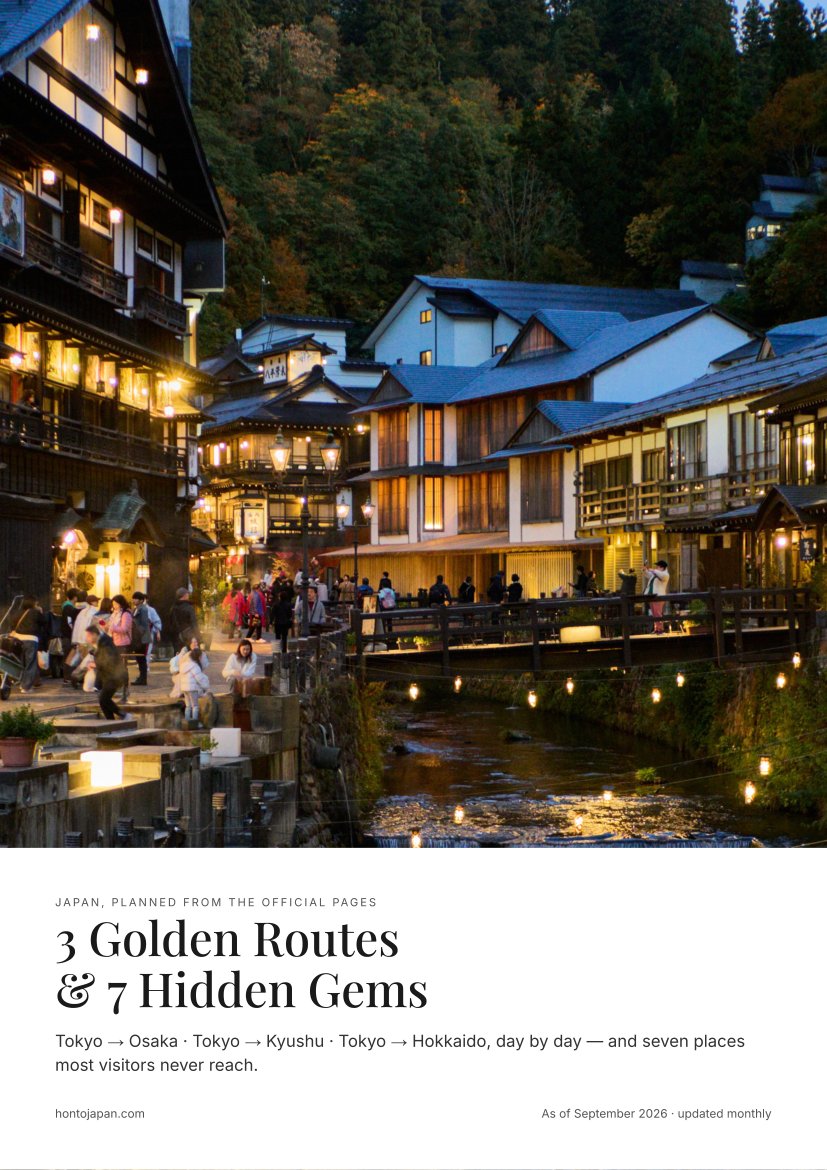
Tokyo to Osaka, Tokyo to Kyushu, Tokyo to Hokkaido — day by day — plus seven places most visitors never reach.
- 12 pages, 80 photographs, every stop linked to its guide
- Every price and opening hour read from the official page
- Re-issued monthly, so it does not go stale in your inbox
Free. One email a month, plus the rare change that matters. Unsubscribe with one click in any email. By subscribing you agree to our privacy policy.