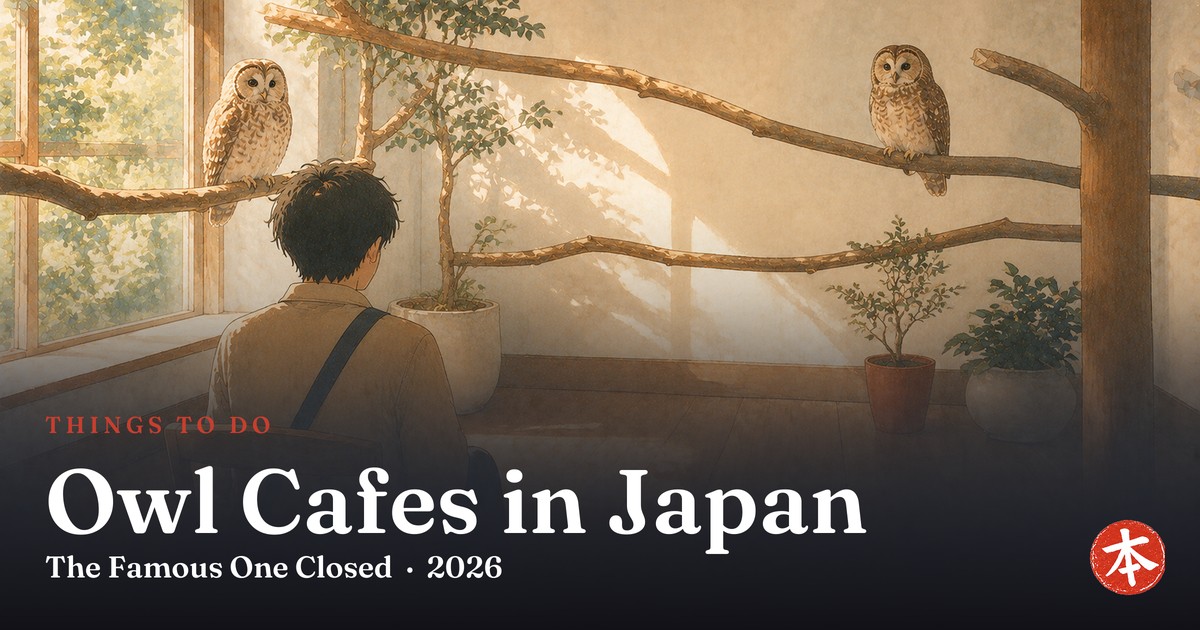
Search for owl cafes in Tokyo in English and one name dominates the results. It has branches in Akihabara, Harajuku and Asakusa, it has the best photographs, and it appears in guides published this year. It has not been trading for years. The operator's own site says the chain never reopened after the pandemic, that it gave up on reopening, and that the birds were moved to a care facility while the business turned to conservation work.
That is the state of English coverage of this subject. So this guide does three things: it lists what is actually open, it explains why entry runs from 800 to 3,800 yen for something that sounds identical, and it takes apart the CITES argument that gets used on both sides of the ethics debate and applies to almost none of these birds.
What is actually open in 2026
Eight minutes inside one of the larger owl cafes still operating in Tokyo. Japanese, but you are watching it to see the room: how the birds are tethered or not, how close visitors get, and how many birds are in one space. That is the thing to decide about before you book, and photographs on booking pages are chosen carefully.
There is no single national chain any more. What exists is a handful of independents plus one small group, and they differ more from each other than the category name suggests.
| Cafe | Where | Entry | Time | Booking |
|---|---|---|---|---|
| Owl Forest (Kamakura) | Kamakura | ¥800 adult / ¥500 child | Unlimited | 🚨 Walk-in only |
| Owl Forest (Kyoto) | Kyoto | ¥1,000 (age 5+) | Unlimited | Walk-in only |
| Owl Forest (Osaka) | Osaka | ¥1,000 / ¥800 child | Unlimited | Walk-in only |
| Owl Forest (Yufuin) | Oita | ¥900 / ¥600 child | Unlimited | Walk-in only |
| Torinoiru Cafe | Yanaka, Tokyo | ¥2,200 incl. drink | Free time* | Walk-in OK |
| OWL VILLAGE | Harajuku, Tokyo | ¥3,800 door / ¥2,500 prepaid | 60 min | Hybrid |
| Akiba Fukurou | Akihabara, Tokyo | Not published | Not stated | 🚨 Reservation only |
| Owl Family | Osaka / Hakata | ¥1,500 + tax | 60 min, hourly | Via third parties |
*Torinoiru switches to a one-hour limit only when busy. Note the tax line on Owl Family: it is one of the few venues quoting a price before tax, so the real figure is closer to 1,650 yen.
Why does the price vary by twelve times?
Because you are buying different things. 800 yen in Kamakura gets you unlimited time in a small provincial shop. 3,800 yen in Harajuku gets you a structured 60-minute session in central Tokyo with a keepsake included, and the same venue sells 5,000 and 10,000 yen courses with more attached. Neither is overpriced for what it is — but a guide that prints "around 2,000 yen" as the going rate is describing nothing.
Which one should a first-time visitor pick?
If you are in Tokyo and want certainty, book OWL VILLAGE online — paying in advance also cuts the price by 1,300 yen, which is the largest discount in this whole category. If you want a quieter room and do not mind planning, Akiba Fukurou is reservation-only by design, limiting numbers so the birds are not crowded. If you are traveling outside Tokyo anyway, Kamakura at 800 yen with no time limit is the best value in Japan for this.
The booking models are opposite, and getting it wrong wastes a morning
This is the single most practical thing to know, because the two dominant venues work in exactly contrary ways.
| Owl Forest chain | Akiba Fukurou | |
|---|---|---|
| Reservations | 🚨 None accepted at all — not by phone, not online | 🚨 Reservation only — no walk-ins |
| How you get in | Go to the shop and buy a ticket | Book ahead; same-day slots exist |
| Risk | Tickets can sell out | Turning up without one is wasted |
| Phone | Normal | Not answered — the shop keeps calls off the floor for the birds |
So the advice "book an owl cafe in advance" is impossible at four of the venues in the table above, and the advice "just turn up" will get you turned away at another. Check the individual shop, every time.
What about opening days?
Less regular than a cafe implies. Owl Family's Osaka flagship is closed Mondays, Wednesdays and Fridays — three days a week. One venue outside Tokyo opens weekends and holidays only, and another runs on a seasonal schedule announced by financial year, publishing a notice when the season ends. Torinoiru in Yanaka is the outlier: open every day of the year, 13:00 to 20:00.
The CITES argument does not apply to these birds
Every English discussion of owl cafes eventually reaches the endangered-species question, usually in one of two forms: the accusation that cafes trade protected birds without paperwork, or the defense that everything is fine because certificates exist. Both are aimed at a rule that does not cover the birds in these rooms.
Japan's domestic trade restrictions attach to species listed in CITES Appendix I. For owls, Appendix I contains three species worldwide — the forest owlet, the Norfolk Island boobook and the Madagascar red owl. None of them is a species kept in Japanese owl cafes.
Then is there no rule about the birds at all?
There are rules, they are just different ones. An owl cafe needs registration as a display business, must post its registration number, expiry and responsible manager where you can see them on the way in, and must meet welfare standards on enclosure size, temperature, lighting and rest. What it does not have is a closing time: the well-known 8 p.m. display rule is written for dogs and cats only, so owls have no statutory limit on how long the day runs.
Is there English support?
It varies more than you would expect for a category built on foreign visitors. OWL VILLAGE runs a full English booking flow, which is the main reason to use it if you want the trip locked in before you land. Owl Family has no English site at all — both its English paths return errors — and books through third-party platforms instead. Torinoiru Cafe has an English page that carries opening hours and nothing else: no prices, no rules, no age policy. Read the Japanese page with a translator and you will know substantially more than the English one tells you.
Bird flu: what actually changes, and why
Every winter the question comes up, and the usual English answer — that owl cafes close under poultry disease rules — is wrong about the mechanism.
| Assumption | What actually applies |
|---|---|
| Owl cafes fall under the poultry disease law | No. Owls are not poultry, so that Act does not cover them |
| Nothing applies, so nothing changes | No. Ministry guidance for birds kept at zoos and similar facilities applies |
| What the guidance says | At response level 2 or above: contact and feeding are halted, and free-flight display is suspended in principle |
In the 2025-26 season the highest level ran from late October to the end of April. As of this writing the country is back at the baseline level. The practical consequence for a winter visit: the shop may well be open while the touching and the feeding option are suspended — which is most of what people come for. If you are visiting between November and April, ask before you pay.
Is the feeding option worth adding?
It is small money and it is time-boxed. OWL VILLAGE sells feeding at 500 yen per tray at four fixed times in the day rather than on demand. Torinoiru charges 500 yen for large owls and 300 for small and medium birds. Being fixed-time matters: turn up at the wrong hour and the option is not available, whatever the website implies.
Rules inside the room, and the age limits that contradict each other
There is no national rulebook for visitor behavior, so each shop writes its own. The consistent ones are worth knowing before you go in.
| Rule | Detail |
|---|---|
| No flash | Near-universal. One venue states plainly that flash risks blinding the birds |
| Where you may touch | Head and back only at most shops. Not the wings, stomach or legs |
| Contact windows | OWL VILLAGE: contact only for a 35-minute window inside the 60-minute slot; the rest is the birds' break |
| Hygiene | Hand sanitising on entry, hand washing before you leave; some shops also disinfect shoe soles |
| Perfume | Some venues ask you not to wear strong fragrance |
| Wild birds | At least one shop asks visitors who have handled wild birds that day not to come in |
Can I bring a small child?
How long do the birds actually work?
One operator publishes its shift system, which is unusual enough to be worth quoting: birds work one to three hours a day, with roughly 25 to 30 birds per shop and only four or five on the floor in any given hour. That is the operator's own account rather than an inspected figure, and no law requires it — remember that owls have no statutory display-hour limit, so any rotation you see is the shop's own policy. Which is exactly why the shops that publish one are worth preferring.
For a first-hand visit, Andy Roams’ Unique Harajuku Experiences – The Village Owl Cafe describes how the hour alternates between time with the owls and cake and a drink while they rest, and notes the day he went was sold out.
How does the hourly changeover work?
At Owl Family the session is a full changeover on the hour — everyone enters at the top of the hour and the room resets. That has a practical consequence: arriving at twenty past means waiting for the next hour, not joining late. OWL VILLAGE works similarly on a 60-minute cycle and asks visitors to start packing up at the 55-minute mark. The unlimited-time shops in Kamakura, Kyoto, Osaka and Yufuin have no changeover at all, which is a genuinely different experience for the money.
Places English guides still recommend that are gone
An out-of-date article costs you an afternoon here, because several of the most-photographed venues have closed quietly.
| Venue | Status |
|---|---|
| Owl no Mori (all branches) | 🚨 Gone. Operator states it did not reopen after the pandemic, moved the birds to a care facility and turned to conservation. Peak: six locations |
| Torinoiru Cafe Asakusa | 🚨 Delisted with no closure notice. Its URL still returns a page, but silently serves the Sendagi branch's content |
| Owl Family Osaka Tenmangu | Closed February 2018 — yet its full price table is still live on the operator's site |
| OWL VILLAGE Kichijoji | Pages are password-protected and absent from navigation, but the FAQ still describes it. Not stated officially as closed |
| "Owl Forest Harajuku / Akihabara" | 🚨 Never existed. The trademark holder lists only Kamakura, Kyoto, Osaka and Yufuin. The Harajuku property is a shiba dog cafe |
The Asakusa case is the one to watch for: the page loads, so a link checker sees nothing wrong, and only reading the content reveals it is describing a different branch entirely.
Are there owl cafes outside Tokyo?
Most of them, in fact. Only two of the venues in this guide are in Tokyo. The rest are in Kamakura, Kyoto, Osaka, Hakata and Yufuin, and the cheapest and most relaxed of them — unlimited time, 800 to 1,000 yen — are all outside the capital. If your itinerary already includes Kamakura as a day trip or Kyoto for a few nights, that is the better place to do this, not Harajuku.
Before you book: a short checklist
Three questions answer almost everything, and all three are on the shop's own page rather than in any guide.
| Ask | Why it matters |
|---|---|
| Reservation or walk-in? | The two big names are opposite. Getting it wrong means a wasted trip either way |
| Time limit or unlimited? | 800 yen unlimited and 3,800 yen for 60 minutes are different products |
| Is contact currently suspended? | Between November and April, bird flu guidance can halt touching and feeding while the shop stays open |
And when you arrive, glance at the sign by the door for the registration number and the responsible manager's name — it is a legal requirement, and the fastest way to tell a properly licensed venue from one that is not. For the wider category, our animal cafe guide covers what the law does and does not require, our cat cafe guide covers the gentler version of the same idea, and our themed cafes guide puts it in context. Geographically these cluster in the districts covered by our Akihabara map and Harajuku guide.
Owl cafe FAQ
Is Owl no Mori still open?
How much does an owl cafe cost in Japan?
Do I need a reservation for an owl cafe?
Are owl cafes legal in Japan?
Do owl cafes need CITES permits for their birds?
Can I touch or hold the owls?
Do owl cafes close during bird flu outbreaks?
Are owl cafes suitable for young children?
Bottom line (2026) — The chain English guides recommend most, Owl no Mori, no longer trades; its birds were moved to a care facility. What is open runs from ¥800 in Kamakura with unlimited time to ¥3,800 in Harajuku for 60 minutes, and paying online in advance there saves ¥1,300. Booking models are opposite: the Owl Forest chain takes no reservations at all, while Akiba Fukurou is reservation-only. The CITES argument does not apply — only three owl species worldwide are on Appendix I and none is kept in these cafes. Between November and April, bird flu guidance can suspend touching and feeding while the shop stays open.
Sources
Prices, opening hours, closing days, booking policy, age limits, contact windows and photography rules: each cafe's own Japanese website, read individually. The closure of the former chain, the delisted Asakusa branch and the 2018 Osaka closure: the operators' own notices. The species listed in CITES Appendix I and the domestic trade controls that follow from it: the Act on Conservation of Endangered Species and the Ministry of the Environment. Registration, signage and welfare standards for display businesses: the Act on Welfare and Management of Animals and its ordinances. Bird flu response levels and the halting of contact and feeding: the Ministry's guidance for birds kept at zoos and similar facilities. All read on August 31, 2026 — shops change hours and policies without notice, so confirm before you travel.
Tokyo to Osaka, Tokyo to Kyushu, Tokyo to Hokkaido — day by day — plus seven places most visitors never reach.
- 12 pages, 80 photographs, every stop linked to its guide
- Every price and opening hour read from the official page
- Re-issued monthly, so it does not go stale in your inbox
Free. One email a month, plus the rare change that matters. Unsubscribe with one click in any email. By subscribing you agree to our privacy policy.