Nikko confuses first-timers because it's three destinations wearing one name: the gilded World Heritage shrines near the stations, the volcanic lake country of Okunikko above 48 hairpin bends, and the Kinugawa onsen gorge on its own rail spur. Sorting them is the whole game — and 2026 added urgency: the NIKKO PASS jumped to ¥8,000, the Akechidaira Ropeway is closed until September 2027, the lake cruise raised its fares in April, and the city officially warns that autumn traffic turns a 45-minute bus ride into four-plus hours.
Nikko's three areas at a glance
| Area | What's there | From Tobu-Nikko Stn (official bus) |
|---|---|---|
| Central Nikko | Toshogu (¥1,600) · Rinnoji (¥400–900) · Futarasan · Shinkyo Bridge | 6 min to Nishisando-iriguchi · loop bus ¥220–350 |
| Okunikko | Irohazaka hairpins · Lake Chuzenji & cruise (¥2,000–2,200) · Kegon Falls elevator (¥600) · Senjogahara · Yumoto Onsen | 45 min / ¥1,250 to Chuzenji · ~1h17 / ¥1,950 to Yumoto |
| Kinugawa-Kawaji | Riverside onsen hotels · theme parks | Train via Shimo-Imaichi · ¥330 from Tobu-Nikko |
| 🚨 Akechidaira Ropeway closed (Jan 15, 2026 → reopening planned Sep 2027) · 🚨 Autumn: Irohazaka can take 4+ hours (official warning) | ||
The whole vertical circuit — shrines, hairpins, lake — in one well-paced day:
Getting there and the pass decision
Which pass fits which trip?
From Asakusa, Tobu's limited expresses make Tobu-Nikko in about 1 hour 50 minutes direct — the flagship SPACIA X lists roughly ¥3,340 all-in for a standard seat (¥1,400 fare + ¥1,940 express, seasonal variation applies, with a premium tier and an ¥18,000 two-room Cockpit Suite for the committed) — while local trains take an hour longer for about half the money, per the official tourism site. The pass math got steeper in the new era: the NIKKO PASS ALL AREA is now ¥8,000 for four days — far above the sub-¥5,000 numbers fossilized in old blogs — but it swallows the expensive part of Nikko whole: every Tobu bus including the ¥1,950 Yumoto run, the local trains, and the Chuzenji cruise. Day-trippers doing only the shrines want the ¥3,000 WORLD HERITAGE AREA pass (2 days, Asakusa round trip included). Both exclude limited-express charges — budget those separately.
Central Nikko: the World Heritage hour-by-hour
What do the shrines actually cost and when do they open?
The bus stop that matters is Nishisando-iriguchi — officially six minutes from Tobu-Nikko Station — putting you below the cedar avenue to the whole trio. Toshogu, Ieyasu's baroque mausoleum, runs ¥1,600 (younger students ¥550; +¥800 for the treasure-museum set; ¥500 audio guide), open 9:00–17:00 April–October and to 16:00 in winter, last entry 30 minutes prior. Rinnoji prices its halls separately — Sanbutsudo ¥400, the Taiyuin mausoleum ¥550, or ¥900 combined — and opens from 8:00, an hour before Toshogu, which is the crowd-beating move; note the old all-shrines combo ticket is officially discontinued. Futarasan Shrine anchors the mountain-worship side: its sacred peak Mt. Nantai opens to climbers April 25 – November 11 at ¥1,000, cash only. The World Heritage loop bus stitches it together at ¥350 a ride (¥220 to Shinkyo Bridge).
Okunikko: above the hairpins
What changed up the mountain in 2026?
Two things, one sad, one expensive. The Akechidaira Ropeway — whose deck frames Kegon Falls and Lake Chuzenji in one view — closed January 15, 2026 for renewal, reopening planned September 2027, per the operator's official notice; reroute those old itineraries. And the Lake Chuzenji cruise revised fares on April 17, 2026: the hop-on circuit now runs ¥2,000 regular / ¥2,200 busy-season for the 55-minute loop (through November 30). Unchanged and reliable: the Kegon Falls elevator (¥600 round trip, 8:00–17:00 in the long season) down to the basin-level deck, the boardwalks of Senjogahara, and the road's end at Yumoto Onsen (¥1,950 by bus from the station — the single fare that argues hardest for the ALL AREA pass). All of it hangs off one bus spine, so the official times — 45 minutes to Chuzenji, about 1h17 to Yumoto — are your planning skeleton.
The autumn warning, and where to sleep
The city's official English guidance says it plainly: in foliage season (mid-October to mid-November) the Irohazaka hairpins congest so severely that Nikko Station to Lake Chuzenji can take over four hours instead of 45 minutes — and it officially recommends overnighting with slack in the plan. The overnight logic doubles as the area's best trick anyway: sleep at Chuzenji or Yumoto to own the lake at dawn, or ride the ¥330 connection to Kinugawa Onsen for the big riverside baths. Nikko slots into the same escape-from-Tokyo canon as our Nara, Kusatsu and Atami guides — it's the one where altitude, not distance, does the transporting.
(For a rail pass that actually reaches this side of Kanto, our Tokyo Wide Pass guide covers the three-day window, the shinkansen legs it covers, and the Tobu transfer at Utsunomiya.)
(For a hotel by the Shinkyo Bridge: our Nikko Kanaya Hotel guide notes that from Tobu-Nikko or JR Nikko Station a Tobu bus to the Shinkyo stop takes about 5 minutes, and the hotel is about 3 minutes on foot from there, up a steep slope.)
FAQ
How is Nikko laid out?
How do I get to Nikko from Tokyo?
Is the NIKKO PASS worth it — and did it really get more expensive?
How much is Toshogu Shrine?
What’s the deal with the Akechidaira Ropeway?
How do I see Kegon Falls?
Is the Lake Chuzenji cruise worth it?
How bad is the autumn traffic, really?
What else is in the shrine district besides Toshogu?
Nikko or Kinugawa — where should I sleep?
Bottom line (2026) — Nikko is three destinations under one name — the World Heritage shrines, the highland lake country, and Kinugawa’s onsen gorge — linked by a single bus spine with fares of ¥1,250/¥1,700/¥1,950 and a loop bus at ¥220/¥350. The NIKKO PASS now costs ¥8,000, and Nikko City warns that foliage-season traffic to the highlands can stretch from 45 minutes to 4+ hours — plan to overnight.
Sources
Area structure and the traffic warning (45 minutes to 4+ hours, overnight recommendation): Nikko City's official English tourism site. Bus times and fares (6/45/77-minute spine, ¥1,250/¥1,700/¥1,950 fares, loop-bus ¥220/¥350): Tobu Bus's official April 2026 timetable and area fare pages. Access times and the local-train-half-price note: Tobu Railway's and the city's official access pages. SPACIA X fares (from the official chart image; seasonal): Tobu's official SPACIA X boarding page. NIKKO PASS ALL AREA (¥8,000/4 days, inclusions) and WORLD HERITAGE AREA (¥3,000/2 days): Tobu's official English pass pages, raw-verified. Toshogu hours and fees: the shrine's official (Japanese) pages. Rinnoji fees and the discontinued combo ticket, and Futarasan's Nantai climbing season and fee: their official pages. Kegon elevator hours and fares: its official site. Chuzenji cruise fares and the April 17, 2026 revision: the cruise operator's official fare page. The Akechidaira Ropeway closure and September 2027 reopening plan: Nikko Kotsu's official notice. All read on August 12, 2026. The embedded video is by its creator.
Some links on this page may be affiliate links, which means we may earn a commission if you book or buy through them — at no extra cost to you. See our affiliate disclosure.
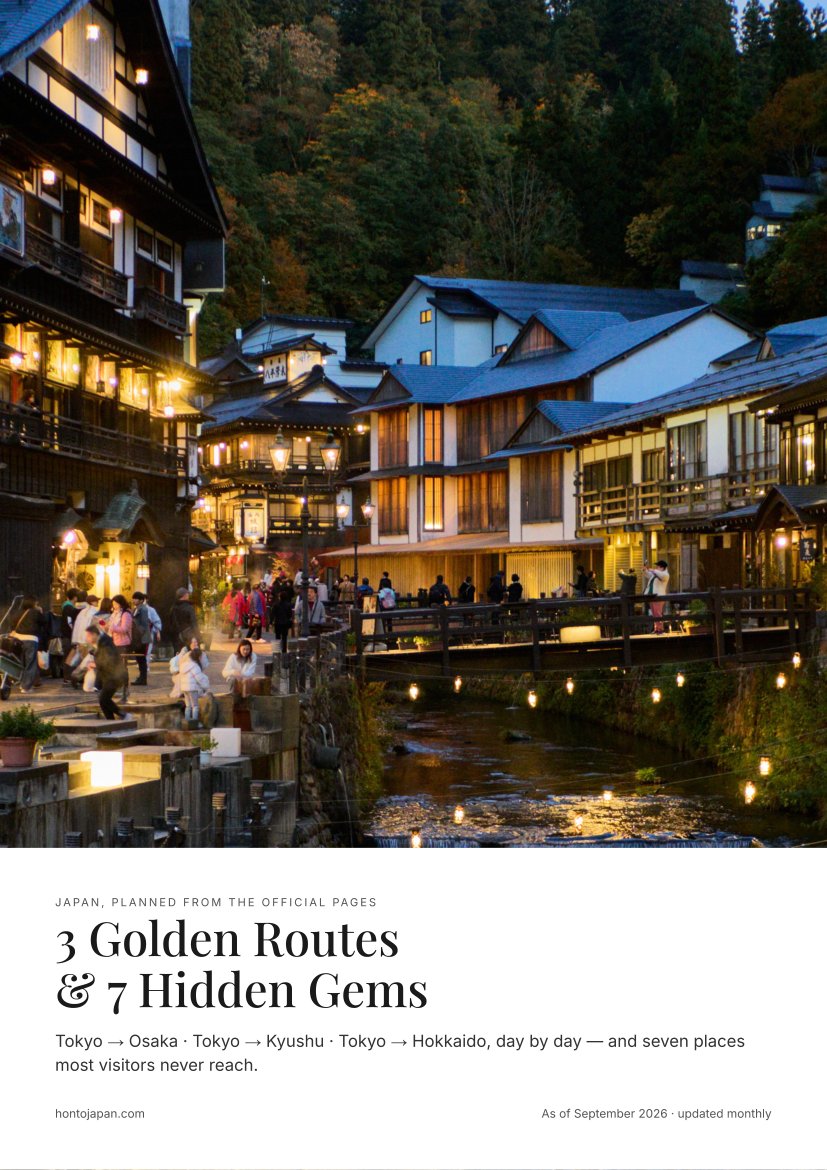
Tokyo to Osaka, Tokyo to Kyushu, Tokyo to Hokkaido — day by day — plus seven places most visitors never reach.
- 12 pages, 80 photographs, every stop linked to its guide
- Every price and opening hour read from the official page
- Re-issued monthly, so it does not go stale in your inbox
Free. One email a month, plus the rare change that matters. Unsubscribe with one click in any email. By subscribing you agree to our privacy policy.