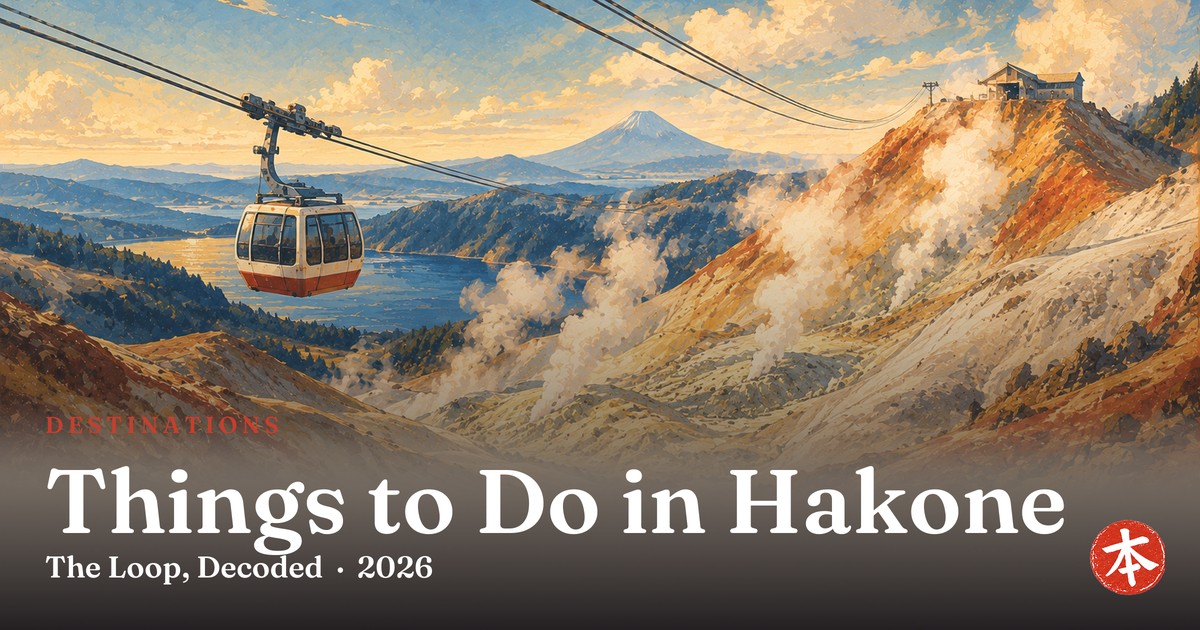
Hakone is the easiest real mountain day trip from Tokyo: about 80 minutes on the Romancecar, then a loop you ride rather than walk — a switchback mountain train, a cable car, a ropeway over a steaming volcanic valley, a boat across a caldera lake, and a bus home, all on one pass.
What the English-language guides leave out is the part that changes how you plan the day. Owakudani — the volcanic valley everyone photographs — is a designated warning zone. The road in is closed outside a fixed window, volcanic gas is being emitted, the prefecture explicitly asks people with respiratory or heart conditions not to come, and the famous walking trail is reservation-only, helmet-required, and explicitly Japanese-language only. None of that means don't go. It means go informed.
Hakone at a glance
| Getting there | Romancecar, Shinjuku → Hakone-Yumoto, approx. 80 minutes. Reservations open 10:00 JST one month ahead |
|---|---|
| The loop | Mountain train → cable car → ropeway → boat → bus. A full day without rushing |
| Freepass, 2 days | ¥7,100 from Shinjuku · ¥6,000 from Odawara (child ¥1,600 / ¥1,500) |
| 🚨 Not in the pass | The Romancecar surcharge (¥1,200 each way) and the Izuhakone bus |
| 🚨 Owakudani | Designated warning zone. Road open 9:00–17:00 only · volcanic gas being emitted |
| Owakudani trail | Reservation-only, helmets, ¥800 cashless, 30 people per session — and Japanese-language only |
| Open-Air Museum | ¥2,000 door / ¥1,800 online · 9:00–17:00, year round |
| Day-use onsen | From ¥1,700 weekdays · one major facility lifted tattoo restrictions in April 2025 |
🚨 Owakudani: what the prefecture actually says
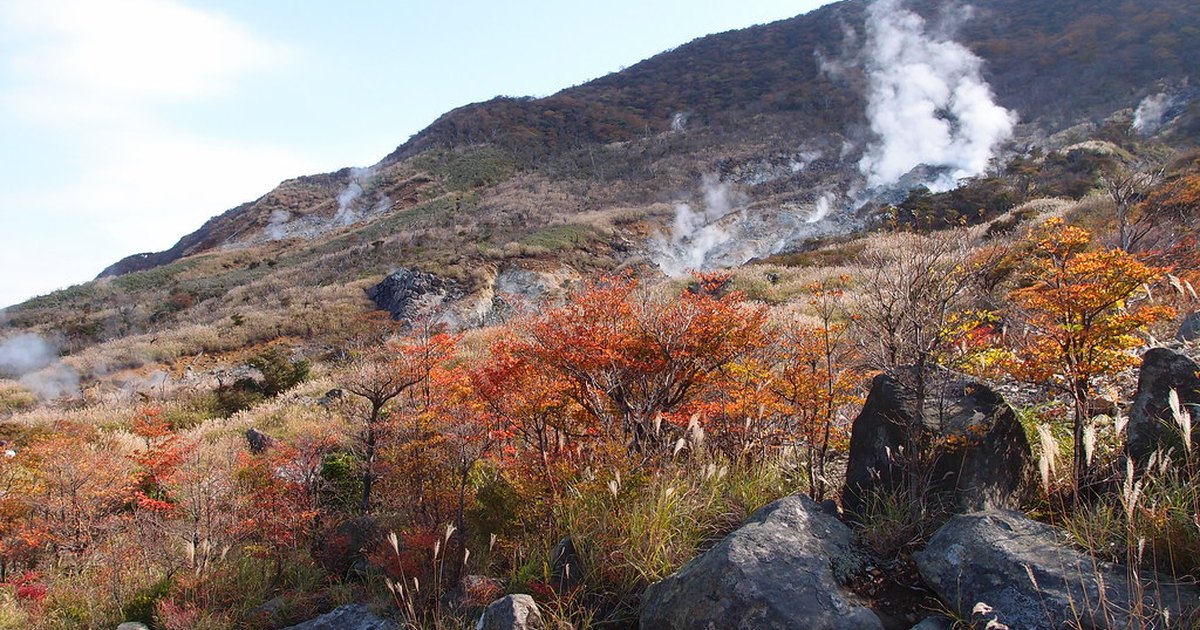
Hakone’s official tourism channel spends seven minutes inside Owakudani itself — the sulfur-stained hillside, steam venting straight out of the ground, and the black eggs boiled in it. Worth watching before you decide how long you want to stand there.
"The area around Owakudani is designated a warning zone."
"Volcanic gas is being emitted at Owakudani."
The prefectural road from the Owakudani junction to the Owakudani park parking area is closed — open only between 9:00 and 17:00.
And the part that belongs in every English guide and appears in none: "Those who are susceptible to volcanic gas — people with asthma, bronchial disease, respiratory disease, heart disease, or fitted with a cardiac pacemaker — should refrain from visiting the Owakudani park area, as it may be life-threatening."
That is not a liability disclaimer buried in small print. It is the prefecture telling a specific group of people not to come.
Two things are true at the same time, and it's worth holding both. The transport was operating normally when we checked — the official status board read "Normal operation" at 09:27 on August 5, 2026, with no waiting time reported — and the shops at Owakudani were posting live conditions. You can go. But the ropeway's own operator states it measures volcanic gas concentration in real time and suspends service when readings rise, alongside suspensions for winds of 30 m/s or more, extreme weather and mechanical trouble. Check the status board on the morning you travel, not the week before.
The walking trail: reservation-only, and Japanese-only
The Owakudani nature trail — closed after the 2015 volcanic activity — reopened as a guided walk you must book in advance. The official conditions:
- About 700m, roughly 40 minutes, on a loop.
- Four sessions a day: 10:00, 11:30, 13:00 and 14:30, 30 people each.
- ¥800 per person, cashless only — cards and transport IC, no cash.
- You wear a helmet, issued before entry.
- Canceled outright depending on weather and volcanic conditions.
- Elementary school age and older, and — quoting the official conditions — participants must be capable of running to safety.
That is the operator asking non-Japanese speakers not to book. If you don't read Japanese, plan Owakudani as a ropeway stop with a view, the shops and the black eggs — not as a walk. The rest of Hakone is fully accessible in English.
The eggs, since you'll want them: boiled in the sulfur springs, shells turned black, ¥500 for four including tax, sold 9:00 to 16:20 and they do sell out. One honest note on eating up there — the official site states the kitchen and café are currently fast food only, with no lunch buffet. Don't plan a meal around it.
The loop, leg by leg
- Hakone-Yumoto → Gora, mountain train. The climb is steep enough that the train reverses direction at three switchbacks, and at each one the driver and conductor physically swap ends of the train. It's a genuinely charming piece of engineering theater.
- Gora → Sounzan, cable car. About ten minutes up the slope.
- Sounzan → Togendai, ropeway, over Owakudani. Your ropeway ticket allows stopovers — but it is valid only on the day of purchase.
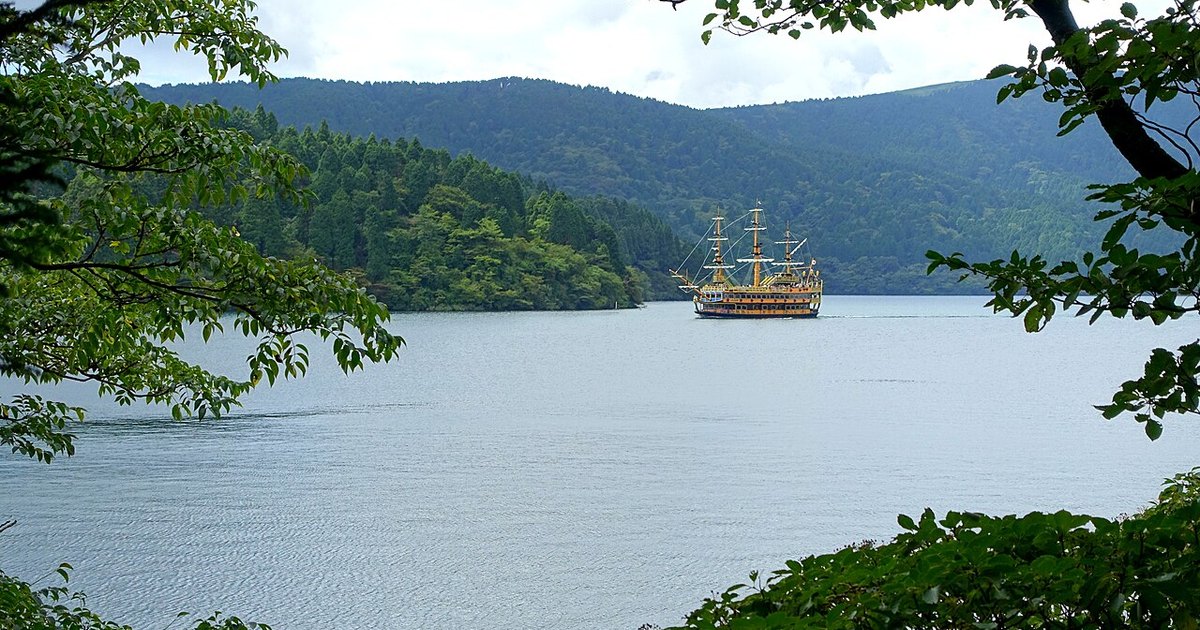
- Togendai → Hakonemachi or Motohakone, boat across Lake Ashi, roughly 25–40 minutes. 🚨 A one-way boat ticket does not allow you to get off partway — the operator states this explicitly, and it catches people who assumed they could hop off at the middle port.
- Motohakone → Hakone-Yumoto, bus, officially about 40 minutes.
Direction matters less than most guides suggest, but starting early does: the ropeway and boat are the bottlenecks, and the last departures are much earlier than you expect in a country where trains run late. Build the day around being through the ropeway by mid-afternoon.
The Freepass, and the two things it doesn't cover
The Hakone Freepass covers unlimited rides on eight modes of transport — the mountain train, mountain bus on designated routes, cable car, ropeway, the boat, the Odakyu highway bus on designated routes, Tokai bus on designated routes and the sightseeing-facility loop bus — plus discounts at around 70 attractions.
| From Shinjuku | 2 days ¥7,100 adult / ¥1,600 child · 3 days ¥7,500 / ¥1,850 |
|---|---|
| From Odawara | 2 days ¥6,000 adult / ¥1,500 child · 3 days ¥6,400 / ¥1,750 |
| 🚨 Romancecar | Not included. Surcharge ¥1,200 each way, Shinjuku–Hakone-Yumoto |
| 🚨 Also not included | The Izuhakone bus · the Odawara version excludes the Odakyu line ride itself |
| 🚨 Validity | The day you buy it counts as day one |
| Child age | 6–11 |
| Where to buy | App, Odakyu stations, 7-Eleven, Odakyu Travel, mountain railway machines, bus offices, major agencies · from one month ahead |
The Romancecar exclusion is the one that produces genuine trouble. It is a limited express with assigned seats, and the pass covers the ride but not the express surcharge — so you need a separate seat reservation, which opens at 10:00 Japan time exactly one month before travel and does sell out on autumn weekends. The validity rule is the other one: buy the pass on the morning you travel, not the night before, or you have thrown away a day.
What to actually stop for
- Hakone Open-Air Museum — sculpture across a hillside, which is a much better idea than it sounds in a valley this green. ¥2,000 at the door, ¥1,800 online; students ¥1,600/¥1,400, elementary and junior high ¥800/¥600, preschoolers free, and ¥1,000 for a disability pass holder plus one companion. 9:00–17:00, open year round, last admission 30 minutes before close.
- Pola Museum of Art — a serious collection in a building sunk into the forest. ¥2,200 adult, ¥1,700 students, junior high and younger free, ¥1,100 for disabled visitors, parking ¥700. Daily 9:00–17:00, last admission 16:30. 🚨 It closes entirely for two periods in 2026 — check before you build a day around it.
- Hakone Shrine, on the lake. The treasure hall is ¥500 for junior high and above, ¥300 for elementary, open 9:00–16:00 year round; the amulet office runs 8:15–17:00.
- A day-use onsen at Hakone-Yumoto — see below. This is the correct last stop before the train home.
For a slower two-day version, Kathryn Frazer’s 2 days in Hakone itinerary on Adventures of A+K starts at Hakone Shrine first thing in the morning, because the line for a photo under the Heiwa-no-Torii can run over an hour, then walks about 40 minutes along the Old Tokaido to the Amasake Chaya tea house.
The onsen, and the tattoo question
Hakone is an onsen town first and a sightseeing loop second, and you do not need to stay overnight to use one. One of the major day-use facilities is a free three-minute shuttle from Hakone-Yumoto station: the large baths run ¥1,700–1,800 on weekdays and ¥2,000–2,200 on weekends and holidays, with elementary schoolers at ¥1,000. Opening hours are 10:00–20:00 on weekdays and to 21:00 on weekends and holidays. 🚨 Children below elementary school age are not admitted — a real problem for families that book on the assumption everyone can come.
The universal fallback anywhere in Japan is a private bath. The same place rents 19 outdoor baths at ¥10,400–14,400 on weekdays for 120 minutes (¥11,400–15,400 weekends). Expensive for two people, and it removes the question entirely.
Doing it in a day, or doing it properly
One day works if you leave Shinjuku by about 8am, do the loop in one direction with two stops, and accept that you are moving. Two days is the version people come back raving about: the loop on day one, a night in a ryokan with dinner and a bath, and the museums at an unhurried pace on day two — which is also exactly what the two-day pass is priced for.
For the pass mechanics in detail — what it covers, how the Romancecar surcharge works and whether it beats point-to-point tickets for your route — see our dedicated guide to the Hakone Freepass. For where Hakone fits in a wider trip, see the 7-day itinerary, and the seasonal guide — autumn foliage here is genuinely worth planning around, and genuinely crowded. If you're basing yourself in the city, where to stay in Tokyo covers the districts with the easiest Odakyu access.
(Working out the order to do it in? Our Hakone map lays out every leg with its fare and last departure — including the 17:55 cable car that quietly ends your day.)
(Hakone is one of ten — our day-trips-from-Tokyo hub ranks the escapes so you can pick the right one for your window.)
(Getting there in style: the Romancecar guide covers the free panorama seats and the one-month booking rule.)
(For a ryokan night in Gora: our Gora Kadan guide notes that check-in is from 3 pm, dinner starts no later than 7 pm, and diet requests close at 6 pm the day before.)
FAQ
What is the Hakone loop and how long does it take?
Is Owakudani open?
Can foreign visitors walk the Owakudani trail?
Is the Hakone Freepass worth it?
What should I do in Hakone besides the loop?
Can you visit Hakone with tattoos?
Sources
Checked August 5, 2026: Kanagawa Prefecture's Owakudani page (updated May 27, 2026) for the warning-zone designation, the 9:00–17:00 road restriction, the statement that volcanic gas is being emitted and the health advisory quoted above; the Hakone tourism association's official booking system for the nature trail's length, duration, session times, capacity, ¥800 cashless-only fee, helmet requirement, weather cancellation, the elementary-school-age and able-to-run conditions and the Japanese-language-only statement; Odakyu Hakone's official transport status board (showing normal operation and no waiting time at 09:27 on August 5, 2026) and its ropeway pages for the suspension criteria and the real-time volcanic gas monitoring; the official route pages for the loop legs, the three switchbacks, the boat's 25–40 minute crossing and no-stopover rule on one-way tickets, the ropeway ticket's stopover and same-day validity, and the roughly 40-minute bus leg; the Romancecar page for the approximately 80-minute journey, the ¥1,200 surcharge and the 10:00-one-month-ahead reservation opening; the Hakone Freepass pages for the eight covered modes, the roughly 70 discounts, the exclusions, the purchase-date-counts-as-day-one rule, the 6–11 child ages, the sales channels and the prices quoted; and the individual sites of the Open-Air Museum, the Pola Museum, Hakone Shrine, the Owakudani shops and the Hakone-Yumoto day-use onsen for their prices, hours, closures, the black egg pricing and sales cutoff, the fast-food-only note, the under-six admission rule and the April 1, 2025 lifting of tattoo restrictions. Ropeway and boat fares were revised on October 1, 2025; the post-revision figures are used. Deliberately not stated: the ropeway's current operating hours (the operator announced a change effective April 1, 2026 and we could not read the document giving the new times), per-section ropeway journey times (three different official figures exist), which port pair each one-way boat fare belongs to (official pages disagree), the current volcanic alert level (the page we reached carries a 2019 date), Freepass prices from stations the operator declines to publish, the trail's specific operating dates this month, and the access status of the lakeside torii. Conditions here change with the volcano — check the operator's status board on the day.
Some links on this page may be affiliate links, which means we may earn a commission if you book or buy through them — at no extra cost to you. See our affiliate disclosure.
Tokyo to Osaka, Tokyo to Kyushu, Tokyo to Hokkaido — day by day — plus seven places most visitors never reach.
- 12 pages, 80 photographs, every stop linked to its guide
- Every price and opening hour read from the official page
- Re-issued monthly, so it does not go stale in your inbox
Free. One email a month, plus the rare change that matters. Unsubscribe with one click in any email. By subscribing you agree to our privacy policy.