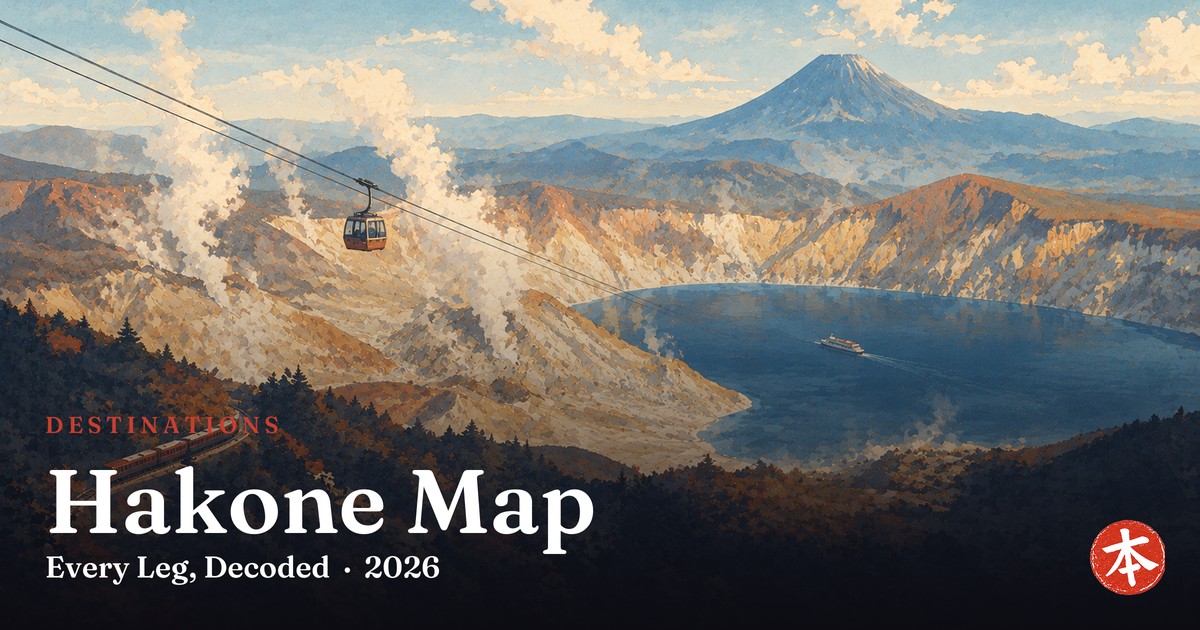
Hakone confuses people because it looks like a place and behaves like a circuit. There is no single town center to walk around. What there is instead is one continuous numbered chain of stations running from Odawara up over a volcano and down to a caldera lake — and you ride it with five different vehicles operated as one system.
Once you see the chain, the map stops being confusing. The operator numbers every stop in a single sequence: Odawara is OH47, Hakone-Yumoto OH51, Gora OH57, Sounzan OH62, Owakudani OH63, Togendai OH65, and the two lake ports are OH66 and OH67. Everything is in that order. There are no branches to get wrong.
Below is where each area sits, what each leg costs and how long it takes, the two clock times that silently decide your day — and two long closures coming in December 2026 and early 2027 that will change the loop for anyone traveling in that window.
Hakone at a glance
| The shape | One chain, OH47 → OH67. Odawara → Hakone-Yumoto → Gora → Sounzan → Owakudani → Togendai → the lake ports |
|---|---|
| Full circuit | About 10 hours by the operator's own model course |
| 🚨 Direction | The operator recommends counter-clockwise — bus to the lake first. The usual English advice is the congested way |
| 🚨 The 17:55 rule | The cable car's last departure is 17:55, both directions, every day. It is the only Gora–ropeway link |
| Ropeway fare | Flat ¥2,000 one way however far you ride · ¥3,000 round trip, valid 2 days |
| Freepass, 2 days | ¥7,100 from Shinjuku · ¥6,000 bought at Odawara |
| 🚨 Suica | Works on the train and buses. Does not work on the cable car — but a tapped credit card does |
| 🚨 Closures | Ropeway sections shut Dec 7–24, 2026 and Jan 12 – Feb 26, 2027 |
The map, in the order you will actually meet it
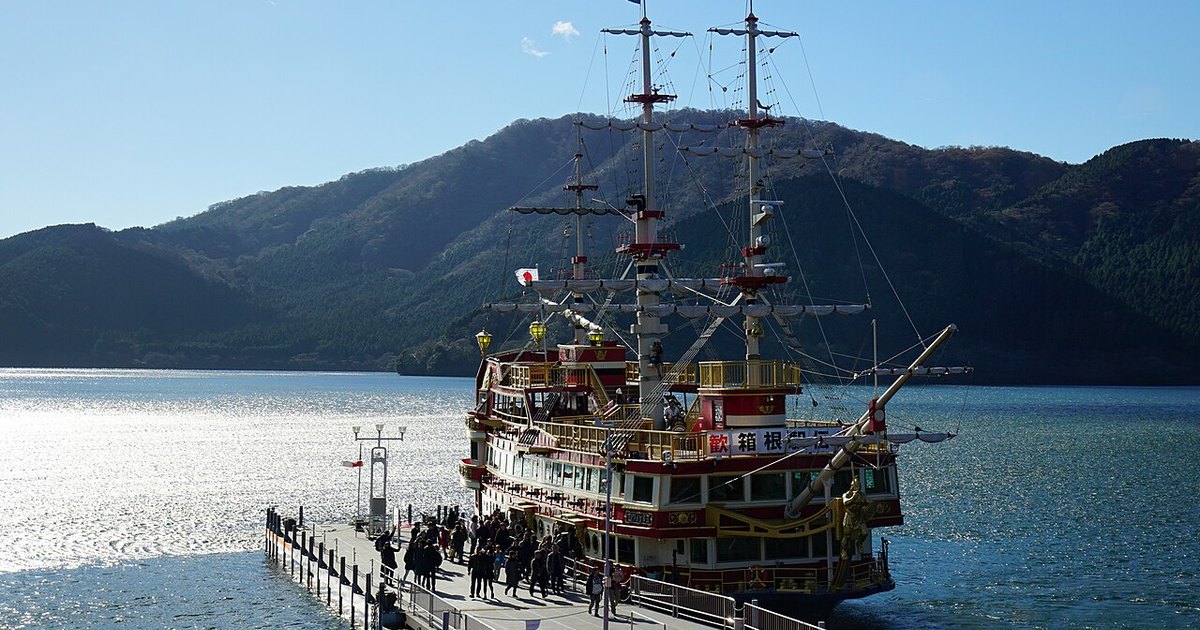
Nine areas, arranged along the chain. This is the part that no flat map communicates well, because the sequence matters more than the geography.
| Area | Station | What it is |
|---|---|---|
| Odawara | OH47 | The gateway from Tokyo. Not in the mountains — this is where you change |
| Hakone-Yumoto | OH51 | The hub. Hot springs, shops, and where the loop starts and ends |
| Miyanoshita & Kowakidani | OH54–55 | Old hotel country, on the train line halfway up |
| Gora | OH57 | Train ends, cable car begins. The open-air museum is one stop before |
| Sounzan | OH62 | Cable car ends, ropeway begins |
| Owakudani | OH63 | The steaming volcanic valley. Ropeway-to-ropeway change — different platform by direction |
| Ubako | OH64 | Quiet intermediate ropeway stop |
| Togendai | OH65 | Ropeway meets the lake. Boats and buses all converge here |
| Hakonemachi / Motohakone | OH66 / OH67 | The two lake ports. Shrine, old highway, and buses back to Yumoto |
🚨 Go counter-clockwise — the operator says so, and English guides say the opposite
Its own words, on its own model course: it presents "the reverse-direction course" rather than the Hakone-Yumoto-to-Gora route, because that route "tends to be congested."
So: bus first to Motohakone, boat across the lake, ropeway over the volcano, cable car down, mountain train home. You meet every vehicle in the opposite order to the crowds.
The operator's model day, with its own clock: 10:00 leave Hakone-Yumoto by bus, 11:50 board the boat at Motohakone, the volcanic valley through the afternoon, 15:00 down the cable car from Sounzan and back onto the train, 18:00 back at Hakone-Yumoto. It budgets about 10 hours for the circuit. That is a full day, and it is why we would rather see anyone do it over two days with a night in a ryokan in between.
Every leg: what it costs, how long it takes, when it stops
From Hakone’s own official tourism channel, updated for 2026. Japanese, but every leg of the loop appears in order on screen, which makes it easy to match against the table above.
| Leg | Fare (adult) | Time | Notes |
|---|---|---|---|
| Odawara → Hakone-Yumoto (train) | ¥360 | — | Or ¥480 by bus, 18 min |
| Hakone-Yumoto → Gora (mountain train) | ¥460 | 37 min | Three switchbacks; driver and conductor swap ends |
| Gora → Sounzan (cable car) | ¥430 | About 10 min | 🚨 First 08:45, last 17:55 |
| Sounzan → Togendai (ropeway) | ¥2,000 flat | Allow 45 min | Same price for any distance; you may break the journey |
| Togendai → Motohakone (boat) | ¥1,700 | 25–40 min | Special cabin is ¥800 extra |
| Hakonemachi ↔ Motohakone (boat) | ¥600 | Short hop | Special cabin ¥240 extra |
| Motohakone → Hakone-Yumoto (bus) | ¥1,210 | 30–32 min | Three different routes serve this |
The two clock times that decide your day
Hakone does not close late. Two figures matter more than any opening hour.
- 🚨 The cable car's last departure is 17:55 — in both directions, on weekdays and weekends alike, first at 08:45. It is the only link between Gora and the ropeway. Miss it and you are taking a bus around.
- 🚨 The ropeway runs 9:00 to 17:00 from February to November, and 9:00 to 16:15 in December and January. And there is a rule attached that is easy to miss: after 17:00 the Owakudani grounds are closed to sightseeing — you may only pass through to change gondolas.
For comparison, the mountain train runs late — last departure from Gora at 22:16 on weekdays, first at 05:45 — so the bottom of the mountain stays open long after the top has shut. Plan the high ground early and the hot springs late.
🚨 The ropeway closes for weeks in December 2026 and early 2027
Owakudani ↔ Sounzan: suspended December 7 to December 24, 2026 — 18 days.
Togendai ↔ Ubako ↔ Owakudani: suspended January 12 to February 26, 2027 — 46 days.
Substitute buses run in both cases — about 10 minutes for the first section, about 15 for the second, roughly every 15 minutes, following the ropeway's own operating hours. Your Freepass is valid on them. If you do not hold a ropeway ticket, the operator directs you to Izuhakone Bus's regular routes instead.
And the operator does not pretend it will be pleasant: it states the substitute buses will be "extremely crowded" with congestion expected on the roads, and recommends approaching Owakudani from the section still running normally. A 46-day closure of the lake side of the ropeway substantially changes the loop for anyone traveling in January or February 2027.
The Freepass, and the three things it does not cover
The Hakone Freepass covers eight forms of transport without limit, plus one round trip on the Odakyu line between your starting station and Odawara. Our full breakdown is in the Hakone Freepass guide; here is what matters for planning the map.
| From | 2 days (adult / child) | 3 days |
|---|---|---|
| Shinjuku | ¥7,100 / ¥1,600 | ¥7,500 / ¥1,850 |
| Machida | ¥6,820 / ¥1,600 | ¥7,220 / ¥1,850 |
| Ebina, Hon-Atsugi | ¥6,640 / ¥1,600 | ¥7,040 / ¥1,850 |
| Odawara or in Hakone | ¥6,000 / ¥1,500 | ¥6,400 / ¥1,750 |
1. The Romancecar is not included. The limited express seat costs ¥1,150 booked ticketless or ¥1,200 as a paper ticket, each way, on top. Board without one and you pay the fee plus ¥350 on board, with no seat guaranteed.
2. Izuhakone buses cannot be used with it at all — and those are exactly the buses you are sent to if the ropeway is closed and you have no ropeway ticket.
3. The Komagatake ropeway is a discount, not free travel. It is a different ropeway from the one in the loop, and people conflate them.
Buy it from one month before travel at Odakyu stations, on the operator's app, or at Seven-Eleven. Ticket machines sell same-day-valid passes only, and a paper pass is collected at the station where your journey ends — so do not plan to keep it as a souvenir.
Paying: the one gap that catches everybody at Gora
The fix is a contactless credit card. Tap-to-pay is accepted across the mountain railway, the cable car, Hakone Tozan buses, the boat, the ropeway and the highway buses. So the machine that refuses your Suica will take your Visa. Buses accept transit IC on all routes and all vehicles except the fixed-route sightseeing bus, and you can top up on board.
Luggage, and whether to drive instead
Send your bags ahead. Hakone Tozan Bus runs a carry service between Hakone-Yumoto Station and partner lodgings. Under a tariff effective April 1, 2026 it is ¥1,500 per standard piece (up to 140cm total, 15kg) or ¥2,500 for large (up to 200cm, 30kg), each way. Drop off at Hakone-Yumoto between 8:30 and 12:00 and it reaches your lodging from 15:00. Going back, hand it in at the front desk by 10:00 and collect it at Hakone-Yumoto between 13:30 and 18:30 — but note the return direction cannot be booked online; you arrange it at the lodging.
On driving: the loop is built for people without a car, and the official numbers make the case by themselves. The Owakudani car park is small and time-limited — open 9:00 to 16:20 February to November, with all vehicles out by 16:40 — and on holidays it charges ¥500 for the first 30 minutes and up to ¥2,600 for the day. You would also be driving one way while the loop goes around. Take the pass.
Owakudani: open, and a designated warning zone at the same time
Both of these are true, and a useful article has to hold them together rather than picking the reassuring half.
- The volcanic alert level is 1 — the lowest active-volcano level — and has been since October 2019. The most recent monthly assessment confirmed no change. Kanagawa Prefecture states the ropeway is under no special volcanic operating restriction.
- The area around Owakudani is nevertheless a designated warning zone. The prefectural road in is closed except between 9:00 and 17:00.
- 🚨 People with asthma, bronchial, respiratory or heart conditions, or a pacemaker, cannot ride the Sounzan-to-Ubako ropeway section at all. That is the operator's rule, not a suggestion.
- 🚨 Gas concentration and the alert level are unrelated systems — the operator says so outright. The ropeway suspends when sulfur dioxide reaches 5.0 ppm, measured at multiple points, regardless of the alert level being 1.
Practically: check the operator's live status board on the morning you travel, not the week before. When we checked it on August 5, 2026, all eight services were running normally with no wait over 30 minutes — but the site also carries a standing notice that some Hakone vehicles are running reduced timetables against the published ones. For what to actually do once you are up there, see our things to do in Hakone guide.
Frequently asked questions
Which direction should I travel the Hakone loop?
What does each leg of the loop cost?
Is the Hakone Freepass worth buying?
Does my Suica or PASMO work in Hakone?
When does the last cable car run?
Are there any planned closures I should know about?
Can I visit Owakudani, and is it safe?
Bottom line (2026) — Hakone is one numbered chain of stations from Odawara to Lake Ashi, ridden by five different vehicles. The 17:55 cable car ends your day, and ropeway closures are scheduled for December 2026 and January 2027. Owakudani is open and a designated volcanic warning zone at the same time.
Sources & what we deliberately did not state
Fares, journey times, first and last departures, operating hours and the closure dates were read on August 5, 2026 from the operators' own pages and from the timetable and fare data those pages are built on, then cross-checked against the operator's own routing engine — which is how we caught that a naive reading of the triangular fare table gives the wrong answer for Hakone-Yumoto to Gora. Closure dates come from the operator's own PDF notice. Volcanic facts come from the Japan Meteorological Agency, Kanagawa Prefecture and Hakone Town. The Freepass prices come from the official price sheet, which states it is current as of October 1, 2025.
Deliberately not stated: the winter boat timetable, because the operator publishes only a March 20 to November 30 calendar; the ropeway's hours from December 1, 2026, because the current notice states its own validity ends November 30; the live volcanic gas reading, because the figure did not load; and Izuhakone Bus fares, because that is a different company we did not verify. Where the operator's own pages disagreed with each other — as they do on ropeway journey times — we have said so and given the conservative figure. Note also that some of the operator's pages still carry inspection-closure dates from 2021 and 2022 as though current. Official does not automatically mean current; check the status board on the day.
Some links on this page may be affiliate links, which means we may earn a commission if you book or buy through them — at no extra cost to you. See our affiliate disclosure.
Tokyo to Osaka, Tokyo to Kyushu, Tokyo to Hokkaido — day by day — plus seven places most visitors never reach.
- 12 pages, 80 photographs, every stop linked to its guide
- Every price and opening hour read from the official page
- Re-issued monthly, so it does not go stale in your inbox
Free. One email a month, plus the rare change that matters. Unsubscribe with one click in any email. By subscribing you agree to our privacy policy.