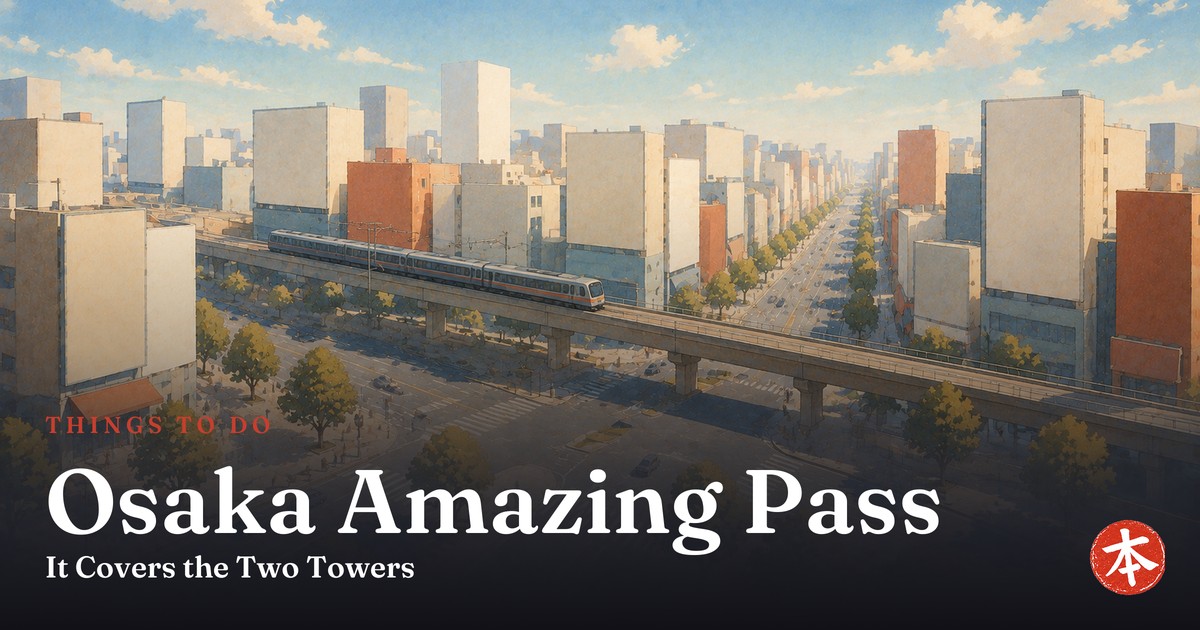
If you have been pricing Osaka attractions individually, stop for a moment. The listing for this pass names Umeda Sky Building, Tsutenkaku Tower and the Osaka Castle Museum among roughly 40 included facilities — which is most of a typical Osaka list already.
| Named inclusions | Umeda Sky Building, Tsutenkaku Tower, Osaka Castle Museum, Tennoji Zoo, Nagai Botanical Gardens |
|---|---|
| How many facilities | Around 40, per the listing |
| Transport | Unlimited — but limited to Osaka City only |
| Format | Digital. No exchange for a physical ticket. Scan the QR at gates that accept QR |
| Requirement | A phone with a live internet connection and network coverage |
| Sharing | Cannot be transferred or distributed. Split groups buy separately |
| Durations | 1-day or 2-day, plus an Itami version |
| Watch for | The Osaka Wheel was flagged as temporarily closed |
It includes attractions you were probably buying anyway
This is the arithmetic that decides whether a city pass is a good idea, and it is unusually easy to do here because the listing names the big ones.
The three it names first
Umeda Sky Building, Tsutenkaku Tower and the Osaka Castle Museum. Those are the observation deck with the open-air roof, the tower in Shinsekai, and the city’s landmark. A first Osaka itinerary that includes none of them is unusual, and a pass that includes all three changes the sum before you have even counted the transport.
What that does to the calculation
The usual objection to city passes is that you have to visit an unreasonable number of things to break even. That objection is weaker here, because Osaka’s attractions are close together and the transport is included on top. Three paid entries plus a day of subway travel is a realistic day in this city, not a forced march.
Around forty facilities, and why we are not listing them
The listing says approximately 40, and names five. It does not publish the full list on the booking page. We could reconstruct a list from elsewhere and some of it would be out of date, which is worse than useless when somebody plans an afternoon around it. If a specific attraction is your reason for buying, verify it on the pass’s own facility list.
Check the Osaka Amazing Pass → Affiliate link — affiliate disclosure.
Osaka City only — the boundary that catches people
The transport half of this pass is generous inside a line and worth nothing outside it.
Private lines inside the city, not out of it
This is the part that misleads. Seeing Hankyu, Keihan and Kintetsu on an inclusion list suggests you can ride out to Kyoto or Nara, because those are the companies that run those routes. You cannot. The inclusion is their track within Osaka City, and the city boundary is where the pass stops.
The bus exception is unspecified
The listing excludes some municipal bus routes without naming them. We are not going to guess at which, and in practice this matters less than it sounds because the subway covers most of what a visitor needs. But if a bus is central to your plan for a day, check it rather than assume.
What this means for day trips
Plan Osaka days on the pass and out-of-city days on something else. If your trip includes Kyoto or Nara, those legs are a separate ticket and possibly a separate pass — and buying a two-day Amazing Pass to cover a day you spend outside the city is the most common way to waste money on this product.
It is digital, and it needs a live connection
Two of the three operational facts here are good news. The third is a condition worth respecting.
No physical exchange
The listing says there is no need to exchange your online voucher into a physical ticket at designated locations. That is a real advantage over passes that require a counter visit on your first morning, and it means the pass is usable the moment you arrive.
QR gates only
You scan the QR code at ticket gates that accept QR codes. That phrasing is doing quiet work: not every gate at every station is a QR gate. Look for the marked ones rather than joining the nearest queue, particularly at large stations during rush hour.
The internet requirement is a real dependency
The listing states that to use the service you need to connect to the internet from a smartphone and be in an area with network coverage. Your ticket is a live request, not a saved image. On an underground network, that is worth thinking about — a screenshot will not open a gate, and a dead battery is a dead pass.
See pass options → Affiliate link — affiliate disclosure.
You cannot hand one to a friend
This is stated clearly and it changes how groups should book.
| What the listing states | What it means when booking |
|---|---|
| After purchase, tickets cannot be transferred or distributed to other people | One person cannot buy four and share them out |
| If travelers will not use the tickets together, purchase separately | Split the booking by who is actually traveling as a unit |
Why this catches families
Groups split constantly on a city day — one adult takes the children to the zoo, another goes shopping, everyone meets for dinner. If the whole party is on one booking, that split is exactly the situation the rule addresses. Decide the groupings before you book, not at the first station.
It follows from the format
A digital pass tied to an account is issued differently from four paper cards in an envelope. The transfer restriction is not arbitrary; it is what happens when a ticket lives inside an app. Knowing the reason makes it easier to remember and to plan around.
The practical booking pattern
Book by traveling unit rather than by household. Two adults doing everything together is one booking. Two adults who will separate is two. It costs the same and it removes an entire category of problem.
The Itami version, and one attraction currently closed
There is an upgrade, and on the day we read the listing part of what it adds was unavailable.
What the upgrade includes
The Itami version adds admission to the Expo ’70 Commemorative Park and the Osaka Wheel, plus the Osaka Monorail between Itami Airport and Bampaku-kinen-koen Station. It is aimed at visitors flying into Itami or making a trip out to the Expo park, which sits outside the standard pass’s city boundary.
Why that specifically matters here
Because Osaka Wheel admission is one of the two attractions the Itami upgrade adds. A closure notice on a standard pass would be a minor inconvenience; on this version it removes part of what you are paying extra for. Check that notice for your own dates before choosing the upgrade — it is a live status line and ours was read in September.
Whether the upgrade still makes sense
It can, if the monorail and the Expo park are what you wanted. Those are the other two components and neither is affected. What changes is the arithmetic: with the wheel out, the upgrade has to justify itself on transport and one park rather than on three things.
Check availability → Affiliate link — affiliate disclosure.
Deliberately not stated here
| What we are not saying | Why |
|---|---|
| Prices for the 1-day, 2-day or Itami versions | They differ by version and we did not verify any of them. The comparison only works with the page’s own numbers |
| The full list of about 40 facilities | Not published on the booking page. A reconstructed list would be wrong somewhere, and somebody would plan a day on it |
| Which municipal bus routes are excluded | The listing says some are, without naming them |
| Opening hours of the included attractions | Forty facilities means forty schedules. Each has its own page |
| When the Osaka Wheel reopens | The notice says the date is yet to be determined. We are not going to improve on that |
| Whether Kaiyukan is included | It is not among the facilities the listing named, and absence from a partial list is not proof either way. Check the pass’s own list — our Kaiyukan guide covers the ticket separately |
Osaka Amazing Pass FAQ
Which attractions does the Osaka Amazing Pass include?
Does it cover transport outside Osaka?
Is it a physical pass or a digital one?
Can I buy several and hand them out to my group?
What is the Itami version?
Is the Osaka Wheel open?
How do I decide between one day and two?
Does it work on the airport trains?
Check the Osaka Amazing Pass → Affiliate link — affiliate disclosure.
Bottom line (2026) — the listing names Umeda Sky Building, Tsutenkaku Tower and the Osaka Castle Museum among roughly 40 included facilities, so price it against the tickets you were already going to buy. Transport is unlimited but limited to Osaka City only, covering Osaka Metro, municipal buses except some routes, and the Hankyu, Hanshin, Keihan, Kintetsu and Nankai lines within the city — not out to Kyoto or Nara. It is a digital pass with no physical exchange, scanned at QR-capable gates, and it requires a live internet connection. Passes cannot be transferred, so split groups must book separately. The Itami version adds the monorail, the Expo ’70 park and the Osaka Wheel — and the wheel was flagged as temporarily closed when we read the page.
Sources
Written on September 2, 2026 from the Klook listing for the Osaka Amazing Pass: the unlimited travel on Osaka subway, private railways and buses by presenting the pass on a smartphone; access to approximately 40 attractions; free entry named for Umeda Sky Building, Tsutenkaku Tower and the Osaka Castle Museum, with Osaka Tennoji Zoo and the Nagai Botanical Gardens also listed; the one-day and two-day durations; the railway and bus coverage stated as limited to Osaka City only, covering Osaka Metro, Osaka Municipal Bus except for some routes, and private lines including Hankyu, Hanshin, Keihan, Kintetsu and Nankai; the discount coupons for shops and restaurants; the Itami version adding admission to the Expo ’70 Commemorative Park and the Osaka Wheel plus the Osaka Monorail between Itami Airport and Bampaku-kinen-koen Station; the statement that there is no need to exchange online vouchers for physical tickets and that you scan the QR code at ticket gates that accept QR codes; the requirement to connect to the internet from a smartphone in an area with network coverage; the rule that after purchase tickets cannot be transferred or distributed and that travelers not using them together should purchase separately; the notice that the Osaka Wheel was temporarily closed due to a lightning strike with the reopening date yet to be determined; and a 4.7/5 rating across 21,400 reviews with 1,000,000+ bookings. More on how we work: how we research.
Facility lists, coverage boundaries and closure notices all change, and the wheel notice in particular is a live status line. This reflects what that source said on September 2, 2026, and the booking page carries the current position for your dates.
in English
Every week we read the Japanese sources English-language media never touches — new openings, price changes, limited releases, rule changes, the seasonal things that come and go in three weeks — and send you a three-minute read of what actually matters. Hit reply with a question about your trip and a human answers.
Free. Unsubscribe anytime. We never share your address.