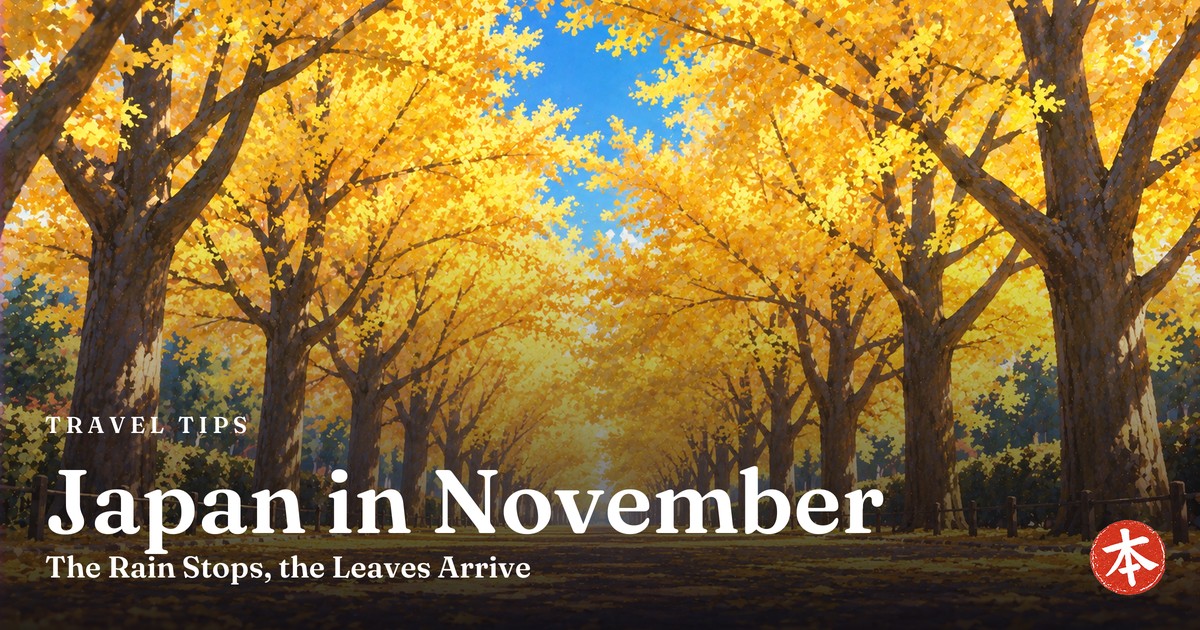
If October is the month Japan gets rained on, November is the month it dries out. On the Japan Meteorological Agency’s 30-year normals, Tokyo’s rainfall falls from 234.8 mm to 96.3 between the two months, Kyoto’s from 143.2 to 73.9, and Osaka’s from 136.0 to 72.5. Typhoons are gone: no November landfall in thirty years. Temperatures settle at 12.5 to 14 C across the main cities.
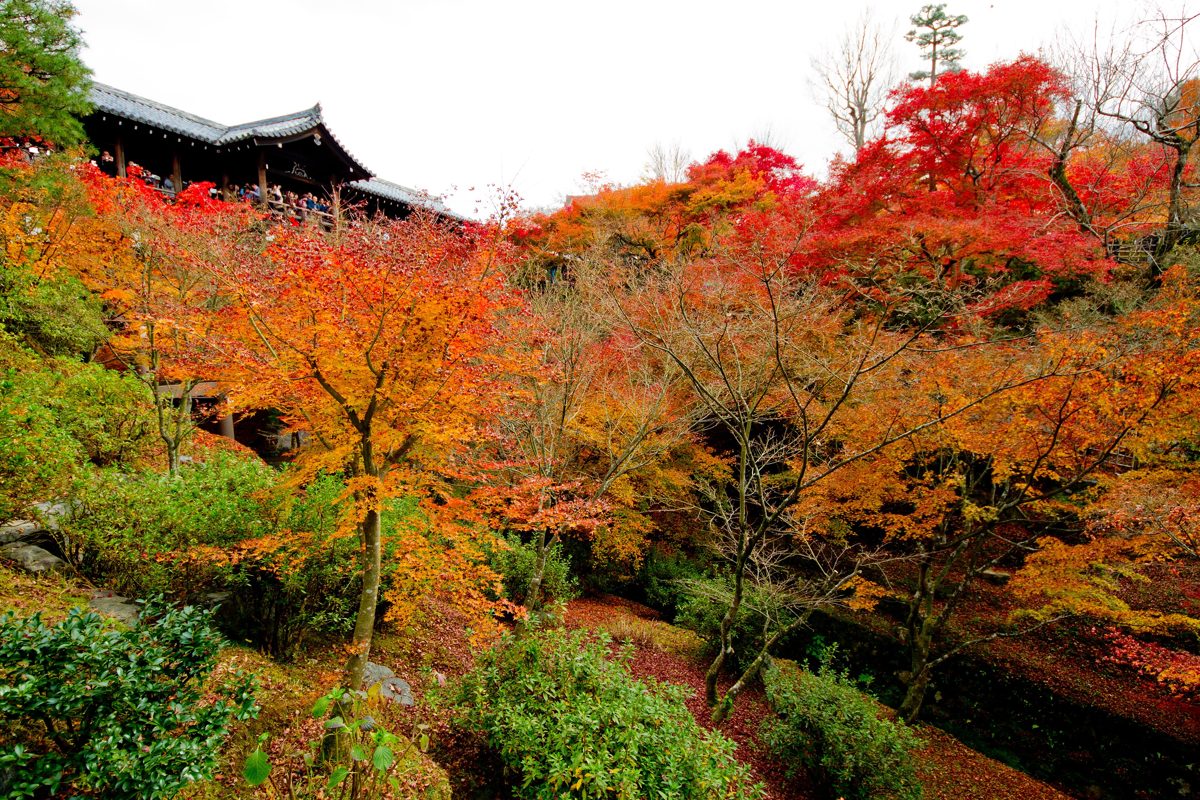
And the leaves arrive — but on the official map, later than the guidebooks say. The JMA’s average maple-coloring line for November 30 runs through Kanto, Tokai, Chugoku, Shikoku and northern Kyushu. Kyoto sits in the early-to-mid December band. If you are timing a trip to the color, that gap between what the maps say and what the brochures say is the most useful thing on this page.
Japan in November at a glance
| City | Avg temp (C) | Daily high / low (C) | Rain (mm) | Sunshine (h) |
|---|---|---|---|---|
| Sapporo | 5.2 | 8.7 / 1.6 | 114 | 99 |
| Tokyo | 12.5 | 16.7 / 8.8 | 96 | 150 |
| Nagoya | 12.6 | 17.3 / 8.6 | 79 | 167 |
| Kyoto | 12.5 | 17.3 / 8.4 | 74 | 141 |
| Osaka | 13.8 | 17.8 / 10.2 | 72 | 153 |
| Hiroshima | 12.9 | 17.7 / 8.9 | 69 | 153 |
| Fukuoka | 14.2 | 18.2 / 10.6 | 91 | 137 |
| Naha | 22.5 | 25.0 / 20.4 | 119 | 122 |
November: Japan Meteorological Agency 30-year normals (1991–2020), read on September 14, 2026.
The dry-out: how much less rain November brings
| City | October (mm) | November (mm) | Change |
|---|---|---|---|
| Tokyo | 234.8 | 96.3 | -59% |
| Nagoya | 164.7 | 79.1 | -52% |
| Kyoto | 143.2 | 73.9 | -48% |
| Osaka | 136.0 | 72.5 | -47% |
| Hiroshima | 109.2 | 69.3 | -37% |
| Fukuoka | 94.5 | 91.4 | -3% |
| Naha | 179.2 | 119.1 | -34% |
| Sapporo | 109.9 | 113.8 | +4% |
JMA 1991–2020 normals. Sapporo is the exception: its November is slightly wetter than its October, and part of it is snow.
Why does the rain stop so suddenly?
The autumn rain front and the tail of typhoon season both clear the main islands by early November, and the winter pattern that follows brings dry air to the Pacific side. The result is the sharpest month-to-month drop of the year in the east: Tokyo loses 59 percent of its rainfall between October and November. Our October guide covers the wet side of that line.
Is November drier than December?
Not quite, but close. Tokyo goes from 96.3 mm in November to 57.9 in December; Kyoto from 73.9 to 57.3. November is the transition month, and the December guide picks up the fully dry winter that follows.
Where is the exception?
Sapporo, where November (113.8 mm) is slightly wetter than October (109.9) and the average sits at 5.2 C with lows of 1.6. That is early winter, and the precipitation is increasingly snow. Sapporo also records the lowest sunshine of the eight cities in November, 99.1 hours.
Autumn leaves in November: the official map versus the brochures
Where is the color in early November?
The north. Southern Hokkaido is at its average coloring date on November 10, and Tohoku follows by November 20. Kanazawa and the Hokuriku coast reach the line at the end of the month; our Kanazawa guide covers a city where the gardens are the point.
And in late November?
Tokyo, Nagoya, Hiroshima and Fukuoka all sit on or near the November 30 line, so the last week of the month is when the lowland cities of the main island turn. Ginkgo, the yellow street trees, run on a similar schedule: the JMA puts the Pacific coast of Kanto, the Kinki region, Chugoku, Shikoku and Kyushu at late November to early December for ginkgo.
What if I can only come mid-November?
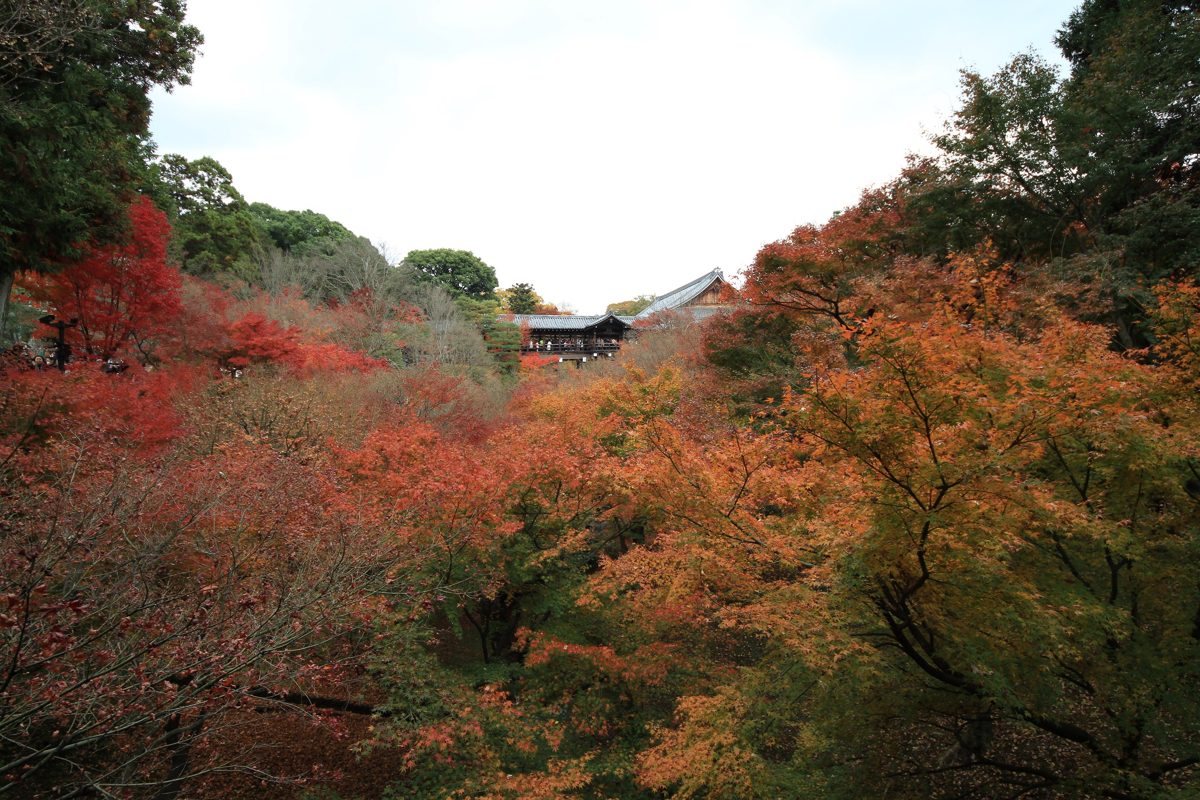
Go north of the November 20 line, or go up. Tohoku, Hokuriku and mountain areas above the JMA’s lowland stations are on average at color by mid-month. Kyoto in mid-November is, on the normals, still mostly green with the first trees turning; it is not the postcard yet.
Are these dates reliable?
They are 30-year averages and the JMA publishes each year’s observed date separately. In a warm autumn every line moves later. Treat the map as the month-picker and check the current year before you lock a non-refundable booking to a peak.
Typhoons: the month the risk ends
The JMA normals for November: 2.2 typhoons form in the western Pacific, 0.5 approach Japan, and none made landfall in the entire 1991 to 2020 record. Compare October at 1.7 approaches and 0.3 landfalls, and September at 3.3 and 1.0. November is the first month since spring in which a storm canceling your trains is not a realistic planning item.
North to south: eight Novembers
Sapporo
5.2 C, lows of 1.6, 113.8 mm, 99 hours of sun. Winter has started. The leaves are gone by mid-month and the ski season has not begun.
Tokyo, Nagoya, Kyoto
All at 12.5 to 12.6 C, with highs of 16.7 to 17.3 and lows of 8.4 to 8.8. Rain between 74 and 96 mm. Nagoya is the sunniest of the eight at 167.1 hours. This is the temperature band most visitors will spend the month in, and it is a mild one for a coat and no gloves.
Osaka, Hiroshima, Fukuoka
Slightly warmer at 13.8, 12.9 and 14.2 C, and Hiroshima the driest of the eight at 69.3 mm. Fukuoka’s sunshine drops to 137.3 hours as the winter cloud from the Sea of Japan begins to reach Kyushu.
Naha
22.5 C, lows of 20.4, 119.1 mm, humidity 69 percent. Warmer than Tokyo in May. Okinawa does not have an autumn in the mainland sense; November is simply the month the summer heat lets go.
The two November holidays
| Holiday | Date | 2026 | 2027 |
|---|---|---|---|
| Culture Day | November 3 (fixed) | Tuesday | Wednesday |
| Labour Thanksgiving Day | November 23 (fixed) | Monday — three-day weekend | Tuesday |
Cabinet Office national holiday list. Neither moves; both are fixed dates.
Do the holidays make November crowded?
The November 23 weekend in 2026 lands inside the leaf season for Tokyo and the surrounding regions, which concentrates domestic travel. Culture Day on a Tuesday is a single day off. Neither is a week-long block; the full calendar is in our holidays guide. For Tokyo specifically, the best time to visit page puts November against every other month.
Planning a November week around the numbers
Which direction should the route run?
Either, for rain. The whole main island is dry. The variable is the leaf line: a trip that starts in Tokyo late in the month and moves to Kyoto in the first days of December follows the color south and west on the official map. The reverse, Kyoto first in mid-November, arrives early.
What do the highs and lows mean for a day out?
The daily range is about eight degrees: Tokyo 16.7 to 8.8, Kyoto 17.3 to 8.4, Osaka 17.8 to 10.2. Mornings at a temple are single digits; afternoons are mild. Sunset comes early — Meiji Jingu’s own November gate hours, for one example, are 6:10 am to 4:10 pm.
How should I read a cold forecast?
As normal. Lows of 8 to 9 C in the main cities are the average, not an outlier, and Sapporo’s lows are near freezing. A cold snap in November is unremarkable; a warm one is what delays the leaves.
Three things travelers get wrong about November
“Kyoto peaks in the last week of November”
That is the phrase in almost every English itinerary, and it is not what the official map says. The JMA draws the November 30 isochrone through Kanto and Tokai and places the Kinki region, which is Kyoto, in the band that colors in early to mid December. The popular date is not wrong every year; it is early on average, and in a warm autumn it is early by a lot. If you can only pick one week for Kyoto’s gardens, the first week of December is closer to the official normal than the last week of November. We are aware this contradicts most of what you will read elsewhere, which is why we are quoting the agency that measures the trees rather than the people who photograph them.
“November is already cold”
It depends entirely on which end of the country you mean. Sapporo at 5.2 C with lows near freezing is cold by any definition. Tokyo, Kyoto and Nagoya at 12.5 C are mild by European or North American November standards, with afternoon highs near 17. Fukuoka is warmer still, and Naha at 22.5 C is a warm spring day. The country spans seventeen degrees of average temperature in the same month, and the single word “cold” does not describe it.
“I should still worry about typhoons”
Not in November. The normals show half a typhoon approaching Japan in the month on average and no landfall at all in three decades. The related risk in November is the opposite one: the dry, clear weather that makes the month pleasant also makes it the beginning of the season when the Sea of Japan coast starts to see winter cloud and, in the north, snow.
How to check the current year yourself
Where do these numbers come from?
From the Japan Meteorological Agency, which publishes 30-year climatological normals for every observatory in the country and updates them once a decade; the current set covers 1991 to 2020. Every figure in the table above is that agency’s number for the named station, unrounded except where we have said so. The typhoon counts are the same agency’s averages for formation, approach and landfall by month.
What does “normal” actually mean?
An average over thirty years. Any given November can be warmer, wetter or later than the normal, and the normal for a whole month says nothing about the week you happen to be there. It is the right tool for choosing between months and between cities, which is what this page is for, and the wrong tool for predicting a specific weekend.
How do I find this year’s leaf dates?
The JMA publishes its observed maple and ginkgo dates for each station as they happen, alongside the normals. In a year when the autumn has been warm, expect the observed dates to run behind the averages on this page; in a cool one, ahead. Check the observations in the week before you travel rather than months ahead, and treat any booking that depends on a specific peak as a bet.
Is November a good month for hot springs and food?
The temperatures say yes without our needing to editorialize: single-digit mornings and mild afternoons in the main cities are the conditions an outdoor bath is built for, and the month sits between the summer heat and the deep-winter cold on the Sea of Japan side. We do not rank onsen towns here, and we do not list seasonal menus we have not seen, but the climate numbers explain why so many Japanese domestic travelers choose this month for exactly those two things.
What should a first-timer take from all this?
Three things. The rain stops in November, so the umbrella is optional for the first time since spring. The color reaches the big cities at the very end of the month and Kyoto in December, so a trip aimed at leaves belongs late, not early. And the country is not one temperature: Sapporo is in winter, Naha is in late spring, and the six cities in between are in a mild autumn with cold mornings. Plan the route to the numbers, and November delivers what the brochures promise for October.
Japan in November FAQ
Is November a good time to visit Japan?
When do the autumn leaves peak in Kyoto?
What is the weather like in Tokyo in November?
Are there typhoons in November?
What are the public holidays in November?
How cold is Hokkaido in November?
Which cities are sunniest in November?
Is Okinawa still warm in November?
Bottom line (2026). November is the month Japan dries out: Tokyo 96.3 mm, Kyoto 73.9, Osaka 72.5, down from 235, 143 and 136 in October, with no typhoon landfall in thirty years. Main-city temperatures sit at 12.5 to 14 C. The JMA’s maple line reaches Tokyo by November 30 and puts Kyoto in early to mid December, later than most guides claim. Holidays: November 3 and November 23, the latter a Monday in 2026.
Sources
Climate figures are Japan Meteorological Agency 30-year normals (1991–2020) for the Sapporo, Tokyo, Nagoya, Kyoto, Osaka, Hiroshima, Fukuoka and Naha observatories; typhoon counts are the JMA typhoon normals; maple and ginkgo dates are read from the JMA’s official isochrone maps; holidays are from the Cabinet Office list for 2026 and 2027; the Meiji Jingu November gate hours are from the shrine’s own English site. All read on September 14, 2026.
Some links on this page may be affiliate links, which means we may earn a commission if you book or buy through them — at no extra cost to you. See our affiliate disclosure.
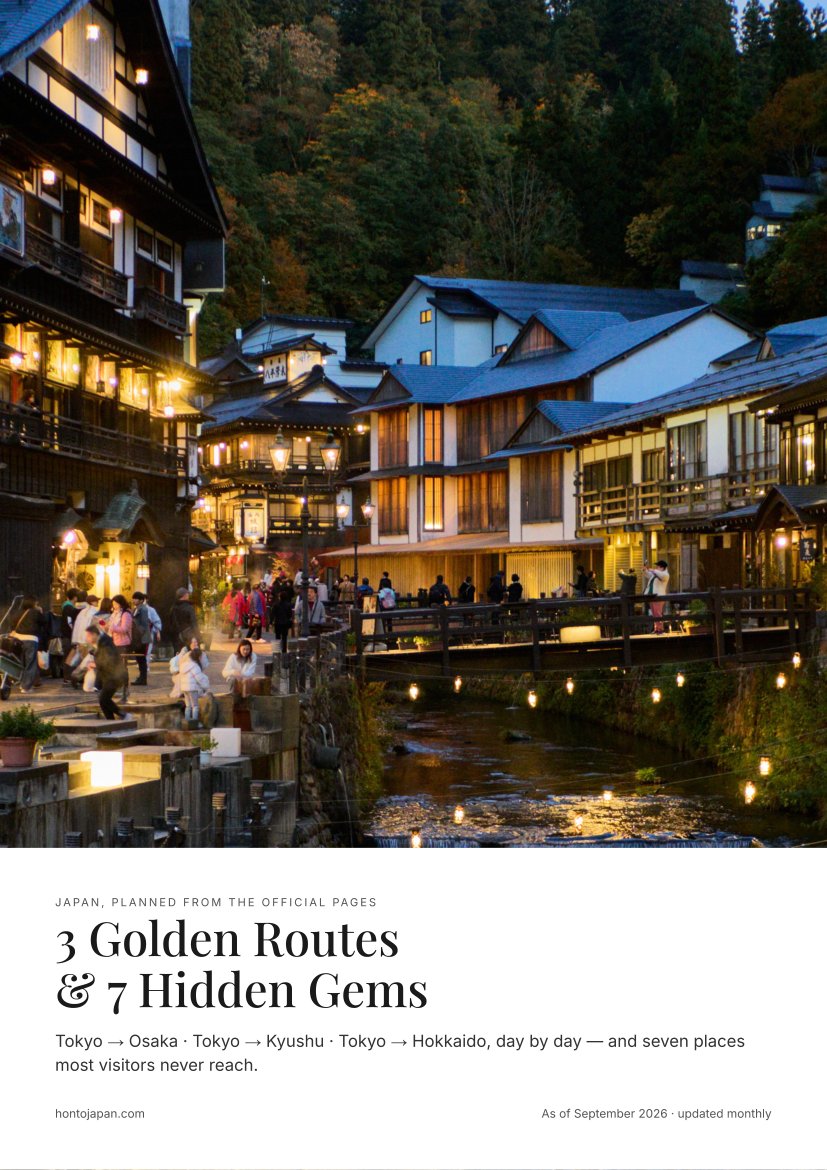
Tokyo to Osaka, Tokyo to Kyushu, Tokyo to Hokkaido — day by day — plus seven places most visitors never reach.
- 12 pages, 80 photographs, every stop linked to its guide
- Every price and opening hour read from the official page
- Re-issued monthly, so it does not go stale in your inbox
Free. One email a month, plus the rare change that matters. Unsubscribe with one click in any email. By subscribing you agree to our privacy policy.