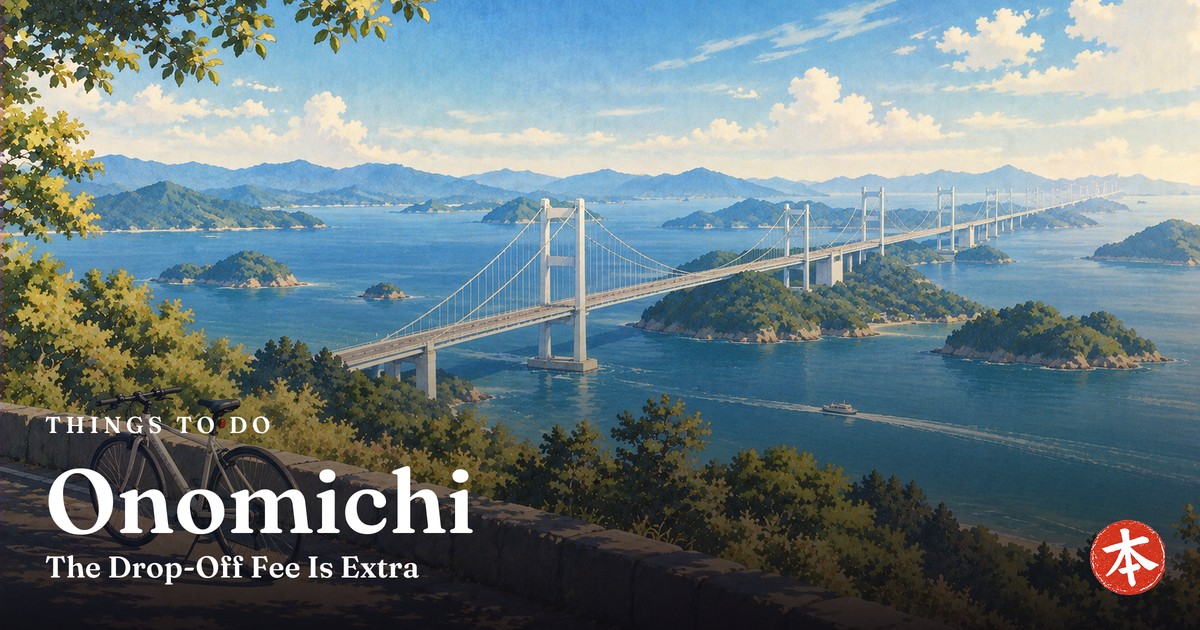
The reason people cycle the Shimanami Kaido from Onomichi is that you do not have to come back. You ride about 70 km across six islands to Imabari and leave the bike there. What the guides do not tell you is that dropping it at the far end costs a separate 1,000 yen on top of the rental — so a one-way crossing on a standard bike is ¥4,000, not the ¥3,000 you see quoted.
There are two more conditions worth knowing before you choose a bike. The e-bike must come back the same day, which rules out an overnight crossing. The tandem cannot be dropped at all — it goes back where it came from. Below are the official rates for every bike, the battery range that decides whether you make it, and what changed at the Onomichi end this year.
Onomichi bike rental: the official rates
| Bike | Adult / day | Child / day | Drop at another terminal? | Multi-day? |
|---|---|---|---|---|
| Cross bike / city bike | ¥3,000 | ¥1,000 | Yes | Yes |
| Kids’ bike | — | ¥1,000 | Yes | Yes |
| Electric assist | ¥4,000 | — | Yes | Yes |
| E-bike | ¥8,000 | — | Yes | No — same day |
| Tandem | ¥4,000 | — | No — same terminal | No |
| Student group (20+, pre-booked) | ¥2,000 | ¥500 | Yes | Yes |
| One-way drop fee: ¥1,000 (junior high and above) / ¥500 (elementary and below) — charged in addition to the daily rate | ||||
All prices tax included. Shimanami Japan, official rental page.
So what does a one-way crossing really cost?
¥4,000 for an adult on a standard bike: ¥3,000 for the day plus the ¥1,000 drop fee. On an electric assist it is ¥5,000. The operator is not hiding this — it is on the same page as the rates — but it sits in a separate column and is easy to miss when you are comparing bikes. Budget for it as part of the crossing rather than as an extra, and the arithmetic stops being a surprise at the far end when you are tired and handing the bike back.
The two Onomichi rentals you cannot use for a crossing
Why can the e-bike not be kept overnight?
And the tandem?
The tandem is the stricter of the two: the official terms state that it cannot be dropped at another terminal at all. It goes back where it came from, which makes it a there-and-back machine rather than a crossing one. It is also only stocked at three terminals — Imabari Sunayama, Sunset Beach and Omishima — and requires riders of 155 cm or more.
What should I rent, then?
For a one-way crossing kept simple: the standard cross bike. It is the cheapest, it can be dropped anywhere, and it can be kept for several days if you want to break the ride into two. The electric assist is the upgrade that keeps every option open; the e-bike and the tandem are both good bikes with a condition attached. One more thing in the standard bike’s favor: because it can be kept for several days, you can ride to an island, stay the night and continue in the morning without paying twice. That turns a hard day into two easy half-days, and it is the version of this route most people enjoy more.
The battery range that decides whether you finish
How far does the electric assist actually go?
The maker’s published figures are 200 km in eco mode, 105 in auto and 62 in power. Set those against a route of about 70 km and the arithmetic is immediate: eco and auto cross comfortably, and power mode does not reach. If you ride the whole thing on maximum assist you will be pedaling an unpowered bike at some point, and these bikes are heavier than the ones you are used to.
What about the child-seat version?
Much shorter, and the gap matters: 68 km in eco, 53 in auto, 45 in power. Eco mode only just covers the route with a child on board, and anything above eco does not. If you are riding with a child, plan around battery swaps rather than around distance.
Can I swap the battery?
Yes, at three points: the Setoda tourist information office, Setoda Sunset Beach and Omishima. All three sit in the middle stretch, which is where a battery run down on auto mode would give out. Knowing they exist is the difference between rationing the assist and using it.
What changed at the Onomichi end
Where do I pick up the bike now?
By the station. The operator states that the cycling hub has moved from Onomichi Port to a renewed terminal in front of Onomichi Station, and that a new connection between Hiroshima Airport and the town has opened alongside it. If a guide sends you to the port terminal, it predates the move.
Is there a boat option as well as the bridges?
Seasonally, yes. The operator has announced a limited-run Onomichi–Imabari sea route operating on 16 days between October 3 and November 29. That is a narrow window and it is published as a limited operation, so treat it as something to check rather than to build a plan around.
How does Onomichi fit with the rest of the region?
It sits between Hiroshima and Imabari, which makes it a natural stop rather than a destination you go out of your way for. Our Hiroshima guide covers how the city is laid out, Hiroshima to Miyajima the other half-day trip from there, and Osaka to Hiroshima the approach from the east. Whether a rail pass is worth it depends on the rest of your route — see our rail pass guide.
Rules, helmets and the things worth stopping for
Is the helmet compulsory, and is it included?
The operator asks you to wear one and lends one free with every bike. The catch is the reverse case: helmets are not lent on their own. If you bring your own bicycle to the route, borrowing a helmet is not a service on offer. Japanese road law treats a bicycle as a vehicle — our cycling rules guide covers what that means for drinking, phones and riding two abreast.
What happens if the bike breaks?
They come to you. The operator runs a callout and free swap service for punctures and mechanical failures, which is the practical reason to rent from them rather than independently on a route that crosses six islands. One thing that does not flex: if you return early, there is no refund of the difference.
What is the bridge at the Imabari end?
The Kurushima Kaikyo Bridge, opened in 1999, which is not one bridge but three suspension bridges running about 4 km across the strait between Oshima and Imabari, 4.1 km in total length. The water beneath carries roughly 1,000 vessels a day and has been treated as a hazard for centuries — there are electronic tidal signal boards telling ships the speed and direction of the current. At certain hours you can look down from the second and third spans and see whirlpools.
Is there another bridge route nearby?
There is, and it is newer than most guides. The Yumeshima Kaido in Ehime’s Kamijima was completed when the Iwagi Bridge opened on March 20, 2022, joining Ikina and Iwagi islands. It is a cable-stayed bridge with a 475 m central span and what the operator describes as one of the tallest concrete main towers in the country. It is a separate route from the Shimanami Kaido, not part of the 70 km crossing.
When are the terminals actually open?
The operator’s own contact hours shift with the season: 8:30 to 19:00 from March through November, and 8:30 to 18:00 from December through February. That matters most for the e-bike, which has to be back within opening hours on the same day — in winter that is an hour less than you might assume.
Which bridge should I actually stop on?
Tatara Bridge, the fourth from Onomichi and the border between Hiroshima and Ehime prefectures. It held the record as the world’s longest cable-stayed bridge when it was completed, and directly under its main tower there is an acoustic quirk the operator calls the naki-ryu: clap, and the sound rings up the tower. It is the only bridge on the route where this works.
Is it officially recognized as a cycling route?
Yes, twice over. The operator states that the Shimanami Kaido is signposted as a National Cycle Route — a designation Japan applies to a small number of long-distance routes built to a standard for signage, safety and support — and that CNN named it one of the seven best cycling routes in the world. The practical consequence of the first is the one that matters on the day: the blue line painted along the road surface means you do not need a map to stay on route.
Is there a discount I should know about?
Yes. Holders of a Japanese disability certificate — physical, intellectual or psychiatric — and one accompanying helper each pay half the rental rate. The certificate is shown at the terminal when you collect the bike.
Onomichi and Shimanami FAQ
How much does it cost to rent a bike on the Shimanami Kaido?
Can I ride one way and leave the bike at the other end?
Are there bikes I cannot leave at the far end?
How far will an electric assist bike actually go?
Do I have to wear a helmet?
How long is the route and how many terminals are there?
Which bridge is worth stopping at?
What if I only have a couple of hours?
Bottom line (2026) — A standard bike on the Shimanami Kaido is ¥3,000 a day, and leaving it at the far end costs a separate ¥1,000, so a one-way crossing is ¥4,000. The e-bike (¥8,000) must be returned the same day and the tandem must go back to its own terminal. An electric assist covers the 70 km route in eco or auto mode but not in power mode (62 km). Helmets are free with a rental but are not lent separately. The Onomichi hub has moved to Onomichi Station.
Sources & what we deliberately did not state
All rates, conditions, terminal lists, battery figures and bridge details come from the official Shimanami Japan website — the rental overview and the detailed rental terms — read on September 7, 2026. The operator notes that prices may change, so confirm before you travel.
Deliberately not stated: how long the crossing takes, because no official figure exists and the honest answer depends entirely on the rider; admission prices in Onomichi town itself, because we did not read those official pages today; the number of bikes at the new station terminal, because the operator publishes no figure and we are not taking one from a news clip; and bridge tolls, which we have not verified. Where a guide gives you a confident crossing time, ask whose legs it was measured on.
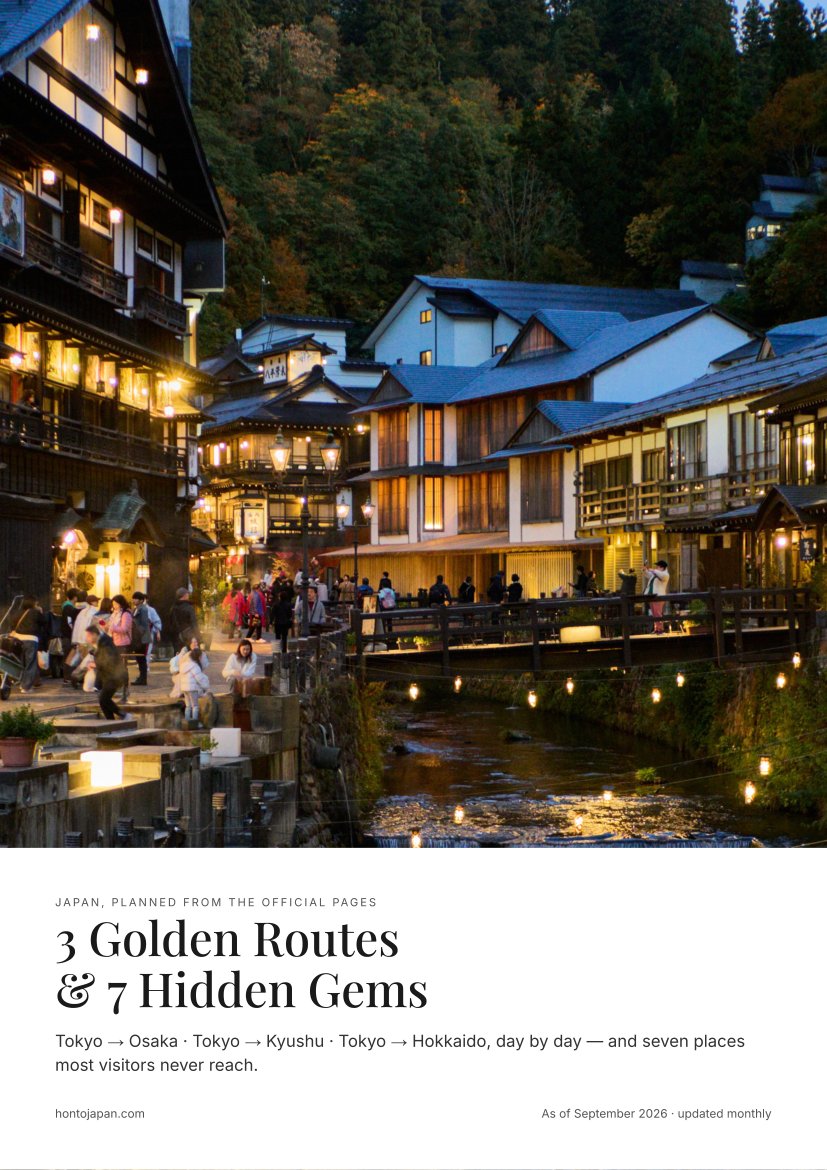
Tokyo to Osaka, Tokyo to Kyushu, Tokyo to Hokkaido — day by day — plus seven places most visitors never reach.
- 12 pages, 80 photographs, every stop linked to its guide
- Every price and opening hour read from the official page
- Re-issued monthly, so it does not go stale in your inbox
Free. One email a month, plus the rare change that matters. Unsubscribe with one click in any email. By subscribing you agree to our privacy policy.