Most food guides to a Japanese prefecture are lists of dishes. That format quietly fails for Akita, because the majority of what Akita is known for is attached to a season, a town, or an event rather than to a restaurant you can book.
Kiritanpo is framed around the autumn rice harvest. Hatahata, the prefectural fish, comes ashore around December. Babahera ice is sold at event grounds, not shops. Inaniwa udon is named after a district in one city. Damako belongs to another town entirely. So the practical question is not “what should I eat in Akita” — it is “when am I going, and which part of the prefecture am I actually standing in”.
| The one dish everyone names | Kiritanpo nabe — framed as autumn, with newly harvested rice and a Hinai-jidori soy broth |
|---|---|
| The one that is a December thing | Hatahata, the prefectural fish, which comes to the coast around December to spawn |
| The one you cannot look up | Babahera ice — sold at event venues, shaped like a rose |
| Dishes tied to a specific town | Inaniwa udon (Yuzawa) · damako nabe (Gojome) · ishiyaki (Oga) · Yokote yakisoba (Yokote) · butter mochi (Kita-Akita) |
| The one to take home | Iburigakko — smoked pickled daikon |
| Why the sake is good | Rice, clean water, and cold winters — two-thirds of Akita’s breweries are over 100 years old |
Why Akita food is harder to plan than it looks
The list is not the problem. The calendar is
Akita’s official tourism material opens its food section with a line that translates roughly as “come to Akita and eat this”, and then does something unusual: it splits what follows into local dishes, regional menu items, and ingredients. Those are three different kinds of thing, and they need three different kinds of plan. An ingredient you will meet without trying. A regional menu item means going to the town it belongs to. A seasonal dish means going in the right months.
What that means if you have three days
You will not eat this list. You will eat the intersection of this list with your dates and your route, and that intersection is smaller than it looks on paper. The productive move is to pick the one or two things that anchor the trip — the ones you would be disappointed to miss — and let the rest be whatever you happen to walk past.
The one thing that is true year-round
Rice, and everything downstream of it. Akita is a rice prefecture first, and most of what follows on this page is a consequence of that: the rice becomes kiritanpo and damako, feeds the cattle, and ends up as sake. If you understand that one fact, the rest of the food stops looking like a random list and starts looking like variations on a theme.
The Akita dishes that only make sense in autumn
Kiritanpo is easier to understand once you watch someone make it. Here the actor Rina Ikoma, who grew up in Akita, tries making it for the first time herself — the rice being pounded onto the skewer starts around three minutes in, and the pot goes on later. It is in Japanese, but the whole point of this dish is the texture of half-crushed rice, and that is something you can only really see.
Kiritanpo nabe, and what is actually in it
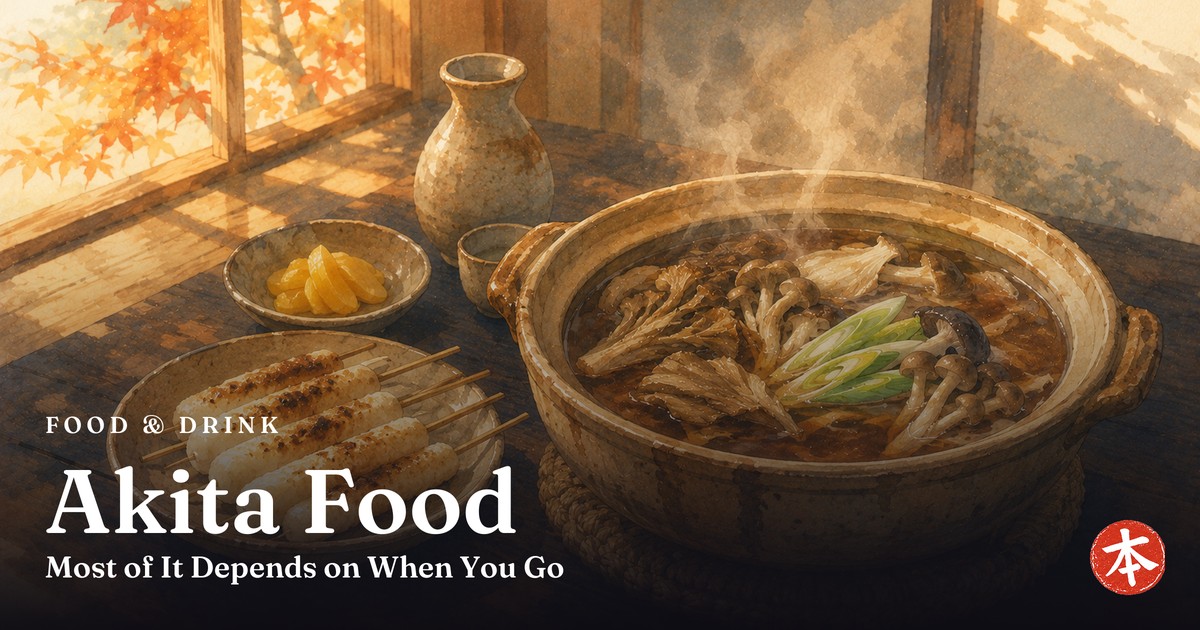
The official description is precise enough to be worth following closely. It is a hotpot with a soy-based broth made using Hinai-jidori chicken, into which go the kiritanpo and mushrooms and other autumn ingredients. The framing is explicit: autumn, with freshly harvested rice. That is the whole dish in one sentence, and it explains why it is a seasonal thing rather than a permanent one.
Two towns claim it, and the official page picks a word carefully
The page lists two local associations: one in Odate City, and one in Kazuno, which it describes as the birthplace. We are quoting that rather than adjudicating it. Regional food origins in Japan are frequently contested and the contest is part of the culture; if you are in either town, the version in front of you is the one that matters.
Damako nabe, the version with a different shape
Damako is cooked rice mashed and rolled into balls — the same raw material as kiritanpo, formed differently. Damako nabe simmers them in a soup with jidori chicken, mushrooms and burdock. The official page calls it the soul food of Gojome Town, which is the detail that turns it from a dish into a destination.
Hinai-jidori, the chicken underneath both
Akita’s official material calls Hinai-jidori one of Japan’s three great flavorful chickens, and describes it in terms of the meat’s own richness rather than tenderness. It turns up as yakitori and in oyakodon as well as in the hotpots. If you want one ingredient to notice while you are there, this is the one that appears in the most places.
The town decides the dish: Akita food by place
Inaniwa udon, from a district rather than a city
Inaniwa udon is named for the Inaniwa district of Yuzawa City, where it has been made for a long time. What distinguishes it, according to the official description, is the production method: it is twisted by hand, and that is what produces the firmness and the smooth throat feel it is known for. It is described as a refined, delicate taste rather than a hearty one, which is worth calibrating your expectations to.
Ishiyaki, which is a cooking method more than a dish
This is the most theatrical thing on the list. Chunks of seafood go into a wooden tub, and then heated Oga stone is dropped in to bring the whole thing to a boil at once. The seasoning is miso. The official page frames it as the bold cooking method of fishermen, which is the right way to think about it: you are eating a technique that existed because it worked on a boat, not because it looked good.
Yokote yakisoba, and the detail that defines it
Thick straight boiled noodles, fried in a thin sauce that contains dashi and that each shop makes its own version of, topped with a fried egg. And then the line that matters: the fukujinzuke is the point. That pickle relish on the side is not a garnish in this dish. If you order Yokote yakisoba and it arrives without it, you are eating something else.
Butter mochi, from the Matagi country
The official page calls it the Matagi’s snack — the Matagi being the traditional hunters of the northern mountains — and places it at the foot of Mt. Moriyoshi in Kita-Akita. It is mildly sweet with a soft, stretchy texture. There is one instruction attached: eat it as it is, without grilling it. Mochi normally invites grilling. This one does not.
How this compares with eating in the cities
If your only reference point for Japanese regional food is what you have eaten in Tokyo, the difference is worth naming. Our guide to Japanese street food covers the things that exist more or less everywhere, and a Tokyo food tour is a guided version of the same idea. Akita is the opposite structure: fewer things, each tied to somewhere specific.
Hatahata, and the food that arrives in December
The prefectural fish, and its schedule
Hatahata is Akita’s prefectural fish, and the official description is about timing: it has the habit of coming to the Akita coast around December to spawn. That is a fish with a calendar, and it is the clearest example on this page of why Akita food planning is a date question.
The three forms you will actually meet
The official page names them. Shottsuru, a fish sauce made from hatahata. Kayaki, hotpot dishes. And hatahata-zushi, a fermented preserved sushi. The processed forms are the reason the fish is present in Akita cooking outside its season — the run is December, the flavor is year-round.
Why shottsuru is worth trying even if the fish is not in season
Because a fish sauce made from a specific local fish is a more direct piece of regional cooking than most dishes are. It is the ingredient that makes other things taste like Akita. If you are there outside December and want the connection anyway, this is the way to it.
Babahera and the food you cannot look up
What it is
Yellow and pink sherbet-style ice cream, served by a seller — traditionally an older woman, which is where the name comes from — who arranges it into the shape of a rose as she serves it. It is as much a performance as a dessert.
Why it does not fit in a plan
The official page says it is sold at event venues and places like them, and then gives an instruction rather than an address: if you see it, you absolutely should eat it. That is unusual language for an official tourism page, and it is honest. There is no shop to add to your map. This is a thing you encounter.
The wider point about planning Akita
Babahera is the extreme case of something that runs through this whole list. A meaningful part of what makes Akita’s food interesting is that it has not been flattened into something bookable. That is a genuine pleasure and a genuine planning problem at the same time, and pretending otherwise would not help you.
Akita rice, sake and the ingredients underneath
The rice, and one thing we are not going to claim
Akitakomachi has been the prefecture’s flagship variety for years. The official page also mentions a newer variety, Sakihokore — but it describes it as due to debut, in the future tense, referring to a year that has already passed. That tells you the page has not been updated rather than telling you anything about the rice. So: the variety exists, and we are not going to describe its current availability from a page that is plainly out of date.
Why two-thirds of the breweries are over a century old
The official explanation has three parts and all of them are geographic. Rice, because Akita has always had it. Clean water. And cold — the page is explicit that the winter temperature matters, because it allows the slow fermentation that good sake needs. That is not marketing; it is a description of why the industry settled there and stayed.
Junsai, the one nobody warns you about
Water shield — a water plant with a slippery coating and a texture the official page describes as popping when you bite it. It grows only in clean water, and Mitane Town has the highest production in Japan. It is low calorie and high in fiber. It is also genuinely strange to eat if you have never had it, which is a reason to rather than not to.
Akita beef, and where it fits
Kuroge wagyu raised in the prefecture, described as tender with a lighter fat than you might expect. It is the least distinctively Akita thing on this page, in the sense that good wagyu exists in many prefectures — but the feed connection back to the rice is the thread that ties it in.
Eating your way north
If you are approaching Akita overland rather than flying in, the food starts before you arrive. Regional bento sold at stations are their own tradition — our guide to ekiben covers how that works — and Sendai is the usual staging point on the Tohoku side, with its own completely different set of local dishes.
Akita food FAQ
What food is Akita famous for?
What is kiritanpo, exactly?
Is kiritanpo only available in autumn?
What is the difference between kiritanpo and damako?
What is iburigakko?
What is babahera ice, and where do I find it?
When can I eat hatahata?
Is Akita good for sake?
Bottom line. Akita’s food is not a menu, it is a map with a calendar on it. Kiritanpo nabe belongs to the autumn rice harvest and to Odate and Kazuno. Hatahata comes ashore around December. Inaniwa udon is Yuzawa, damako is Gojome, ishiyaki is Oga, yakisoba is Yokote, butter mochi is Kita-Akita. Babahera cannot be looked up at all — it is sold at event grounds, and the official advice is simply to eat it if you see it. Pick one or two of these to build the trip around, and treat the rest as whatever your route happens to cross. The one thing available everywhere, all year, is the rice — and everything else on this list is downstream of it.
Sources & what we deliberately did not state
Checked on September 3, 2026. Researched in Japanese from the Akita Prefectural Tourism Federation’s official tourism site, food and sake section. From that page: kiritanpo nabe as an autumn dish using newly harvested rice, in a soy-based broth made with Hinai-jidori, with mushrooms, and the listing of associations in Odate City and in Kazuno, which the page describes as the birthplace; Inaniwa udon as a specialty of the Inaniwa district of Yuzawa City, made by hand-twisting, giving firmness and a smooth throat feel; damako as mashed and rolled cooked rice, damako nabe simmered with jidori, mushrooms and burdock, described as the soul food of Gojome Town; ishiyaki as chunks of seafood in a wooden tub brought to the boil by heated Oga stone, seasoned with miso, described as the bold cooking method of fishermen; iburigakko, with the explanation that pickles are called gakko in Akita, made from daikon smoked over cherry or oak and pickled in rice bran, noted as pairing with cheese; Yokote yakisoba with thick straight boiled noodles, a thin dashi-containing sauce made differently by each shop, a fried egg on top, and fukujinzuke as the point; babahera as yellow and pink sherbet-type ice served in the shape of a rose and sold at event venues; butter mochi as the Matagi’s snack from the foothills of Mt. Moriyoshi, to be eaten without grilling; Hinai-jidori as one of Japan’s three great flavorful chickens; Akitakomachi and the newer variety Sakihokore; junsai with Mitane Town having the highest production in Japan; Akita beef as kuroge wagyu; hatahata as the prefectural fish that comes to the coast around December to spawn, and its forms as shottsuru, kayaki and hatahata-zushi; and the statement that two-thirds of the prefecture’s breweries are more than a hundred years old, with rice, clean water and winter cold given as the reasons. More on how we work: how we research.
Deliberately not stated. Restaurant names, prices and opening hours, because the official page carries none of them — it lists local associations and phone numbers instead. Precise dates for the hatahata run, because the official wording is around December and tightening that would be inventing precision. A schedule or location for babahera, because the page says only event venues and similar places. The current status of the Sakihokore rice variety, because the official page still describes it in the future tense referring to a year that has passed, which means the page is out of date rather than that we know something. And any verdict on whether Odate or Kazuno originated kiritanpo, because the official page names one as the birthplace and lists both, and that is as far as our source goes. This reflects what that source said on September 3, 2026.
in English
Every week we read the Japanese sources English-language media never touches — new openings, price changes, limited releases, rule changes, the seasonal things that come and go in three weeks — and send you a three-minute read of what actually matters. Hit reply with a question about your trip and a human answers.
Free. Unsubscribe anytime. We never share your address.