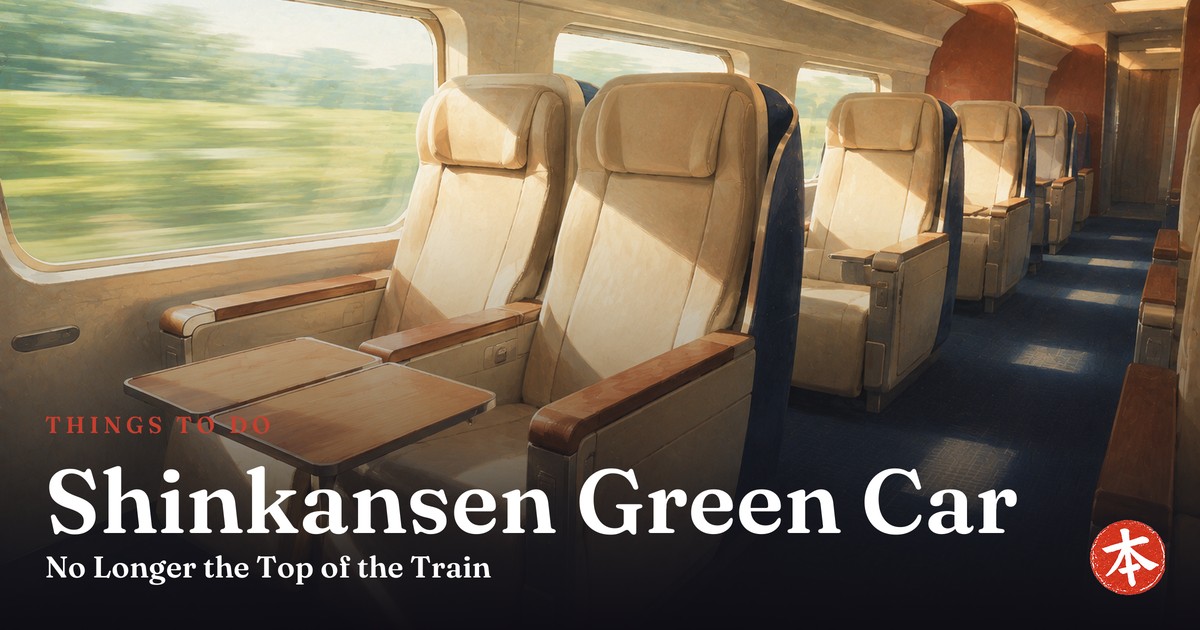
The Green Car has been the answer to “what is the good seat on the Shinkansen” for so long that most English guides still treat it as the top of the train. On October 1, 2026 that stops being true on the Tokaido Sanyo Kyushu route. JR Central is introducing Supreme Class, a private cabin sold above the Green Car, and the fares are already published.
That single change reframes the whole question. The Green Car is not getting worse. It is getting a ceiling put above it, which means the honest way to decide is no longer “is this the best seat” but “is this supplement worth it for my particular journey”. That is a different question, and it has a different answer depending on how long you are on the train, who is traveling with you, and what you intend to do while you are moving.
| What is changing | JR Central introduces Supreme Class on October 1, 2026 on the Tokaido Sanyo Kyushu Shinkansen |
|---|---|
| What that does to the Green Car | It becomes the middle tier on that route, not the top one |
| Supreme Class cabins | Two sizes: Car No. 7 for up to two guests, Car No. 10 for one |
| Tokyo to Shin-Osaka, Supreme Class | 60,790 yen (Car 7) / 42,390 yen (Car 10), per adult one way, fare and limited express included |
| Can you book it yet? | No. JR Central says purchase and boarding details will be announced in due course |
| Where the Green Car still wins | Long legs, crowded dates, and when you are working or sleeping |
| Where it does not | Short legs, and families — the supplement is full adult price for children |
Check Shinkansen tickets and seat classes → Affiliate link — affiliate disclosure.
What changes for the Green Car on October 1, 2026
JR Central’s own page opens with the line “Introducing Supreme Class — 1 October 2026”. The route header on the fare table reads Tokaido Sanyo Kyushu, so this is the spine of the network: the run from Tokyo through Nagoya and Osaka, on down through Okayama and Hiroshima to Hakata.
What Supreme Class actually is
It is a cabin rather than a seat. JR Central describes two types of different size: Car No. 7 for up to two guests, and Car No. 10 for one guest. The marketing language on the page is about a private space where lighting, climate, seating and sound are shaped to your preference. Onboard there is a Welcome Service including a beverage and a confection, plus exclusive products through a Mobile Order Service.
The thing to hold onto is the word cabin. A Green Car seat is a better seat in a shared carriage. Supreme Class is a room. That is a category difference, not an upgrade of degree, and it explains why the fares look the way they do.
The published fares, and what they include
These are per adult, one way, on a Nozomi in the regular season, and JR Central states they include the basic fare and the limited express ticket fare. That last point matters: this is the whole cost of getting there, not a supplement to add to something else. The figures were published as of June 17, 2026.
| Route | Car No. 7 (up to two guests) / Car No. 10 (one guest) |
|---|---|
| Tokyo ↔ Nagoya | 47,060 yen / 32,660 yen |
| Tokyo ↔ Shin-Osaka | 60,790 yen / 42,390 yen |
| Tokyo ↔ Okayama | 74,440 yen / 51,840 yen |
| Tokyo ↔ Hiroshima | 86,620 yen / 60,020 yen |
| Shin-Osaka ↔ Hakata | 72,690 yen / 50,090 yen |
Seasonal adjustment is small and worth knowing anyway: 200 yen is deducted in the off-peak season, 200 yen added in the peak season, and 400 yen added in the super-peak season. On a sixty thousand yen fare that is noise, but it confirms that Supreme Class sits inside the same seasonal pricing system as everything else rather than outside it.
The rule that catches couples
For the two-guest cabin, JR Central states that an accompanying passenger in Car No. 7 must purchase his or her own Shinkansen ticket valid for the same train, and that any seat class is acceptable. A passenger aged six or younger needs no ticket. So the Car No. 7 fare is not a fare for two people. It is the cabin, and your companion still needs to be ticketed onto that train.
You cannot book it yet, and that is the official position
JR Central says Supreme Class will be available through the Tokaido Sanyo Shinkansen Online Reservation Service, and that details on how to purchase and board will be announced in due course. We are quoting that plainly because it is the most useful sentence on the page. The class is announced, the prices are set, and the mechanism is not published. Any guide that currently explains the booking steps for Supreme Class is inventing them.
What a Green Car seat actually buys you
The most watched Japanese video on this question is a straight comparison: reserved seat versus Green Car, ridden back to back. Twenty-six minutes, in Japanese, but the seat width, the legroom and the footrest are all visible — and seeing the two next to each other settles the question faster than any specification table.
Strip away the brochure language and the Green Car is a wider, quieter carriage with fewer people in it. Klook’s Shinkansen listing describes the seating choice on Japanese bullet trains as Ordinary, Green Car, or Gran Class, which is a useful reminder that on some services there has been a tier above the Green Car for years.
Space, and the part of it you actually notice
The practical difference is not one thing, it is the accumulation: more room per passenger, fewer passengers around you, and a carriage that people generally treat as somewhere to be quiet. On a four-hour run to Hiroshima that accumulation is the product. On a fifty-minute run to Nagoya it is mostly theoretical, because you have barely settled before you are collecting your bag.
What the ordinary car already gives you
This is the comparison most upgrade decisions skip. A reserved ordinary seat on a modern Shinkansen already comes with a guaranteed seat, a reclining seat, a tray table and a power outlet, and the trains run at speeds up to 320 km/h either way. If your mental image of the alternative is standing in a vestibule, you are comparing the Green Car against the wrong thing. Compare it against a reserved ordinary seat, because that is the seat you would otherwise be sitting in.
The luggage question, which is not a class question
Oversized luggage on the Shinkansen is governed by a reservation system rather than by which class you buy. Klook’s listing markets the ability to secure seats with oversized luggage space as its own feature, separate from seat class. If you are traveling with large cases, solve the luggage problem as a luggage problem. Buying a Green Car seat does not solve it for you.
See seat classes and fares for your route → Affiliate link — affiliate disclosure.
What does a Shinkansen Green Car cost?
We are going to be disciplined about this, because a half explanation of Shinkansen pricing is worse than none. The Green Car supplement is not simply added on top of the ordinary reserved fare, and the reason is a subtraction that happens first.
The mechanic, in one sentence
In a Green Car the express fee becomes the reserved fee minus 530 yen, and then the Green supplement is added to that. So the gap between an ordinary reserved seat and a Green Car seat is smaller than the headline supplement suggests. The full working, with the numbers for specific routes, is in our Shinkansen price guide, which is where we keep the fare arithmetic so there is one version of it rather than five.
The rule that changes the answer for families
Children get a reduced base fare. They do not get a reduced Green Car supplement. The Green Car and Gran Class supplements are charged at the full adult price for children, and the official rule is explicit about it. For two adults and two children this is often the single fact that decides the question, because you are paying four adult supplements for two adults’ worth of comfort.
Why we do not quote a single Green Car price here
Because there is not one. The supplement varies by distance and the base fare varies by route and season, so a number attached to no route is a number that will be wrong for your trip. If you want the shape of it before you book, our guide to Shinkansen tickets covers what you are buying and how many tickets a journey actually involves — and it is more than you would guess, because a Green Car journey involves three.
How to book a Green Car seat from outside Japan
The three routes to a seat
You can buy at a station machine or counter in Japan, through JR’s own online reservation service, or through a booking platform before you leave. Each has a different failure mode. The station is fine until you arrive at a busy hour with luggage. JR’s own service is the most direct and is the only channel JR Central has named for Supreme Class. A platform is the least friction on arrival day, which is when friction costs the most.
What the platform route actually removes
Klook’s Shinkansen listing describes itself as an official Japan Railway partner and markets four specific removals: a QR code that works as your ticket on most routes with no queuing at machines, reserved space for oversized luggage, the ability to change your train timing in the app, and payment in your own currency before you travel. The listing carries more than 70,000 reviews.
The phrase to read carefully
“Most routes” is doing real work in that QR code claim, and we are pointing at it rather than around it. It means there are routes where the QR code is not the whole story. Check what your specific booking produces — a code, a voucher, or something to exchange — on the booking page for your route rather than assuming the general case applies to you.
Booking timing, which matters more than class
The seat you cannot buy is worth nothing regardless of its class. Reservations on the busiest dates go early, and there are periods when the usual free seating rules on Nozomi do not apply at all. Our Shinkansen reservation guide covers when booking opens and what changes during the crowded seasons.
Book Shinkansen tickets before you land → Affiliate link — affiliate disclosure.
When the Green Car is worth it, and when it is not
The four cases where it earns the money
Long legs. The supplement is charged for the journey, not per hour, so the value per minute rises with distance. Tokyo to Hiroshima or Shin-Osaka to Hakata is where it lands. Crowded dates. The Green Car thins out when the ordinary cars do not. Working. If the two hours are billable or the deck needs to be finished, the quieter carriage is a tool rather than a treat. Sleeping. On an overnight-adjacent schedule after a long flight, the ability to actually sleep changes the next day.
The three cases where it does not
Short legs. Tokyo to Nagoya is under two hours; you are paying full price for a benefit you will use briefly. Families with children. Full adult supplements for children usually settles it. When you have not solved luggage. A better seat next to a case you have nowhere to put is not a better journey.
A test that works better than a rule
Ask what you will do during the ride. If the honest answer is “look out of the window and eat something”, the ordinary reserved seat does that perfectly well, and the money is better spent on an itinerary that puts you on the right line in the first place. If the honest answer is “work, or recover”, the Green Car is buying you the conditions to do it.
What October changes about this test
Almost nothing, which is the useful part. Supreme Class is priced as a different product entirely — 60,790 yen for Tokyo to Shin-Osaka in the two-guest cabin, fare included — so it is not competing for the same decision. It is not the Green Car with more legroom. The Green Car question stays the question it always was; there is simply now something above it for travelers making a different calculation.
Green Car and the Japan Rail Pass
There is a Green version, and we are not quoting its terms
A Green version of the nationwide pass exists, which is why this question follows the Green Car around. What we are deliberately not doing is repeating its price or its conditions from memory. Pass terms have been revised, and the version on the official site at the moment you buy is the one that governs your trip. Our guide to using a rail pass on the Shinkansen covers how pass travel and seat classes interact, including the trains a pass does not cover.
The comparison that actually decides it
A Green pass is worth more than an ordinary pass only if you will use Green Car seats often enough to clear the difference. For two long trips it rarely does. For a rail-heavy two weeks it can. The arithmetic is yours to run against your own itinerary, and it is the kind of calculation where writing out the actual legs beats reading a general recommendation.
And Supreme Class?
Unknown, officially. JR Central has published the class, the cabins, the fares and the onboard service, and has said that purchase and boarding details are still to come. Whether any pass will cover it is exactly the sort of detail that would appear in that later announcement. We would rather tell you it is unpublished than fill the gap.
Shinkansen Green Car FAQ
Is the Green Car the highest class on the Shinkansen?
What is Supreme Class, and how much does it cost?
Can I book Supreme Class now?
What does the Green Car supplement actually cost?
Does the Japan Rail Pass cover the Green Car?
Will a rail pass cover Supreme Class?
Do children pay for a Green Car seat?
Is the Green Car worth it on a short trip?
Bottom line. The Green Car is a wider, quieter seat in a shared carriage, and from October 1, 2026 it is no longer the top of the Tokaido Sanyo Kyushu Shinkansen — Supreme Class sits above it, at 60,790 yen Tokyo to Shin-Osaka in the two-guest cabin with the fare included, and JR Central has not yet published how to book it. None of that changes the Green Car decision, which is still the same test: long legs, crowded dates, and journeys you intend to work or sleep through. Short hops and families with children are where the supplement stops making sense, because it is charged at full adult price for children.
Sources & what we deliberately did not state
Checked on September 3, 2026. From JR Central’s official Supreme Class page, which itself carries the note “Information as of 17 June 2026”: the introduction of Supreme Class on 1 October 2026; the route header Tokaido Sanyo Kyushu; the two cabin types, Car No. 7 for up to two guests and Car No. 10 for one guest; the fare table per adult one way on Nozomi in the regular season, including the basic fare and the limited express ticket fare, covering Tokyo to Nagoya, Shin-Osaka, Okayama and Hiroshima and Shin-Osaka to Hakata; the seasonal adjustment of minus 200 yen off-peak, plus 200 yen peak and plus 400 yen super-peak; the rule that an accompanying passenger in Car No. 7 must buy a ticket valid for the same train in any seat class and that a passenger aged six or younger needs none; the statement that the class will be sold through the Tokaido Sanyo Shinkansen Online Reservation Service with purchase and boarding details to be announced in due course; and the Welcome Service of a beverage and a confection with a Mobile Order Service. From the Klook Shinkansen listing: the description of an official Japan Railway partner; more than 70,000 reviews; a QR code serving as the ticket on most routes with no queuing at machines; reserved oversized luggage space; train time changes in the app; payment in your own currency; the three seating options of Ordinary, Green Car and Gran Class; and speeds up to 320 km/h. The Green Car fare mechanic and the children rule are covered in our own price guide. More on how we work: how we research.
Deliberately not stated. Green Car seat dimensions and seat pitch, because they were not on the official pages we read today. Route-by-route Green Car supplement figures, because that arithmetic lives in our price guide and we did not re-read JR’s fare tables for this piece. Gran Class fares. Whether Supreme Class replaces Green Car cars or runs alongside them on every service, because the official page names the cabin cars and the route group and nothing further. And whether any rail pass will cover Supreme Class, because JR Central has explicitly said those details are still to be announced. This reflects what those sources said on September 3, 2026; the booking page and JR’s own announcements carry the current position for your dates.
Check Shinkansen routes, times and seat classes → Affiliate link — affiliate disclosure.
in English
Every week we read the Japanese sources English-language media never touches — new openings, price changes, limited releases, rule changes, the seasonal things that come and go in three weeks — and send you a three-minute read of what actually matters. Hit reply with a question about your trip and a human answers.
Free. Unsubscribe anytime. We never share your address.