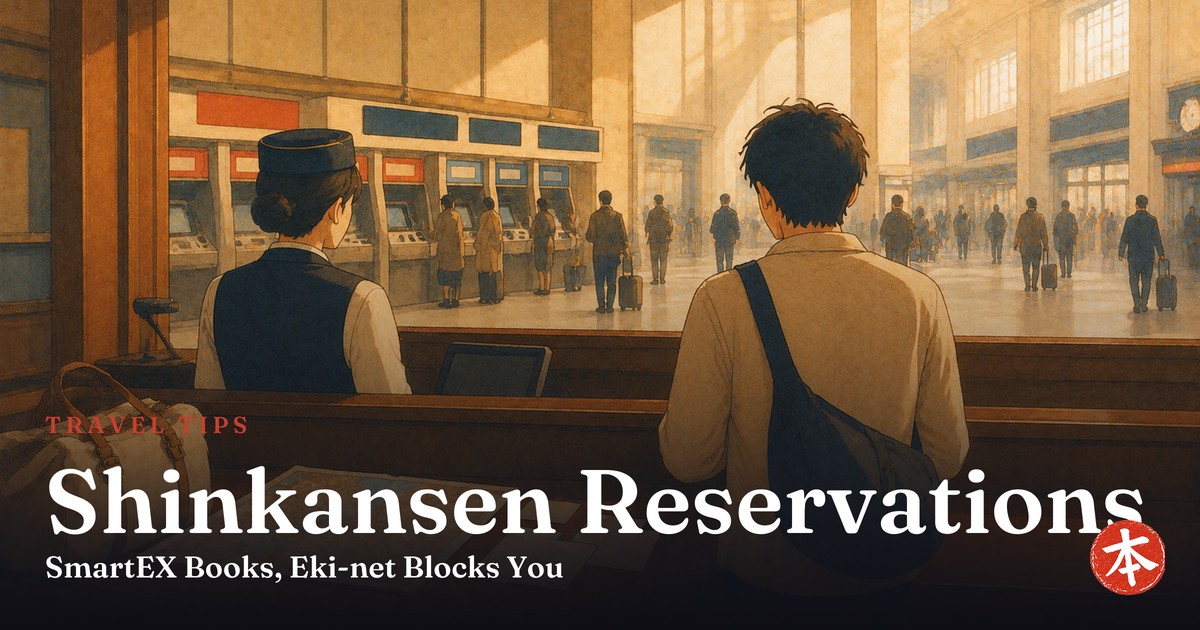
Reserving a shinkansen seat as a foreign visitor is straightforward once you know which site is meant for you – and confusing until then. There are four legitimate ways to get a reserved seat, and which one you use depends on the line, whether you have a Japan Rail Pass, and whether you are still overseas or already in Japan. This guide is about the booking itself – the decision tree, the four channels, and the rules that catch people out. For the ticket types themselves, the trains, and the fare breakdown, we link the deeper guides.
Which reservation channel are you? A decision tree
Four questions, in order. The answer to each one narrows what you should use.
→ Tokaido / Sanyo / Kyushu (Tokyo – Nagoya – Kyoto – Osaka – Hiroshima – Hakata – Kumamoto): use SmartEX.
→ Tohoku / Joetsu / Hokuriku / Yamagata / Akita / Hokkaido: use JR-EAST Train Reservation (not eki-net).
→ Any line, no online preference: use a Midori-no-madoguchi ticket office or a station machine on arrival.
Q2. Do you have a Japan Rail Pass?
→ Bought on the official JR Pass website: reserve online through JRPR (JAPAN RAIL PASS Reservation), then pick up the paper ticket at a machine or counter.
→ Bought through a travel agency: exchange your voucher in Japan first, then reserve at a station machine or counter. JRPR is not open to you.
→ Either way: do not try SmartEX – it cannot be used with a Rail Pass.
Q3. Are you still overseas?
→ SmartEX and JR-EAST Train Reservation both take bookings from your own country.
→ Eki-net does not: its site states customers living outside Japan cannot use the service.
Q4. Just walking up on the day?
→ Non-reserved car (“jiyuseki”) on Nozomi, Hikari, Kodama, Sakura or others – buy at the station machine and board the next train. Nozomi's non-reserved section is cars 1 and 2 only, with 165 seats total – not the three cars many English guides state.
If you already know your booking route, jump to the section for it. If you are new to shinkansen tickets in general, start with our shinkansen ticket guide – this article assumes you know what a “reserved seat” and a “non-reserved seat” are.
SmartEX: the default for Tokaido, Sanyo and Kyushu
What it covers, and what it does not
SmartEX is the shared English booking site of JR Central, JR West and JR Kyushu, and it covers the routes visitors ride most often: Nozomi, Mizuho, Hikari, Sakura, Kodama and Tsubame, in ordinary reserved, ordinary non-reserved, and Green Car (first class). It does not cover the JR East lines north of Tokyo – Tohoku, Joetsu, Hokuriku, Yamagata, Akita – and it cannot be used together with a Japan Rail Pass. That combination case is the most common source of confusion, and the official page settles it plainly:
Registering from abroad
The English registration is deliberately light – an email address and a credit card, with no annual membership fee. The official English wording on cross-border use:
The English page does not publish a country list for accepted foreign-issued cards, so we do not quote one – major international brands are widely reported to clear, but the definitive test is your own card at the registration screen. The one caution the official page does put in writing is that payment settles in yen and a foreign transaction fee may be charged by your card issuer on each transaction – including each time you change a booking, because a change refunds the old fare and takes a new one.
When can I book?
The official window is a year ahead:
The nuance to understand: the first eleven months are a tentative booking – you pick from a provisional timetable, and SmartEX confirms the actual train, time and seat after 8:00 a.m. one month before boarding, notifying you by email. Bookings are also possible the same day, right up to four minutes before departure.
Changes and cancellations on SmartEX
This is where SmartEX genuinely shines against a paper ticket: changes are free and unlimited until departure, subject to a three-month window from the original purchase. The wording:
Cancellations, unlike changes, do cost a small fee. Before departure, the official refund page lists 320 yen for both Ordinary Car Reserved and Ordinary Car Non-Reserved seats. Green Car uses a different scale published on the same page as a separate table – we do not quote that here because it varies by section; check the official refund page for the exact amount. For a non-reserved SmartEX ticket only, the refund window extends to 23:30 on the day of boarding.
How you actually get on the train
Two paths, both painless once set up. Register a supported IC card or mobile IC (Suica, PASMO, ICOCA and eight other domestic brands) into your SmartEX account in advance and tap at the shinkansen gate – the fare is charged to your credit card at booking, not from your IC balance. Alternatively, hold the QR-Ticket SmartEX issues at the gate reader – you also need the QR-Ticket to exit at your destination, so do not delete the email.
For a real-route worked example on the Tokaido, the Tokyo to Osaka shinkansen guide walks through the booking against a specific journey. The Nozomi ticket guide covers what you are booking onto – stops, car layout, the 165-seat non-reserved section – in detail.
JR-EAST Train Reservation: for the north and east
If your shinkansen is Tohoku, Joetsu, Hokuriku, Yamagata, Akita or bound for Hokkaido, SmartEX cannot help you and eki-net will not let you register. The route open to visitors is JR-EAST Train Reservation, a separate English site run by JR East. It covers the JR East shinkansen network and a handful of limited-express services visitors take often – Narita Express, Azusa, Nikko.
The situation you will not read in older English guides is what happens on the Japanese eki-net site itself. Its own attention notice states:
That is by design: eki-net registers a Japanese address and phone number, and its account flow is not designed for visitors. JR-EAST Train Reservation exists precisely to fill that gap.
Midori-no-madoguchi and station machines: the fallback that always works
Why the counter is still the most reliable option
Every JR shinkansen station has a Midori-no-madoguchi – the green-signed ticket office – and English-menu vending machines beside it. Nothing about the counter requires an account, an app, a QR code or a foreign card that clears an unfamiliar payment gateway. The official English line from JR Central on the machines:
The counter is the friction-free option when you want a human, need to combine tickets, are refused online, are moving with a group, or hold a Rail Pass bought through an agency and cannot use JRPR. Pass holders in particular should treat the counter as the default rather than the fallback.
Hours: check the station, not the network
The maximum published hours run from early morning to late evening, but individual stations differ. The Japan Rail Pass site states:
For late-evening or very early departures, do not assume the office at your specific station will match the maximum – a smaller station may close by 20:00.
What to say at the window
The official English-language guidance for visitors buying at a JR Central counter lists the five pieces of information staff need:
If you can write those five lines on a piece of paper or a phone screen before you approach the counter, the transaction takes under a minute.
Changes and refunds at the counter
For a standard paper shinkansen ticket, the JR Central English page allows one free swap:
Refund fees are laid out in a fixed schedule: 220 yen for the basic fare and for a limited-express non-reserved or Green Car non-reserved ticket; 340 yen for a reserved seat, limited-express reserved, Green Car reserved or sleeping-car reserved ticket until two days before departure; and 30 percent (with a 340 yen floor) from one day before until the scheduled departure time. If you miss your reserved train, the ticket can still be used to ride a non-reserved seat on the same route the same day.
JR Rail Pass seat reservations: free, but the rules matter
For Rail Pass holders, the headline is short: seat reservations cost nothing extra. The official line:
How you make the reservation, however, depends entirely on where you bought your pass.
If you bought your Rail Pass on the official site (online)
You get access to JAPAN RAIL PASS Reservation (JRPR), the pass holder's own seat-booking site: “If you purchased a JAPAN RAIL Pass online, you can book a reserved seat on the dedicated website.” The catch is the pickup step – the online reservation is not the ticket itself:
At a reserved-seat machine, the flow is three steps: scan the QR code on the pass (or enter the reservation number) and enter your passport number; input the section, date and time and choose the train; check and issue. JRPR covers up to 110 trains per pass, does not allow two trains at the same time, and does not cover S Work cars or GranClass on the pass fare alone.
If you bought your Rail Pass through a travel agency
JRPR is not open to you – the rule ties it to the official site purchase – and you reserve at a station instead. That means exchanging your voucher for the actual pass on arrival (or at a JR exchange office), and then visiting a Midori-no-madoguchi or a reserved-seat ticket machine to book seats train by train. The reservation itself is still free. The JR Pass shinkansen guide lays out the ride-and-reserve loop in more detail.
The Nozomi and Mizuho exclusion
The single biggest surprise for Rail Pass holders is that the pass does not cover the fastest trains at all:
The workaround is the [ONLY WITH JAPAN RAIL PASS] NOZOMI MIZUHO Ticket, sold only in Japan at Midori-no-madoguchi and station machines. It is a per-section surcharge on top of the pass – as of the pricing on the official page, Tokyo to Shin-Osaka has been 4,960 yen, Tokyo to Nagoya 4,180, and Tokyo to Hiroshima 6,500 – with the same amount applying whether you take a reserved, non-reserved or Green Car seat. If Nozomi speed is not the point of the trip, Hikari on the same route is fully covered and takes roughly 20 to 30 minutes longer.
Riding without a reservation: what to know
The system is designed to let you walk up. Every Nozomi, Hikari and Kodama on the Tokaido has non-reserved cars (“jiyuseki”) – you buy a non-reserved ticket at the machine and take the next train that opens its doors. Two nuances matter. First, Nozomi's non-reserved section is cars 1 and 2 only, with 165 seats between them – many English guides state three cars, which is wrong for Nozomi. Hikari and Kodama do have three non-reserved cars. Second, on peak-period dates listed on the JR Central schedule, some or all trains switch to fully reserved seating, and a non-reserved ticket on those trains permits only standing in the vestibules of ordinary cars. Our shinkansen ticket guide keeps the current peak-date schedule.
Peak dates worth planning around
The Japan Rail Pass site names three high-traffic windows explicitly: May 1 to 6 and September 18 to 23 (consecutive holidays), August 7 to 16 (Obon), and December 29 to January 3 (year-end/New Year, the single most popular travel week of the Japanese calendar). If your trip falls in any of these, book early – SmartEX opens a full year ahead, and the most-loaded trains fill within days once the one-month confirmation clears.
Fees, cancellations and refunds at a glance
| Channel | Change fee | Cancellation fee (before departure) | Hours |
|---|---|---|---|
| SmartEX | Free, unlimited (within 3 months of purchase) | 320 yen (ordinary reserved and non-reserved); Green Car separate | 24 hours (excluding maintenance) |
| JR-EAST Train Reservation | See official site (Access Denied from many overseas IPs; live numbers not verifiable at time of writing) | See official site | Check on the site |
| Ticket window (paper ticket) | One swap free (same type) | 220 yen non-reserved; 340 yen reserved (to 2 days out); 30% (min 340) from 1 day out | Up to 4:00 a.m. – 11:30 p.m.; varies by station |
| JR Pass seat reservation | Free (JRPR: rebook online; counter: rebook at counter) | Free reservation, so no fee to release | Counter/machine hours; JRPR site 24 hours |
Two things to notice in the table: the SmartEX flexibility on changes is a genuine advantage over a paper ticket if your plans are provisional, and the JR Pass row's “free” applies only to the reservation itself – the pass has its own purchase price and revision schedule, covered in our Rail Pass shinkansen guide.
Common mistakes visitors make
Six patterns, all avoidable. Registering on eki-net from overseas – the site is closed to you; use JR-EAST Train Reservation. Combining SmartEX with a Rail Pass – not possible; the SmartEX booking becomes a full-fare charge against your card. Riding Nozomi on a Rail Pass without the NOZOMI MIZUHO Ticket – a fare-dodge that the conductor will catch. Reserving online with an agency-bought pass – JRPR is closed to agency purchases; use the counter. Counting three cars for Nozomi non-reserved – it is cars 1 and 2 only, 165 seats total. Skipping the JRPR pickup step – the online reservation is not the ticket; collect the paper reserved-seat ticket at a machine or counter before boarding.
FAQ
Which shinkansen booking site should I use as a foreign visitor?
Can I book a shinkansen from outside Japan?
How far in advance can I reserve a shinkansen seat?
Are seat reservations free with a JR Pass?
Can I take the Nozomi with my JR Rail Pass?
Can I use SmartEX with a Japan Rail Pass?
Do I have to book, or can I just walk up on the day?
How much does it cost to change or cancel a shinkansen reservation?
What if I miss my reserved train?
How do I actually get on the train after I book?
What days should I avoid trying to reserve?
Is there any way to reserve a shinkansen without a Japanese phone number or address?
Bottom line (2026) — There are four routes to a reserved Shinkansen seat, and the right one depends on the line and the ticket. SmartEX books Tokaido, Sanyo and Kyushu from abroad; eki-net is blocked to overseas residents; JR Pass reservations are free but must be picked up on a machine or at a counter; and every Nozomi, Hikari and Kodama has non-reserved cars for walk-ups.
Sources
Booking channels, SmartEX terms, reservation windows, change and cancellation rules, IC and QR entry, Rail Pass reservation rules including JRPR pickup, the Nozomi/Mizuho exclusion and the NOZOMI MIZUHO Ticket, and peak-date guidance: SmartEX (smart-ex.jp/en/), Japan Rail Pass (japanrailpass.net/en/), JR Central (global.jr-central.co.jp/en/) and eki-net (eki-net.com). Read August 26, 2026. Terms change; confirm on the operator's own page before you book. The embedded video is by its creator.
Tokyo to Osaka, Tokyo to Kyushu, Tokyo to Hokkaido — day by day — plus seven places most visitors never reach.
- 12 pages, 80 photographs, every stop linked to its guide
- Every price and opening hour read from the official page
- Re-issued monthly, so it does not go stale in your inbox
Free. One email a month, plus the rare change that matters. Unsubscribe with one click in any email. By subscribing you agree to our privacy policy.