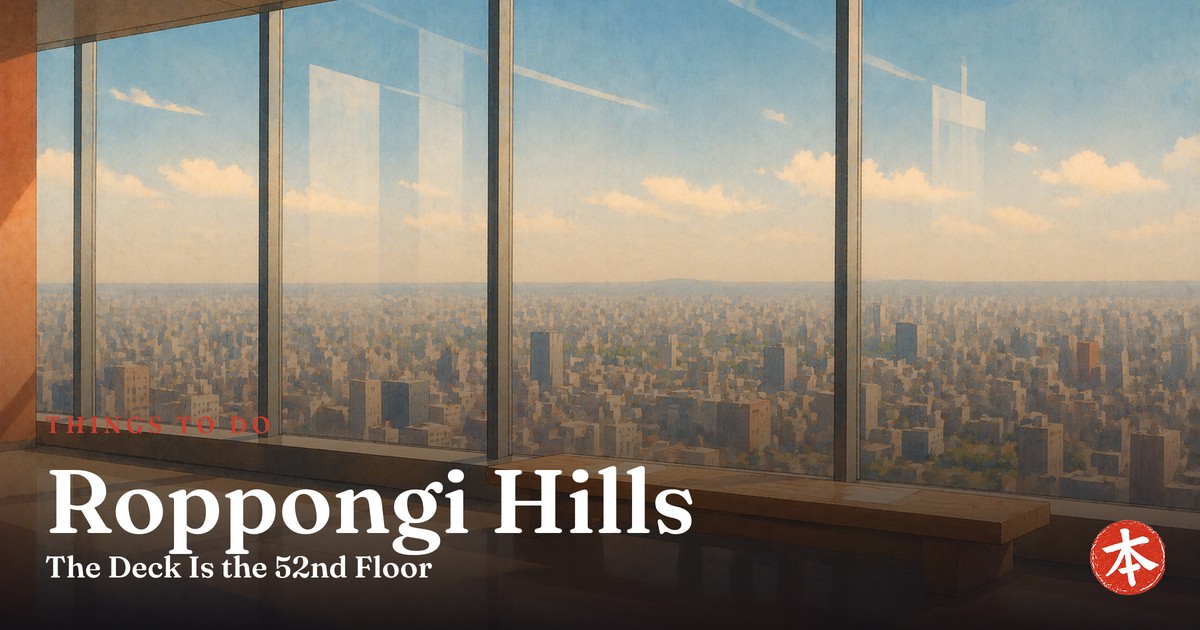
Tokyo City View is the cheapest of the big Tokyo viewing decks — the listing showed a from-price of US$7.49. It is also the one where people most often buy something slightly different from what they pictured, because the building has both an enclosed deck on the 52nd floor and a roof, and the ticket name does not tell you which you are getting.
| What you book | Admission to Tokyo City View in Roppongi Hills Mori Tower |
|---|---|
| The deck | 52nd floor, enclosed, views in every direction |
| The roof | Mentioned on the listing — which option includes it is not stated |
| Price | From US$7.49 — a from-price, not the only price |
| Hours | Not shown on the listing. We are not guessing |
| How long | 1–2 hours, per the listing |
| You can see | Tokyo Skytree, Tokyo Tower, Odaiba, Ebisu Garden Place |
What the ticket names, and what it leaves open
The listing is clear about one thing and vague about another, and knowing which is which saves you the specific disappointment this attraction is known for.
The 52nd floor is the part you are definitely buying
The address on the booking page is the 52nd floor of Roppongi Hills Mori Tower, and the description leads with views from that floor. This is an enclosed deck: glass on all sides, weather-proof, open in rain. If you book anything here, this is what you have booked.
The roof is where the ambiguity lives
The same description also mentions rooftop views of Tokyo city center from up above. What it does not do is say which ticket option admits you to a roof, or whether that is a separate add-on with its own conditions. We are not going to fill that gap in with a guess. What we will say is that this is the single most common thing to get wrong here, and it is entirely avoidable by reading the option before you reserve.
Read the option, not the title
Attraction listings are titled for search rather than for accuracy, and “observatory deck” covers a range of things in one building. The reliable move is to open the option you intend to buy and read what it lists, rather than reasoning from the name at the top of the page. That takes about a minute and it is the whole of the advice.
See Tokyo City View options → Affiliate link — affiliate disclosure.
The listing showed no opening hours at all
This is unusual enough to be worth a section. Every other deck we have written up carried its hours on the booking page. This one had the field empty when we read it.
What a blank field actually means
Usually it means the hours vary — by day of the week, by season, or because the building runs events that change access. It can also just mean nobody filled it in. Either way, the practical consequence is the same: the booking page is not your source for timing this visit, and the operator’s own page is.
You cannot borrow another tower’s hours
It is tempting to reason that Tokyo decks stay open late, so this one does too. They are run by different operators inside different buildings with different tenants, and last entry is typically well before closing at all of them. Assuming a late door because a competitor has one is exactly the shape of mistake that ends with a locked entrance.
What to check before you commit to a time
Two things: the operating hours for the specific date, and the last-entry time, which is almost always earlier and is the number that actually binds. If you are planning this as an evening stop after dinner, confirm both. If you are going in the afternoon, neither is likely to matter.
What you can see, and why a central deck reads differently
An eighteen-minute walk around the whole 52nd floor in 4K, taking in every side of the deck in turn. It is in Japanese, but this is the clearest available answer to the question a central observatory raises — what you are looking at in each direction, and how much of Tokyo is between you and the horizon.
The listing names four things you can pick out from up there: Tokyo Skytree, Tokyo Tower, Odaiba and Ebisu Garden Place.
That list tells you where you are standing
Those four points sit in four different directions, which is the useful information hiding inside a marketing sentence. You are in the middle of the city, not on its edge. The view has no empty quarter, no side that is just water or sky, and no obvious front. That is why the listing suggests walking the whole deck and finding your own spot rather than shooting from wherever the lift left you.
Density instead of horizon
A deck at the edge of a city gives you a skyline. A deck in the middle gives you texture — roads, blocks, the way one district ends and another starts. If you have been walking Tokyo for three days, this is the view that makes the map make sense, and that is a different pleasure from the postcard one.
Daylight for orientation, night for the glow
The listing offers both framings and both are honest. In daylight you get the layout. After dark you get Tokyo Tower lit up inside your view rather than as a distant landmark, and Tokyo Skytree standing off to the other side. Neither is the correct answer; they are two different attractions sharing a floor.
Check dates and options → Affiliate link — affiliate disclosure.
US$7.49, and what a price like that signals
The from-price is the lowest of the major Tokyo viewing decks by a wide margin, and it is worth understanding why rather than treating it as a bargain or a warning.
It is a from-price, not the price
A from-price is the cheapest option on the page. If the roof, an exhibition or a timed slot costs more, that is a different line further down. Budget from the option you actually want, not from the number in the search result — this is the most common way people end up feeling misled by a listing that was accurate.
What you are not paying for
The premium Tokyo decks charge for open-air access, timed entry that guarantees space, and in one case a rooftop that has become a destination in itself. If this deck is cheaper, that is the category of thing being left out. What is not being left out is the view, which is the part most people came for. Whether that trade suits you is a judgment only you can make, and it is a much easier one to make when you know what the money is buying.
The shop is a real part of the visit
The Tokyo City View Shop carries observatory-only goods alongside Roppongi and Tokyo items. Observatory-exclusive merchandise is a genuine category in Japan and it is not available at street level, so if you buy souvenirs at all, this is a better ten minutes than most station shops. It sits at the end of the route, which is why people miss it.
Check availability → Affiliate link — affiliate disclosure.
Fitting it into a Tokyo day
Roppongi Hills is a large complex and the observatory is the top of it, not the whole of it. That changes how you should schedule this compared with a standalone tower.
Whether the museum and the deck are one ticket
We did not verify how the two admissions relate, so we are not going to state it either way. If you want both, look at what each option includes before you reserve. Getting this wrong means paying twice in the same building, which is annoying in a way that is entirely preventable.
What to pair it with outside the building
Roppongi sits between several districts you are probably already visiting, so this works as an afternoon anchor with Harajuku earlier in the day. If you want an open-air deck instead of an enclosed one, that is a different building and a different trip — our guide to Shibuya Sky covers the one people usually mean.
When to skip it
If you have already booked a high view elsewhere on the same trip and your reason for adding this one is that it is cheap, the honest answer is that a second deck in the same city gives you diminishing returns. Where this one earns its place is as the central view — the one that explains the city rather than photographing it.
Deliberately not stated here
| What we are not saying | Why |
|---|---|
| Opening and closing hours | The field was blank on the listing when we read it. We are not borrowing another attraction’s hours |
| The last-entry time | Not stated. It is almost certainly earlier than closing, which is why it matters |
| The yen gate price | Not verified from the operator. US$7.49 is the listing’s from-price, labeled as such |
| Whether rooftop access is included | The listing mentions rooftop views without saying which option admits you. We are not guessing at a physical access question |
| Whether the Mori Art Museum shares the ticket | Not stated on this listing and not verified elsewhere |
| The height of the deck | Not verified. We name the floor the listing named — the 52nd — and no measurement |
Roppongi Hills observatory FAQ
Is the Roppongi Hills observatory indoors or on the roof?
How much are Tokyo City View tickets?
What time does it open and close?
What can you actually see from up there?
How long should I allow?
Is the Mori Art Museum the same ticket?
Is it better in daylight or after dark?
What is in the Tokyo City View Shop?
Check Tokyo City View tickets → Affiliate link — affiliate disclosure.
Bottom line (2026) — Tokyo City View is the 52nd-floor enclosed deck in Roppongi Hills Mori Tower, and at a from-price of US$7.49 it is the cheapest of the major Tokyo views. The listing also mentions rooftop views but does not say which option includes the roof, which is the thing to check before you reserve. The opening hours field was blank, so confirm the times with the operator rather than assuming a late door. You can pick out Tokyo Skytree, Tokyo Tower, Odaiba and Ebisu Garden Place from up there, which tells you this is a central view rather than a skyline one. Allow one to two hours and leave time for the observatory-only shop on the way out.
Sources
Written on September 2, 2026 from the Klook listing for the Roppongi Hills Tokyo City View Observatory Deck: views from the 52nd floor and rooftop views of central Tokyo; the address given as the 52nd floor of Roppongi Hills Mori Tower; the landmarks named as Tokyo Skytree, Tokyo Tower, Odaiba and Ebisu Garden Place; the recommendation to walk the observation area and find your own spot; the Tokyo City View Shop and its observatory-exclusive goods; the suggested duration of one to two hours; and the listed from-price of US$7.49, with a 4.7/5 rating across 5,200 reviews and 200,000+ bookings. The opening hours field on that listing was empty, which is why no hours appear in this guide. More on how we work: how we research.
Prices, options and access arrangements change, and a deck inside a working office tower changes with the building. This reflects what that source said on September 2, 2026, and the operator publishes its own current times and inclusions that are worth a glance the week you go.
Tokyo to Osaka, Tokyo to Kyushu, Tokyo to Hokkaido — day by day — plus seven places most visitors never reach.
- 12 pages, 80 photographs, every stop linked to its guide
- Every price and opening hour read from the official page
- Re-issued monthly, so it does not go stale in your inbox
Free. One email a month, plus the rare change that matters. Unsubscribe with one click in any email. By subscribing you agree to our privacy policy.