Japan has ten shinkansen lines run by five different companies, and almost every confusing thing about the network traces back to that second number. Five train types have no unreserved seats at all. The oversized-baggage rule everyone tells you about applies to four lines out of ten. An IC card opens the gate on JR East's lines and does nothing on the Tokaido. And three separate things change on October 1, 2026: the Japan Rail Pass gets more expensive, a new class above Green Car launches, and the Sanyo food trolley disappears. Here is the network as its operators actually describe it.
The ten lines
| Line | Operator | Section | Opened |
|---|---|---|---|
| Tokaido | JR Central | Tokyo – Shin-Osaka | 1964 |
| Sanyo | JR West | Shin-Osaka – Hakata | Full line Mar 10, 1975 |
| Tohoku | JR East | Tokyo – Shin-Aomori (JR East's longest) | 1982 |
| Joetsu | JR East | Tokyo – Niigata | 1982 |
| Hokuriku | JR East → JR West at Joetsu-Myoko | Tokyo – Tsuruga | 1997 / 2015 / Mar 16, 2024 |
| Yamagata (mini) | JR East | Tokyo – Yamagata / Shinjo | 1992 · Shinjo 1999 |
| Akita (mini) | JR East | Tokyo – Akita | 1997 |
| Hokkaido | JR Hokkaido | Shin-Aomori – Shin-Hakodate-Hokuto (149km) | Mar 26, 2016 |
| Kyushu | JR Kyushu | Hakata – Kagoshima-Chuo | 2004 + 2011 |
| Nishi Kyushu | JR Kyushu | Takeo-Onsen – Nagasaki (66km, 5 stations) | Sep 23, 2022 |
The network seen through its own route map, including the 2024 Tsuruga extension:
🚨 Before you plan: two live situations
② Three things change on October 1, 2026. The Japan Rail Pass rises in price, a new class called Supreme Class launches, and the Sanyo Shinkansen food trolley ends. If you are reading this before then, some of what follows has a shelf life.
The trains, and the five with nowhere to sit unreserved
Which train name means what?
Each line runs a fast, a semi-fast and an all-stops service, and learning the three names for your line is most of the battle. Tokaido and Sanyo: Nozomi, Hikari, Kodama. Through services onto the Kyushu line: Mizuho, Sakura, Tsubame. Tohoku and Hokkaido: Hayabusa, Hayate, Yamabiko, with Nasuno as a Tokyo-area commuter service. Joetsu: Toki and Tanigawa. Hokuriku: Kagayaki, Hakutaka, Asama as far as Nagano, and Tsurugi as a Tsuruga shuttle. The mini-shinkansen lines run Komachi (Akita) and Tsubasa (Yamagata), coupled to Tohoku trains for the run out of Tokyo. Nishi Kyushu has exactly one name: Kamome.
The five fully reserved trains
This is the single most consequential thing in this article. Hayabusa, Hayate, Komachi, Tsubasa and Kagayaki have no unreserved seats at all. That covers the fast services to Aomori, Hakodate, Akita, Yamagata and Kanazawa — so a Japan Rail Pass alone does not get you aboard on the day; you still need a seat reservation, which is free with the pass but must be made. On the other lines, unreserved sections are published per train: Yamabiko cars 1–5, Nasuno 1–8, Hakutaka 1–4, Asama 1–5, Toki 1–5, Tanigawa 1–10. And on the Tokaido, note the change most guides missed: Nozomi's unreserved section is cars 1 and 2, not the cars 1 to 3 you may have read.
And the eight periods when even Nozomi is fully reserved
JR Central and JR West publish the dates outright. In the current fiscal year: April 24–May 6, August 7–16, September 18–23, October 10–12, November 21–23, December 25–January 5, January 9–11 and March 20–22. Two things soften it: every other train type keeps normal unreserved seating in those windows — Hikari, Kodama, Mizuho, Sakura and Tsubame — and an unreserved ticket still lets you board a Nozomi, but the operators are explicit that this means standing in the vestibule, not finding a seat.
If your route runs west, two city guides cover the ground the trains drop you into: Fukuoka at the far end of the Sanyo line, and Sendai on the Tohoku side in the other direction. Both are cities where the station is the center rather than the edge, which changes how you plan the first hour.
Passes: what the fine print actually says
The Nozomi and Mizuho exclusion, and the way around it
The Japan Rail Pass is not valid for any seat, reserved or unreserved, on Nozomi or Mizuho. The official workaround is a supplementary ticket sold only to pass holders, and the details matter: it must be bought each time, before boarding, it is not sold online — only at reserved-seat ticket machines, JR ticket offices, travel centers and some agencies — and the price is identical for Green, reserved and unreserved. Current fares: Tokyo–Nagoya 4,180, Tokyo–Kyoto 4,960, Tokyo–Shin-Osaka 4,960, Tokyo–Hiroshima 6,500, Shin-Osaka–Hakata 4,960, Hakata–Kagoshima-Chuo 5,150 yen. It is valid one day, one direction, on the named section only. In practice, on most Tokyo–Kyoto trips the Hikari costs you about twenty extra minutes and nothing extra in yen — see our JR Pass and shinkansen guide for when paying the supplement is actually worth it.
The October 1 price change
For exchange orders bought through overseas agencies, from October 1, 2026: seven-day ordinary 50,000 → 53,000 yen and Green 70,000 → 74,000; fourteen-day 80,000 → 84,000 and 110,000 → 116,000; twenty-one-day 100,000 → 105,000 and 140,000 → 147,000. What we will not do is tell you what happens to online purchases: the official online-purchase table carries no date qualifier and still shows the old prices, so anyone claiming to know either way is filling a gap the railway left. For the whole pricing picture see our JR Pass price guide.
Regional passes are stranger than the national one
Three traps, all from official pages. The Hokkaido Rail Pass cannot be used on the Hokkaido Shinkansen — JR Hokkaido states it twice on the same page, and it is the classic way to strand yourself at Shin-Hakodate-Hokuto. JR Kyushu's passes do cover Mizuho, the exact opposite of the national rule — though they explicitly do not cover Hakata to Kokura, because that stretch is JR West's Sanyo line. And none of JR Central's tourist passes allow the Tokaido Shinkansen at all. Meanwhile JR East has consolidated its regional offering into a single JR EAST PASS at 35,000 yen for 5 consecutive days (or 50,000 for 10) — the older area passes with flexible days inside a two-week window are gone from its pages — and the JR TOKYO Wide Pass is now 16,000 yen. One honest gap: JR West's pass pages never mention Nozomi or Mizuho anywhere, defining coverage purely by line, section and seat class, so we are not going to assert what they do or do not allow. Our regional JR passes guide goes area by area.
Luggage, seats and the things that differ by operator
The oversized-baggage rule covers four lines, not ten
On the Tokaido, Sanyo, Kyushu and Nishi Kyushu, baggage whose three dimensions total more than 160cm and up to 250cm requires a seat with an oversized-baggage area. The reservation itself is free — JR Central states it costs the same as an ordinary or Green reserved seat — and boarding without one incurs a 1,000 yen charge. Over 250cm is not permitted aboard at all. Two exemptions worth knowing: sports equipment, musical instruments, wheelchairs and strollers need no reservation regardless of size, and some decks now have a trial no-reservation baggage corner locked with your own transport IC card. Then the part guides flatten into "all shinkansen": JR East says reservations are not required on the Tohoku, Hokkaido, Akita, Yamagata, Joetsu and Hokuriku lines, where space is first-come, first-served. If your route is Tokyo to Kanazawa or Tokyo to Sendai, the rule you read about does not apply to you.
Your IC card behaves differently depending on whose track you are on
On JR East, a plain IC card works: the Touch de Go! Shinkansen service lets you ride on the stored balance of Suica, PASMO, Kitaca, TOICA, manaca, ICOCA, PiTaPa, SUGOCA, nimoca or Hayakaken — with three conditions. Unreserved seats only, a one-time activation before first use, and it cannot be used across Morioka or across Fukushima. On sections with no unreserved seating, JR East tells you to sit in any empty reserved seat and yield it if its holder appears. On the Tokaido and Sanyo the same card does nothing at the shinkansen gate: you need EX-Yoyaku (1,100 yen a year) or Smart EX (free) tying the card to a booking, or a paper ticket. And on paper tickets generally: you will often hold two — a base fare ticket and a limited-express ticket — which JR Central instructs you to insert into the gate together. The tell for whether a ticket works in automatic gates is a black magnetic stripe on the back.
Booking windows, and the class nobody has heard of
Counters and most websites open reservations at 10:00 one month before departure. EX-Yoyaku and Smart EX open at 05:30 a full year ahead on limited stock — a real advantage for a peak-season Tokyo–Kyoto run. Above Green Car, a new tier arrives on October 1, 2026: Supreme Class, a private lockable cabin on 16-car N700S sets between Tokyo and Hakata, about twelve services a day at launch, with car 7 taking up to two guests and car 10 taking one. Tokyo to Shin-Osaka was announced at 60,790 yen (car 7) and 42,390 (car 10) as of June 2026, with sales opening September 15 and available only through EX-Yoyaku or Smart EX. Whether a Japan Rail Pass can be combined with it is not stated anywhere official, so do not assume either way.
Onboard, and the two myths
Smoking, food and power
Every shinkansen is entirely non-smoking — JR Central abolished the onboard smoking rooms on March 16, 2024, and JR West and JR East say the same for their lines. But "Japan's bullet trains are smoke-free" is only half the story: the stations are not. JR Central states that every Tokaido station has a smoking room inside the gates, and JR West lists 18 Sanyo and 11 Hokuriku stations with them. On food, the romantic image is largely obsolete: the Tokaido trolley survives only in Green Cars of Nozomi and Hikari, with none at all in ordinary cars or on Kodama; the Sanyo trolley runs only in Green Cars 8–10 and ends entirely on October 1, 2026 in favor of mobile ordering; Mizuho, Sakura, Kodama and Tsubame have none; JR East's Hayabusa has a trolley but no bento or sandwiches, and Hayate, Yamabiko and Nasuno have none; JR Kyushu has none on any shinkansen. Buy at the station — which is exactly why station bento culture is what it is. On power: N700S has an outlet at every seat, while older N700A and N700 sets have them at window seats and the front and rear rows only in ordinary cars; the Hokuriku W7 was the first to put one at every ordinary-car seat. JR East warns that some of its trains do not have an outlet for every seat. Free Wi-Fi runs across the network, generally requiring re-login every 30 minutes.
🚨 The Mount Fuji seat, and why we are not telling you
It is the most repeated shinkansen tip in English — sit on a particular side, take a particular seat letter, and Fuji appears. We went looking for the official source and there isn't one. Not on JR Central's pages, not JR West's, not JR East's, not the Japan Rail Pass site. Every version of the advice traces to travelers rather than to the railway. It may well be reliable folklore — but it is folklore, and this guide only prints what an operator published. For where Fuji actually is relative to the corridor, our Mount Fuji guide covers the viewing spots that are documented.
What is still being built — and what is not
Exactly one section is genuinely under construction: Shin-Hakodate-Hokuto to Sapporo, about 212km and roughly 80% tunnel. The 2030 target is gone. JRTT now forecasts completion around the end of fiscal 2038, warns that further risks could add several more years, and states that it is appropriate to fix an opening date only once tunneling reaches a certain point — meaning there is no date. In December 2025 it reported to the ministry that costs could rise by up to 1.2 trillion yen. Excavation stands at about 93% overall, but the Sapporo-side heading is only 44%. West of Tsuruga, the Hokuriku Shinkansen's continuation to Shin-Osaka has no official opening year whatsoever: the ministry describes it as unstarted and still in environmental assessment, and JRTT's own progress table leaves both the construction-start and opening rows blank. The same is true of the Shin-Tosu to Takeo-Onsen gap on the Nishi Kyushu route. Any year you see for either is not from the ministry or from JRTT.
(For the buying and boarding side, our shinkansen ticket guide has the gate procedure, the card-name rule that blocks registration, and the 28-day expiry on visitor IC cards.)
(At the southern end of the line, our Kagoshima map guide explains how the tram, the ferry and the loop buses connect, and why the ferry’s first boat is now 4:00 rather than any hour.)
FAQ
How many shinkansen lines are there?
Which trains can’t I use with a Japan Rail Pass?
Is the Japan Rail Pass getting more expensive?
Which trains have no unreserved seats?
When is Nozomi fully reserved?
Do I need to reserve space for a large suitcase?
Can I just tap my Suica to ride a shinkansen?
Why do I have two tickets?
What is Supreme Class?
Is there still a food trolley?
Which side is Mount Fuji on?
When does the shinkansen reach Sapporo?
Bottom line (2026) — Japan has ten shinkansen lines and exactly one still under construction. Five train types have no unreserved seats at all, the Japan Rail Pass price rises on October 1, 2026, and part of the Kyushu Shinkansen is suspended after the July earthquake. Sourced from JR operators’ own pages, JRTT and the ministry – confirm your route and pass value against those before booking.
Sources
Line data, opening years, train types, rolling stock, seat settings, onboard services, smoking policy, power outlets and the oversized-baggage rules: the official pages and press releases of JR Central, JR West, JR East, JR Kyushu and JR Hokkaido. Pass conditions, the Nozomi and Mizuho exclusion, the supplementary ticket prices and the October 2026 price revision: japanrailpass.net. Regional pass terms: each operator's own pass pages. The Kyushu Shinkansen service suspension: JR Kyushu's official notice. Supreme Class: JR Central's announcement, information as of June 17, 2026. Construction forecasts, cost figures and tunneling progress: the Japan Railway Construction, Transport and Technology Agency, and Japan's Ministry of Land, Infrastructure, Transport and Tourism. All read on August 21, 2026. The embedded video is by its creator.
Some links on this page may be affiliate links, which means we may earn a commission if you book or buy through them — at no extra cost to you. See our affiliate disclosure.
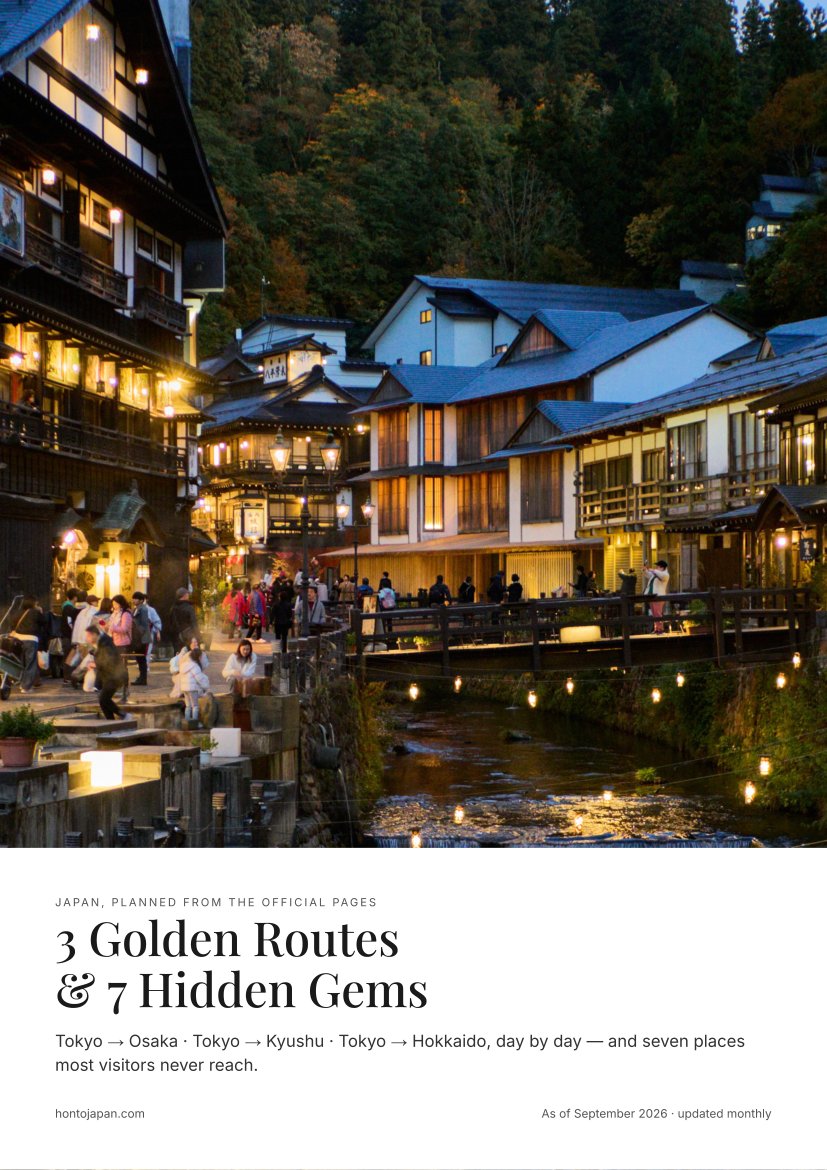
Tokyo to Osaka, Tokyo to Kyushu, Tokyo to Hokkaido — day by day — plus seven places most visitors never reach.
- 12 pages, 80 photographs, every stop linked to its guide
- Every price and opening hour read from the official page
- Re-issued monthly, so it does not go stale in your inbox
Free. One email a month, plus the rare change that matters. Unsubscribe with one click in any email. By subscribing you agree to our privacy policy.