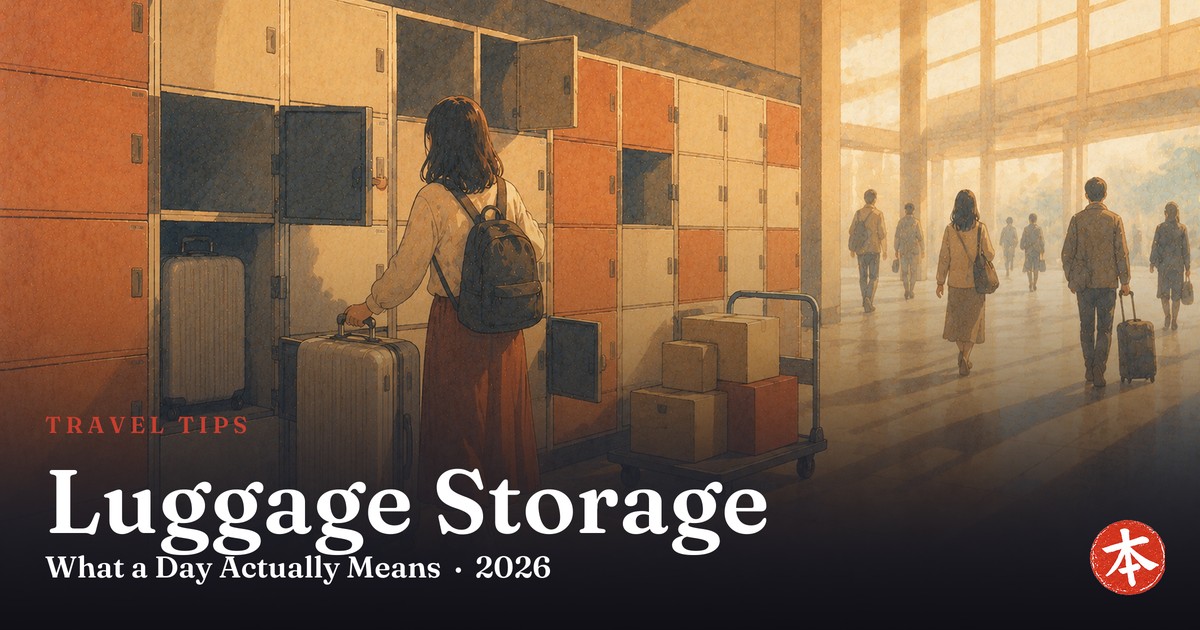
Japan is the best country in the world at moving your luggage for you, and the worst at explaining the rules in English. Three examples from the operators' own pages: a locker "day" ends at midnight at Narita, runs 24 hours from insertion at Haneda, and rolls over at 2:00am at Kansai. Yamato — the company everyone has heard of — cannot hold your bag overnight at all, and says so. And forwarding a suitcase from Tokyo to Osaka costs 3,160 yen, not the 2,630 yen that Yamato's own website still serves from a stale table. Here is what each operator actually publishes.
The three routes, and when each one wins
| Coin locker | Staffed / app storage | Forward by courier | |
|---|---|---|---|
| Best for | A few hours, small–medium bag, no booking | Oversized bags, lockers full, multiple days | Changing cities · airport ↔ hotel |
| Typical cost | 300–1,500 yen/day | 500–2,000 yen/item/day · Crosta flat 1,000 | 3,160 yen Tokyo→Osaka, size 160 |
| Max duration | Narita 8 days · Haneda 7 · Kansai 10 | 30 days at Tokyo/Ueno/Sendai and Crosta | n/a |
| Size ceiling | Widest published: Kansai LW 86×55×65cm | Crosta ≤2m, ≤30kg · Haneda 3-dim ≤300cm · ecbo ≤20kg | 200cm total, 30kg, one side ≤170cm |
| 🚨 Overnight? | Yes | Yes | Yamato counters: no — same-day only |
A walk through every locker bank inside Tokyo Station, in Japanese:
Sending bags ahead? Our luggage forwarding tool shows what it costs to send a suitcase from hotel to airport, hotel to hotel or airport to hotel, and the day to send it, from Yamato’s official fares.
Coin lockers: the rules differ by building
What do they cost, and do they take cards?
Narita runs two systems side by side. The daily banks are 400 / 600 / 800 yen for small, medium and large, up to eight days. The hourly banks are 300 / 500 / 600 yen for the first six hours, then the daily rate again every 24 hours — and Terminal 3 has an extra-large locker at 1,200 yen per 12 hours that the airport says takes skis. Narita states that all its lockers are touch-panel type and accept Suica. Haneda: Terminals 1 and 2 run 400 / 500 / 600 / 1,000 / 1,500 yen by height and take cash, credit, e-money or QR; Terminal 3 is more expensive at 500 / 700 / 900 yen per 24 hours with no extra-large tier. Kansai runs 300 to 1,200 yen, all banks open 24 hours. So the old line that Japanese lockers are cash-only is no longer true at any of the three main airports.
What if I overstay?
Haneda publishes the answer: past the permitted period — seven days at each terminal — staff move your belongings to a designated storage area and hold them for 30 days from that date. Narita publishes no equivalent rule, and we are not going to extrapolate one from Haneda's. Kansai allows up to 10 consecutive days including the first.
How do I find a free one?
Use the official tools rather than luck. Narita, Haneda and Kansai each publish real-time availability per locker bank on their locker pages. At Tokyo Station, the station's own site links a Suica locker availability view and the To Locca reservation service — which, despite looking like a third-party app, is operated by JR East Smart Logistics, a JR East group company — plus the TOKYO STATION NAVI app, which shows Suica locker availability in real time. What no operator will tell you is that a locker will be free when you arrive; that is why the staffed desks below matter.
Staffed cloakrooms and ecbo: where the big bags go
Tokyo Station, in detail
JR East Logistics runs four desks with identical pricing: 500 yen for items up to 100cm total dimensions, 1,000 up to 200cm, 2,000 above that, per item per day. Outside the Yaesu South gate 9:30–20:00; inside the gates at Gransta B1 North 9:30–20:00; by the Shinkansen South transfer gate 9:00–21:00; and inside the Marunouchi Central gate 10:00–20:00. Ueno's third-floor desk matches. Tokyo, Ueno and Sendai hold bags for up to 30 days — the operator's own worked example is one medium bag from January 10 to 16 at 1,000 yen a day for 7,000 yen total. Two rules that surprise people: a tote or paper bag sitting on your suitcase is charged separately, and at Shinagawa weekend rates apply on weekdays during Golden Week (April 27–May 6), Obon (August 10–19) and New Year (December 28–January 6). Note also that Tokyo Station's porter service ended on March 31, 2025, so guides recommending it are out of date. Sagawa's Tokyo Service Center, on the Nihonbashi side, runs 7:00–21:00 at 1,000 to 2,000 yen by size — and states that it screens every bag with explosives detection equipment.
Crosta, for western Japan
Crosta is the JR West group's cloak service inside Kyoto, Shin-Osaka, Osaka, Hiroshima and Hakata stations, and its pricing is the simplest in the country: a flat 1,000 yen per item, whatever the size, 8:00 to 20:00, 365 days a year, up to 30 days, with 100,000 yen of cover per item. Payment is by card. The claim ticket is bearer-transferable — the operator states that anyone holding it can collect. Three things to plan around: it warns it may stop accepting luggage when full, especially at weekends and holidays; pickup after 8pm means coming back after 9am the next day with an extra charge (Shin-Osaka runs to 11pm); and it refuses strollers and cardboard boxes, which no English guide mentions. Crosta also runs a same-day carry service — Kyoto Station to an Osaka or Shin-Osaka station desk for 2,500 yen a bag, or hotel-to-station and station-to-hotel inside Kyoto for 1,500.
ecbo cloak, and a common misconception
500 yen a day for a bag whose longest side is under 45cm, 800 yen above that — charged per calendar day, not per hour, with a fresh day's charge each time you cross midnight. Cover to 100,000 yen, weight limit 20kg, more than 1,000 partner locations. The mechanics: staff photograph your bags at drop-off and share the images in the app, and those photos are what you present at pickup — no ID needed. The catch is cancellation: free changes stop at 23:59 the day before, and you cannot change or cancel on the day; a no-show is not refunded. And the misconception worth clearing up: ecbo is often framed as the scrappy alternative to the stations. It is not — JR East Logistics and Gransta both use ecbo as the booking layer for their own Tokyo, Ueno and Shinagawa desks.
At the airports
Haneda publishes proper staffed-storage rates: 800 yen under 120cm, 1,000 from 120 to 199cm, 2,000 from 200 to 300cm, for up to two weeks, with a 30kg limit — and Terminal 3's desks run 24 hours while Terminals 1 and 2 run 8:00–19:30. Narita and Kansai publish no prices at all. Narita states outright that charges vary by company and to ask the operator you intend to use; Kansai gives only a phone number. That absence is worth knowing before you plan around a number you found elsewhere.
Forwarding: the option that actually changes how you travel
What does it cost, in the cases that matter?
A standard checked suitcase, about 75 x 50 x 30cm, totals 155cm and therefore falls into size 160. Tokyo to Osaka or Kyoto: 3,160 yen. Within Tokyo: 3,020 yen. Anything to or from an airport adds the 660 yen counter fee, so an airport shipment inside Kanto is about 3,680 yen. Same-day from Haneda to a central Tokyo hotel is 5,170 yen at size 160, or 5,780 to Yokohama, Kawasaki or Urayasu. In Kansai, same-day within Osaka city is 2,860 yen, and Osaka to Kyoto or Kobe 4,020. Discounts exist — 100 yen for dropping off at an agency, sales office or convenience store, 150 for Kuroneko Members, 60 for the digital discount — but note that multi-parcel discounts do not apply to airport shipments or to suitcases of size 160 and above.
The direction trap
Speed is not symmetric, and this is where itineraries break. Airport to hotel can be same-day: from Haneda, drop off by 11:00am and collect after 6pm at a hotel in central Tokyo, Yokohama, Kawasaki or Urayasu. Hotel to airport is a two-day service — Yamato's own example is that from Kyoto the deadline is two days before your flight — and hotel to Kansai Airport arrives at 7am the next day. For airport pickup specifically, the rule is: send at least two days before departure (three for some areas), the shipment must arrive at the airport at least one day before you fly, and you collect it one to three hours before boarding. Also note the two separate 660 yen fees — one for sending to an airport, one for sending from Narita, Haneda or Kansai — introduced on June 1, 2025 and July 1, 2025 respectively, which is why pre-2025 guides run low. Elsewhere, delivery is next-day almost everywhere, with Hokkaido, Aomori, Akita, Iwate, the Izu and Ogasawara islands, Nagasaki, Miyazaki, Kagoshima and Okinawa taking about two days. One moving target: Haneda Terminal 3's Yamato pickup counter changes floor twice in 2026 — third floor until June 21, second floor until November 30, first floor after that — so treat any undated floor number as unreliable.
What you cannot send
Yamato's terms bar cash, checks, securities, credit and cash cards, ashes, firearms, live animals, flammables, poisons, anything containing personal information — and, named explicitly, documents that are difficult to reissue, including passports. Declared value is capped at 300,000 yen per parcel. If you are shopping heavily, the interaction with duty-free rules is worth understanding before you pack a box — see our tax-free shopping guide. And one gap we will not fill: no operator we read publishes any rule specific to lithium batteries or power banks. Yamato bars flammable and volatile goods generically, ecbo bars flammable hazards generically, and that is all anyone says.
🚨 Traveling after October 2026? Japan's tax-free system changes on November 1, 2026. Instead of the tax being taken off at the register, you will pay the full price in store and claim the consumption tax back at customs when you leave, within 90 days of purchase — the retailer refunds it after that check. Until October 31, 2026 the system described here still applies. Our tax-free shopping guide has the detail.
The rule that catches people on the shinkansen
Do I have to reserve space for a big suitcase?
Yes, above a threshold — and the reservation is free, which is the part guides get wrong. JR West states that baggage with total dimensions between 160 and 250cm requires a reservation, at no extra charge, and describes that as roughly the size that attracts an oversized-baggage fee on international flights. Turn up without one and you are charged 1,000 yen. Above 250cm, JR West says plainly: not allowed. One practical wrinkle for visitors — the lockable compartment on some cars requires a contactless IC card such as Suica or ICOCA to operate, so without one you cannot lock it. And a recent change: from July 1, 2025, JR West began trialing the oversized-baggage compartment on some decks as a storage area usable without prior reservation. If you would rather not think about any of this, forward the bag — which is exactly why the couriers exist. For how the airport-to-city leg fits together, see our Haneda to Tokyo Station guide, and for sequencing a multi-city route around forwarding deadlines, our seven-day itinerary.
(Shipping to a convenience store for pickup does not work for visitors — our Japanese 7-Eleven guide quotes the official English FAQ stating it outright.)
(If your hotel can hold the bags instead: our hotel luggage storage comparison of 34 hotels and chains finds 25 that say they hold bags after checkout, 2 that do not, and 9 that set a same-day deadline.)
FAQ
What are my options, in order?
How long is a locker “day”?
How much do airport lockers cost?
Will my big suitcase fit in a locker?
Can I leave a bag with Yamato overnight?
What does ecbo cloak cost, and what is the catch?
What do station cloakrooms cost?
What happens if I am late picking it up?
How much does it cost to forward a suitcase to my next city?
Can I send my bag to the airport and collect it there?
What can’t I send or store?
Do I need my passport to store luggage?
Bottom line (2026) — A locker “day” means three different things at three airports: at Narita it ends at midnight, at Haneda it is 24 hours from insertion, and at Kansai it rolls over at 2am. Yamato counters cannot hold a bag overnight at all, and forwarding a suitcase Tokyo to Osaka is ¥3,160, not the ¥2,630 still shown by Yamato’s own fallback table.
Sources
Locker sizes, fees, day definitions, payment methods, permitted periods and overrun handling: Narita International Airport, Tokyo International Air Terminal (Haneda) and Kansai Airports' official pages. Cloakroom rates, durations, late pickup rules and seasonal pricing: JR East Logistics, Gransta / JR East Cross Station, Crosta (Handsfree Japan) and Sagawa Express. App storage pricing, insurance, weight limits, cancellation terms and prohibited items: ecbo cloak and its help center. Forwarding rates: Yamato Transport's live rate master — the file its own calculator loads — with Yamato's published rounding applied and cross-checked against the worked example on its Kyoto page; lead times, airport counter fees, deadlines and prohibited items from Yamato's English FAQ and the TA-Q-BIN terms and conditions. Oversized-baggage rules: JR West. All read on August 21, 2026. The embedded video is by its creator.
Some links on this page may be affiliate links, which means we may earn a commission if you book or buy through them — at no extra cost to you. See our affiliate disclosure.
Tokyo to Osaka, Tokyo to Kyushu, Tokyo to Hokkaido — day by day — plus seven places most visitors never reach.
- 12 pages, 80 photographs, every stop linked to its guide
- Every price and opening hour read from the official page
- Re-issued monthly, so it does not go stale in your inbox
Free. One email a month, plus the rare change that matters. Unsubscribe with one click in any email. By subscribing you agree to our privacy policy.