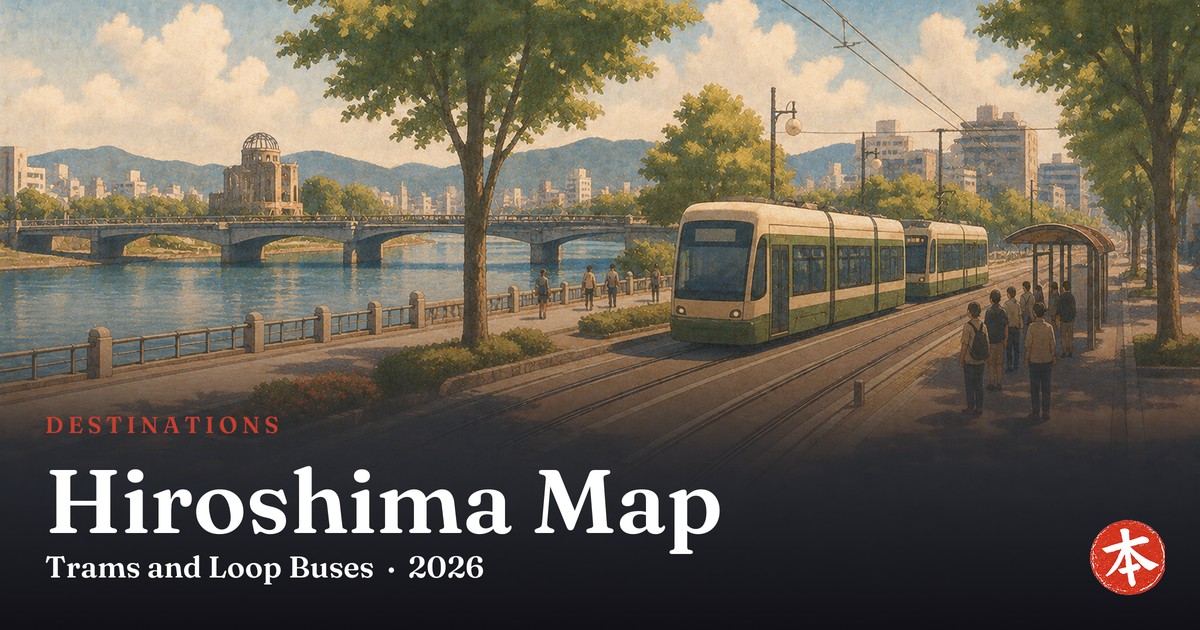
Hiroshima is one of the easiest Japanese cities to understand — a river delta with a tram line running straight through the middle of it — and one of the hardest to find current information about, because three things changed in the last twelve months. The tram stop moved inside the station building. Platforms B and D swapped in March 2026, so the Miyajima tram now leaves from the other side. And in July 2026 the sightseeing loop bus scrapped its three colored routes and stopped serving Kamiyacho and Hatchobori altogether. Official city pages have not all caught up. Here is the city as its operators describe it in August 2026.
The shape of the city, in one paragraph
Why is everything on an island between rivers?
Because the city was built on one. Hiroshima City's own description: silt carried down by the Ota River formed a delta, and about 400 years ago the lord Mori Terumoto named the five villages at its mouth Hiroshima and built a castle there. The city calls itself the "city of water" and counts three river systems — the Ota, the Seno and the Yahata. The practical consequence for a visitor: the Peace Memorial Park sits at the top of the wedge where the Old Ota River splits from the Motoyasu, which is exactly why it is a park shaped like a triangle with water on both sides. And the old highway through town — from Enkobashi past Kyobashi, through the Ebisu and Kinzagai arcades, along Hondori, past the Peace Park and over Honkawa Bridge — is still walkable, and still the best mental east-to-west line to hang the city on. A sobering measure of the bomb: of the 50-plus bridges that stood in 1945, the city counts six surviving A-bombed bridges within 5km of the hypocenter.
The tram: one fare, nine services, four platforms
Which line do I want?
| Line | Route | Official journey time | Daytime frequency |
|---|---|---|---|
| 2 | Hiroshima Sta — Hiroden-Miyajimaguchi (platform D) | 66 min | every 10 min |
| 1 | Hiroshima Sta — Kamiya-cho — Hiroshima Port (platform B) | 44 min | every 12 min |
| 5 | Hiroshima Sta — Hijiyama-shita — Hiroshima Port (platform A) 🚨 does not pass Hatchobori or Kamiya-cho | 29 min | every 12 min |
| 6 | Hiroshima Sta — Eba (platform C) | 34 min | every 15 min |
| 9 | Hatchobori — Hakushima (for Shukkeien) | 8 min | every 18 min |
| L | Loop line via Matoba-cho and Hijiyama-shita — opened March 28, 2026 | 44 min | every 25 min |
Riding the trams and the ferry across a day, filmed in Japanese:
The platform swap that catches everyone
When the station stop opened in August 2025, Line 2 — the Miyajima line — left from platform B. On March 28, 2026 Hiroden swapped it with Line 1: Line 1 moved from D to B, and Line 2 moved from B to D. Lines 5 and 6 did not move. So a guide written in the seven months between those dates sends you to the wrong platform with perfect confidence. The current layout, from Hiroden's own diagram: A = Line 5 (Hiroshima Port via Hijiyama-shita), B = Line 1 (Hiroshima Port via Kamiya-cho), C = Line 6 (Eba), D = Line 2 (Hiroden-Miyajimaguchi). Hiroden adds that platforms may change with operating conditions — read the signs.
Getting between the four places you actually want
Hiroshima Station to the Peace Memorial Park
Two ways, both 240 yen, both roughly a quarter of an hour. Hiroden's English leaflet gives Line 2 or Line 6 to Genbaku Dome-mae, then one minute on foot, at about 15 minutes; or Line 1 to Hondori, then six minutes on foot, also about 15. Hiroshima City's own page says about 20 minutes for the same trip, and the city adds a rail alternative: JR to Shin-Hakushima, then the Astram Line to Hondori, about 15 minutes plus a 400-meter walk west. We are giving you the range rather than picking a winner — Hiroden itself notes that times vary with traffic.
To Miyajima, and to the port
Miyajima: Line 2 all the way to Hiroden-Miyajimaguchi, which Hiroden puts at about 72 minutes from the station (its own line table says 66 — again, a range), then one minute on foot to the ferry terminal and about ten minutes across. From Genbaku Dome-mae it is about 57 minutes. Budget 240 yen for the tram, 180 for the JR ferry and 100 yen for the Miyajima visitor tax. Our Miyajima guide covers the island itself, including the tide rule that decides whether the great torii is walkable that day. Hiroshima Port is 29 minutes on Line 5 or 44 on Line 1; the city gives 30 to 50 minutes for the whole trip depending on mode. From the port, Line 1 or Line 7 gets you to the Peace Park in about 30 minutes.
Shukkeien, the castle and the baseball stadium
Shukkeien needs a change: Line 2 or 6 to Hatchobori (about 7 minutes), then Line 9 three minutes to Shukkeien-mae, then three minutes on foot. From there the castle is a ten-minute walk. Note that the garden's own access page still tells you to board at platform A at Hiroshima Station for lines 1, 2 and 6 — that is out of date, because platform A is now Line 5 only. Trust Hiroden's platform diagram over the attraction's page. Mazda Zoom-Zoom Stadium is about ten minutes on foot from the station's south exit, or ten minutes from the Matoba-cho tram stop — which reopened on March 28, 2026 and is now served only by the new loop line.
The loop bus, rebuilt from scratch in July
What exactly changed?
Chugoku JR Bus scrapped the three-route system on July 18, 2026. Its wording: the Orange, Green and Lemon route names are abolished and every service now runs the same route from the Shinkansen exit to Peace Boulevard — and the Kamiyacho, Hatchobori and Hatchobori (Nagarekawa entrance) stops are no longer served. Frequency is 42 services a day, every 10 to 15 minutes, 9:00 to 18:00, with one service an hour detouring to the Museum of Contemporary Art. The single-loop timings from the Shinkansen exit: Hiroshima Castle at 6 minutes, the A-Bomb Dome at 10, the Peace Memorial Park and Museum at 14, back to the station at 33.
Where does it leave from, and what does it cost?
The Shinkansen exit — the north side of the station, not the south side where the trams are. That single fact reorganizes a first morning in the city. It is 240 yen a ride or 600 yen for a day pass, sold on board, online (with an early-purchase discount if you buy two days ahead, though the discounted figure is not published) and at the bus ticket counter by the Shinkansen exit, open 9:30 to 17:30 daily. IC cards work, Welcome Suica included, and a Japan Rail Pass gets you on for free. If you stay aboard past the station you have to change buses and ask the driver for a transfer ticket.
What is open, what closed, and which pass to buy
Peace Memorial Park and Museum
The park is free, open at all times and never closed, covering 122,100 square meters. The A-Bomb Dome cannot be entered — the city states plainly that the area inside the fence is off limits and that it is not a facility you go into, only view from outside; Hiroden's English map says the same thing. It was designated a historic site in 1995, inscribed as World Heritage in 1996, and made a Special Historic Site on September 18, 2025. The museum is 200 yen for adults, 100 for high school students, free below that; in August it runs 7:30 to 20:00, extended to 21:00 on the 5th and 6th. It closes February 15 to 20, 2027. Our Peace Memorial Park guide covers the reservation-only early and late entry windows in detail.
Which pass, in one decision
Crossing to Miyajima today? Buy the one-day tram and ferry pass at 1,000 yen. It covers the whole Hiroden network plus the Miyajima Matsudai ferry, includes the 100-yen visitor tax, and knocks the Miyajima Ropeway round trip from 2,000 down to 1,500 yen — cash only, on the day, one round trip per pass. Staying in the city? The tram-only day pass is 700 yen, so it pays off from the third ride. Using buses too? The Visit Hiroshima Tourist Pass runs 1,000 / 1,500 / 2,000 yen for one, two or three days and adds six bus operators including the loop bus — but note it excludes the visitor tax, which you buy separately at Miyajimaguchi. Two traps: the product called Hiroshima City Pass is a commuter ticket, not a tourist pass, and it excludes both the loop bus and the Miyajimaguchi section; and while the magnetic versions of the day passes are gone (refunds ended December 31, 2025), the paper scratch-off versions are still sold. While you are working out the day, the local dish is worth planning around — see our okonomiyaki guide for how the Hiroshima style differs from the Osaka one.
The other systems, briefly
The Astram Line is a single subway-like line through the north of the city; fares rose on October 1, 2025 and now start at 220 yen. For visitors its one job is the Shin-Hakushima to Hondori hop, 220 yen, which turns a JR arrival into a downtown arrival without a tram. Hiroshima Bus Center, in Kamiya-cho, is the hub for everything regional: 27 operators, about 2,400 departures and 24,500 passengers a day by its own April 2024 count. Its exits 3 and 5 open onto the tram stops, and from its Dome-side exit the A-Bomb Dome is about 300 meters west — about two minutes by tram, or a short walk.
(For the island leg itself, our Hiroshima to Miyajima guide has the tram at a flat 240 yen since February 2025, and what the East Corridor works mean for a 2026 visit.)
(For a ryokan on Miyajima: our Iwaso Ryokan guide notes that its 38 rooms are all Japanese style, and that only the Shinkan rooms and two cottages have their own bath, which is not onsen water.)
FAQ
Where do I catch the tram at Hiroshima Station?
Which platform goes where?
What does the tram cost?
Do Line 1 and Line 5 both go to Hiroshima Port?
Has the sightseeing loop bus changed?
Is the loop bus covered by the Japan Rail Pass?
Can I still go inside Hiroshima Castle?
What does the Peace Memorial Museum cost, and when is it open?
Which transport pass is the right one?
Do old IC cards and passes still work?
Bottom line (2026) — Hiroshima’s tram stop moved into the station building in August 2025, platforms B and D swapped in March 2026, and the sightseeing loop bus abolished its three colored routes in July 2026 – including the Kamiyacho and Hatchobori stops. Even official city pages still describe the old system, so use the operator’s current pages rather than any printed map from earlier.
Sources
Flat fares and the February 2025 revision, line routes and journey times, stop numbering, the August 2025 station relocation, the March 2026 platform swap and loop-line opening, the platform diagram, English stop names, journey suggestions and all pass details: Hiroshima Electric Railway's official pages, press releases and English route leaflet. Loop bus route change, timetable, fares and rail-pass acceptance: Chugoku JR Bus. Delta geography, the old highway, surviving A-bombed bridges, park facts and A-Bomb Dome designations: Hiroshima City. Admission and hours: Hiroshima Peace Memorial Museum. Keep closure and access: Hiroshima Castle. Fares: Astram Line. Operator counts and exits: Hiroshima Bus Center. Ferry access and journey time: JR West Miyajima Ferry. All read on August 21, 2026. The embedded video is by its creator.
Some links on this page may be affiliate links, which means we may earn a commission if you book or buy through them — at no extra cost to you. See our affiliate disclosure.
Tokyo to Osaka, Tokyo to Kyushu, Tokyo to Hokkaido — day by day — plus seven places most visitors never reach.
- 12 pages, 80 photographs, every stop linked to its guide
- Every price and opening hour read from the official page
- Re-issued monthly, so it does not go stale in your inbox
Free. One email a month, plus the rare change that matters. Unsubscribe with one click in any email. By subscribing you agree to our privacy policy.