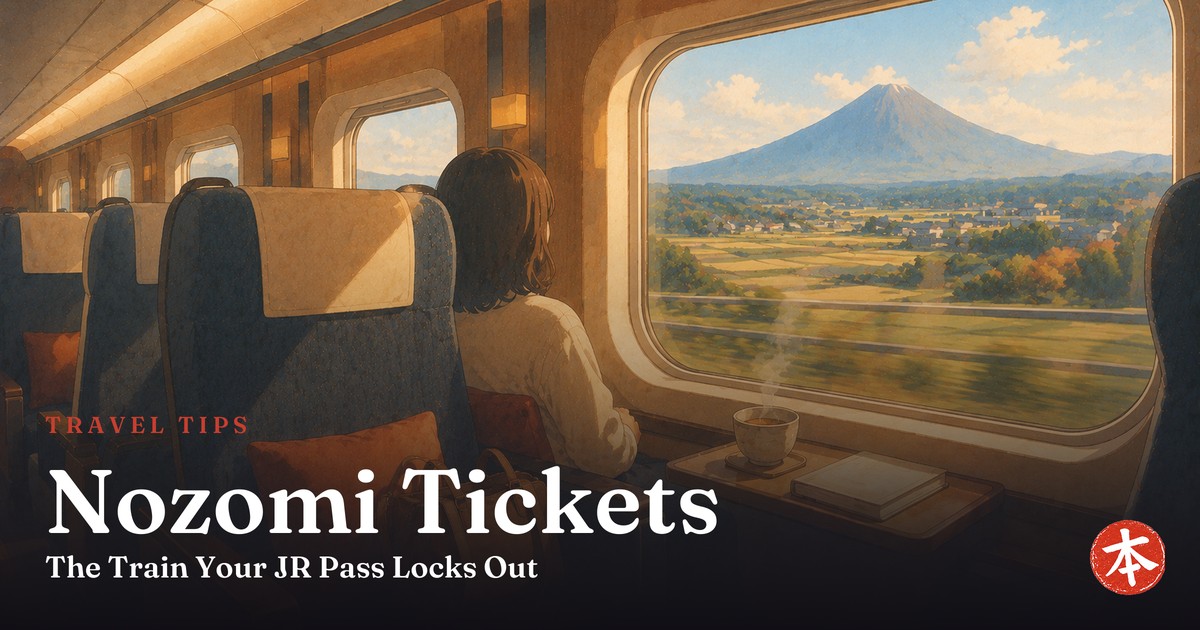
The Nozomi is the fastest train on the Tokaido and Sanyo Shinkansen, and the one that most confuses visitors — because it is the only Shinkansen the JAPAN RAIL PASS does not cover. Since October 2023, Pass holders can still ride it, but only by buying an add-on called the NOZOMI MIZUHO Ticket each time they board. This guide is about the ticket itself: what it costs, why the price is identical whether you sit in non-reserved, reserved or Green Car (so Pass holders really should always upgrade), where you can and cannot buy it, and how travelers without a Pass should book instead. For the wider question of how to buy a Shinkansen ticket at all, and for the JR Pass surcharge maths, we link the deeper guides below.
Why the Nozomi is a special case
The Nozomi runs the same tracks as the Hikari and the Kodama, but skips more stops. On the Tokaido line between Tokyo and Shin-Osaka it is the fastest way to travel, and the JR Pass site notes that a maximum of 12 Nozomi trains run between Tokyo and Shin-Osaka per hour at peak times. The reason it is treated separately in every ticketing conversation is a rule that JR states in one clear sentence:
The Hikari, Kodama, Mizuho, Sakura and Tsubame all keep normal non-reserved seating and are fully covered by the Pass. Nozomi and Mizuho sit outside that. Since October 2023, a Pass holder can still legally ride them, but only by buying the NOZOMI MIZUHO Ticket in advance of each trip. Everything else in this guide follows from that one rule.
The NOZOMI MIZUHO Ticket: price table and the Green Car trick
The add-on is a fixed-price ticket by route, and this is where most English guides oversimplify. Here are the official prices, tax included:
| Route | NOZOMI MIZUHO Ticket price (yen) |
|---|---|
| Tokyo – Nagoya | ¥4,180 |
| Tokyo – Kyoto | ¥4,960 |
| Tokyo – Shin-Osaka | ¥4,960 |
| Tokyo – Hiroshima | ¥6,500 |
| Shin-Osaka – Hakata | ¥4,960 |
| Hakata – Kagoshima-Chūō | ¥5,150 |
Now the part that changes how you should think about the ticket. The official page states, literally:
This is the single most underused clause in the current JR Pass rulebook. If you paid for the Green Pass, the surcharge does not scale up when you use it — the upgrade is included in the 4,960 yen.
Where you can buy the NOZOMI MIZUHO Ticket (and where you cannot)
The sales channels are stated on the same JR Pass page, and every one of them is inside Japan:
The sales period is stated as from one month prior to the day of boarding the train to the day of boarding the train. Two practical points follow. First, you cannot pre-buy this ticket from abroad. The JR Pass itself can be bought overseas — the NOZOMI MIZUHO Ticket cannot. It is not sold on Klook, not on JRailPass.com, not on any resale platform. Second, once you land, the fastest route is the Midori-no-madoguchi — the green-window ticket office — at your arrival station. Both Narita and Haneda have one; so does every major JR station in Japan.
One more official rule worth internalising:
You must show both at the gate. Losing your Pass invalidates the surcharge ticket too.
Non-reserved seating on Nozomi: two cars, 165 seats, and eight peak-period blocks
The car layout
A Nozomi runs as a 16-car set (N700, N700A or N700S). The car assignments matter for anyone planning to sit non-reserved or to upgrade to Green:
| Cars | Class | Notes |
|---|---|---|
| 1 – 2 | Non-reserved (Ordinary Car) | 165 seats total across both cars, normal operation only |
| 3 – 7 | Reserved (Ordinary Car) | Car 7 is the S Work business-work car |
| 8 – 10 | Green Car | 2+2 seating |
| 11 – 16 | Reserved (Ordinary Car) | 2+3 seating |
The often-repeated claim that non-reserved is "Cars 1 to 3" is wrong: it is two cars, not three, and 165 seats in total. On a busy morning at Tokyo Station, the queue for non-reserved routinely runs past the 165th person, and the back of the line stands.
The eight peak-period blocks (2026 fiscal year)
On these dates, Nozomi trains have no non-reserved seating at all — the whole train is reserved-only. JR Central and JR West published the list jointly:
And the fallback JR Central specifies for anyone who turns up with only a non-reserved limited-express ticket during a peak period:
You can stand, but not in the Green Cars. If any of your travel dates fall inside one of these eight windows, book reserved seats in advance — or use a Hikari or Kodama, which keep non-reserved seating all year.
How to buy a Nozomi ticket if you do not have a JR Pass
For travelers without a Pass, there are three official routes into a Nozomi seat. All three sell the ticket for the same total; the difference is speed, English support and where the transaction happens.
| Method | English | Foreign card | Best for |
|---|---|---|---|
| Smart EX (online) | Full English site | Yes (3-D Secure; success rates vary by issuer) | Booking before you arrive; changing plans on the fly |
| Midori-no-madoguchi | Staff at major stations handle English | Cash or credit card accepted | Complex itineraries, upgrades, questions |
| Ticket machine | English menu (JR Central states this on its official buy page) | Yes | A quick reserved seat when the counter has a queue |
Smart EX — the online default
Smart EX is the official online booking system for the Tokaido, Sanyo and Kyushu Shinkansen. Its own page lists the applicable trains as Nozomi, Mizuho, Hikari, Sakura, Kodama, and Tsubame. Reservations open at 5:30 am one year before the boarding date and stay open up to four minutes before departure. The change policy is unusually generous:
You board with a QR code or a registered IC card — no paper pickup required. One catch worth flagging: Smart EX does not include the conventional-train leg to the Shinkansen station the way a paper ticket does. Smart EX itself states that if you take a conventional train to or from the Shinkansen boarding station, you will need to pay that fare separately. On Tokyo–Osaka in particular this changes the maths; we cover it in the Tokyo-to-Osaka Shinkansen guide.
The green window and the ticket machine
At the counter, JR Central's official buy page tells you what to say — the exact information the agent expects: departure station, destination station, date and time of boarding, type of train (Nozomi, Hikari, Kodama, etc), number of persons (adult, child aged 6 to 11 years), and type of seat (non-reserved, reserved, or first class car, and smoking or non-smoking). That single sentence is more useful than a phrasebook. At the machines, JR Central states that every ticket vending machine in our stations is equipped with English menus and sells tickets with information in English, and the larger ones handle limited-express and reserved-seat tickets directly.
Routes and approximate walk-up totals
Fares below are approximate regular-season totals for a Nozomi reserved seat, walk-up paper-ticket pricing, one adult. JR's system has four seasonal tiers and Smart EX applies its own adjustments, so the exact amount for your date lives on the booking screen. We do not print single fixed numbers because they would misrepresent how the fare actually works.
| Route | Nozomi reserved (approx., regular season) | Fastest time |
|---|---|---|
| Tokyo – Kyoto | approximately ¥14,170 | ~2h 12min |
| Tokyo – Shin-Osaka | approximately ¥14,720 (¥8,910 base + ¥5,810 limited express) | ~2h 21–27min |
| Tokyo – Hiroshima | approximately ¥19,760 | ~3h 49min |
| Tokyo – Hakata | approximately ¥23,810 | ~4h 45min |
Fares are updated by JR periodically; check Smart EX before booking. For the Tokyo–Osaka route, where the seasonal tiers matter most, our Tokyo-to-Osaka Shinkansen guide gives the four-tier breakdown. Kyoto is worth noting on its own: Nozomi stops at Kyoto before Shin-Osaka, so Kyoto is roughly 15 minutes closer to Tokyo, at almost the same fare.
If you miss your Nozomi, or it is delayed
Missing your train
The rule is narrow. A limited-express reserved-seat ticket, if you miss the train, is still usable on the same day — but only in a non-reserved seat in an ordinary car on a later Shinkansen. You cannot switch to another reserved seat, you cannot use Green Car, and you cannot move it to a different day. Smart EX phrases the same rule slightly differently: in the event that you are late for boarding your reserved train, you may board a Shinkansen leaving later on the same date, using a non-reserved seat in an Ordinary Car. So if it is a peak-period date with no non-reserved seats at all, missing your Nozomi means buying a new ticket.
Delays and refunds (for JR Pass holders)
That refund applies to the NOZOMI MIZUHO Ticket, which is separate from the Pass itself. It is worth doing — take the ticket to a staffed gate on arrival. Refund handling fees on unused tickets are 340 yen for Green Car and standard-car reserved seats, and 220 yen for standard-car non-reserved. And a rule that catches people: after the start of travel, no refund will be granted.
What the English internet still gets wrong about Nozomi
1. "JR Pass covers Nozomi." Not since October 2023. You need the NOZOMI MIZUHO Ticket on top of the Pass.
2. "Non-reserved is Cars 1 to 3." Wrong. It is Cars 1 and 2 only, 165 seats. Car 3 is reserved.
3. "Non-reserved is easy to get outside peak periods." Not on weekday mornings and evenings between Tokyo and Shin-Osaka — 165 seats fill fast.
4. "You can buy the NOZOMI MIZUHO Ticket on Klook or JRailPass." No. Domestic sales channels only: reserved-seat ticket machines, Midori-no-madoguchi, Travel Service Centers, and some travel agencies. All inside Japan.
5. "Green Car costs more with the NOZOMI MIZUHO Ticket." Not for JR Pass (Green car) holders — the price is identical across non-reserved, reserved and Green. Always upgrade.
6. "There is a food and drink trolley on Nozomi Ordinary Car." Not since October 2023. Onboard sales continue in Green Car only. Buy your bento at the station.
7. "If I miss my Nozomi I can just take the next reserved seat." No. Same day, non-reserved, ordinary car only. Green Car and reserved seats are not permitted.
8. "EX Early Discount tickets work on Nozomi." The best-known EX early-discount fares are for Hikari and Kodama, not Nozomi. Do not plan a Nozomi trip around them.
9. "Smart EX covers the conventional train to the station." No — that is a paper-ticket feature (the Tokyo Ward and Osaka City zones). Smart EX charges the conventional leg separately.
10. "Kyoto is further from Tokyo than Osaka on the Nozomi." No. Nozomi stops at Kyoto before Shin-Osaka; Kyoto is about 15 minutes closer to Tokyo.
FAQ
Can I use my JAPAN RAIL PASS on a Nozomi?
Why does the surcharge cost the same in non-reserved, reserved and Green Car?
Can I buy the NOZOMI MIZUHO Ticket before I arrive in Japan?
Which cars are non-reserved on a Nozomi?
What are the 2026 fiscal-year peak periods with no non-reserved seating?
What is the fastest way to buy a Nozomi ticket if I do not have a JR Pass?
Does a Smart EX ticket include the conventional train to the station like a paper ticket does?
What if I miss my Nozomi?
What happens if my Nozomi is delayed?
How often does the Nozomi run?
Is the Nozomi worth the surcharge over a Hikari for a JR Pass holder?
How do I ask for a Nozomi ticket at a JR ticket office?
Related guides
If you are still deciding how to buy any Shinkansen ticket, start with our Shinkansen tickets guide. For the mechanics of reserving a seat online, see the Shinkansen reservation guide. For the JR Pass decision — is the Nozomi surcharge worth it over a Hikari? — the JR Pass Shinkansen guide works through the numbers. And for the busiest single corridor the Nozomi runs, our Tokyo-to-Osaka Shinkansen guide covers seasonal pricing, Smart EX versus paper, and the conventional-train zone rule in detail.
Bottom line (2026) — The Nozomi is the one Shinkansen the JAPAN RAIL PASS does not cover; the add-on NOZOMI MIZUHO Ticket unlocks it at a fixed price per route. Because that price is identical in non-reserved, reserved and Green Car, Pass holders should always upgrade. Every sales channel is inside Japan — you cannot buy it from abroad. A two-hour delay refund applies.
Sources
The JR Pass rule on Nozomi and Mizuho, the NOZOMI MIZUHO Ticket price table, the same-price clause across seat classes, the domestic-only sales channels, the sales period, the combined-use rule and the two-hour delay refund: japanrailpass.net official English pages. Peak-period non-reserved rules, the standing-passageway fallback, ticket-office phrasing, the English-menu ticket machines and the child age definition: global.jr-central.co.jp official English pages. Smart EX terms, the applicable trains, the one-year booking window, the change policy and the conventional-train-separate clause: smart-ex.jp/en. Read August 26, 2026. Fares are updated by JR periodically and dynamic tiers apply on Smart EX; confirm on the booking screen before you buy. The embedded video is by its creator.
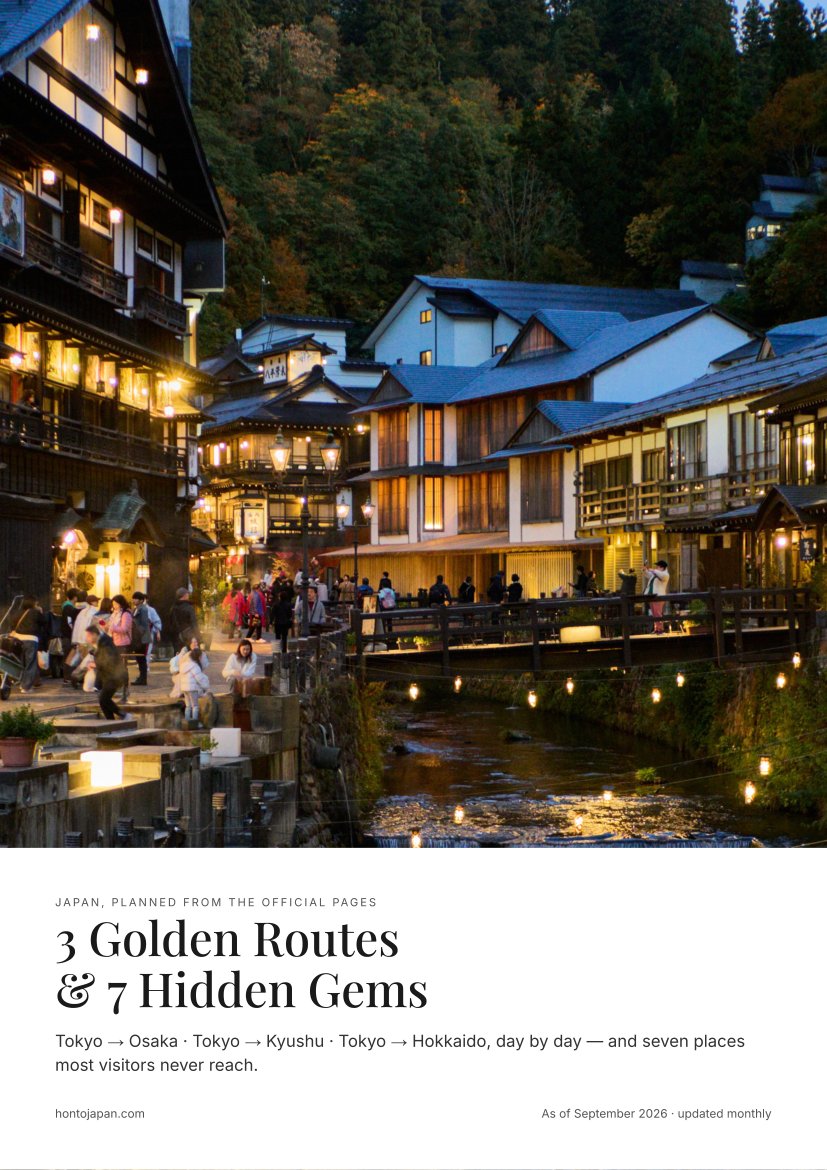
Tokyo to Osaka, Tokyo to Kyushu, Tokyo to Hokkaido — day by day — plus seven places most visitors never reach.
- 12 pages, 80 photographs, every stop linked to its guide
- Every price and opening hour read from the official page
- Re-issued monthly, so it does not go stale in your inbox
Free. One email a month, plus the rare change that matters. Unsubscribe with one click in any email. By subscribing you agree to our privacy policy.