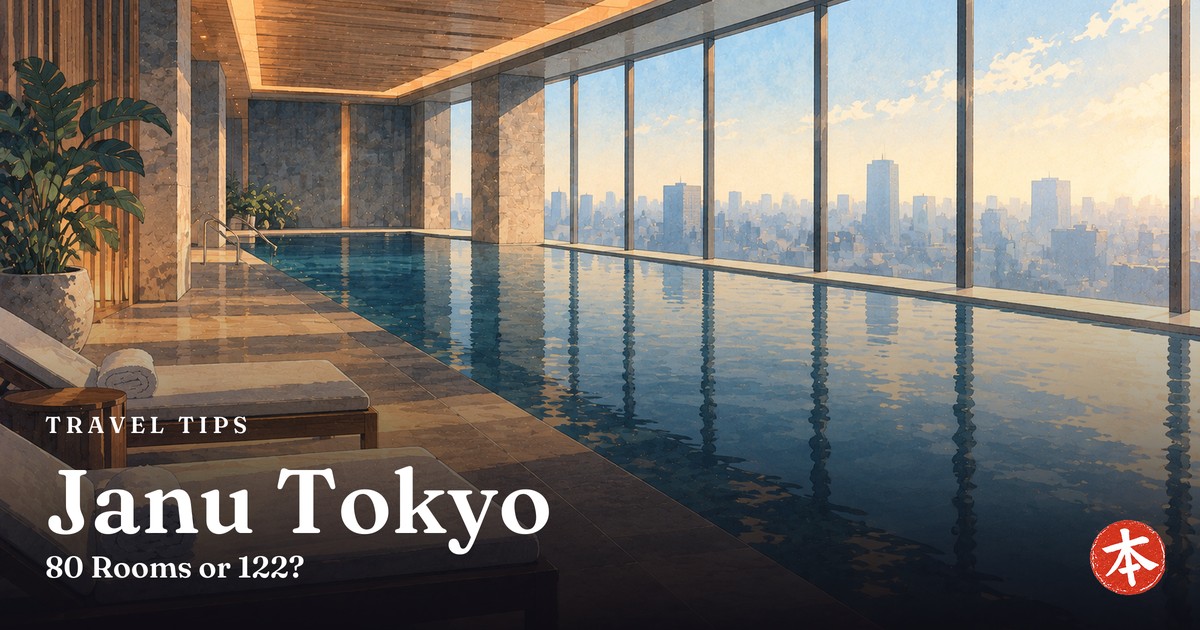
Start with something odd. Janu Tokyo’s own website gives two different room counts. The counter running across the header of every page on janu.com reads 80 bedrooms. The body text on the hotel’s own page says 122 rooms and suites. It does the same thing twice more: seven restaurants in the header against eight dining destinations in the text, and six treatment rooms against the wellness page’s seven.
We are not going to resolve those for you, because we cannot — and neither can the guides that confidently print one figure. What we can do is set out precisely what the official pages say, alongside the things that are stated once and clearly: a 4,000 sqm wellness floor, rooms from 55 sqm to a 284 sqm suite, and a position as the only hotel in Azabudai Hills. For how this sits against the rest of the city, see our Tokyo luxury hotels guide.
Janu Tokyo at a glance
| What | What the official site says |
|---|---|
| Rooms | 80 (site header) or 122 (page text) — both published |
| Room sizes | From 55 sqm to the 284 sqm Janu Suite |
| Dining | 7 (header) or 8 (text). Named: Sumi, Janu Mercato |
| Wellness floor | 4,000 sqm, called one of the largest gyms in Tokyo |
| Pool | 25 m indoor lap pool, plus a lounge pool |
| Treatment rooms | 6 (header) or 7 (wellness page) |
| Architect | Jean-Michel Gathy, Denniston |
| Location | Azabudai Hills, Minato — the complex’s only hotel |
| Group | Aman Group |
| Rates | Not published — dynamic pricing only |
Why does a hotel disagree with itself?
Most likely because the header counter was written at one point in the property’s life and the page copy at another, and nobody reconciled them. It happens. The reason we lead with it is not to score a point — it is that every English guide to this hotel states one of these numbers as fact, which means half of them are repeating a figure the hotel itself contradicts elsewhere on the same domain.
Rooms at Janu Tokyo: what is actually published
How large are the rooms?
The accommodation page gives the range plainly: from light-filled 55 sqm rooms to the 284 sqm Janu Suite. That entry size is the number worth holding on to. Fifty-five square meters is roughly double a typical international five-star room in central Tokyo, where space is the thing money actually buys.
Who designed them?
Jean-Michel Gathy of Denniston, named on the hotel’s own page. If you have stayed anywhere in the Aman orbit the vocabulary will be familiar — the site’s framing is “a private place to pause and reset” against the energy of the city outside.
What does a stay actually look like?
For that we defer to someone who has been. The video below is a Japanese couple’s two-night stay, and it does the thing a press photograph cannot: shows the rooms at ordinary hours, in ordinary light, with luggage in them.
The wellness floor is the real story at Janu Tokyo
If one thing distinguishes this hotel from the rest of Tokyo’s top tier on paper, it is the sheer footprint given over to movement.
How big is it, and what is in it?
4,000 sqm, which the hotel describes as one of the largest gyms in Tokyo. The published list runs: a 25 m indoor lap pool, a lounge pool, two Spa Houses, seven treatment rooms, a personal training studio, a movement studio, a spin studio, a martial arts studio, a golf simulator, a consultation room, and both standard and family changing rooms. That last item is worth noticing: a family changing room is not something a hotel builds unless it expects children in the wellness area, which quietly tells you this floor is not designed as an adults-only sanctuary.
What are the Spa Houses?
Two private houses running traditional banya and hammam journeys. The site offers three distinct journeys ranging from two to four hours. That duration is the tell: this is not a sixty-minute massage slot, it is a half-day structured as a sequence.
Is there anything you cannot get at another Tokyo hotel?
Two things stand out from the published list. Aerial yoga, offered as private or group sessions, and a boxing masterclass led by Rui Ebata, whom the hotel identifies as a Japanese kickboxing world champion. A named world champion teaching in-house is not a facility, it is a booking — and it is the sort of detail that disappears from every summary of this property.
Can I use it if I am not staying?
The official pages do not say. They describe the spaces and invite enquiries for specific experiences, but publish no policy on day access. We are flagging the gap rather than filling it.
Dining, and the second number that does not match
Seven restaurants or eight?
Which ones are actually named?
Two, on the main page: Sumi, described as a sumibiyaki omakase experience, and Janu Mercato, all-day Italian. The framing across the section is social rather than reverent — the site talks about “the collective joy of dining with others,” which is a deliberate step away from the hushed counter. For the other end of that spectrum in this city, see our kaiseki guide.
Can I eat there without staying?
The site is structured as though you can. Its booking menu carries two separate routes — Book a Room and Reserve a Table — presented at the same level rather than nested one inside the other. That is how a hotel signals that its restaurants take outside bookings. We are describing the site’s structure rather than quoting a policy, because no page we read states one explicitly; if you are planning a dinner around it, confirm when you reserve.
What about hours and prices?
Not published on the pages we read. Neither restaurant hours nor menu prices appear, so we do not print them. Reservations go through the site’s own booking route.
Azabudai Hills: the complex Janu Tokyo sits inside
What else is in the building?
More than most hotel neighborhoods. Azabudai Hills holds Japan’s tallest building, a Pace gallery the site describes as spanning more than 510 sqm, the Shueisha Manga-Art Heritage Tokyo Gallery — called the city’s first art space celebrating manga heritage — and the relocated Mori Building Digital Art Museum, which we cover in our teamLab Borderless guide.
Where is it, in terms a visitor understands?
Minato ward, between Roppongi and Toranomon, and the hotel is explicit that it is the complex’s sole hotel. If you are weighing districts rather than properties, our where to stay in Tokyo guide covers what this part of the city is and is not good for, and our Park Hyatt guide covers the Shinjuku alternative.
What is the Azabudai Hills Market?
A food hall inside the complex where, in the site’s own description, the stalls celebrate Japan’s leading food producers. It sits alongside the fine dining rather than in place of it, which is the point: you can eat at a counter run by a producer and at a hotel restaurant in the same building on the same day. The wider complex is characterized by what the site calls seams of greenery wrapping pedestrian walkways, rooftops and curving courtyards — it is designed to be walked through rather than entered and exited.
Is there a reason to time a visit?
Yes, and it has a deadline. French artist Jean Jullien’s PAPER PEOPLE installation is in the hotel’s public spaces and the exhibition runs until September 30, 2026. That is a published end date rather than a vague “currently on”, so it can be planned around — in either direction.
Who Janu Tokyo appears to be built for
You can read a hotel’s intent off the words it chooses about itself, and this one is unusually consistent about what it wants to be.
What does the site’s own language tell you?
The recurring words are social ones. The dining section talks about “the collective joy of dining with others.” The wellness section is framed around “the power of collective exercise.” The tagline running through the property is “where design and sociability align,” and the invitation on the front page is to “explore, connect and find joy.” Not one of those phrases is about seclusion.
How does that differ from what people expect?
Most visitors arrive at this hotel by way of its group, and expect the vocabulary of retreat — silence, distance, a room you do not leave. The published language points the other way: a 4,000 sqm floor for group exercise, up to eight places to eat, and a martial arts studio. Note also that the site describes the relationship only as Aman Group. It does not use the phrase “sister brand,” which English coverage applies freely, so neither do we.
Is it a hotel you stay inside, or one you leave?
Both, and the building is the reason. Because Janu is the sole hotel in Azabudai Hills, the galleries, the food market and the digital art museum are all a lift ride rather than a taxi. That makes it unusual among Tokyo luxury hotels, where the good things are typically nearby rather than downstairs — a distinction our luxury hotel guide treats as a real difference rather than a marketing one.
Janu Tokyo FAQ
How many rooms does Janu Tokyo have?
How big are the rooms at Janu Tokyo?
What is in the wellness center at Janu Tokyo?
Can non-guests use the spa or gym?
How much does it cost to stay at Janu Tokyo?
What restaurants does Janu Tokyo have?
Where exactly is Janu Tokyo?
Is there anything on right now worth timing a stay around?
Bottom line (2026) — Janu Tokyo’s own site publishes two room counts (80 and 122), two restaurant counts (7 and 8) and two treatment room counts (6 and 7). What it states once and clearly: rooms from 55 sqm to a 284 sqm suite, a 4,000 sqm wellness floor with a 25 m lap pool and two Spa Houses, and status as the only hotel in Azabudai Hills. Rates are not published. The Jean Jullien installation ends September 30, 2026.
Sources & what we deliberately did not state
Every figure and description above comes from janu.com — the Janu Tokyo page, the accommodation page, the wellness page and the Azabudai Hills page — read on September 7, 2026. Where the site contradicts itself we have shown both figures rather than choosing one.
Deliberately not stated: the nightly rate, because there is no published rack rate to quote; the opening date, because it does not appear on the pages we read and we are not willing to source a fact from a video title; restaurant opening hours and menu prices, for the same reason; and whether non-guests may use the spa or gym, which the official pages simply do not address. If another guide gives you all four confidently, ask where they came from.
Tokyo to Osaka, Tokyo to Kyushu, Tokyo to Hokkaido — day by day — plus seven places most visitors never reach.
- 12 pages, 80 photographs, every stop linked to its guide
- Every price and opening hour read from the official page
- Re-issued monthly, so it does not go stale in your inbox
Free. One email a month, plus the rare change that matters. Unsubscribe with one click in any email. By subscribing you agree to our privacy policy.