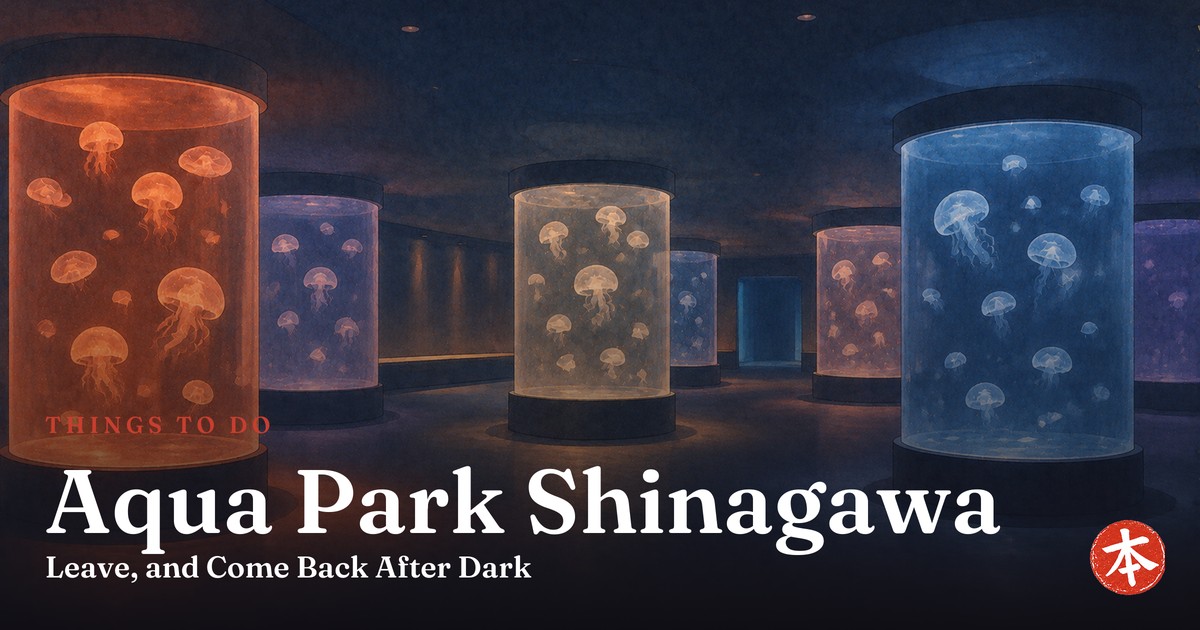
Two sentences on this listing matter more than everything else on it. The first is that you may re-enter as many times as you wish during the day of your visit. The second is that the show in The Stadium changes from day to night. Put those together and this stops being a two-hour attraction.
| The unusual term | Unlimited re-entry on the day of your visit |
|---|---|
| Why that matters | The Stadium show changes from day to night and by season |
| Where | Takanawa, on the Shinagawa side — a station you pass through anyway |
| The character | An aquarium crossed with a light installation. LED merry-go-round at the entrance |
| Named areas | Jellyfish Ramble, Little Paradise, Wonder Tube, Aqua Jungle, The Stadium |
| Inside | A bar — the Coral Cafe |
| Price and hours | Neither was shown on the listing. We are not guessing |
Unlimited re-entry changes how you plan the day
Most Japanese attractions are one-way. You go in, you come out, and the ticket is finished. This one is not, and almost nobody uses that properly.
Why this is worth more in Shinagawa than anywhere else
Shinagawa is a transfer point rather than a destination. Shinkansen services stop there, it sits on the run in from the airport, and a great many Tokyo itineraries pass through it without meaning to. An attraction you can dip into, leave, and return to is worth far more at a station like that than it would be at the end of a branch line.
The day-to-night trick
Here is the actual use case. Go in during the afternoon, walk the areas, see the daytime show. Leave, eat, come back after dark, and see the same Stadium running a different production. You have used one ticket for two distinct experiences, and you have filled the awkward evening hours that a normal aquarium visit does nothing for.
Ask about the procedure the first time you leave
The listing states the policy without describing the mechanics, and we did not verify them. Whether you need a stamp, a re-entry pass or simply your voucher again is the kind of thing that takes one question at the door and is impossible to resolve once you are outside. Ask on the way out, not on the way back.
Check Aqua Park Shinagawa tickets → Affiliate link — affiliate disclosure.
The Stadium is the reason to come back
The listing describes it as a show produced with water, light and sound, with the productions changing from day to night and every season.
Seeing it twice is not repetition
That is the point being made and it is worth taking literally. A lighting-driven show in daylight and the same show after dark are different pieces of work, because the entire medium is different. If the design is good — and the ratings suggest it is — the evening version is the one the designers were actually thinking about.
Seasons change it too
The listing says productions change every season as well. That gives this attraction something most aquariums do not have: a reason to return on a later trip. It also means anything you read about a specific show, here or anywhere, has a shelf life.
Show times are not on the listing
We are not going to print a schedule we did not verify. Shows at Japanese attractions run to a posted timetable that varies by day and season, and the timetable is displayed on site and on the operator’s page. Check it when you first go in — that is also when you decide what time to come back.
The route: a merry-go-round, a tunnel and a jungle
The listing names five areas plus the entrance, and the mix tells you what kind of place this is.
| Area | What the listing describes |
|---|---|
| Entrance | Fish and art flowers leading to an LED merry-go-round, ringed by a touch-panel jellyfish tank |
| Jellyfish Ramble | Tanks of jellyfish lit in a rainbow array of colors |
| Little Paradise | Tropical fish and sea creatures, changing with the season’s theme |
| Wonder Tube | A tunnel with sawfish and manta rays passing overhead |
| Aqua Jungle | Jungle environments and aquatic life replicas |
| The Stadium | Water, light and sound shows |
A merry-go-round inside an aquarium
That single detail tells you everything about the register of this place. It is not a compromise or a gimmick bolted on — it is at the entrance, which means it is a statement of intent. You are in an attraction that is as interested in design and atmosphere as in the animals.
The Wonder Tube is the traditional part
A walk-through tunnel with rays above you is the one exhibit here that any aquarium visitor would recognize, and sawfish are genuinely uncommon. If you want the part of the visit that is simply a good aquarium, this is it.
Little Paradise rewards a return trip
The listing says its exhibits change depending on the season’s theme. Combined with the seasonal Stadium shows, that means two of the named areas here are designed to be different on a later visit — which is a fairly deliberate business decision and a genuine benefit if you come to Tokyo more than once.
See ticket options → Affiliate link — affiliate disclosure.
It is built for the evening
Everything above points the same way. This is an attraction whose material is light, and light works better in the dark.
The LED question, honestly
If you want species labels, quiet rooms and a natural-history register, the LED-and-music approach will read as noise. That is a real preference and there is no point pretending otherwise. If you want an attraction that looks like nothing else and holds a group with mixed interests for two hours, this format is doing something the traditional aquariums are not.
There is a bar inside
The Coral Cafe serves snacks near the entrance. An aquarium with a bar is a clear signal about the intended visitor: adults in the evening, not only families in the afternoon. It also makes the leave-and-return plan easier, because you can break the visit inside rather than outside if you want to.
Who this suits
Couples and groups looking for an evening that is not dinner and not drinking. Families with children who respond to lights and music. Anybody staying near Shinagawa with a free evening. It suits a serious aquarium enthusiast least, and that is worth saying plainly.
Check availability → Affiliate link — affiliate disclosure.
Fitting it into a Tokyo day
The location does most of the work here. You do not have to build a day around Shinagawa; you have to notice that you are already going through it.
Where it sits among Tokyo aquariums
This is the design-led evening one. Sunshine Aquarium in Ikebukuro is the rooftop one with the flying penguins and works better in daylight. The Tokyo Skytree area has its own aquarium sold as a tower combo. They are genuinely different products rather than three versions of the same afternoon.
Staying nearby makes the re-entry policy real
The leave-and-return plan only works if returning is easy. If you are based around Shinagawa or on the same line, it is trivial. If you are across the city, one visit is the sensible plan and the evening show is the one to pick. Our guide to where to stay in Tokyo covers how the districts sit relative to each other.
When to skip it
If your Tokyo days are already full and you have one aquarium slot, and what you want from it is animals rather than atmosphere, choose a different one. This place is excellent at what it is, and what it is happens to be quite specific.
Deliberately not stated here
| What we are not saying | Why |
|---|---|
| The price | The listing did not display one and we did not verify a yen fare from the operator |
| Opening and closing hours | Not shown on the listing. Last entry is always earlier than closing |
| Show times at The Stadium | Not stated, and they change by day and season. Check the timetable when you go in |
| The re-entry procedure | The policy is stated; the mechanics are not. Ask at the door the first time you leave |
| A suggested duration | The listing gives none, and the re-entry policy makes it your decision anyway |
| Which species are in Little Paradise | The listing says the exhibits change with the season’s theme, so any list would go stale |
Aqua Park Shinagawa FAQ
Can you really re-enter Aqua Park Shinagawa on the same ticket?
What is The Stadium?
Is this a normal aquarium?
What are the main areas?
Where exactly is it?
What are the voucher rules?
How long should I allow?
Is it good with children?
Check Aqua Park Shinagawa tickets → Affiliate link — affiliate disclosure.
Bottom line (2026) — the listing states you may re-enter as many times as you wish on the day of your visit, and that The Stadium’s water, light and sound show changes from day to night and every season. Used together, that is an afternoon visit and an evening one on a single ticket — and it is unusually practical because the attraction sits by Shinagawa, a station most Tokyo trips pass through anyway. Expect a light installation with animals: an LED merry-go-round and touch-panel jellyfish tank at the entrance, then Jellyfish Ramble, Little Paradise, the Wonder Tube with sawfish and manta rays, Aqua Jungle and a bar. No price, hours or show times were shown, so check those for your date.
Sources
Written on September 2, 2026 from the Klook listing for the Maxell Aqua Park Shinagawa ticket: the statement that you may re-enter as many times as you wish during the day of your visit; the LED merry-go-round and touch-panel jellyfish tank at the entrance; the Coral Cafe bar serving snacks; Jellyfish Ramble described as tanks of jellyfish illuminated in a rainbow array of colors; Little Paradise with tropical fish exhibits changing with the season’s theme; the Wonder Tube with sawfish and manta rays; Aqua Jungle with jungle environments and aquatic life replicas; The Stadium producing shows with water, light and sound that change from day to night and every season; the address in Takanawa; the voucher conditions requiring a login, presentation on your device and internet access; and a 4.7/5 rating across 2,800 reviews with 100,000+ bookings. No price, opening hours or show schedule was displayed, which is why none appear here. More on how we work: how we research.
Shows change by season by design, and re-entry policies are the kind of term an operator can revise. This reflects what that source said on September 2, 2026, and the booking page carries the current terms for the day you are going.
in English
Every week we read the Japanese sources English-language media never touches — new openings, price changes, limited releases, rule changes, the seasonal things that come and go in three weeks — and send you a three-minute read of what actually matters. Hit reply with a question about your trip and a human answers.
Free. Unsubscribe anytime. We never share your address.