Search for an onsen ryokan in Osaka and you will be handed a list. Work through that list against the properties' own websites, as we did in August 2026, and three of the best-known names on it are not trading. Two of them are mid-renovation and reopen on the same day. One posted a closure notice with no date on it at all.
That is the first thing this guide is for. The second is the bigger misunderstanding underneath it: people write that Osaka has no hot springs. Osaka Prefecture has more registered spring sources than Kyoto. What it does not have is many ryokan — and the reason those two facts sit together is the most interesting thing about staying here.
Three well-known Osaka onsen are closed right now
Start here, because this is the part that wastes trips. All three of these appear in current English listings as places you can book.
| Property | Where | Status as of August 2026 |
|---|---|---|
| Premium Minoh Kanko Hotel | Minoh | ⛔ Closed since March 31, 2025 — reopens October 1, 2026 |
| Fudouguchikan (Inunakiyama Onsen) | Izumisano | ⛔ Closed since May 7, 2026 — reopens October 1, 2026 |
| Okumizuma Onsen | Kaizuka | ⛔ Closed "from September 16 for the time being" — no reopening date |
| Inunaki Onsen Center | Izumisano | ⛔ Permanently closed, July 2024 |
| Taikoen | Osaka City | ⛔ Ceased trading June 30, 2021 |
| Hotel Mielparque Osaka | Osaka City | ⛔ Ceased trading December 31, 2023 |
| Osaka Shin-Hankyu Hotel | Umeda | ⛔ Ceased trading January 2025 |
Two of them reopen on the same day
It is a coincidence worth planning around. Minoh Kanko Hotel and Fudouguchikan both reopen on October 1, 2026 — the former after roughly eighteen months dark, the latter after about five. Minoh took bookings from July 1, 2026. If you are reading this before October, both are unbookable; after it, both are new-looking properties that no review you find will have visited yet.
Okumizuma is the one to be careful with. Its notice says it is closed from September 16 for the time being pending work on the source and the building, and will announce a reopening when the work finishes. The notice carries no year, there are no dated posts, and no availability appears in its booking system. We can tell you it is shut; we cannot tell you when it will not be, and neither can anyone else without phoning.
One name changed rather than closed
Ushitaki Onsen Iyoyakanosato appears in older guides and no longer exists under that name — Kishiwada City states the operation ended on February 28, 2019, with a new operator from April 2019. The property is open under the name Ushitaki Onsen Shikimatsuri. If you search the old name you will find outdated pages; the current business is real and taking guests.
Working out the hotel tax for your dates? Our accommodation tax calculator gives it for Tokyo, Kyoto, Osaka, Hokkaido and 30+ other places from your room price, guests and dates, with the 2026–2027 changes.
How few ryokan Osaka has, and why nobody can count them exactly
Two official numbers, and they agree. Osaka City publishes a full register of licensed lodging businesses: of 1,861 properties, only 35 — about 1.9 percent — carry the word ryokan in the business name. Measured by guests instead of buildings, the prefecture's own survey counted 294,116 ryokan stays out of 18,436,930 overnight stays in 2023, or 1.6 percent. Business hotels took 59.6 percent and city hotels 27.7.
The word is no longer a legal category
Here is the part that explains why no article can give you a firm count. When the Hotel Business Act was revised, the separate licences for "hotel business" and "ryokan business" were merged into a single ryokan-and-hotel business license. A modern business hotel and a century-old tatami inn now hold the same permit.
Osaka has more spring sources than Kyoto
This is the fact that reframes the whole subject. From the Environment Ministry's national survey of hot spring use:
| Osaka | Kyoto | Tokyo | |
|---|---|---|---|
| Hot spring areas | 17 | 37 | 22 |
| Registered sources | 173 | 146 | 168 |
| Sources below 25°C | 40 | 57 | 72 |
| Onsen accommodation | 42 | 182 | 41 |
| Annual overnight stays at those | 2,366,149 | 1,757,764 | 614,330 |
The springs exist; they are just not in ryokan
Read the last two rows together and the structure appears. Osaka has 42 hot spring properties against Kyoto's 182 — less than a quarter. And yet more people stay overnight at Osaka's than at Kyoto's. The only way both can be true is if Osaka's few are very large.
That is exactly what they are. Osaka's hot spring water is used by big urban complexes, not by a street of small family inns. So the honest version of "Osaka has no onsen ryokan" is this: the water is here, the ryokan form is not. If a hot spring village is what you are picturing, that is a different trip — and Kyoto is under half an hour away.
"Natural hot spring" in central Osaka may have arrived by truck
If a hotel in the middle of the city advertises a natural hot spring, ask where the water is from. Two central Osaka properties answer that question on their own websites, and the answer is that it is brought in.
| Property | What the official site says |
|---|---|
| Onyado Nono Namba | The water is brought in from Shijonawate City in Osaka Prefecture |
| Onyado Nono Osaka Yodoyabashi | Radon spring water from Mount Ikoma, 642 m, carried in by tanker every day |
This is not a scandal and not illegal. It is disclosed plainly, the water is real spring water, and the bath is a good one. It simply is not what a visitor pictures when they read "natural hot spring" on a hotel page — and no English guide we found mentions it.
Which places do have their own source
Two, verifiably. Spa World in Shinsekai has a registered source of its own — the source is recorded at an address in the same Naniwa Ward block as the building, at 38.9 degrees, pH 7.2, classified as a simple spring, faintly yellow with a slight sulfurous smell. There is genuine hot spring water rising under the streets by Tsutenkaku, which is the single fastest way to end the "Osaka has no onsen" argument.
Outside the city, Nose Onsen states its water is 100 percent from its own source, with a bath that is neither heated nor diluted. That is the one property in this guide that matches what most people mean by an onsen ryokan.
Two places that say outright it is not an onsen
Worth knowing, because both are commonly listed as hot springs. Minoh Kanko Hotel states that its own open-air bath and the private baths at the adjoining spa garden are not hot springs, and discloses that the water is diluted, heated and filtered in a circulation system. Reimeien in Minato Ward writes that its bath is not a natural hot spring before describing what it is — a herbal bath using fourteen medicinal ingredients, trodden in by hand daily. Both are being straight with you. Aggregator listings are not.
A spring does not have to be hot to count as one
The Japanese legal definition catches English speakers out. Water qualifies as an onsen if it is either at least 25 degrees at source, or contains one of a list of specified substances above a set concentration. Temperature is only one of two routes in.
Which is why 40 of Osaka's 173 sources are below 25 degrees and still count. The clearest example in this guide is Minamitei at Inunakiyama, whose water is officially classified as a simple sulfur cold mineral spring — the word cold is part of the classification. It is heated for bathing. It is legally, unambiguously an onsen. If you booked it expecting the word "hot spring" to describe the water coming out of the ground, that is a translation problem rather than a misrepresentation.
Where you can actually stay: tatami inns in the city
A fifteen-minute stay report from a tatami-floored hotel in central Osaka with its own bath and sauna. Japanese, but it shows the compromise this article describes: not a ryokan in the traditional sense, but a city hotel built to feel like one, in a district where a genuine inn is very hard to find.
These are not hot springs. They are working ryokan with tatami rooms in the middle of Osaka, which is a different and in some ways rarer thing.
| Inn | Location | Notable |
|---|---|---|
| Kaneyoshi Ryokan | Soemoncho, 3 min from Nippombashi | Founded 1919; rooms overlooking the Dotonbori canal; large public bath (not an onsen) |
| Ryokan Kuramoto | Shinsaibashi, 3 min from Dotonbori | Founded 1954; all rooms tatami; changed its name back from "hotel" to ryokan in 2020 |
| Yamatoya Honten | Shimanouchi, 3 min from Nippombashi | Kaiseki, fugu and kue hotpot; basement public bath with sauna |
| Hokousou | 3 min walk from JR Tennoji | Publishes its rates; cash only; 24:00 curfew |
| Imazato Ryokan | Higashinari, 4–5 min from Imazato | 16 rooms; publishes rates; serves breakfast and dinner |
Kaneyoshi is the one to look at first if the location matters to you: a 1919 inn with tatami rooms facing the canal, in the middle of Dotonbori. One warning that no aggregator will show you — the inn has published closure periods of October 12–23, 2026 and February 10–25, 2027. Check those dates before you plan around it.
The two that publish their prices
Most Osaka ryokan send you to a booking site rather than list rates. Two do not, and both are cheap by any standard. Hokousou, three minutes from JR Tennoji, publishes a six-mat room at 6,000 yen for one guest and 10,000 for two, with a ten-mat room at 13,000 for two, and breakfast at 650 yen. Imazato Ryokan starts at 5,500 yen per person for a small tatami room with shared bath, with breakfast at 800 to 900 yen and dinner at 2,000 to 3,000 — dinner must be ordered by phone the day before.
Where you can actually stay: hot springs within reach
Once you accept that the onsen are outside the center, the options improve considerably. These are the ones confirmed to be open.
| Property | Getting there | Water |
|---|---|---|
| Hotel Seiryu (Ishikiri Onsen) | 20 min from Namba with no transfer, then 5 min walk | Natural hot spring; day use 1,000 yen |
| Minamitei (Inunakiyama Onsen) | 25 min by car from Kansai Airport; free shuttle from Izumisano | Simple sulfur cold mineral spring; day use 1,200 yen |
| Nose Onsen | Shuttle from Ikeda 14:20, one departure daily | 100% own source; day use 1,000 yen weekdays |
| Ushitaki Onsen Shikimatsuri | 53 min by bus from Kishiwada | Two springs, one indoor one outdoor; day use 750 yen |
| Yumoto Onsenso Yamanoyu | Bus to Inunakiyama, 3 min walk | Day use 700 yen, 10:00–18:00 |
The easiest one to reach, and the one for a departure day
For a first onsen while based in the city, Hotel Seiryu is the practical answer: Kintetsu from Namba, no transfer, about twenty minutes, then five minutes on foot from Ishikiri Station. It calls itself a hot spring ryokan despite the name, the baths run from 6:00 to 23:30, and the view is the point — it describes the bath as sitting at a height equivalent to about the 70th floor, looking down over the plain. We are not quoting its spring classification because the property does not publish one in readable form.
For a last night before flying, Minamitei is 25 minutes by car from Kansai Airport with a free shuttle from Izumisano Station, and its water is a genuine sulfur spring. A sulfur bath on the way to the airport is a better use of a departure day than another shopping street.
Nose Onsen is the most authentic and the hardest to reach. Its shuttle runs once — 14:20 from Ikeda, 14:45 from Yamashita, returning at 10:20 — so arriving independently means a car. Note that it announced a room-rate revision from September 1, 2026, so any price you find quoted for a stay there predates the change. Its day-use rates are current: 1,000 yen on weekdays, cash only.
The two taxes that appear at check-out
Neither is usually included in the price you booked, and one of them changed recently enough that almost every English page still shows the old rates.
Lodging tax changed on September 1, 2025
| Room rate per person per night | Tax now | Before Sept 2025 |
|---|---|---|
| Under 5,000 yen | None | None (under 7,000) |
| 5,000–15,000 yen | 200 yen | 100 yen |
| 15,000–20,000 yen | 400 yen | 200 yen |
| 20,000 yen and above | 500 yen | 300 yen |
Three more points. It is charged per person per night, so the cheap inns above sit right on the line — Hokousou at 6,000 yen is taxed, a 4,950 yen room is not. It is collected by the property at check-in or check-out, which is why it rarely appears in your booking total. And it applies to licensed private lodgings as well as hotels, which is unusual. There is no separate Osaka City tax on top — unlike Kyoto, it is a single prefectural tax.
Bathing tax is charged on top, and the rate varies by city
| Municipality | Staying overnight | Day use |
|---|---|---|
| Osaka City | 150 yen per day | 150 yen (exempt under 1,500 yen) |
| Izumisano (Inunakiyama) | 150 yen per night | 75 yen |
| Minoh | 200 yen per day | 75 yen |
So a night at an onsen ryokan in Minoh carries lodging tax plus 200 yen of bathing tax, and Minoh's rate is above the 150 yen that the other two charge. Children are exempt — under twelve in Izumisano and Minoh, elementary school age and under in Osaka City. One property already shows you this working: Minamitei prints its day-use price as 1,200 yen including 75 yen of bathing tax.
Tattoos, and the one place you cannot sleep
Of every property checked for this guide, only four state a tattoo policy at all — and all four refuse entry. The rest is not stated officially, which is not permission.
| Property | What it states |
|---|---|
| Ushitaki Onsen Shikimatsuri | Refuses bathers with tattoos including stickers and paint; anyone found will be removed with no refund |
| Onyado Nono (both Osaka properties) | Refuses tattooed bathers, but offers a cover sticker of about 8 x 10 cm at some properties |
| Nose Onsen | Guests with tattoos cannot use the bath |
| Reimeien | Refuses entry to the bath for guests with tattoos |
Shikimatsuri's wording is the strictest we have seen anywhere in Japan, and it is worth reading literally: a temporary sticker or painted design counts. If you have any tattoo and the bath is why you are booking, contact the property first. For the wider picture on how bathing works, our ryokan guide covers the etiquette side.
Solaniwa Onsen is not somewhere you can stay
It appears constantly in English lists of Osaka onsen accommodation, and it does not hold a lodging license — it is absent from Osaka City's register of licensed accommodation, which means overnight stays are not permitted there. Its own site puts it accurately: you can enjoy the feeling of a little onsen trip, a ryokan mood. A mood is what it is offering. The spring itself is real, drawn from 1,000 meters down, with open-air baths fed directly from the source, and it is an excellent day-use bath. Sleeping there is not on the menu; a separately licensed hotel operates in the same building under a different name.
If your Osaka nights are going to be in a business hotel anyway — which, statistically, they are — that is not a failure of planning. It is what the city is. Use the ryokan for one night, or use an onsen day-use bath, and spend the rest of the budget on the city itself.
Osaka ryokan FAQ
Are there any real ryokan in Osaka?
Which Osaka onsen ryokan are closed right now?
Does Osaka have hot springs?
Is the natural hot spring in central Osaka hotels real?
Do I pay a tourist tax when I stay in Osaka?
Can you stay overnight at Solaniwa Onsen?
Do Osaka ryokan and onsen allow tattoos?
Is it worth staying in a ryokan in Osaka rather than Kyoto?
Bottom line (2026) — Three well-known Osaka onsen are shut, and Minoh Kanko Hotel and Fudouguchikan both reopen on October 1, 2026. Ryokan are genuinely scarce — 1.9 percent of licensed properties, 1.6 percent of stays — and the license category no longer exists, so nobody can count them properly. But Osaka has 173 spring sources against Kyoto's 146; they are simply used by a few very large facilities rather than by small inns, and some central hotels truck their water in and say so. Best bets: Kaneyoshi for tatami over the Dotonbori canal, Hotel Seiryu for a hot spring 20 minutes from Namba, and Minamitei for a sulfur bath 25 minutes from the airport. Budget for lodging tax plus bathing tax at check-out.
Sources
Closure dates, reopening dates, room types, meal service, bath hours, curfews, payment methods and tattoo policies: each property's own website and closure notices, read individually. The count of licensed lodging businesses and the absence of a lodging license for one day-use bath: Osaka City's register of licensed accommodation. Overnight stays by accommodation type: the prefecture's accommodation survey. Hot spring areas, source counts, source temperatures and onsen accommodation figures: the Ministry of the Environment's national hot spring statistics, together with the legal definition of an onsen. Lodging tax rates, the room-rate-only assessment and the exclusions: Osaka Prefecture's tax pages and its published Q&A. Bathing tax rates and exemptions: the Osaka City, Izumisano and Minoh municipal tax pages. The name change at Ushitaki: Kishiwada City. All read on August 31, 2026 — renovation dates and rates move, so confirm with the property before you book.
Some links on this page may be affiliate links, which means we may earn a commission if you book or buy through them — at no extra cost to you. See our affiliate disclosure.
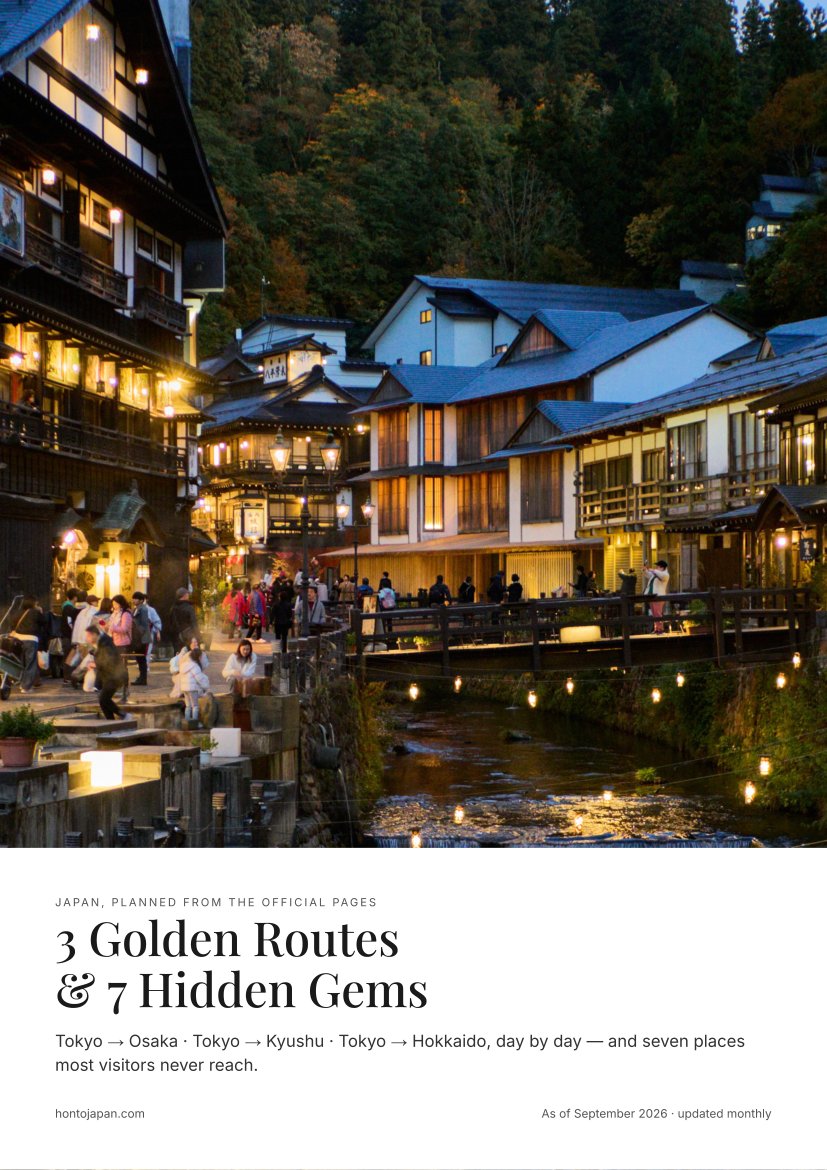
Tokyo to Osaka, Tokyo to Kyushu, Tokyo to Hokkaido — day by day — plus seven places most visitors never reach.
- 12 pages, 80 photographs, every stop linked to its guide
- Every price and opening hour read from the official page
- Re-issued monthly, so it does not go stale in your inbox
Free. One email a month, plus the rare change that matters. Unsubscribe with one click in any email. By subscribing you agree to our privacy policy.