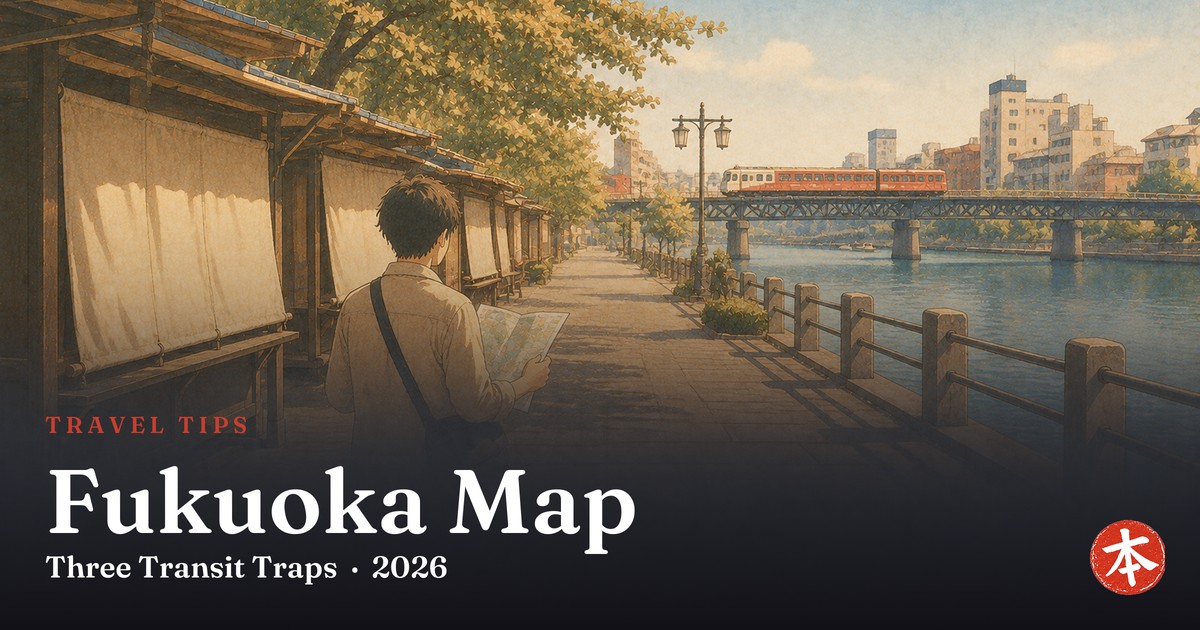
Fukuoka is one of the easier Japanese cities to move around in — three subway lines, one main bus network, one IC card and a compact, walkable center — but a handful of specific rules trip up almost every first-time visitor. The International Terminal is not on the subway (the Domestic one is). Nishitetsu buses cannot break a 10,000-yen note. And the tourist pass everyone buys does not cover the direct bus to Dazaifu. This guide is a working map of how the city actually gets you around, written from the operators’ own English pages, with the traps flagged up front.
How Fukuoka’s transit actually works
At street level, Fukuoka runs on three overlapping systems and one card. The Fukuoka City Subway is a compact three-line network that links the airport with Hakata and Tenjin — the axis nearly every visitor needs. Nishitetsu buses fill in the rest, especially east–west runs to Momochi and out to the suburbs. The Nishitetsu train takes you south to Dazaifu, Kurume and beyond. And a single IC card — Hayakaken, nimoca, SUGOCA or a Suica you already carry — taps you through all of them. The two big stations at the center are Hakata (the JR and subway hub) and Tenjin (the shopping and Nishitetsu-bus hub); most itineraries live between those two, plus the airport and a day trip to Dazaifu. The city is genuinely walkable in a way Tokyo is not, and knowing this changes how much transit you actually need.
🚨 The three transit traps that catch first-time visitors
2. Nishitetsu buses cannot break a 10,000, 5,000 or 2,000-yen note. The operator says so in English on the bus how-to page. The on-board change machine handles 1,000-yen notes and small coins only. Break your notes at a conbini first, or ride with an IC card.
3. The Tourist City Pass does not cover the Dazaifu Liner bus. The official pass page states plainly that it is not available for the direct "Tabito" bus from Hakata to Dazaifu. Wrong pass on that route means you pay again. Use the Nishitetsu "Fukuoka City + Dazaifu Liner" combo, or take the Nishitetsu train from Tenjin instead.
The subway: three lines, one axis that matters
The Fukuoka City Subway is the backbone. The Airport Line runs, in the tower's wording, "between Meinohama and Fukuoka Airport" — the one that carries almost every tourist between the airport, Hakata and Tenjin. The Hakozaki Line runs between Nakasu-Kawabata and Kaizuka, mostly a residential and northeastern-suburbs route. The Nanakuma Line runs between Hashimoto and Hakata, a newer diagonal across the west of the city. The two you are most likely to use — Airport and Hakozaki — meet at Nakasu-Kawabata, which is also the closest station to the yatai riverfront.
Operating hours are broad: trains run from about 5:30 am to 0:25 am, every 4 to 8 minutes, according to the same page. Fares are set by distance traveled, not a flat rate, and the current amount for a specific segment is on the subway's fare page or on Jorudan — quoting a single number here would age quickly. If you plan to hop on and off, the Subway 1-Day Pass at 640 yen for adults and 320 for children covers all three lines for a day.
Nishitetsu buses and paying on board
Fukuoka's buses are almost all run by Nishitetsu, and they are how you get to places the subway does not reach — Momochi and the seaside, some of the residential Tenjin edges, and the direct Dazaifu route. The English how-to page tells you the flow: board through the center door, take a numbered ticket from the orange box if you are paying cash, or tap your IC card on the reader if you are not. The front monitor updates the fare against your ticket number as the bus moves. Pay at the front on the way out.
The change-machine rule that catches people
This is the single most awkward moment on a Fukuoka bus. If your only cash is a 10,000-yen note fresh from the airport ATM, the fare box will not help you. Two fixes: break the note at a convenience store before you board, or buy a nimoca IC card — Nishitetsu's own — at 2,000 yen including a 500-yen deposit and 1,500 in credit. After that, the payment problem disappears.
Is there still a ¥100 loop bus in central Fukuoka?
It comes up in older guides. On Nishitetsu's current English discount-ticket page we cannot find a clean statement of a running "100-yen loop" product, and rather than write from an out-of-date blog we would rather send you to the operator or the information counters at Hakata or Tenjin bus terminal to confirm on the day. In practice, if you buy the Fukuoka City 1-Day Pass or the Tourist City Pass, city bus fares are already covered, so the loop question rarely changes anything.
One-day passes: which one actually wins
| Pass | What it covers | Adult | Best for |
|---|---|---|---|
| Fukuoka City Subway 1-Day Pass | All 3 subway lines, one day | ¥640 | Subway-only day between Hakata / Tenjin / Airport |
| Nishitetsu Fukuoka City 1-Day Bus Pass | City buses within Fukuoka City | See operator | Bus-heavy day (Momochi etc.) |
| FUKUOKA TOURIST CITY PASS (City) | Buses, trains, subways, ferries | ¥2,500 | Mixed day using several modes — not Dazaifu Liner |
| FUKUOKA TOURIST CITY PASS (City + Dazaifu) | Above + train reach to Dazaifu | ¥2,800 | Dazaifu via train, plus city moves |
| Fukuoka City + Dazaifu Liner "Tabito" | City buses + Tabito bus to Dazaifu | ¥2,100 | Dazaifu via the direct Tabito bus |
A key catch on the Tourist City Pass, straight from its official page: it is only available to overseas tourists on a short-stay visa, and you have to present your passport at the sales counter. If you are on a long-stay visa, or you cannot show a passport, this pass is not for you — the Nishitetsu bus pass or the subway pass are the alternatives. The other catch — worth repeating because it costs money — is that the Tourist City Pass does not cover the Dazaifu Liner "Tabito" bus. See the Dazaifu section below.
Airport to downtown: domestic versus international
This is the one every visitor asks about, and it has a short and a long answer. The short answer: from the Domestic Terminal, walk out of the arrivals hall, follow signs to the subway, tap in, and you are at Hakata in about 5 minutes. From the International Terminal, walk out, take the free shuttle bus for 11 minutes to the Domestic Terminal, then do the same. The airport's own English page states the direct-connection point explicitly:
The long answer: if you are onward-connecting to other Kyushu cities, the subway lands you at Hakata Station where you change to JR Kyushu — the airport site names Kokura, Yamaguchi, Oita, Miyazaki, Kumamoto, Kagoshima, Saga and Nagasaki as onward JR destinations. If Tenjin is your first stop, ride the Airport Line one more station past Hakata. For a general primer on Japan's IC card ecosystem before you land, our Suica and IC card guide covers the interoperability, and for staying online on the ride, our Japan eSIM guide covers the airport-to-hotel data question.
To Dazaifu: the pass trap in one place
Dazaifu is the classic day trip from Fukuoka, and there is a right way to pay for it that depends on how you go. Two routes:
Option A: Nishitetsu Dazaifu Liner "Tabito" (direct bus)
The Tabito bus goes direct, and the operator's English page publishes the numbers: 40 minutes from Hakata Bus Terminal to Dazaifu, and 25 minutes from Fukuoka Airport International Terminal to Dazaifu, with reservations not required and 28 buses on weekdays. Fares: 800 yen cash or 780 by IC from Hakata; 700 or 680 from the airport. Two important limits on the same page: the bus does not run from Fukuoka Airport to Hakata Bus Terminal — this is a Dazaifu route only — and the Tourist City Pass is not valid on it. If you want a one-day ticket that does cover Tabito, the right choice is the Fukuoka City + Dazaifu Liner "Tabito" One Day Unlimited Ticket at 2,100 yen for adults.
Option B: Nishitetsu train from Tenjin
The other route is the Nishitetsu train from Nishitetsu Fukuoka (Tenjin) Station down the Tenjin-Omuta Line, changing for the short Dazaifu branch. This is what the Tourist City Pass (City + Dazaifu) at 2,800 yen is built for — it covers city moves plus the train reach to Dazaifu. Which you pick usually comes down to where you are starting from that morning: Hakata or the airport, take Tabito; Tenjin, take the train.
Yatai streets: what the official page will and will not tell you
Fukuoka's yatai — the mobile food stalls that pop up in the evenings — are the city's signature food scene, and the official Fukuoka City tourist page notes the attention they have drawn abroad:
The best-known cluster is along the river in Nakasu-Kawabata — the photographs you have probably seen of night-time stalls are almost all from there — with additional stalls in the Tenjin/Yakuin area and the Hakata Old Town. What we will not pin down here: exact opening hours, the current stall-by-stall map, and the operating-rule details. The city regulates yatai by ordinance and updates it periodically; the English official page does not publish those specifics as a single clean list, and putting made-up hours in a guide is exactly the kind of thing that ruins a visitor's evening. On the day, check the current Fukuoka City tourist page or ask your hotel — it is a five-second question that avoids arriving at a closed stall.
Common mistakes tourists make — and the fix
A summary of the traps you can spot ahead of time:
| Mistake | What actually happens | Fix |
|---|---|---|
| Looking for the subway at the International Terminal | There isn't one there. | Free shuttle bus to Domestic Terminal — 11 minutes — then subway. |
| Paying a Nishitetsu bus fare with a 10,000-yen note | The fare box refuses it. | Break the note at a conbini first, or use an IC card. |
| Assuming the Tourist City Pass covers the Dazaifu Liner | It does not — the pass page states this in bold. | Buy the Nishitetsu "Fukuoka City + Tabito" combo for ¥2,100 instead, or take the Nishitetsu train. |
| Trying to take Tabito back from Fukuoka Airport to Hakata | "From Fukuoka Airport to Hakata Bus Terminal — No boarding". | Take the subway from the Domestic Terminal. |
| Reading a fixed subway-fare table on an old blog | Fares are set by distance and can change. | Check the official Fukuoka City Subway fare page, or search on Jorudan for your date. |
FAQ
How do I get from Fukuoka Airport to Hakata?
Which subway lines actually matter for tourists?
Should I get the Tourist City Pass or a one-day subway pass?
Does the Tourist City Pass work on the Dazaifu Liner bus?
Can I take the Tabito bus from Fukuoka Airport back to Hakata?
How do I pay on a Nishitetsu bus?
Which IC card should I buy in Fukuoka?
What is the ¥100 loop bus I keep reading about?
What is the best way to get to Dazaifu?
Where should I go to see the yatai food stalls?
Is the airport really as close to the city as people say?
What common mistakes should I avoid?
Bottom line (2026) — Fukuoka runs on three subway lines, one bus network and one IC card, but three traps still catch first-timers: the International Terminal is not on the subway (an 11-minute shuttle connects it to Domestic), Nishitetsu bus change machines will not break a 10,000-yen note, and the Tourist City Pass does not cover the Dazaifu Liner "Tabito". Only the Domestic terminal has a direct subway link.
Sources
Subway lines, operating hours, distance-based fare structure and the 1-Day Pass price; the airport's Domestic-only direct subway connection and the 11-minute International-to-Domestic shuttle; Nishitetsu bus boarding flow, IC-card acceptance and the notes the on-board change machine cannot break; the Dazaifu Liner "Tabito" times, fares and the airport-to-Hakata no-boarding rule; the Fukuoka City + Tabito combo ticket price; the FUKUOKA TOURIST CITY PASS coverage, prices, passport requirement and the exclusion of the Dazaifu Liner; the yatai note about The New York Times '52 Places' list: read from Fukuoka City Subway, Fukuoka Airport, Nishitetsu, and Fukuoka City's official tourist site (gofukuoka.jp) in English. Read August 26, 2026. Fares, timetables and pass rules can change; confirm on the operator's official page before you buy. The embedded video is by its creator.
Tokyo to Osaka, Tokyo to Kyushu, Tokyo to Hokkaido — day by day — plus seven places most visitors never reach.
- 12 pages, 80 photographs, every stop linked to its guide
- Every price and opening hour read from the official page
- Re-issued monthly, so it does not go stale in your inbox
Free. One email a month, plus the rare change that matters. Unsubscribe with one click in any email. By subscribing you agree to our privacy policy.