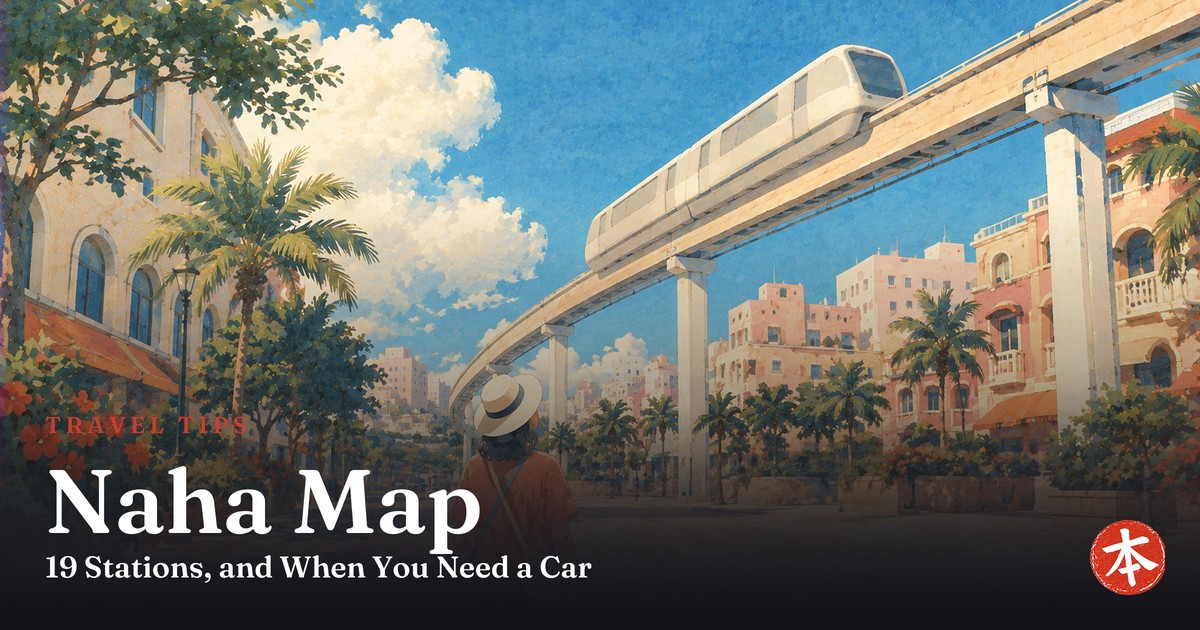
Naha has one monorail with 19 stations, four bus companies with distance-based fares, and a ferry pier that most visitors miss because they do not know it is a ten-minute walk from the middle of Kokusai-dori. This guide is the practical map of moving around inside Naha – which Yui Rail station is actually closest to what, when the one-day pass pays for itself, and the single trick that keeps a rental car from becoming a parking bill. For the whole island – Churaumi, Onna, Kouri, the Kerama Islands, the airport limousine network – start with our Okinawa map guide and come back here for the city.
Naha Transit at a Glance
Four things do almost all the moving in Naha. Yui Rail, the monorail, is the spine – 19 stations from the airport to Tedako-Uranishi in Urasoe, end to end in 37 minutes for 390 yen. City buses fill the gaps the monorail misses, with four operators sharing a distance-based fare and a single real-time search portal called Busnabi Okinawa. Taxis are, in Visit Okinawa Japan's own phrasing, "a quick, convenient, and plentiful option" in the city and short hops with a small group often beat the monorail. And ferries from Tomari Port, ten minutes on foot from a monorail station in the middle of the city, are how you leave Naha by water for the Kerama Islands. What is not on this list is a rental car. For the city itself, it is a parking bill, not a tool.
Yui Rail: 19 Stations from the Airport to Shuri
Yui Rail opened on August 10, 2003, the first rail line on Okinawa since World War II. The four Urasoe stations at the eastern end were added when the Urasoe extension became operational on October 1, 2019. The whole route is about 17 kilometers, the full journey takes 37 minutes for 390 yen, and trains run from 6:00 a.m. to 11:30 p.m. every day, at intervals of 4 to 15 minutes.
The full station list, west to east
| # | Station | What is it for |
|---|---|---|
| 1 | Naha Airport | Terminal-connected. Where most trips start. |
| 2 | Akamine | Local. Not a visitor stop. |
| 3 | Oroku | Local. |
| 4 | Onoyama Park | Park and stadium. Handy on event days. |
| 5 | Tsubogawa | Local. |
| 6 | Asahibashi | Naha Bus Terminal, and the walk to Naminoue Beach and Shrine. |
| 7 | Kenchomae (Prefectural Office) | Western end of Kokusai-dori. DFS Ryubo department store. |
| 8 | Miebashi | Middle of Kokusai-dori. 🚨 Ten-minute walk to Tomari Port for Kerama ferries. |
| 9 | Makishi | Eastern end of Kokusai-dori. Closest to Makishi Public Market. |
| 10 | Asato | Local, on the way to the new-town area. |
| 11 | Omoromachi | New-town shopping and DFS T Galleria. |
| 12 | Furujima | Local. |
| 13 | Naha City Hospital | Hospital access. Not a visitor stop. |
| 14 | Gibo | Local, uphill towards Shuri. |
| 15 | Shuri | Shuri Castle Park, about 15 minutes on foot uphill. |
| 16 | Ishimine | 🚨 Urasoe City, not Naha. Local. |
| 17 | Kyozuka | 🚨 Urasoe City. Local. |
| 18 | Urasoe-Maeda | 🚨 Urasoe City. Local, park-and-ride potential. |
| 19 | Tedako-Uranishi | 🚨 Urasoe City. Line terminus. |
One-way fares from Naha Airport
Adult fares from Naha Airport Station to any other station, straight from the operator's table. Children aged 6 to 14 pay child fares; under-6s travel free with an adult, up to two per adult.
| To | Adult | Child |
|---|---|---|
| Akamine / Oroku | ¥250 | ¥130 |
| Onoyama Park / Tsubogawa / Asahibashi / Kenchomae | ¥290 | ¥150 |
| Miebashi / Makishi / Asato / Omoromachi | ¥320 | ¥160 |
| Furujima / Naha City Hospital / Gibo / Shuri | ¥360 | ¥180 |
| Ishimine / Kyozuka / Urasoe-Maeda / Tedako-Uranishi | ¥390 | ¥200 |
The four Urasoe stations most visitors skip
Ishimine, Kyozuka, Urasoe-Maeda and Tedako-Uranishi are all in Urasoe City, not Naha. They were added in 2019 to serve commuters and to give drivers a park-and-ride option coming into the city. For a visitor with a Kokusai-dori hotel and a day of Shuri and the market ahead, the practical monorail effectively ends at Shuri. Knowing these four exist is useful; needing them is unlikely unless your hotel is deliberately out there.
Getting from the airport terminal to the platform
The airport's own description is that the route runs from the communication passage of the domestic area 2F to Naha Airport Station. In practice that is a three-to-five minute walk with a rolling bag if you land at the domestic terminal. An international arrival has to cover the connection to the domestic terminal first, so budget closer to 10 to 15 minutes with luggage. Either way, it is much faster than the taxi queue on a busy afternoon.
Buses: Four Companies, One Real-Time App
Naha's buses are run by four operators – Naha Bus, Ryukyu Bus Kotsu, Okinawa Bus and Toyo Bus – and the fare is distance-based, not a flat rate. That means a specific number for a specific trip is a thing the app tells you, not a thing we can print in a guide without going out of date. The operators themselves point riders to Busnabi Okinawa for real-time transit details, and it is the authoritative source for planning a bus trip. If you would rather not think about it, the monorail plus a short taxi covers most first-visit itineraries.
One thing worth naming so you can send it elsewhere: the airport limousine buses that run to Onna, Nago and the Churaumi Aquarium area. They are a real option, but they are outside Naha and belong in the wider island picture – our Okinawa map guide covers those. Inside the city, the local buses fill the gaps the monorail misses, particularly for the coastline west of Naminoue and points south of the airport.
One-Day Passes and Which One Actually Wins
The one-day pass is ¥1,000 for adults and ¥500 for children. The two-day pass is ¥1,800 and ¥900. The key wording from the operator is that a one-day pass remains valid for 24 hours from issuance, while a two-day pass is valid for 48 hours – not a calendar day. If you activate at 3pm, it runs until 3pm the next day.
The math of when it pays
The most expensive one-way fare on the whole line is 390 yen from Naha Airport to the eastern end. A round trip on that is 780 yen, still less than the 1,000-yen pass. In practical terms, the pass wins when your day is three or more segments. An airport arrival day that runs hotel drop, Kokusai-dori for dinner, and one late trip out to Omoromachi pays. A day that is just Omoromachi for shopping and one evening return to Kokusai-dori usually does not.
Two example days that pay for the pass
Shuri and Kokusai-dori in one day. Airport to Kenchomae, walk Kokusai-dori east to Makishi, back to Naha Airport Station for a rental-car pickup or hotel – three segments minimum, four with an evening trip. Pass wins. The new-town day. Hotel to Omoromachi for DFS, Omoromachi back to Makishi for the public market, then Shuri in the afternoon, then home – four segments, and each one is in the mid-fare range. Pass wins by a wider margin.
Getting to Kokusai-dori: Three Stations to Choose From
Kokusai-dori is a 1.6-kilometer stretch of stores, restaurants and bars, and the monorail meets it at three different stations. The right one to use depends on which end of the street you want and, for arrival days, where your hotel is.
| Station | Where on Kokusai-dori | Also useful for |
|---|---|---|
| Kenchomae | Western end | DFS Ryubo, the prefectural office area, Naha City Hall |
| Miebashi | Middle of the street | 🚨 Ten-minute walk to Tomari Port for the Kerama ferry |
| Makishi | Eastern end | Makishi Public Market, the small-street food area behind it |
The move most people miss: if a Kerama Islands day is on the plan, book a hotel near Miebashi. You are one monorail station from the airport line, in the middle of Kokusai-dori for dinners, and ten minutes on foot from the ferry pier the morning you sail. That single alignment saves an early taxi you would otherwise take from either end.
Shuri Castle: What to Expect When You Get There
Shuri Castle is a 15-minute walk uphill from Shuri Station. The honest thing to know before you commit: the main hall burned down in October 2019, and reconstruction is still underway. The park is open, and parts of the site are being presented as a working rebuild – which some visitors find as interesting as the original – but what is fenced off, what is visible, and what is inside a construction shell all move as the project advances. Check the Shuri Castle Park official site for the current visible scope before you spend the morning. Our Okinawa map guide covers the wider story of the fire and the rebuild if you want the background.
Do You Need a Rental Car? (Almost Never, in the City)
For everything inside Naha, no. Yui Rail plus a short taxi covers Kokusai-dori, Shuri Castle, the DFS at Omoromachi, Makishi Public Market, Naminoue Beach and the Tomari Port ferry pier. Parking near Kokusai-dori is scarce and priced accordingly – a car sitting outside a Naha hotel is a car you paid to store overnight.
The one rule that saves the money
Rent the car the morning you leave Naha, not on your arrival day. If your trip is a Naha city day, then two nights out at Churaumi or Onna, then back to Naha for the flight, do the city days first on the monorail, walk to a rental counter at Naha Airport Station or downtown the morning you head north, and return the car on your way back to the airport. You skip two or three days of parking fees and a lot of one-way-street driving in central Naha.
When the car actually becomes necessary
The rental car is a tool for outside Naha: the Churaumi Aquarium in the north, the resort coast of Onna, Kouri Island, the southern war memorials, the interior that no bus reaches on a reasonable schedule. Visit Okinawa Japan puts it plainly: rental cars "are perfect for travelers who want to get off the beaten path." The full breakdown of when the car is worth it, and when the airport limousine bus is fine, sits in our Okinawa map guide.
Typhoon Days: What Actually Runs
Yui Rail can suspend service in strong typhoons, and buses do the same on their own timing. There is no rule that says the monorail keeps going when the ferries have stopped, and no rule that says buses will still be running when the monorail is not. What holds in a serious storm is that the ferry decision goes first, the monorail decision goes later, and both are announced by the operators – not the weather app.
Two moves that keep a typhoon day workable
First, do not schedule a Kerama Islands day on a marginal forecast – boats stop before the monorail does, and being stranded on Zamami is worse than losing a deposit. Second, stay near Kokusai-dori if a storm is due: you can walk to food and cover without needing any transit. Watch the operator sites, not just the news.
IC Cards: OKICA, Suica and When Cash Still Wins
Yui Rail accepts Suica, PASMO and other nationwide IC cards as well as the local OKICA. City buses in Naha take them too. If you already have a Suica from an earlier stop in Tokyo or a Suica in a smartphone wallet, you are set – there is nothing to buy. OKICA is Okinawa's local card, and there is little reason for a short-stay visitor to buy one; leave it to residents.
When cash or the one-day pass wins over IC
For a day that is three or more monorail segments, the one-day pass is usually cheaper than paying per tap. For a light day – one or two segments – IC or cash is fine. If you are still deciding whether to get a Suica at all for a wider Japan trip, our Suica guide lays out the practical case. And if the plan is to rely on Busnabi and Google Maps for the bus network, an eSIM that just works from the airport onwards saves the "where is the free Wi-Fi" search on day one.
(Coming in September? Our Japan in September guide shows Naha at 27.9 C and 275 mm of rain, the warmest and wettest of eight cities, at the peak of typhoon season.)
FAQ
How many stations does Yui Rail have?
Which station is Kokusai-dori?
How do I get to Shuri Castle from Naha?
Do I need a rental car in Naha?
How much is the one-day monorail pass, and is it worth it?
Can I use my Suica card on Yui Rail?
How do I get from Naha Airport to my hotel?
How do the ferries to the Kerama Islands work?
What happens on a typhoon day?
What are the four Urasoe stations, and should I use them?
How do city buses work in Naha?
Is Naminoue Beach worth going to?
Bottom line (2026) — In Naha you rarely need a rental car: the 19-station Yui Rail monorail is the spine, plus four bus operators tracked in real time on Busnabi Okinawa. Day passes come in 24 / 48-hour validities. Yui Rail plus a short taxi covers Kokusai-dori, Shuri Castle, DFS Omoromachi, Makishi Public Market, Naminoue Beach and the Tomari Port ferry to the Kerama Islands.
Sources
The Yui Rail line, its opening and Urasoe extension dates, fares and hours, the airport walking route quote, the pass prices and 24 / 48-hour validity wording, the four bus operators and Busnabi Okinawa as the real-time source, Kokusai-dori's length, Tomari Port's Kerama connection and IC card acceptance were read from the Yui Rail official site, Naha Airport's official site, Visit Okinawa Japan, Okinawa Bus Ltd and Wikipedia's Naha and Okinawa Urban Monorail entries. Read August 26, 2026. Bus fares are distance-based, Kerama ferry schedules are seasonal and weather-dependent, and the Shuri Castle main hall is still being rebuilt – confirm on the operator sites before you commit. The embedded video is by its creator.
Tokyo to Osaka, Tokyo to Kyushu, Tokyo to Hokkaido — day by day — plus seven places most visitors never reach.
- 12 pages, 80 photographs, every stop linked to its guide
- Every price and opening hour read from the official page
- Re-issued monthly, so it does not go stale in your inbox
Free. One email a month, plus the rare change that matters. Unsubscribe with one click in any email. By subscribing you agree to our privacy policy.