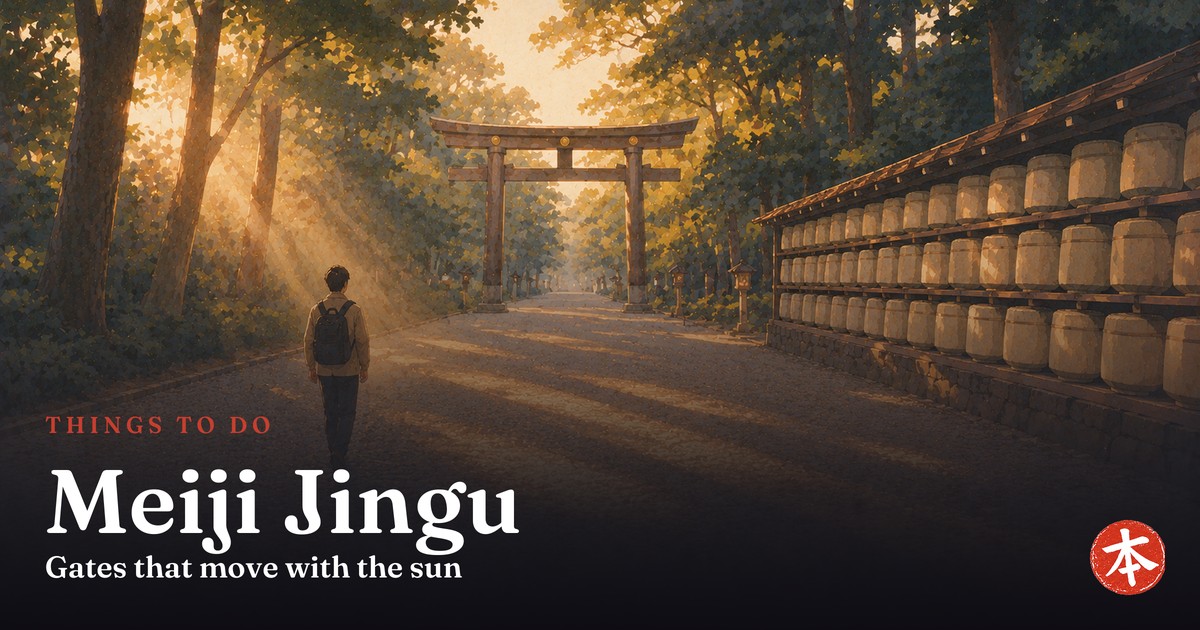
Meiji Jingu refuses the one fact every listicle wants: an opening time. The gates track the sun — 5:00–18:00 this August, 6:40–16:00 in December — per an official monthly table most guides have never read. Inside the 70-hectare planted forest: a 13-ton second-generation torii, a wall of officially empty sake barrels facing French wine casks that toast an emperor's taste, a ¥500 secret garden around a temperature-locked spring, and a walk to the sanctuary the shrine itself warns takes 10-plus minutes from the gate. Here is Tokyo's great Shinto forest, from its own pages.
Meiji Jingu at a glance
| Item | Official answer (Aug 2026) |
|---|---|
| Hours | Sunrise to sunset, by monthly table — Aug: 5:00–18:00 · Dec: 6:40–16:00 · Jun: 5:00–18:30 · open 365 days · free |
| The walk | 🚨 Official warning: main shrine is 10+ min on foot from the entrance · wheelchairs lendable |
| Inner Garden | ¥500 maintenance offering · 9:00–16:30 (Mar–Oct) / 9:00–16:00 (Nov–Feb) · June irises: 150 varieties |
| Museum | ¥1,000 · 10:00–16:30 · closed Thu · 🚨 the old Treasure Museum is a different building — currently closed |
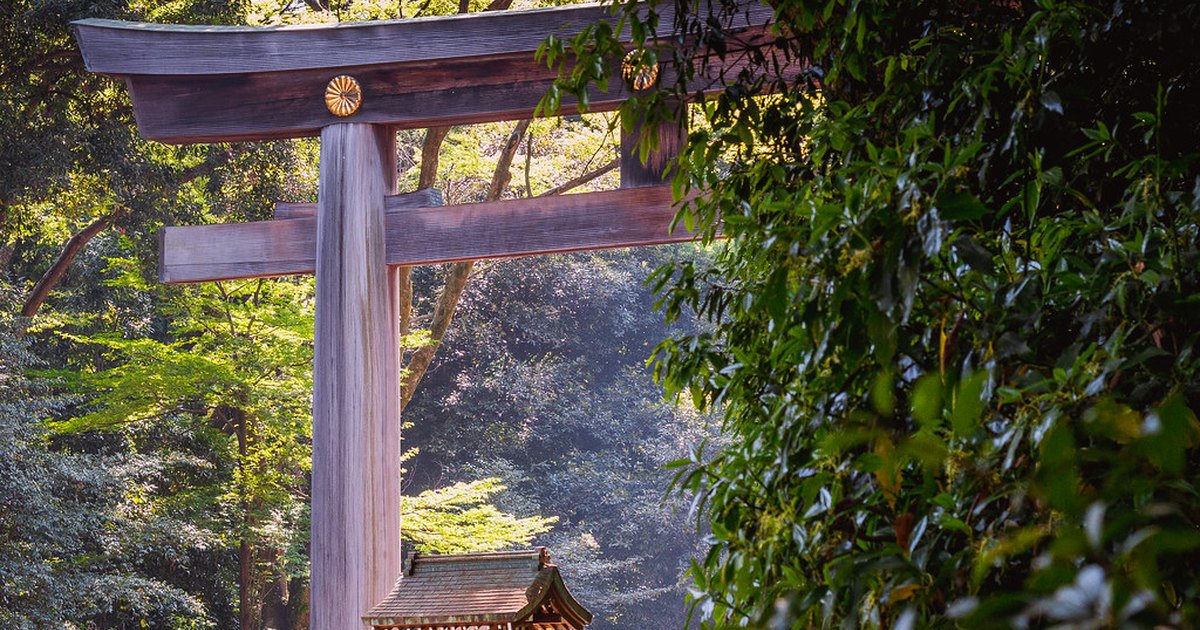
| Great torii | Japan's largest wooden myojin-style torii · 12m × 17.1m · ~13 tons · current one since 1975 (2nd generation) |
| Access | Harajuku/Meiji-jingumae → south gate ~1 min · Sangubashi → west 3 min · Yoyogi/Kita-sando → north 5 min |
Through the forest to the sanctuary:
A forest with opening hours set by the sun
Why doesn't the shrine just pick a time?
Because the institution predates the convention. Meiji Jingu opens "with the sunrise" and closes "with the sunset" — the official English site publishes the twelve resulting schedules, and the spread is dramatic: June's 5:00–18:30 versus December's 6:40–16:00 is a two-and-a-half-hour difference in closing time. Layer on the shrine's own warning that the sanctuary sits more than 10 minutes' walk past the first torii and the practical rule writes itself: in autumn and winter, treat mid-afternoon as last call. The interior facilities run shorter still ("mainly 9:00–16:00" officially), so garden-plus-museum ambitions belong to the morning. The reward for the 5:00 summer opening is the city's best free experience: a raked, birdsong-lined avenue through 100,000 donated trees — a planned forest, planted from 1920, that out-forests most natural ones — with the sanctuary courtyard empty at the end of it.
The objects: barrels, torii, and a well with a fanbase
Is Kiyomasa's Well worth the detour and the fee?
If you have the half hour, yes — it's the Inner Garden's finale and the reason the ¥500 path exists for many Japanese visitors, who queue here as a power spot. The official numbers explain the aura: the spring pours a steady 60 liters per minute at a constant 15°C, summer and winter alike, feeding the garden's pond in an unbroken line.
What's worth slowing down for on the approach?
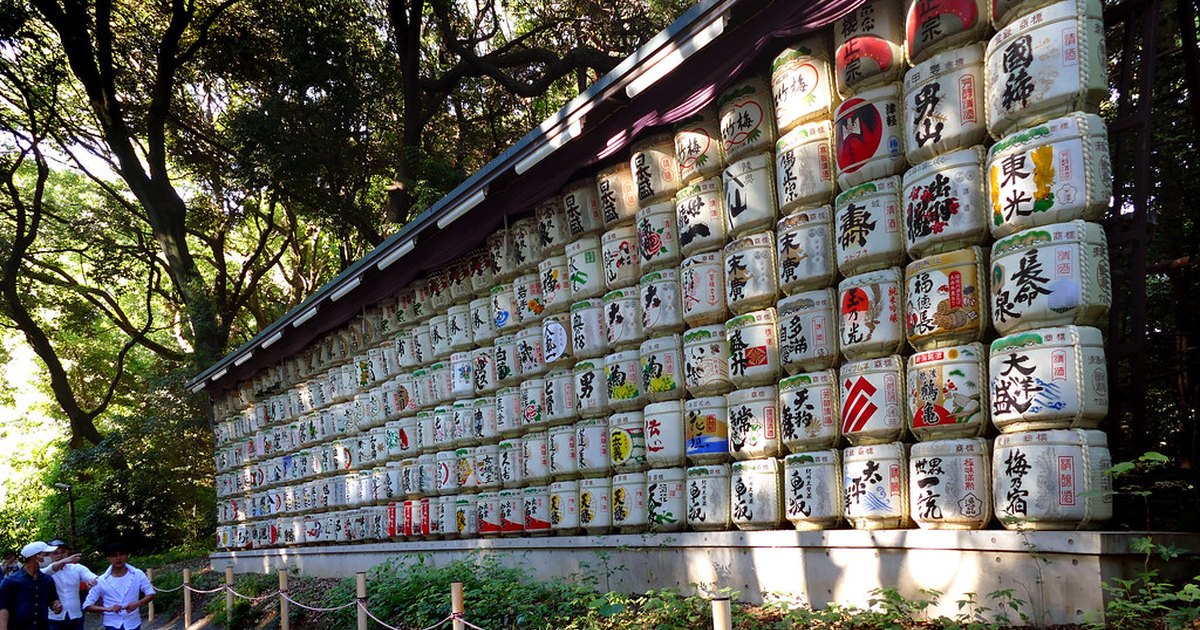
The famous sake-barrel wall earns its photographs, and the official caption improves them: the barrels are empty — decorative offerings (kazaridaru) renewed yearly by the national brewers' association. Directly opposite: Burgundy wine barrels, offered from France each year since 2006, because Emperor Meiji — the monarch who modernized Japan — officially loved French wine; no other shrine approach summarizes an era so neatly. The great torii deserves its pause too: Japan's largest wooden gate of the myojin style at 12 meters by 17.1, roughly 13 tons — and a second generation, its 1966-lightning-struck predecessor replaced in 1975 with cypress said to be over 1,500 years old. Past the sanctuary (where the camphor "married couple" trees, planted 1920, stand roped together as a marriage emblem), the ¥500 Inner Garden hides Kiyomasa's Well — 60 liters a minute at an unwavering 15°C — and June's iris field, for which the garden officially extends its hours.
Fitting it into a Tokyo day
Which entrance should you use — and does it change the visit?
More than you'd expect. The south gate (Harajuku/Meiji-jingumae, about a minute from the ticket gates to the first torii) is the classic entry — barrel walls, the great torii, maximum ceremony — and therefore the crowded one. The west approach from Sangubashi (3 minutes) drops you into the quietest stretch of forest and suits Inner Garden-first plans; the north gates from Yoyogi or Kita-sando (5 minutes) put the museum end last and work well exiting toward Shinjuku. Entering south and leaving north walks the full axis of the forest without retracing a step — the connoisseur's route.
What pairs naturally with the shrine?
Geography does the itinerary-writing: the south gate opens directly onto Harajuku, so the classic sequence is shrine at opening → Takeshita-dori as the shops wake → Omotesando for lunch — sacred to absurd to polished in three hours on foot. The morning Nikkusai rite at 8:00 (again at 14:00) adds ritual to an early visit, and the Kengo Kuma-designed museum (¥1,000, closed Thursdays) rewards emperor-curious visitors — just don't confuse it with the shuttered Treasure Museum up north. For the Buddhist, nocturnal, commercial mirror-image of all this, cross town to Sensoji in Asakusa; for the aerial view of the forest you just walked, Shibuya Sky is one stop away; and our 7-day itinerary slots the shrine where it belongs — first thing, any morning.
(The other side of the station has its own guide now — Harajuku: Takeshita's rules, the new Harakado complex and its basement bathhouse.)
(At New Year the shrine is the busiest place in Tokyo: our hatsumode guide uses Meiji Jingu’s own published sequence and gate hours, and says what the shrine had not yet announced for the holiday.)
FAQ
What time does Meiji Jingu open and close?
How long is the walk to the main shrine?
What’s the story with the sake barrels — is there sake inside?
How big is the great torii?
What is the Inner Garden (Gyoen) and is it worth ¥500?
Is there a museum — and which one is closed?
Can you see rituals or weddings?
Meiji Jingu or Sensoji — do I need both?
What’s the etiquette at the shrine?
Bottom line (2026) — Meiji Jingu has no fixed opening hours — its gates track sunrise and sunset, shifting by up to 2.5 hours across the year (August 2026: 5:00–18:00). The famous sake barrels are empty, the wine barrels are a French tribute to the emperor’s taste, and the great torii is a 13-ton second-generation gate.
Sources
The monthly gate table (all twelve months verified against the official English page's raw HTML), the 10-minute-walk advisory, wheelchair lending, Inner Garden offering, hours and iris details, Kiyomasa's Well figures, museum prices and closure rules, the Treasure Museum's status, torii dimensions and two-generation history, barrel explanations, the couple trees and daily ritual times: Meiji Jingu's official site (meijijingu.or.jp). All read on August 19, 2026. Wedding times and New Year visitor counts are not published on current official pages and are not asserted. The embedded video is by its creator.
Tokyo to Osaka, Tokyo to Kyushu, Tokyo to Hokkaido — day by day — plus seven places most visitors never reach.
- 12 pages, 80 photographs, every stop linked to its guide
- Every price and opening hour read from the official page
- Re-issued monthly, so it does not go stale in your inbox
Free. One email a month, plus the rare change that matters. Unsubscribe with one click in any email. By subscribing you agree to our privacy policy.