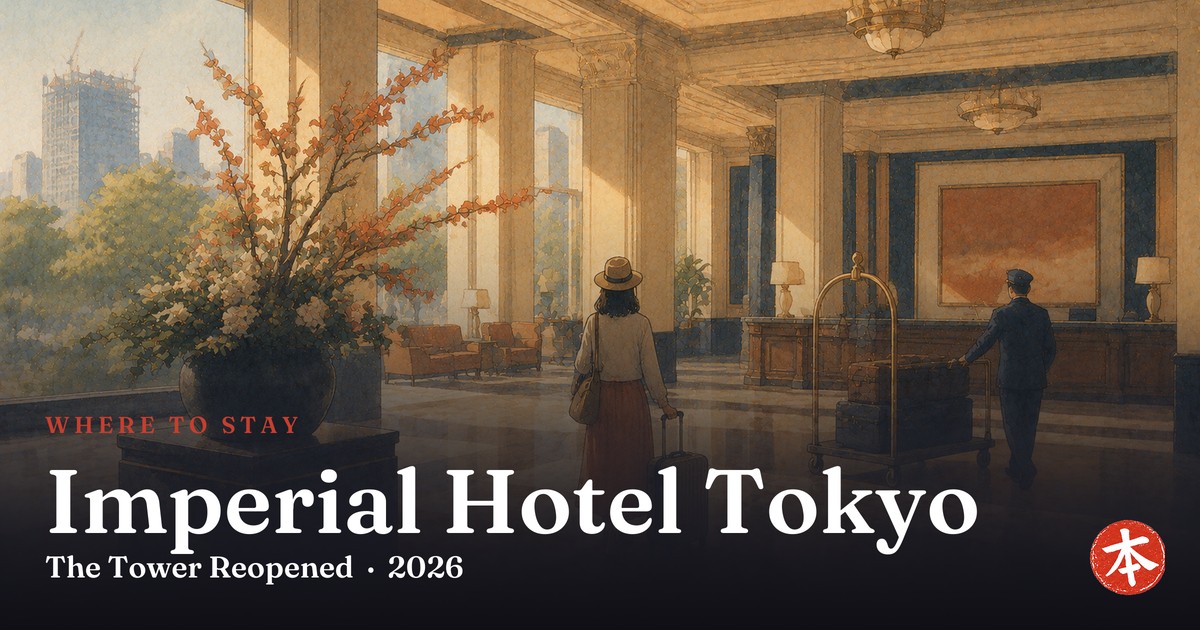
If you research the Imperial Hotel in English, you will probably conclude it is winding down. A notice on its own English site says the Tower Building is being demolished between 2024 and 2030, that the Main Building operates only until 2030, and lists the pool and saunas among the closures. It was last updated in August 2024 and it is still live. The Japanese version of that page has been deleted — it returns a 404. What the company has actually announced since: the Tower has reopened, demolition is now targeted at around the end of FY2030, and the completion date for the new Main Building has reverted to undecided — the widely-quoted 2036 was withdrawn in May 2026, along with the plan that carried it in its name.
Imperial Hotel Tokyo at a glance
| Item | Official answer (Aug 2026) |
|---|---|
| Founded / opened | December 14, 1887 / November 3, 1890 |
| Current buildings | Main Building 1970 (17F) · Imperial Tower 1983 (31F) |
| Rooms | 560 Main + 349 Tower |
| 🚨 Tower Building | Reopened — all rooms and banquet halls operating |
| 🚨 Demolition | Targeted around end of FY2030 — not 2024 |
| 🚨 New Main Building | Completion undecided — "2036" was withdrawn |
| 🚨 Pool & sauna | Open, Tower 20F · staying guests only (companion ¥5,500) |
| Afternoon tea | ¥9,600 weekday / ¥10,000 weekend (to Aug 31) |
| Tea ceremony | ¥5,000 / ¥8,000 · open to the public · no dress code |
| Nearest station | Hibiya, Exit A13 — 3 minutes |
| 🚨 From April 2027 | Tokyo lodging tax becomes 3% of the room rate |
A detailed look at the Imperial Floor rooms and service:
Working out the hotel tax for your dates? Our accommodation tax calculator gives it for Tokyo, Kyoto, Osaka, Hokkaido and 30+ other places from your room price, guests and dates, with the 2026–2027 changes.
🚨 The redevelopment, as the company actually states it
May 14, 2026 — the dates come off. The management plan was renamed from "2036" to "FY2026 Revised Version". Completion for the new Tower: undecided. Completion for the new Main Building: undecided. The document states that the rebuilding periods are not currently determined. Phase one is now described as the Tower Building reopening period, running 2026–2030.
And yet the English consumer page from August 2024 remains live, still saying 2024 to 2030 and still listing the pool among closures — while its Japanese counterpart 404s. Even the updated English page links onward to headlines reading "completed in 2036".
What this means for a stay booked now
Practically: everything is open. The Main Building has no published closure date any more — the "until 2030" line survives only in the stale English notice. The Tower's 349 rooms are selling, as are its banquet halls, and the pool and sauna on the 20th floor are running. The company's own English results deck names the Tower reopening as a driver of the year's room revenue, which is about as clear as a confirmation gets. What did not come back are six restaurants closed during the aborted 2024 wind-down — La Brasserie, the Hotel Bar, Tokyo Kitcho, Ten-ichi, Sushigen and Peking — whose pages remain live and still rank in search results.
One thing the hotel warns you about itself
A notice signed by the general manager states that, depending on time and location, there may be intermittent construction noise both during the day and at night, and that construction lighting may be visible at certain hours. The surrounding project — Hibiya Crosspark, renamed from Tokyo Cross Park in April 2026, about 1.1 million square meters across three zones — is already under construction. The central zone's NTT Hibiya Tower completes in FY2031 and will hold Imperial Hotel banquet halls plus a separate, roughly 100-room luxury hotel under a different brand — the company is explicit that it will not be called Imperial Hotel.
The building you would actually stay in
Wright designed the second one, not this one
The hotel opened in 1890 as a three-story brick-and-timber building. Frank Lloyd Wright's building — the second Main Building — opened on September 1, 1923, the day of the Great Kanto Earthquake, which it survived, and served for 44 years until its rooms closed in November 1967. Its central entrance and lobby were moved to Museum Meiji-Mura in Inuyama, Aichi, where they stand today; the hotel notes that almost everything else — chairs, tables, tableware, carpets — was sold or disposed of first. The current Main Building dates from 1970, the Tower from 1983. What remains inside is one room: the Frank Lloyd Wright Suite, 214 square meters on the 14th floor, described by the hotel as the only suite in the world permitted to bear his name under an agreement with the Frank Lloyd Wright Foundation — bookable by telephone only.
Which floor you want
Three tiers. The Imperial Floors (14–16F of the Main Building) come with floor attendants, a card-key entrance and free overnight shoeshine — rooms from 32 m² superior up through 42 m² deluxe, 54–64 m² junior suites and on to the 214 m² suites. The Regular Floors (7–12F) run the same 32 and 42 m² sizes without the floor service, and include a 143 m² family connecting room. The Tower (20–31F) is the night-view option: 30 m² standard rooms, 49.9 m² premier, a 72.4 m² corner suite facing Ginza and a 105 m² penthouse. No rates are published anywhere — they exist only inside the booking engine, so any "from ¥X" you read elsewhere is not from the hotel. For the wider field, see our Tokyo luxury hotels guide.
Eating, drinking and the tea room
Thirteen outlets, all in the Main Building
All are entirely non-smoking, and every published price includes service charge and consumption tax — the opposite of the American convention, and no tipping is implied. Les Saisons is the formal French room: breakfast from 6,700 yen, lunch from 12,000, dinner from 27,000, with a jacket required for men and nobody under 10 admitted. (A caution: the English page prints 11,000 and 25,000 for the same meals, so we are using the Japanese figures.) Kamon is teppanyaki on the 17th floor, Torakuro Japanese from 45,000 with a request not to wear strong fragrance, and Imperial Viking Sal the buffet the hotel says introduced the format to Japan in 1958. Parkside Diner runs 6:30 to 22:00 for something less formal.
The bar, and the charge that catches people
The Old Imperial Bar on the mezzanine is the single best walk-in in the building: open 11:30 to midnight, drinks from 1,400 yen, no reservation needed outside the early afternoon — and strictly 20 and over, Japan's legal drinking age, applied without exception. Upstairs, Imperial Lounge Aqua on the 17th floor adds a cover charge of 1,100 yen per person after 18:00, which is easy to miss when you are reading a drinks list starting at 1,600.
Afternoon tea — findable only in Japanese
This is a small scandal of website management. Afternoon tea at Aqua ran at 9,600 yen on weekdays and 10,000 at weekends through August 31, moving to 9,400 and 9,800 for the autumn menu from September 1 — served 11:30 to 18:00, with free refills across about twenty drinks, service and tax included. The English URLs for both the afternoon tea hub and this plan page return 404, so an English-speaking reader cannot find these prices on the hotel's own site at all. The Rendez-Vous Lounge on the ground floor does its own version at 6,900 yen. Both lounges are certified by the Japan Tea Association.
Toko-an: the thing nobody writes about
On the fourth floor there is a tea house open to the public by reservation, documented in both languages. 5,000 yen buys a bowl of usucha and a sweet across about thirty minutes; 8,000 gets two bowls, two sweets, an explanation and the chance to whisk your own, for up to eight people. Tax and service included, 5% off if you are staying. And the line that makes it approachable, stated outright by the hotel: there is no dress code — just bring socks, white if you have them. It closes Sundays and holidays. Downstairs, Gargantua on the ground floor has been selling the hotel's pastries and deli food since 1971 — melon bread at 540 yen, a strawberry shortcake at 1,404, fish and chips at 2,700 — open 8:00 to 20:00.
Facilities, access and the tax change
The pool is open — but there is no day pass
It is on the 20th floor of the Tower Building, open 8:00 to 22:00 with last entry at 21:30, and the official wording is that the facilities are exclusively for staying guests, and for every staying guest, whatever the floor, the pool and sauna are free. The only route in for anyone else is as a companion accompanying a guest, at 5,500 yen. It measures 17.5 by 4.5 meters, about a meter deep, around 30°C; under-16s need a guardian, and children in diapers cannot enter — swim diapers included. The gym is elsewhere: 8th floor of the Main Building, 24 hours, guests only via room key, unstaffed and with no changing room or shower, and closed to under-16s.
Getting there
The nearest station is Hibiya — Exit A13, three minutes on foot — on the Hibiya, Chiyoda and Mita lines, with Uchisaiwaicho also three minutes and JR Yurakucho five. Ginza is twelve minutes' walk and Tokyo Station about five by taxi, so guides pointing you to either as "the" station are sending you the long way. From the airports: Haneda about 45 minutes by taxi or 40 by monorail, Narita 90 by taxi or 85–110 by limousine bus — and note that the Haneda limousine bus service is currently suspended. If station access is what you are optimizing for, our Tokyo Station hotels guide covers that area, and boutique hotels the smaller end.
A tax change worth putting in your budget
Tokyo's accommodation tax is currently flat: 100 yen for rooms from 10,000 to under 15,000, 200 yen above. From April 1, 2027 it becomes 3% of the room rate for anything from 13,000 yen up, with cheaper rooms untaxed. At this hotel's price points that is a meaningful change — and it applies by stay date regardless of when you booked or paid, so a reservation made today for a 2027 night is charged on the new basis. Otherwise the terms are straightforward: check-in 14:00, check-out 12:00, cancellation 20% the day before, 80% on the day, 100% for a no-show, bookings up to two years ahead by phone, pets not accepted other than guide, hearing and service dogs, and pre-school children under five sleep free in a parent's bed, one per adult.
FAQ
Is the Imperial Hotel closing?
Wasn’t the Tower Building shut?
What happened to the 2036 opening date?
Is the pool open, and can I use it without staying?
Did Frank Lloyd Wright design the building I’d be staying in?
Is there anything of the Wright building left in the hotel?
What can I do here without booking a room?
Is there a dress code?
Can non-guests eat breakfast there?
Will construction noise affect my stay?
What are the check-in terms and cancellation rules?
Is there a tax I should know about?
Bottom line (2026) — A notice on the Imperial Hotel’s English site still says the Tower Building is being demolished 2024–2030 and lists the pool among the closures. The Japanese version of that page is gone, the Tower has reopened, and demolition is now targeted at the end of FY2030 per the hotel’s official investor disclosures of March 27, 2026 and May 14, 2026.
Sources
The redevelopment schedule, the demolition delay and the withdrawal of the completion dates: Imperial Hotel, Ltd.'s official investor disclosures of March 27, 2026 and May 14, 2026, and its English financial results presentation of May 2026. The contradictory closure notice and its deleted Japanese counterpart: the hotel's official English and Japanese sites, both checked on the same day. Company history, building dates, room counts and sizes, dining venues with hours, prices and dress codes, facility access rules, the accommodation tax change, and reservation, cancellation, children and pet policies: the hotel's official pages in both languages, compared. Tea house and afternoon tea prices: the hotel's official plan pages. All read on August 24, 2026. Prices and schedules change; confirm with the hotel before booking. The embedded video is by its creator.
Tokyo to Osaka, Tokyo to Kyushu, Tokyo to Hokkaido — day by day — plus seven places most visitors never reach.
- 12 pages, 80 photographs, every stop linked to its guide
- Every price and opening hour read from the official page
- Re-issued monthly, so it does not go stale in your inbox
Free. One email a month, plus the rare change that matters. Unsubscribe with one click in any email. By subscribing you agree to our privacy policy.