Almost every guide to Japan will tell you that people here cross at the crossing and wait for the green man even when the street is empty. That is true, and it is usually explained as culture. It is also law — the Road Traffic Act has a chapter on how pedestrians move, and penalty provisions are attached to it.
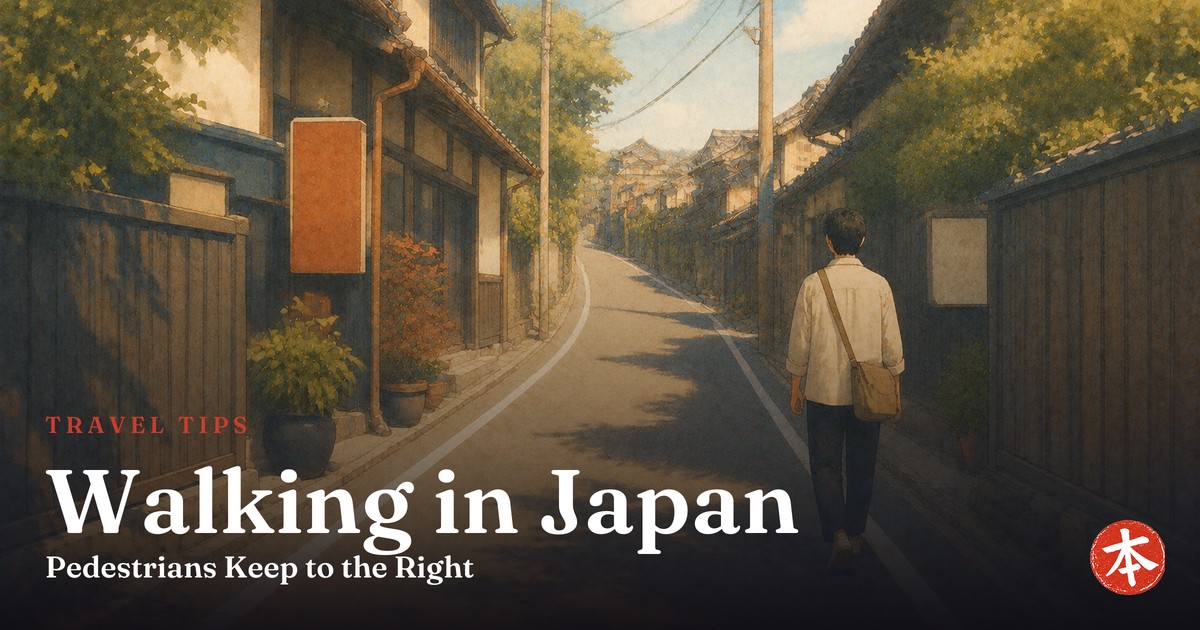
The rule most likely to surprise you is the first one. Japan drives on the left. But on a road with no sidewalk, the act tells pedestrians to keep to the right — which means walking towards the traffic, not with it.
Pedestrians keep right, which is the opposite of the traffic
Two minutes reading Article 10, paragraph 1 of the Road Traffic Act — the provision that puts pedestrians on the right. It is a plain slide-and-voice explanation in Japanese, with the text of the article on screen, which is exactly what you want for a rule that sounds wrong to almost everyone who drives on the same side as Japan does.
The provision is short. Where a road has no separation between a roadway and a sidewalk — or a verge wide enough for people to walk on — pedestrians must keep to the right-hand edge of the road.
Vehicles in Japan keep left. So keeping right puts you facing the oncoming traffic, which is the same safety logic behind the advice given in many countries. The difference is which side that lands on. If you arrive from a right-hand-traffic country and apply the rule you grew up with, you will be on the wrong side here — and if you reason it out from “cars drive on the left, so I should walk on the left”, you will also be on the wrong side, with your back to everything coming.
| Situation | What the act says |
|---|---|
| Road with no sidewalk | Keep to the right-hand edge, facing traffic |
| Right-hand edge is dangerous | You may keep to the left-hand edge instead |
| Road with a sidewalk or wide verge | You must use it, with two listed exceptions |
| Pavement with a marked bicycle portion | Try to avoid that portion as far as you can |
This only applies where there is no sidewalk
That is worth stating plainly, because it is where most visitors get confused. In central Tokyo, Osaka or Kyoto you are almost always on a sidewalk, and the keep-right rule simply does not come up. It bites in the places people actually walk on holiday: the lanes behind a temple, the road out to a trailhead, an old merchant street, a residential grid where the roadway runs wall to wall with no curb at all. If you are wandering through Takayama or the back streets around Gion, this is the rule in play.
The exception is written into the same sentence
The act does not leave you stuck. The same provision says that where keeping to the right would be dangerous, or where there is otherwise no reasonable alternative, you may keep to the left-hand edge. That is unusually practical drafting: the rule exists to make you visible, and it steps aside at the exact moment following it would achieve the opposite. A blind bend with no verge on your side is the textbook case.
Where there is a sidewalk, you have to be on it
The second provision is the one that quietly governs almost every step you take in a Japanese city. On a road that is divided — roadway on one side, sidewalk or a sufficiently wide verge on the other — pedestrians must use the sidewalk side.
The act lists only two exceptions
And they are narrow. The first is when you are crossing the roadway. The second is when road works or a similar unavoidable circumstance make the sidewalk unusable. That is the whole list. There is no allowance for the sidewalk being crowded, or for the road being empty, or for walking two abreast with a friend being easier in the gutter.
In practice nobody is going to stop you for stepping into the road for three seconds to get around a delivery trolley — that is arguably the second exception anyway. But it explains a thing visitors notice and misread: Japanese pedestrians really do stay on the sidewalk, including at midnight on an empty street, and it is not only habit.
There may be a bicycle strip inside the sidewalk
This is the detail that resolves the most common piece of confusion. The act refers to a designated portion of the sidewalk for ordinary bicycles, and says pedestrians walking on such a sidewalk should try to avoid that portion as far as possible. It is phrased as an effort obligation rather than a hard ban.
So when a bicycle comes past you on the sidewalk in Japan, it may well be exactly where it is entitled to be. Look at the surface. Where the strip is designated you will usually see it painted — a different color, a bicycle pictogram, sometimes a line. The rules on the other side of that arrangement are set out in our guide to cycling rules in Japan, where a bicycle turns out to be a vehicle in law.
If there is a crossing nearby, you have to use it
Not “should”. This is the provision behind the behavior everyone notices, and it is why walking fifty meters to a crossing rather than stepping straight across is normal here rather than fussy.
The statute does not define how near is near
It says in the vicinity, and leaves it there. We are not going to convert that into a distance, because the act does not give one and a made-up figure would be worse than no figure. The workable reading is the ordinary one: if you can see a crossing from where you are standing, that is the crossing you are expected to use.
And there are penalty provisions attached
The pedestrian chapter is not advisory. The text carries cross-references to specific articles in the penalties chapter — the rules on processions, for example, point to numbered penalty provisions directly. We are not stating amounts here, because the statute cross-references a penalty article rather than naming a figure in the same place, and we did not retrieve that article. The point for a visitor is not the size of a fine that is very unlikely to reach you. It is that these are traffic rules with enforcement behind them, which is a different thing from local courtesy.
You may not cross diagonally, unless a sign says you may
The next provision is a flat prohibition with one carve-out: pedestrians must not cross a road diagonally at an intersection, except where signs or road markings indicate that diagonal crossing is permitted at that intersection.
Which is exactly why Shibuya feels like an event
The famous scramble crossing is not a cultural quirk or a crowd doing what crowds do. It is the default rule being switched off deliberately at one signposted place. Every intersection where you cannot cut the corner is the rule; the handful where you can are the exception, marked as such. That is a more interesting fact than the usual framing, and it is why the same crowd behaves completely differently one block away. If you are heading there to look down on it, we have a guide to Shibuya Sky tickets.
Never cross immediately in front of or behind a vehicle
A separate provision prohibits crossing the road directly in front of or directly behind a vehicle. The reasoning does not need explaining — it is about what the driver of the next vehicle can see — but the fact that it is written as its own rule tells you how the act thinks about pedestrians: as road users with obligations, not as a protected category that rules happen around.
The exceptions here are specific
The prohibition does not apply when you are crossing by a pedestrian crossing, or when you are crossing in accordance with a traffic signal or the hand signals of a police officer or equivalent. Which is the ordinary case at a busy junction: cars stopped at the line, you crossing in front of them on a green. That is lawful precisely because the exception says so.
There is one more, and it is the simplest of the set: where a sign prohibits crossing, you may not cross. On wide arterial roads and around large junctions you will see this — and it is usually paired with a nearby underpass or footbridge, because the design assumes people still need to get to the other side.
Groups and processions have their own rule, and it surprises people
If you are traveling with a school group, or you happen to walk into a funeral procession, or you are part of any organized column of people, a different provision applies. Certain processions — the act names columns of students and funeral processions among them — must use the roadway, keeping to its right-hand edge, even where a sidewalk exists.
Other processions may use the roadway rather than the sidewalk, and if they do, they keep right as well. A police officer may also direct a procession to keep to the left-hand edge over a specified stretch where that is needed for safety. Penalty provisions are attached to these rules specifically.
You are unlikely to need this personally. It is worth knowing anyway, because it explains a scene that otherwise looks like a rule being broken: a long line of schoolchildren walking in the road with a teacher at each end, on the right, while the sidewalk beside them sits empty. That is the law being followed, not ignored.
What this actually means for a normal day of sightseeing
Most of the time, nothing. Use the sidewalk, cross at the crossing, wait for the signal, and you have satisfied the entire chapter without thinking about it. The value of knowing the rules is in the two or three moments a day when the default does not apply.
The old towns and rural roads are where it bites
Those narrow lanes with no curb are the exact situation the keep-right rule was written for, and they are also where visitors do most of their walking. The habit to build is: no sidewalk, move right, face the traffic. It takes about a day to stop feeling wrong, and the first few minutes after you set off are when the old reflex is strongest — the same failure mode that catches people on a rented bicycle.
If an officer speaks to you
Foot patrols around stations and tourist districts do occasionally redirect people, and it is a correction rather than a confrontation. Do what is asked. Worth knowing separately: for a short-stay visitor, carrying your passport is its own statutory duty, so it is better to have it on you before any conversation than to discover the rule during one. Our guide to what to do in an earthquake covers the other situation where knowing the official instruction in advance beats working it out in the moment.
Deliberately not stated here
Everything above came out of the statute. These did not, so we are leaving them out rather than estimating — a wrong number in a guide like this is worse than a gap:
| What we are not saying | Why |
|---|---|
| Fine amounts for pedestrian offences | The text points to a numbered penalty article rather than stating a figure. We did not retrieve that article. |
| How many meters counts as in the vicinity | The statute does not define a distance. Inventing one would be a fabrication. |
| Whether walking while using a phone is prohibited | That sits in local ordinances, which differ by municipality. Not verified here. |
| Whether you must stand still on escalators | Some municipalities have ordinances on this. It is not a nationwide rule and we did not check them. |
| What drivers must do at a crossing | A different part of the act, which we did not retrieve for this guide. |
| The exact meaning of each signal color | The act delegates this to a government ordinance we did not retrieve. |
Walking in Japan FAQ
Which side of the road do pedestrians walk on in Japan?
Is there an exception to the keep-right rule?
Do I have to use the sidewalk if there is one?
Can I cross the road anywhere I like?
Why can everyone cross diagonally at Shibuya?
Is there a bicycle lane inside the sidewalk?
Do these rules actually carry penalties?
What should I do if a police officer stops me while walking?
Bottom line (2026) — the Road Traffic Act has a chapter on pedestrians, and it is law rather than etiquette. On a road with no sidewalk, keep to the right-hand edge — facing the traffic, which is the opposite side to the one your instincts will pick. Where a sidewalk exists, use it; the act allows only two exceptions. If there is a crossing in the vicinity, cross by it. No diagonal crossing unless a sign permits it, and never immediately in front of or behind a vehicle. Do that, and you have satisfied the whole chapter without thinking about it.
Sources
This guide was written from the Road Traffic Act (Act No. 105 of 1960), retrieved in Japanese from the Japanese government legal database on August 31, 2026, specifically its chapter on the passage of pedestrians: the requirement to keep to the right-hand edge on a road with no separation between roadway and sidewalk, with the exception permitting the left-hand edge where the right would be dangerous; the requirement to use the sidewalk where one exists, with its two listed exceptions; the designated portion for ordinary bicycles which pedestrians should try to avoid; the rule that certain processions use the roadway keeping to its right-hand edge; the requirement to cross by a pedestrian crossing in the vicinity; the prohibition on diagonal crossing except where indicated; and the prohibitions on crossing immediately in front of or behind a vehicle and where a sign forbids it. Where the act delegates a detail to a government ordinance, or cross-references a penalty article we did not retrieve, that is stated above rather than filled in. More on how we work: how we research.
Laws change. This reflects the text as it stood on August 31, 2026.
Tokyo to Osaka, Tokyo to Kyushu, Tokyo to Hokkaido — day by day — plus seven places most visitors never reach.
- 12 pages, 80 photographs, every stop linked to its guide
- Every price and opening hour read from the official page
- Re-issued monthly, so it does not go stale in your inbox
Free. One email a month, plus the rare change that matters. Unsubscribe with one click in any email. By subscribing you agree to our privacy policy.