Most English-language guides summarize this in one line: Japan went smoke-free indoors in 2020, with exceptions for small bars. That is roughly the shape of it, and it leaves out the three things a visitor actually needs.
The first is that the prohibition is written against people, not premises. The second is that the statutory definition of smoking covers heated tobacco and vapor. The third is that the signs on the door are legally specified, which means you can read a building from outside if you know what you are looking at.
The duty is on you, not only on the restaurant
The operative sentence is unusually direct. It says that no person shall smoke, without legitimate reason, in the places the act designates as no-smoking places within covered facilities. Not businesses shall prohibit. No person shall.
That framing matters for a visitor because it removes the usual escape route. In a lot of countries the smoking rules are enforcement obligations placed on the venue, and a customer who lights up is creating a problem for the owner rather than breaching anything themselves. Here the statute reaches the person holding the cigarette directly, and it gives prefectural governors the power to order that person to stop smoking or to leave the no-smoking place.
The venue has its own separate duties
Those exist as well, and they are worth knowing because they explain what you will see. An operator must not keep smoking equipment — ashtrays — in a usable state in a no-smoking place, and is required to make an effort to ask anyone smoking there to stop or to leave. This is the legal reason ashtrays simply vanished from Japanese cafes and restaurants rather than sitting unused on the tables.
Which is why nobody negotiates about it
If you ask a member of staff whether you can smoke somewhere that is not a designated room, the answer will be no, and there will be no discussion of whether the place is empty or whether nobody minds. They are not being inflexible. Neither of you has the authority to make it allowed — the designation is a statutory category, not a house rule.
Heated tobacco and vaping are inside the definition
Both halves are in the statutory text: the word heating sits alongside burning, and the parenthesis expressly brings vapor within the meaning of smoke. A device that heats rather than burns is therefore inside the definition on its face.
This is the point where guidance written abroad most often misleads. In many countries heated tobacco products and vapes occupy a separate, looser regulatory category, and travelers arrive assuming the same split applies here. The Japanese statute wrote both in from the start.
You will still see separate rooms for them
Some venues do provide a room specifically for heated products, and you may see it signed differently from a conventional smoking room. We are not going to tell you what you may do inside one — whether food and drink can be served there turns on a provision we did not retrieve for this guide, and the honest answer is that we have not verified it. What we can say from the definition is that the activity itself is treated as smoking.
The practical version
Treat your vape exactly like a cigarette while you are in Japan. Step into the marked room, or step outside to a marked area. Vaping at the table because it seemed like a lesser category is the single most common way visitors get this wrong, and it is the kind of mistake that gets noticed immediately in a quiet Japanese coffee shop.
Three kinds of facility, and you are almost always in the second
The act sorts covered premises into three categories, and the category decides what is possible inside.
| Category | What it covers | What is possible indoors |
|---|---|---|
| Type 1 facility | Schools, hospitals, child welfare facilities and government office buildings — places used mainly by people at higher risk from second-hand smoke | Nothing indoors. Only a marked, partitioned area outdoors |
| Type 2 facility | Everything that is not Type 1 and not a smoking-purpose facility — so ordinary restaurants, bars, shops, offices, hotels | A room meeting the technical standard, and nowhere else |
| Smoking-purpose facility | Premises whose main purpose is providing a place to smoke, where they meet requirements set by cabinet order | Governed by its own provisions |
Type 1 is stricter than visitors expect
A hospital or a school is not simply no-smoking indoors. The act allows only an outdoor area, partitioned off by the operator and marked as a place where smoking is possible, with the measures the ministry ordinance requires. If you are visiting a clinic or a city office, the working assumption is that there is nowhere to smoke unless you are directed to a specific outdoor spot.
Type 2 is where you will actually be
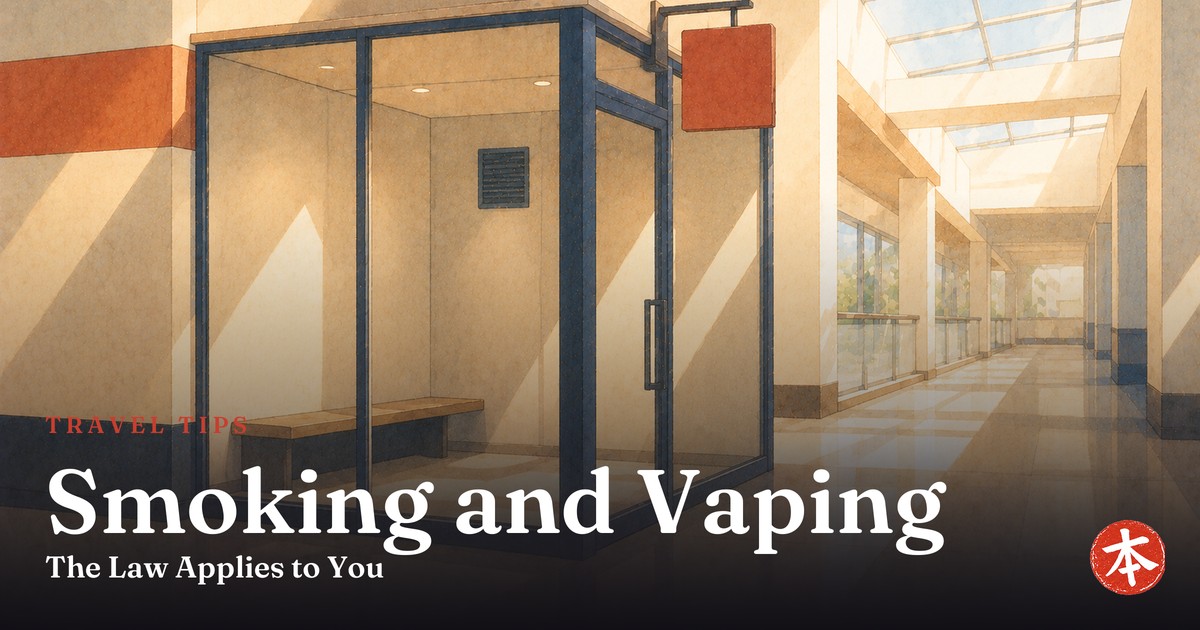
Restaurants, izakaya, hotels, department stores, offices. In all of them the only indoor place where smoking is possible is a room whose structure and equipment meet a technical standard set by ministry ordinance to stop smoke escaping. That is a construction requirement, not a partition and a sign, which is why many businesses simply went fully non-smoking instead.
Read the door: the signs are legally specified
When the signage requirement came in, Tokyo television went out and filmed the doors. Four minutes in Japanese, but the point is visual: you can see the stickers going up on restaurant entrances, and hear a customer say the obvious thing, which is that being able to tell from outside is an improvement.
This is the most useful thing in the whole chapter and almost nobody explains it. The act requires two different signs, in two different places.
| Sign | Where it goes | What the act requires it to state |
|---|---|---|
| Smoking room sign | A conspicuous spot at the entrance to the room itself | That the place is exclusively for smoking, and that entry by people under 20 is prohibited |
| Facility sign | A conspicuous spot at the main entrance of the building | That a smoking room is installed on the premises |
The second one is the traveler's tool. It tells you from the street whether there is smoking anywhere inside, before you sit down and order. If you are sensitive to smoke, or traveling with someone who is, checking the main entrance is faster and more reliable than asking — and it works the same way at a ramen counter in Shibuya as at a hotel.
The signs come down when the room does
The act also handles the reverse case: if an operator stops designating a room for smoking, they must remove the room's sign, and once every such room is gone they must immediately remove the sign at the main entrance. So a stale sign is not supposed to exist. What you see on the door is meant to be current.
Under 20 means not even entering
The act contains a flat prohibition: the operator must not allow a person under 20 to enter a smoking room. It is not conditioned on whether that person is going to smoke. And the requirement that the door sign state this rule is written into the signage provision, so the information is meant to be visible before anyone reaches the door.
Two consequences visitors run into. If you are traveling as a family and the only free seating is inside a smoking-permitted area, a 19-year-old cannot sit there. And the same rule covers staff, which is part of why some places closed their smoking rooms rather than manage it.
Trains and taxis are not in the same box
This is the split that surprises people, and it is a genuine feature of the drafting rather than an inconsistency in practice.
| Mode | How the act groups it | Result |
|---|---|---|
| Taxis and buses, and aircraft | Listed separately from the facilities that may have a smoking room | Entirely smoke-free |
| Railway vehicles and passenger ships | Grouped together with Type 2 facilities | A smoking room may exist on board |
That is the statutory reason a long-distance train can have a smoking room while a taxi never can. It is not a matter of operator preference. The categories are different. Whether a particular service actually provides one is up to the operator, and many have removed them — the act permits, it does not require.
Why some small bars still allow it
The exception everyone has heard about is real, and it lives in the act's supplementary provisions rather than in the main text. Certain eating and drinking establishments that already existed when the rules took effect — the statute calls them existing specified food and drink provision facilities — may operate a smoking-permitted room instead of the stricter arrangement, and the signage terminology is renamed to match.
It is explicitly temporary
The transitional provision applies until a day to be fixed by separate legislation, having regard to the state of progress on preventing second-hand smoke. That is the statute saying, in its own words, that this is a bridge rather than a permanent carve-out. We are not going to predict when it ends, because no date exists to report.
And we are not telling you which businesses qualify
The conditions that decide which establishments count sit in a cabinet order we did not retrieve, and every English-language guide that confidently states a floor area or a capital threshold is repeating a figure from somewhere else. The practical approach is the one above: read the sign at the entrance. A qualifying business has to display one.
What this looks like on an ordinary trip
For a non-smoker, mostly it looks like nothing at all, which is the point of the law. For a smoker, the day involves more planning than at home, and the planning is entirely mechanical.
Accommodation is worth checking at booking
Hotels and ryokan are Type 2 facilities, so the same structure applies, and room-level policy is a separate matter the operator sets. Smoking and non-smoking rooms are usually a booking option rather than something to sort out at check-in, and that is the moment to get it right — whether you are looking at a ryokan in Osaka or somewhere more unusual like a love hotel in Tokyo.
And the streets are a different rulebook entirely
Nothing in this act settles whether you can smoke while walking down a street. That sits with municipalities, and it differs between cities and sometimes between districts. Cities that restrict it generally provide marked outdoor smoking areas, often near stations. The same municipal-ordinance boundary shows up in our guide to the rules for walking in Japan, where the national statute covers where you walk but local rules cover other conduct on the sidewalk.
Deliberately not stated here
Everything above came out of the statute. These did not, so they are gaps rather than estimates:
| What we are not saying | Why |
|---|---|
| Penalty amounts | The act carries penalty provisions in an article we did not retrieve. No figure is stated here. |
| The size or capital thresholds for the small-business exception | Set by cabinet order, which we did not retrieve. Widely quoted elsewhere; not verified by us. |
| Whether you can eat in a heated-tobacco room | Turns on a provision we did not retrieve for this guide. |
| What counts as a smoking-purpose facility | Defined by reference to requirements in a cabinet order. Not retrieved. |
| Whether street smoking is allowed in a given place | Municipal ordinances, which differ city by city. Not a national rule. |
| Duty-free limits on bringing tobacco in | Customs law, a different statute we did not retrieve. |
(For that arrival question, our free Visit Japan Web and customs checker takes the cigarettes, heated tobacco and cigars in one person’s bags and shows whether you need to declare at Japanese customs under the duty-free allowance.)
Bringing snacks or meat from home? Check item by item with our free tool: Can I Bring This Food into Japan?
Smoking in Japan FAQ
Can I smoke indoors in Japan?
Does the law cover heated tobacco and vaping?
How do I know whether a place has a smoking room?
Can someone under 20 go into a smoking room?
Why can I still smoke in some small bars and restaurants?
Is smoking allowed on trains, buses and taxis?
What happens if I smoke where I should not?
Can I smoke outside on the street?
Bottom line (2026) — the Health Promotion Act says no person shall smoke in the no-smoking places it defines, so the duty is yours, not just the restaurant's. Its definition of smoking covers burning or heating tobacco and expressly includes vapor, so treat a vape like a cigarette. Indoors, the only place is a room built to the technical standard, and the sign at the main entrance tells you from the street whether one exists. Under-20s may not enter such a room at all. Some pre-existing small bars may still allow smoking under a transitional provision that runs until a date yet to be set. Street smoking is municipal, so look for the marked area.
Sources
This guide was written from the Health Promotion Act (Act No. 103 of 2002), retrieved in Japanese from the Japanese government legal database on August 31, 2026, specifically its chapter on preventing second-hand smoke and the supplementary provisions: the definition of smoking as producing smoke by burning or heating tobacco, with smoke stated to include vapor; the prohibition addressed to any person on smoking in a no-smoking place; the power of prefectural governors to order a person to stop or to leave; the three categories of covered facility; the requirement that an indoor smoking place be a room meeting a technical standard set by ministry ordinance; the two signage requirements and their removal; the prohibition on admitting people under 20; the prohibition on keeping smoking equipment usable in a no-smoking place; the grouping that places railway vehicles and ships with ordinary facilities while road passenger vehicles and aircraft sit apart; and the transitional provision for existing food and drink establishments running until a day to be fixed by separate legislation. Where the act delegates to a cabinet order or ministry ordinance we did not retrieve, that is flagged above rather than filled in. More on how we work: how we research.
Laws change. This reflects the text as it stood on August 31, 2026.
Tokyo to Osaka, Tokyo to Kyushu, Tokyo to Hokkaido — day by day — plus seven places most visitors never reach.
- 12 pages, 80 photographs, every stop linked to its guide
- Every price and opening hour read from the official page
- Re-issued monthly, so it does not go stale in your inbox
Free. One email a month, plus the rare change that matters. Unsubscribe with one click in any email. By subscribing you agree to our privacy policy.