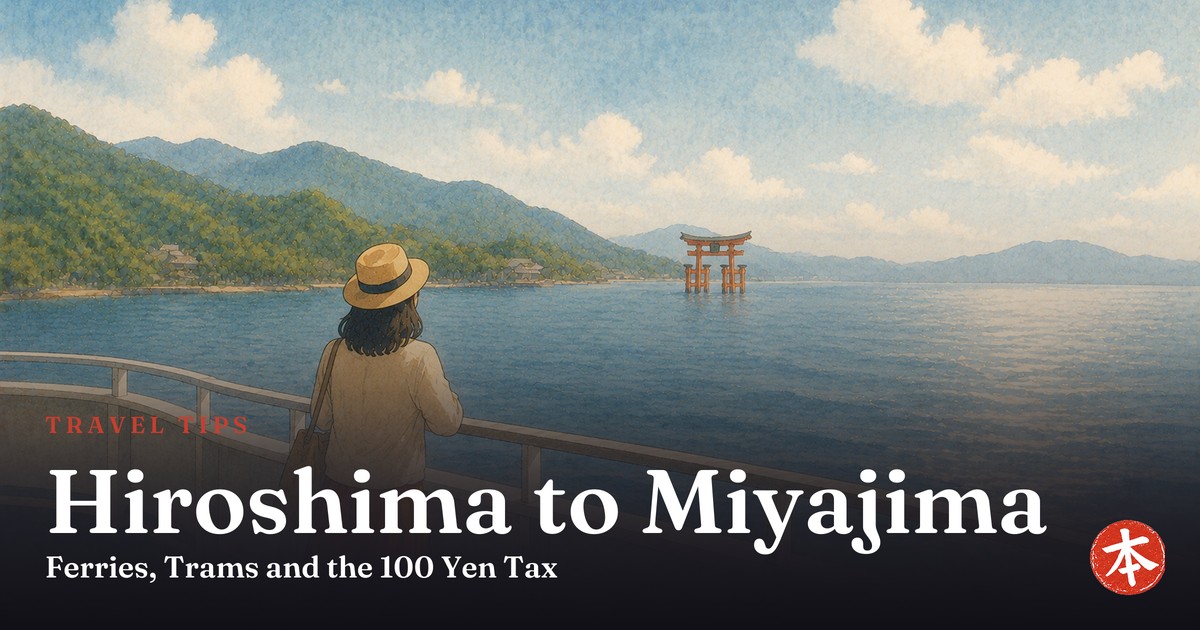
Miyajima is the easiest big day trip in Japan to get half-right. The island sits about 25 to 30 minutes by train plus a ten-minute ferry from Hiroshima Station, boats run every fifteen minutes midday, and nobody needs to book. Yet almost every English page on this route is wrong about the money, because since October 1, 2023 there has been a ¥100 Miyajima Visitor Tax that is not in the advertised ferry fare and is not covered by any pass — the Japan Rail Pass included.
Below are all four routes with fares read off the operators' own Japanese pages, then the questions that decide whether your day works: which of the two identical-looking ferries to board, the 09:10–16:10 window when the JR boat swings close to the Great Torii, what tide level you need, the 6:30 shrine opening nobody prints, and what is still under scaffolding in 2026 — which is not the torii.
Hiroshima to Miyajima at a glance
Four routes, and the right one depends less on price than on where you are standing when you decide to go. Fares are adult one way and all of them exclude the ¥100 visitor tax, charged separately on the leg toward the island.
| Route | Fare (adult, one way) | Time | Best for |
|---|---|---|---|
| JR Sanyo Line + JR ferry | Train ~¥420 (approximate) + ferry ¥200 | 25–30 min + 10 min | Almost everyone — the only route on the Japan Rail Pass |
| Hiroden tram + ferry | Flat ¥240 (¥220 on MOBIRY DAYS) + ferry ¥200 | ~60 min, 66–70 in practice | Downtown by a tram stop, no rail pass |
| World Heritage Sea Route from Peace Memorial Park | ¥2,400 (through-ticket ¥2,500) | 45–50 min | Peace Park and island in one run — see the tide warning |
| High-speed boat, Hiroshima Port | ¥2,300 | 22–26 min | Arriving at Hiroshima Port or the Grand Prince Hotel |
The crossing is the same 10 minutes and the same ¥200 whichever operator you pick, at roughly 15-minute intervals. Getting to Hiroshima is a separate question — see our guides to shinkansen tickets and to whether a Japan Rail Pass pays for your route.
The ¥100 Miyajima Visitor Tax: the fact most English guides skip
Hatsukaichi City levies its own local tax on people entering the island — not a ferry surcharge, and no operator sets it. It has run since October 1, 2023, collected by whichever boat company carries you across.
How much is it, and when do I pay?
¥100 per person, per visit, charged on entry only — the Miyajimaguchi to Miyajima direction, which Matsudai states explicitly on its fare page. A cash round trip is therefore ¥300 out and ¥200 back, not ¥300 each way. There is also a ¥500 annual option, almost certainly not for you.
Is the tax included in the ¥200 ferry fare?
No, and English pages get this wrong in both directions — some omit it, others call it bundled. JR West Miyajima Ferry's fare page states plainly that the ¥100 tax is charged separately on entry. Buying a normal ticket, the machine adds it and you never think about it. On a pass, you will.
Does the Japan Rail Pass cover it?
Who is exempt?
The city draws a distinction English summaries blur. Some fall outside the tax entirely: Miyajima residents, and anyone commuting to a workplace or school there for 48 hours a month or more. Others are in scope but exempted: pre-school children; school-trip participants with their leaders, a category the city says excludes university students; and holders of a Japanese disability certificate. Practically: everyone pays except children under six.
Is the ¥500 annual pass a good deal?
Not for a tourist, and any guide selling it as a saver has not read the rules. You must pay in person at Hatsukaichi City Hall or the Miyajima or Ono branch office, by the 10th of the month before your first visit — not at the terminal, not online, not on the day. It is for locals crossing six or more times a year.
Route 1: JR train and JR ferry, the default
From Hiroshima Station take the JR Sanyo Line toward Iwakuni to Miyajimaguchi; both ferry companies operate out of one terminal a short walk from the station. This is the route almost everyone should take.
How long does the train take, and what does it cost?
Two official sources disagree: the ferry operator says about 28 minutes, Hatsukaichi City about 25. Call it 25 to 30 minutes. On the fare we are deliberately careful: the figure in wide circulation is ¥420, consistent across the Japanese timetable services, but JR West publishes fares only through a dynamic search with no static page to cite. Treat ¥420 as approximate and confirm it at the machine. Either way the leg is covered in full by the Japan Rail Pass.
Which of the two ferries should I take?
JR West Miyajima Ferry and Matsudai Kisen leave from the same terminal, take about 10 minutes, and both charge ¥200 adult, ¥100 child one way; Matsudai also sells a ¥400 round trip. Two things break the tie, both favoring JR: the rail pass covers the JR ferry and not Matsudai, an independent company, and only JR runs the Great Torii sailing. JR also takes all ten nationwide transit IC cards, so a Suica or ICOCA works at the gate.
What is the Great Torii sailing, and which side should I sit on?
When do the ferries start and stop?
JR runs far longer hours, which matters if you stay for the evening. From Miyajimaguchi the JR first sailing is 5:00 and the last 22:42; from Miyajima, 5:45 and 22:14. Matsudai runs 7:15–20:35 outbound and 7:00–20:15 back, its car ferry earlier still.
If those late JR sailings tempt you to stay longer, Helen Foster’s Should You Stay Overnight on Miyajima? on Japlanease weighs the case for a night on the island: she watched the floating torii lit up with just two other people nearby, and reached the Mount Misen ropeway the next morning well before the lines formed.
Route 2: the Hiroden tram, and the fare everyone still prints wrong
The tram runs from outside Hiroshima Station to Hiroden-Miyajimaguchi, steps from the same ferry terminal. It is the slow, cheap option, with the most stale numbers in English.
Why does every guide say ¥270 when it is ¥240?
Is the tram worth the extra hour?
Rarely. The city puts the run at about 60 minutes and timetable data at 66 to 70, against 25 to 30 by train. You save roughly ¥180, stop around twenty times, and none of it counts toward a rail pass. It wins in one case: you are downtown near a tram stop rather than the station, with no pass.
Route 3: the boat from Peace Memorial Park
The World Heritage Sea Route, run by Aqua Net Hiroshima, goes from Motoyasu Pier beside the Peace Memorial Park down the river and across the bay to Miyajima's Pier 3 — the neatest way to chain the two World Heritage sites in a day. It has a catch no English guide mentions.
How much is it, and how long does it take?
¥2,400 adult one way, ¥1,200 for elementary-school children, ¥4,400 return. The widely-repeated ¥2,200 figure is out of date — the operator's page read ¥2,400 when we checked. A through-ticket at ¥2,500 adds the Miyajimaguchi ferry leg for ¥100 more, the smart buy if you go out by boat and back by train. Crossing is 45 to 50 minutes; return tickets are valid two days.
Why do sailings get canceled or rerouted?
Can I book it on the day?
No — reservations close the day before. Buying at the pier for whatever sailing has space is fine, but it is not a guarantee. The timetable runs 17 sailings each way: Peace Park first 8:30, last 17:10; Miyajima first 8:40, last 17:30 — far earlier than the ferry, so a boat-out-boat-back plan ends your day mid-afternoon.
Route 4: the high-speed boat from Hiroshima Port
Setonaikai Kisen runs a high-speed boat from Hiroshima Port (Ujina) via the Grand Prince Hotel pier to Miyajima: ¥2,300 adult, ¥1,150 child one way, current from April 1, 2025. Crossing is about 26 minutes by the operator's figure, 22 by the city's, with eight sailings a day, two weekends and holidays only. It is excellent from the Grand Prince Hotel or off an Inland Sea ferry, and poor from Hiroshima Station, where you pay ten times the ferry fare and still have to reach Ujina.
Tides: the two numbers that actually decide your photo
Most English advice amounts to "come at low tide," which is useless because you cannot look up "low" in a table. The Miyajima Tourist Association answers in centimeters — numbers you read straight off a chart.
What tide level do I need?
At 100 cm or below you can walk out across the sand to the Great Torii. Above 250 cm the shrine and gate appear to float. Those are the association's own thresholds, and it publishes an hourly tide table by month, 6:00 to 23:00 each day with the tidal phase. We deliberately do not print tide times: they change daily and any figure would be wrong tomorrow. Note its caveat that the table is based on Hiroshima Port, and times at Itsukushima Port run slightly earlier.
Can I get both the floating shrine and the walk to the torii?
Sometimes: you need a tide swing putting a reading above 250 cm and one below 100 cm inside your hours on the island. Many long visits catch both; plenty do not, and no planning changes the moon. Decide which photo you want, then pick your date from the table — our Japan eSIM guide covers having data to check it on the day.
Itsukushima Shrine: the 6:30 opening, and what is under scaffolding in 2026
The shrine is a five-minute walk from the pier. Two things about it are consistently misreported in English: the hours, and the building work.
What time does the shrine actually open?
6:30 in the morning, every day except January 1, when it opens at midnight. That matters because the first JR ferry leaves Miyajimaguchi at 5:00 — you can be inside at opening, well before the day trippers. Closing changes six times a year: March 1 to October 14, 18:00; October 15 to November 30, 17:30; December, 17:00; January 4 to end of February, 17:30; January 2 to 3, 18:30. Treasure Hall 8:00–17:00 year-round, Senjokaku 8:30–16:30.
How much is admission?
¥300 for adults, ¥200 high-school, ¥100 elementary and junior high. The Treasure Hall is another ¥300 on the same scale, but the combined ticket is ¥500 (¥300 and ¥150) — see both and you save ¥100. Senjokaku, the huge unfinished hall by the pagoda, is a separate ¥100.
Is the Great Torii still wrapped in scaffolding?
No, and it has not been for years. The shrine's construction page states that the Great Torii repair, begun in June 2019, was completed in December 2022. The netting is gone and the gate is fully visible. This is the most common stale fact in English coverage of Miyajima: pages written during the repair years and never revisited still say otherwise.
So what IS under construction in 2026?
If you want the shrine at 6:30 with the corridors empty, stay overnight rather than chase the first ferry; our guide to staying in a ryokan covers what that involves.
Mount Misen: the ropeway timing trap
The ropeway is described wrongly in English more often than anything but the torii. It is not one ride, does not reach the summit, it closes for weeks in winter, it sometimes needs a reservation, and the top station takes no cards.
Is it one ropeway or two?
Two. The Momijidani Line first — eight-person gondolas at one-minute intervals, about 10 minutes — to Kayatani, then the Shishiiwa Line, a 35-person cabin every 5 to 15 minutes, about 4 minutes more: roughly 15 minutes with the change. Adults pay ¥2,000 round trip or ¥1,100 one way, half at ages 6 to 12, ¥1,800 return at 65 and over.
How do I get to the bottom station?
There is a free shuttle bus, and English guides routinely omit it, telling readers to walk uphill instead. It runs to Momijidani Station from 9:50 at roughly 20-minute intervals, from opposite the Miyajima pier. Take it.
Does the ropeway go to the summit?
When is it closed, and do I need to book?
Two risks. An annual maintenance shutdown of several weeks in mid-winter — in 2026 it ran January 16 to March 6, and 2027 dates were unpublished when we checked, so winter visitors must read the operator's notices first. And it designates specific busy days on which advance booking is mandatory, listed on its front page. Weather suspends service outright too.
Can I pay by card at the top?
No. The operator states explicitly that cashless payment is not available at the summit station — unusual in Japan in 2026, and a detail we have not seen in English anywhere. Carry cash up top.
The deer: what the official record actually says
English guides overwhelmingly tell readers that feeding Miyajima's deer carries a fine. We went looking for it and could not find it — and found a far better reason not to feed them.
Will I be fined for feeding a deer?
No official source says so. Hatsukaichi City has run its deer policy since June 2009 on a plan built around a feeding ban and strict trash control, and signs across the island ask visitors not to feed them. But we searched the city's 36-page management plan for the Japanese terms for penalty, administrative fine, ordinance and the Natural Parks Act, and found no hits for any of them. Feeding is prohibited as policy and signposted, but no official source states a fine.
So why does it matter?
What should I actually do around them?
The association's request is short: do not casually feed the deer, and take your trash home. It adds a warning English guides never carry — people hand deer paper pamphlets on the theory that paper is plant fiber, but modern paper is chemically treated and repeatedly eating it is life-threatening. So keep maps, tickets and pamphlets in a closed bag; deer take them from your hand. The city also records deer snatching snacks, and cautions against contact after collecting ticks and louse flies.
The mistakes that cost people their day
Five, in rough order of how often they bite. Not budgeting for the ¥100 visitor tax, or assuming a rail pass covers it — it does not, and the ticket is sold at the ferry machine, not a JR window. Boarding whichever ferry is closest and missing the JR-only Great Torii sailing, 9:10 to 16:10. Booking the Peace Park boat as your only way over on a spring-tide day. Taking the ropeway up after 15:00 against a 16:30 last descent. And expecting a pristine shrine: the torii is clear, but the East Corridor is under reinforcement through December 2026 and the pagoda until November 2027.
(If you stay the night on Miyajima: our Iwaso Ryokan guide notes that the ryokan’s free pier pickup runs 8:00 am to 8:00 pm and must be requested by phone, not by email.)
FAQ
What is the cheapest way to get from Hiroshima to Miyajima?
Do I have to pay the Miyajima Visitor Tax?
Does the Japan Rail Pass cover the ferry to Miyajima?
Where do I buy the visitor tax ticket if I have a rail pass?
JR ferry or Matsudai ferry – does it matter?
Is the Great Torii still covered in scaffolding?
Should I go at high tide or low tide?
Will I be fined for feeding the deer?
Bottom line (2026) — The standard route is the JR Sanyo Line to Miyajimaguchi plus a ¥200 ferry, and on top of that everyone pays the ¥100 Miyajima Visitor Tax, live since October 1, 2023 and excluded from every pass: Japan Rail Pass holders must buy the tax ticket at the ferry terminal machine, not a JR window. The tram is a flat ¥240 since February 1, 2025, and the boat from Peace Memorial Park is ¥2,400 one way.
Sources
Ferry fares, sailing times and the 9:10–16:10 Great Torii sailing with its right-hand-side advice: JR West Miyajima Ferry and Matsudai Kisen. The ¥100 visitor tax, its October 1, 2023 start, the exemptions, the ¥500 annual rules, the deer policy and the necropsy record: Hatsukaichi City. That no pass includes the tax and that the ticket is sold at the ferry machine, not a JR station: JR West's notice and PDF, the Japan Rail Pass route list and Hiroden. The flat ¥240 tram fare from February 1, 2025: Hiroshima Electric Railway. Sea Route fares and tide cancellations: Aqua Net Hiroshima. Hiroshima Port fares: Setonaikai Kisen. Admission, the 6:30 opening, the seasonal closing times, the December 2022 torii completion and the East Corridor and pagoda works: Itsukushima Shrine. The 100 cm and 250 cm thresholds and the 30-minute summit walk: the Miyajima Tourist Association. Ropeway fares, hours, the free shuttle and the cash-only summit station: Miyajima Ropeway. All read in Japanese on August 27, 2026; fares and construction schedules change, so confirm officially before you travel. The embedded video is the association's own, shown through YouTube's embed function.
Some links on this page may be affiliate links, which means we may earn a commission if you book or buy through them — at no extra cost to you. See our affiliate disclosure.
Tokyo to Osaka, Tokyo to Kyushu, Tokyo to Hokkaido — day by day — plus seven places most visitors never reach.
- 12 pages, 80 photographs, every stop linked to its guide
- Every price and opening hour read from the official page
- Re-issued monthly, so it does not go stale in your inbox
Free. One email a month, plus the rare change that matters. Unsubscribe with one click in any email. By subscribing you agree to our privacy policy.