Most English guides to Sendai either dump a tourist map on you or hand-wave the transit as "take the Loople". Neither works, because Sendai's sights are scattered across hills and river valleys — Zuihoden on one ridge, Sendai Castle on the next, Osaki Hachimangu across a small valley — which is why the city runs a three-layer transit system: two subway lines for the flat downtown grid, a purpose-built loop bus called Loople for the historic sights on the hills, and JR for anything beyond the city. This guide maps what to use for where, and flags the traps: the Loople stops running at 4 p.m., the airport train no longer has a rapid service, and Matsushima has two different stations that catch out first-time visitors.
How Sendai's transit really fits together
The reason Sendai needs three layers, not one, is topography. The downtown grid — the shopping arcades of Ichibancho, the nightlife of Kokubuncho, the government blocks around Kotodai-koen — sits flat between the Hirose river and the JR tracks. The subway handles this flat core easily on two lines. But the sights that make Sendai a stop rather than a transfer city — Zuihoden, Sendai Castle ruins, Osaki Hachimangu — are up on the hills to the west, separated from downtown and from each other by valleys. Walking between them is impractical and the subway does not reach them. That is the gap the Loople loop bus exists to fill. Beyond the city, everything worth going to — Matsushima Bay, Yamadera, the airport, the onsen towns — is on a JR line. Match the tool to the geography and Sendai is easy; mix them up and you waste a day.
| Where you're going | Best tool | Rough time from Sendai Sta. |
|---|---|---|
| Ichibancho, Kokubuncho, Kotodai-koen | Subway (Namboku or Tozai) | 5 min |
| Zuihoden mausoleum | Loople | ~15 min |
| Sendai Castle ruins (Aoba-jo) | Loople | ~25 min |
| Osaki Hachimangu Shrine | Loople | ~40 min |
| Matsushima Bay | JR Senseki Line to Matsushimakaigan | ~40 min |
| Yamadera temple | JR Senzan Line | ~55 min |
| Sendai Airport | Sendai Airport Access Line | ~25 min, ¥680 |
The subway: two lines, distance-based fares
The Sendai Subway is small on purpose. Two lines, both crossing at Sendai Station: the Namboku Line runs 17 stations north to south from Izumi-Chuo down to Tomizawa, and the Tozai Line runs 13 stations east to west from Arai to Yagiyama Zoological Park. Together that is 30 stations across roughly 29 km — enough to cover the flat downtown, the arena and stadium districts, and the university campuses, but not the hills. If your day is downtown-focused, the subway is nearly all you need.
Fares are distance-based, starting at 160 yen per single ride and rising as you go further. The city runs both a standard subway day pass at 840 yen (children 420) and a weekend-and-holidays-only pass at 620 yen (children 310) — use the second one if you are lucky enough to be here on a Saturday, Sunday or public holiday. Signage is bilingual throughout, and the two lines each have their own color, so even a first visit is straightforward.
What the two lines actually cover
The Namboku Line is the workhorse for hotels — most of the mid-range and business chains cluster around its stations, from Kita-Sendai in the north through Kotodai-koen (for the government and shopping district) down to Nagamachi in the south. The newer Tozai Line reaches the university campuses, the international convention center and, at its western terminus Yagiyama, the zoo. If your hotel is downtown you will live on the Namboku Line; the Tozai Line is more of a specific-purpose ride.
Loople Sendai: the loop bus that unlocks the sights
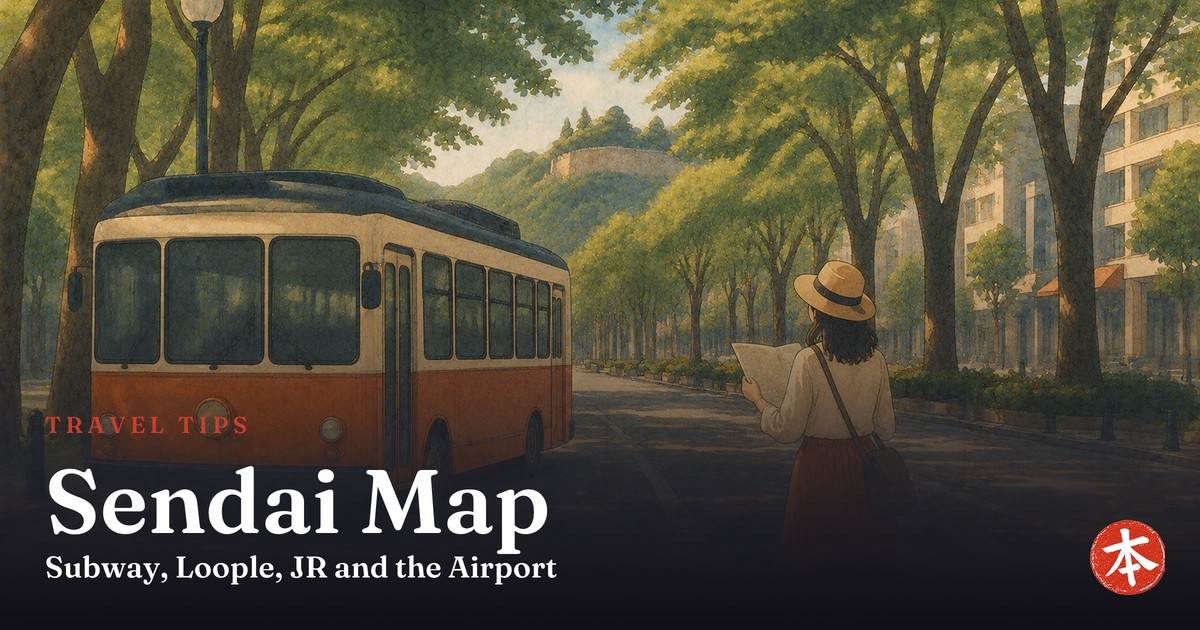
Loople is not a normal bus route. It is a 15-stop, 70-minute circular loop built specifically to link the historic sights that the subway cannot reach — Zuihoden, Sendai Castle, the Aobayama district and Osaki Hachimangu — and it leaves from a dedicated stand at Sendai Station West Exit, bus pool platform 16. Buses run every 20 minutes on weekdays and every 15 minutes on weekends, holidays and throughout August. First bus 9 a.m., last bus from Sendai Station at 4 p.m. That last-bus time is the single most important number to remember when planning your day.
Fares and passes
A single ride is 260 yen for adults, 130 yen for children, with preschoolers free (up to two per adult). If you plan to hop on and off, the day passes make far more sense: the Loople-only day pass is 630 yen (children 320), and the Loople-plus-subway combined pass is 920 yen (children 460). The combined pass is almost always the better call — it pays for itself in three or four rides across either service and it stops you having to think about single fares at all.
🚨 The payment trap
The airport: about 25 minutes on the Access Line
The Sendai Airport Access Line runs a direct train between Sendai Station and Sendai Airport Station. The fare is 680 yen for adults on a paper ticket, or 672 yen on an IC card; children are half that. Journey time is about 25 minutes on the local train, and trains run roughly every 20 minutes between 9am and 5pm and every 30 minutes at other times.
The airport station also has a ticket vending machine that sells the Sendai Marugoto Pass, so you can pick one up the moment you land and use it straight away on the ride into the city — see the pass section below for why that matters.
Day passes: which one, and when
There are four main passes worth knowing, and the right choice depends entirely on where you are going, not on how long you are staying. Match the pass to the route, not the calendar.
| Pass | Adult / Child | Covers | Best for |
|---|---|---|---|
| Subway 1-day | ¥840 / ¥420 | Subway only (weekdays) | Downtown-only days with lots of hops |
| Subway Sat/Sun/Holiday | ¥620 / ¥310 | Subway only (weekends and holidays) | Same, but on a weekend or holiday |
| Loople + Subway | ¥920 / ¥460 | Loople loop + all subway | Classic one-day city sightseeing |
| Sendai Marugoto Pass (2 days) | ¥2,930 / ¥1,470 | Loople + city buses + subway + JR to Matsushima, Matsushimakaigan, Yamadera, Shiroishi + Sendai Airport Line + Miyagi Kotsu buses to Akiu | Anything reaching beyond the city — the big one |
The Sendai Marugoto Pass is the one to reach for the moment your plan includes Matsushima, Yamadera, the airport ride or Akiu Onsen. At 2,930 yen for two days, it covers the entire chain of trips — Loople and subway in the city, JR out to Matsushimakaigan, JR to Yamadera and back, the airport line, and the Miyagi Kotsu bus lines out to Akiu. You buy it at any JR East ticket counter, at the ticket machine at Sendai Airport Station, or from a travel counter. If you are only using the city core, the Loople-plus-subway pass at 920 yen is enough.
IC cards: icsca, Suica and everything else
Sendai has its own IC card, icsca, issued by the city transport bureau and usable on the subway, Loople, city buses and the airport line. But you do not need to buy one if you already have a Japanese IC card from elsewhere: Suica, PASMO, ICOCA and the other regional cards are accepted across the same Sendai systems through the nationwide mutual-use agreement. A Suica from a Tokyo trip works exactly the same as an icsca in Sendai. If you have never bought an IC card, our Suica guide walks through how to get one and top it up. For route-finding on the ground, mobile data helps — see our Japan eSIM guide for the cheapest way to stay connected without renting a pocket Wi-Fi.
Getting to Matsushima: two stations, one right answer
The practical route is the JR Senseki Line from Sendai Station to Matsushimakaigan, about 40 minutes. Trains are frequent enough that you do not need a timetable in daylight hours. If you are day-tripping, aim to be back on a Senseki-line train by mid-afternoon: the bay is worth taking your time, and the sunset on the pine islands is the point of coming.
Onsen: Akiu and Sakunami
The two closest hot-spring areas to Sendai are Akiu Onsen, up the Natori valley to the southwest, and Sakunami Onsen, on the JR Senzan Line toward Yamagata. Akiu is reached by Miyagi Kotsu bus from Sendai Station, and this bus line is included in the Sendai Marugoto Pass — the pass turns Akiu into a genuinely easy half-day trip. Sakunami is best reached by JR Senzan Line to Sakunami Station, then a short shuttle or taxi to the ryokan. Neither is a Zao-scale mountain trip; both work as afternoons out of Sendai rather than overnight destinations, though the traditional ryokan of Akiu are the classic reason people stay a night.
Common mistakes
Three things trip visitors up more than anything else. First, Loople stops running at 4 p.m. — do not build a route that has you standing at Osaki Hachimangu at 4:30 expecting a bus back. Second, Loople cash payments only accept coins and 1,000-yen bills — carry an IC card or exact change. Third, get off at Matsushimakaigan, not Matsushima, when going to the bay. A fourth, quieter one: if you see anywhere claiming the airport train takes 17 minutes, that source is quoting the rapid service that no longer exists — plan for about 25 minutes.
(If you stay on Matsushima Bay: our Hotel Taikanso guide notes that the hotel itself says its bay-view baths are heated water, not an onsen, and that its shuttle does not go to Sendai Station.)
FAQ
Do I need a car to get around Sendai?
What is the Loople bus and why does everyone mention it?
What time does the Loople bus stop running?
Can I pay Loople with a Suica card from Tokyo?
How much does the subway cost?
How do I get from Sendai Airport to the city?
Which pass should I buy?
Wait – Matsushima has two stations?
Is icsca the same as Suica?
What about getting to the Zao Fox Village or the ski areas?
Is the subway easy to navigate in English?
Can I use one day pass for everything?
Bottom line (2026) — Sendai runs a three-layer transit system: two subway lines, the Loople loop bus (15 stops, 70 minutes, first departure 9 a.m., last 4 p.m.), and JR for anything beyond city limits including the Sendai Airport Access Line (~25 minutes). Match the day pass to the route, not the calendar. Loople fareboxes take coins and 1,000-yen notes only.
Sources
Subway network, station counts, distance-based fare rule and day-pass prices: Sendai City Transportation Bureau (kotsu.city.sendai.jp). Loople route, 15-stop 70-minute loop, weekday and weekend frequencies, 9 a.m. first departure and 4 p.m. last departure, single fares and payment rules including the coins-and-1,000-yen-notes-only restriction: official Loople Sendai site (loople-sendai.jp). Airport Access Line fares, IC discount, journey time and the March 14, 2026 abolition of the rapid service: Sendai Airport Transit (senat.co.jp) and related official records. Sendai Marugoto Pass price, two-day validity and coverage — Loople, city buses, subway, JR sections to Matsushima, Matsushimakaigan, Yamadera and Shiroishi, the airport line and the Miyagi Kotsu Akiu route — and its sale at Sendai Airport Station: Sendai City Transportation Bureau. Read August 26, 2026. Fares and timetables change — confirm on the official sites before you travel. The embedded video is by its creator.
Tokyo to Osaka, Tokyo to Kyushu, Tokyo to Hokkaido — day by day — plus seven places most visitors never reach.
- 12 pages, 80 photographs, every stop linked to its guide
- Every price and opening hour read from the official page
- Re-issued monthly, so it does not go stale in your inbox
Free. One email a month, plus the rare change that matters. Unsubscribe with one click in any email. By subscribing you agree to our privacy policy.