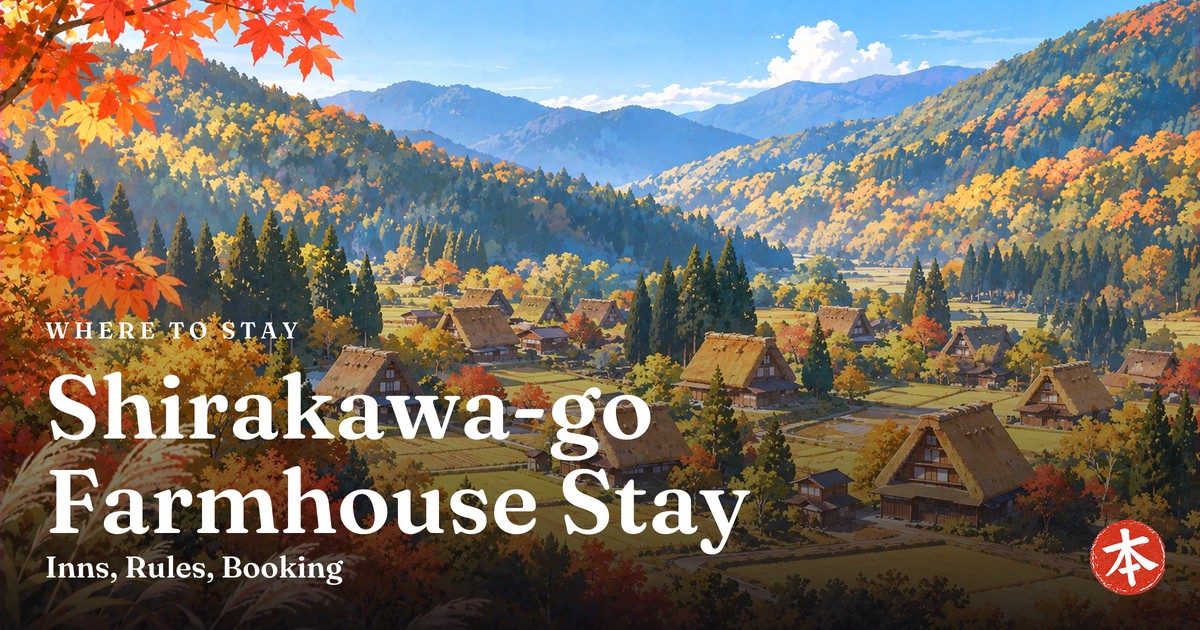
Spending a night in a thatched gassho-zukuri farmhouse is the reason many people go to Shirakawa-go, the village between Takayama and Kanazawa. The farmhouse inns (gassho minshuku) are family homes with a few rooms, and each sets its own rules. Before you book, know that the official English booking pages ask you not to stay on the day you arrive in Japan, that many inns stop serving dinner or cancel the booking if you arrive late, and that several take no children, one night only, or have shower only.
For the bus from Takayama, see our Takayama map, and from Kanazawa our Kanazawa map. If tatami and futons are new to you, read our ryokan guide first.
How a Shirakawa-go farmhouse stay is booked
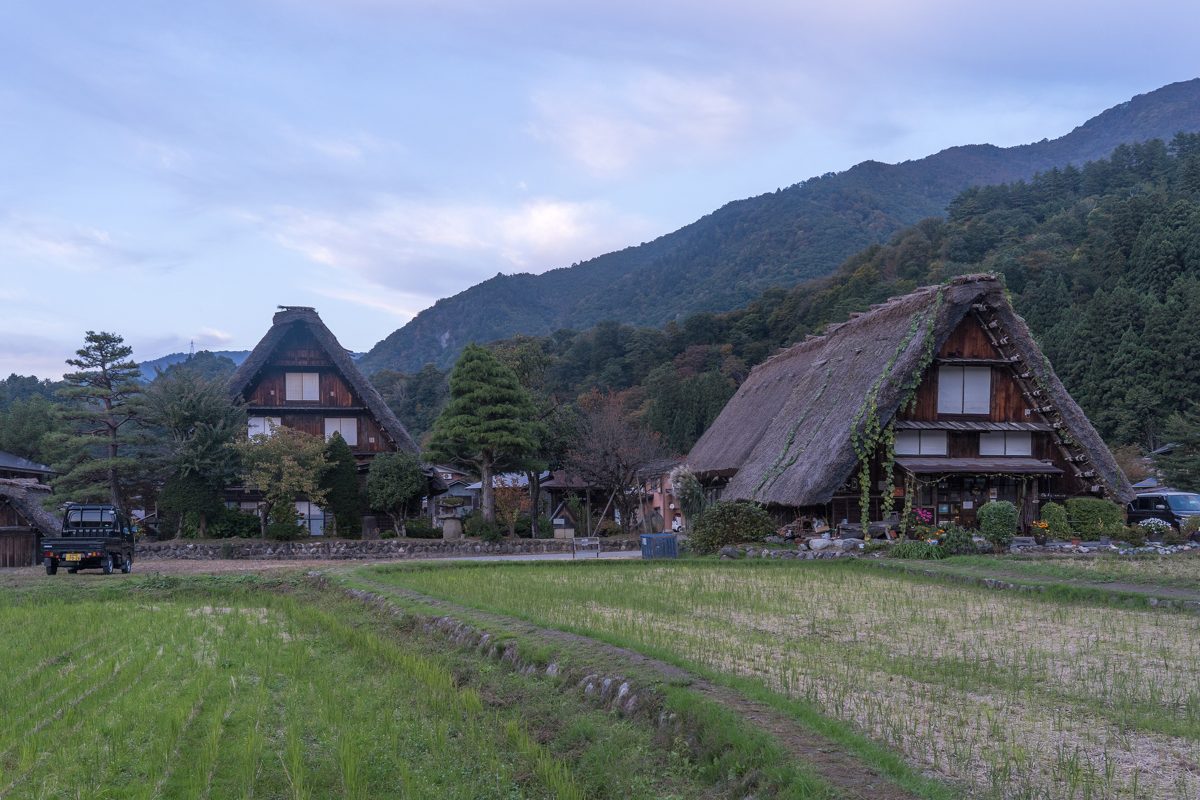
Booking through the tourist association
The association’s site lists about 19 farmhouse inns in Ogimachi, the main village, and takes online bookings about three months ahead. Its English terms say a booking is complete when you pay by card (Visa, Mastercard, JCB or American Express), and that there is no refund after the transaction; anything else is paid at the inn. If a card payment fails, the system holds the room for one hour. You cancel through a link in the confirmation email.
Read the cancellation terms on your plan
The association’s English terms list 20 percent from 15 to 8 days before, 50 percent from 7 days to 1 day, and 100 percent within 24 hours or for a no-show. Its FAQ adds that whether a fee applies is up to each inn, and the plans prove it: Iccha charges 20 percent from 5 to 4 days before and 50 percent from 3 days, while Otaya charges 70 percent the day before. Yoshiro sells a plan paid in cash at the inn and asks for cancellation fees by bank transfer. See our hotel cancellation guide for how this compares.
Language and phone bookings
Koemon says it has no staff who speak other languages and accepts bookings only from people who understand Japanese well enough, with no bookings made on someone else’s behalf; its own site adds that it does not answer email and takes cash only at the inn. Shimizu, by contrast, says English is welcome. The Japanese pages for Kidoya and Furusato ask guests not to book by phone, though the English pages show only a phone number.
What does a Shirakawa-go farmhouse stay cost?
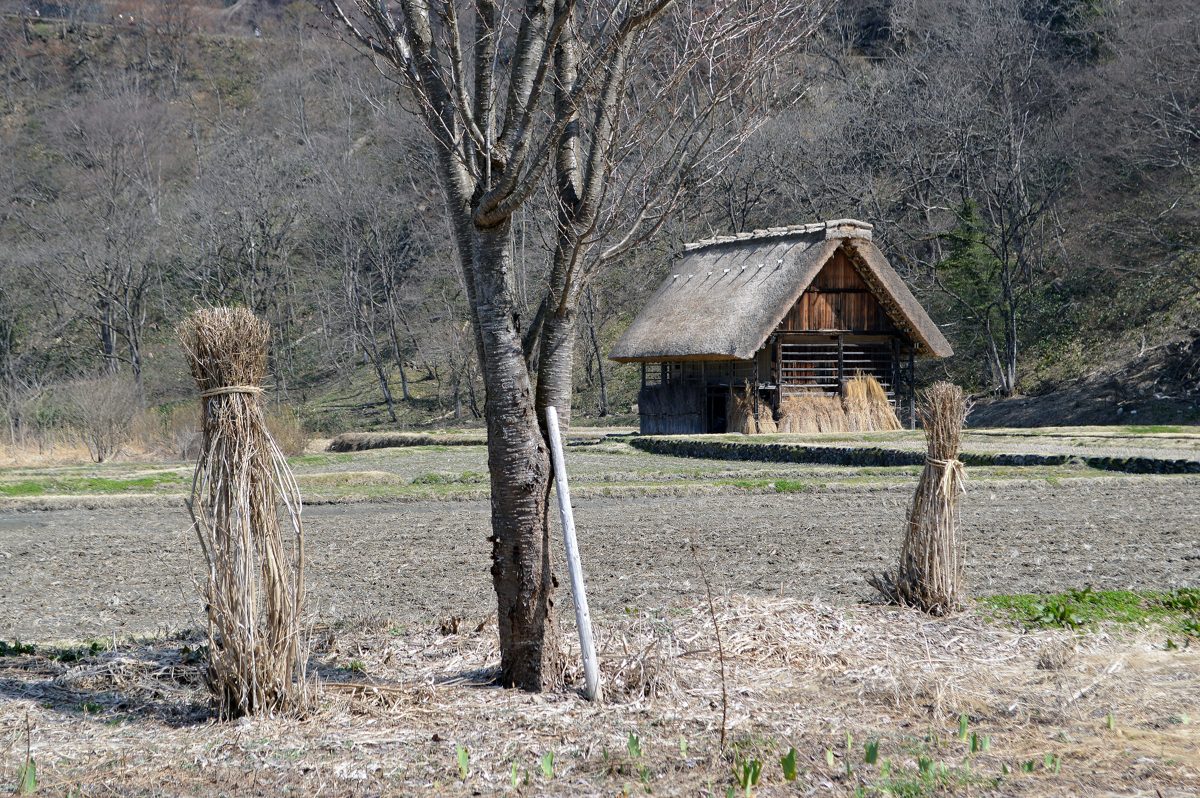
Prices on the booking plans include tax and are per person for two adults sharing a room unless noted. They are starting prices for the plan periods we saw, and change by season.
| Inn | From (per person) | Meals |
|---|---|---|
| Koemon | 20,000 yen | Dinner and breakfast |
| Iccha | 15,400 yen | Dinner and breakfast |
| Kidoya | 14,850 yen (one adult) | Dinner and breakfast |
| Juemon | 19,800 yen (20,350 yen in December) | Dinner and breakfast |
| Otaya | 20,900 yen (22,000 yen from January 2027) | Dinner and breakfast |
| Kanjya | 26,400 yen for one person per room (27,500 yen in December) | Dinner and breakfast |
| Shimizu | 18,700 yen (19,800 yen from November) | Dinner and breakfast |
| Rihee / Bunroku | 16,500 yen | Dinner and breakfast |
| Yoshiro | 13,000 yen (13,500 yen in November) | Breakfast; cash at the inn |
| Wadaya / Furusato | 10,560 yen / 10,450 yen | Room only |
| Nodaniya / Isaburo | 9,900 yen | Room only |
| Hisamatsu (whole house) | 65,010 yen for 2–3 people (66,660 yen from November) | Dinner and breakfast |
From each inn’s plan, read October 8, 2026. Isaburo’s plan we saw ran to October 31, 2026.
Booking deadlines also differ: Iccha closes at midnight the day before, Koemon at 21:00 two days before, Hisamatsu at midnight three days before, and Shimizu at 14:00 on the day. Koemon takes only two groups a day, and Hisamatsu one, with some space shared with the family.
Shirakawa-go farmhouse inns: arrival deadlines and curfews
This is the table that matters most. The times come from each inn’s plan, and many add that there is no refund if dinner is missed or the booking is canceled for a late arrival.
| Inn | Check-in (plan) | No dinner if you arrive after | Booking canceled after | Curfew |
|---|---|---|---|---|
| Iccha | 15:00–17:00 | 18:30 | Not stated | 21:30 |
| Kidoya | 15:00–17:00 | 18:30 | 20:00 | 22:00 |
| Juemon | 15:00–18:00 | 19:30 | 22:00 | 22:30 |
| Hisamatsu | 15:00–17:00 (text says by 18:00) | 20:00 | 20:00, without contact | 21:30 |
| Otaya | 15:00–17:00 | 20:00 | 20:00 | 21:00 |
| Kanjya | 14:00–17:00 | 18:00 | Not stated | 21:00 |
| Shimizu | 15:00–18:00 | 19:30 | 21:00 | 22:00 |
| Nodaniya (room only) | 15:00–18:00 (English: to 17:00) | No meals | 20:00, without contact | 22:00 |
| Wadaya (room only) | 15:00–17:00 | No meals | 20:00 | 21:00 |
| Isaburo (room only) | 15:00–17:00 | No meals | 20:00 | 21:00 |
From each inn’s plan on the association’s booking system, read October 8, 2026. Iccha serves dinner at 18:00.
Nohi Bus warns that buses can run two hours or more late, so leave time between your bus and these deadlines. For how hotels across Japan treat late arrivals, see our late arrival guide.
Children, nights and meals at Shirakawa-go farmhouses
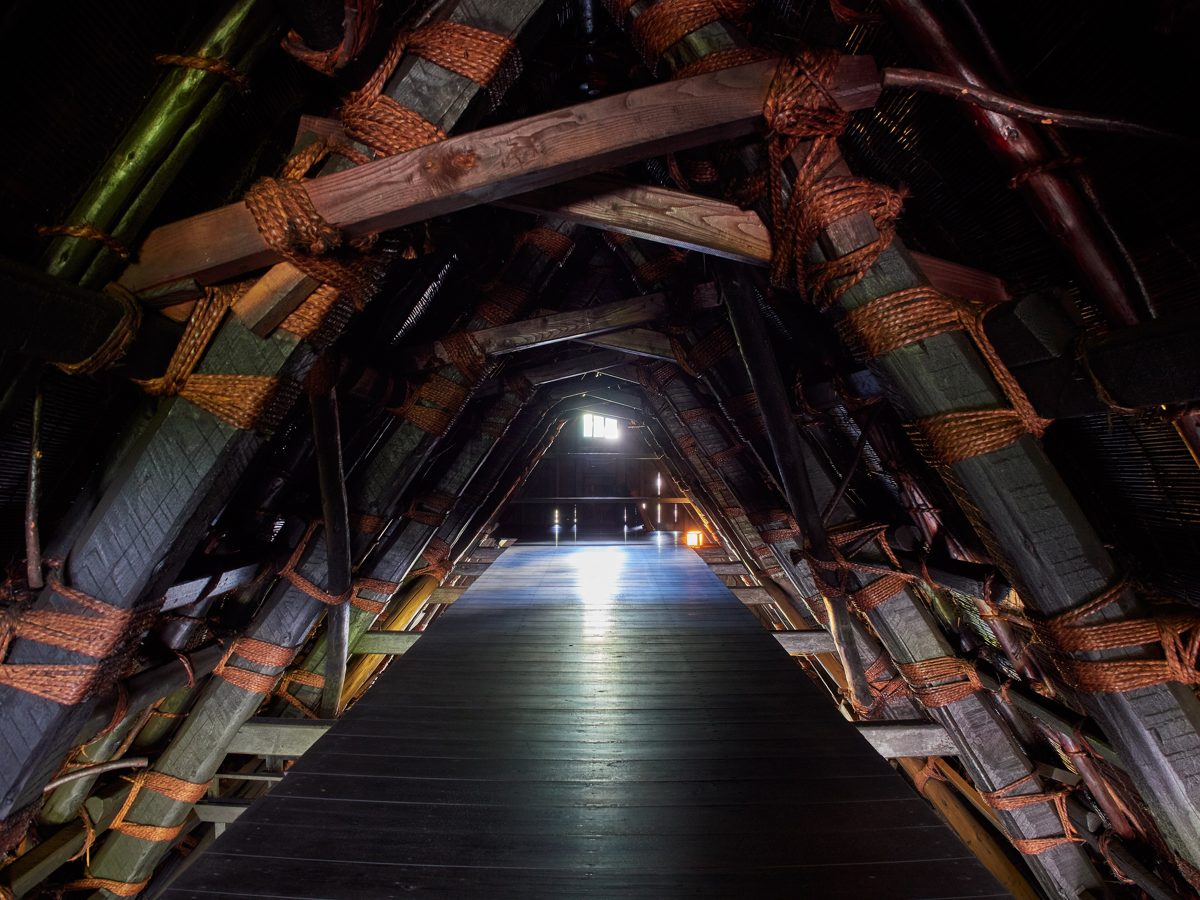
Which inns take children?
Several do not. Nodaniya, Furusato, Bunroku and Isaburo do not take children; Iccha does not take infants (its English page says under 5), and Juemon and Yoshiro do not take preschool children. Inns that publish child rates include Koemon (15,000 yen for elementary and preschool children with meals and bedding, 5,000 yen for young children with bedding only, 2,000 yen for 3 and under with neither), Otaya (18,700 yen for elementary children, preschoolers without meals or bedding free, a futon for a co-sleeping child 2,200 yen in cash) and Rihee (14,300 yen). Hisamatsu counts children 3 and over as guests and charges 1,500 yen at the inn for under-3s. See our kids stay free comparison for hotels.
Can I stay more than one night?
Often not. Koemon, Iccha, Juemon, Wadaya, Nodaniya, Yoshiro, Rihee, Bunroku and Isaburo all say they do not take consecutive nights. Koemon explains that the building is not suited to longer stays.
What about dinner and special diets?
Wadaya, Nodaniya, Furusato and Isaburo are room only, and Yoshiro serves breakfast only; the others serve dinner and breakfast. Wadaya points guests to village restaurants, some of which need booking the day before. Juemon and Bunroku say they cannot provide gluten-free, vegan or halal meals, and Bunroku cannot handle allergies or vegetarian meals either. Koemon asks vegetarians to phone after booking to discuss it, not on the day.
Baths, toilets and house rules
Shower, shared bath or private bath
Do not expect a hot spring in the farmhouse. Otaya, Nodaniya and Shimizu have shower only, and Wadaya’s Japanese page says shower only in summer. Koemon has a private family bath that is not a hot spring, open 17:00 to 21:00 per its own site; most others share a bath. Kidoya’s toilets are shared, mostly Western-style. For a hot spring, the village bath Shirakawago no Yu opens 7:00 to 21:00 (last entry 20:00), costs 900 yen for adults and 500 yen for elementary children, and closes on Thursdays and the second and fourth Wednesdays; towels cost 200 yen and bath towels 300 yen. The official pages do not mention tattoos.
Rules that surprise guests
- Nodaniya does not accept guests who smoke.
- Koemon burns wood, and its irori hearth fills the house with smoke in season; there is no TV, and guests are asked to keep quiet at night and early morning.
- Kanjya’s rooms are divided by sliding paper doors, so you hear the next room; it asks guests who mind noise to choose another inn.
- Wadaya, Nodaniya and Isaburo do not let guests cook in the kitchen.
- Hisamatsu and Koemon do not take pets; Kidoya lends yukata for 500 yen.
Koemon is worth reading closely if it is your choice. Its plan lists check-in from 15:00 to 17:00, while its own site gives a last check-in of 18:00 and asks guests to arrive by then at the latest; parking and luggage storage before and after your stay are free. Its own site says vegetarian meals can be prepared if you tell it in advance. Juemon asks guests to book a time for its bath, and its rooms have air conditioning.
Getting to a Shirakawa-go farmhouse stay
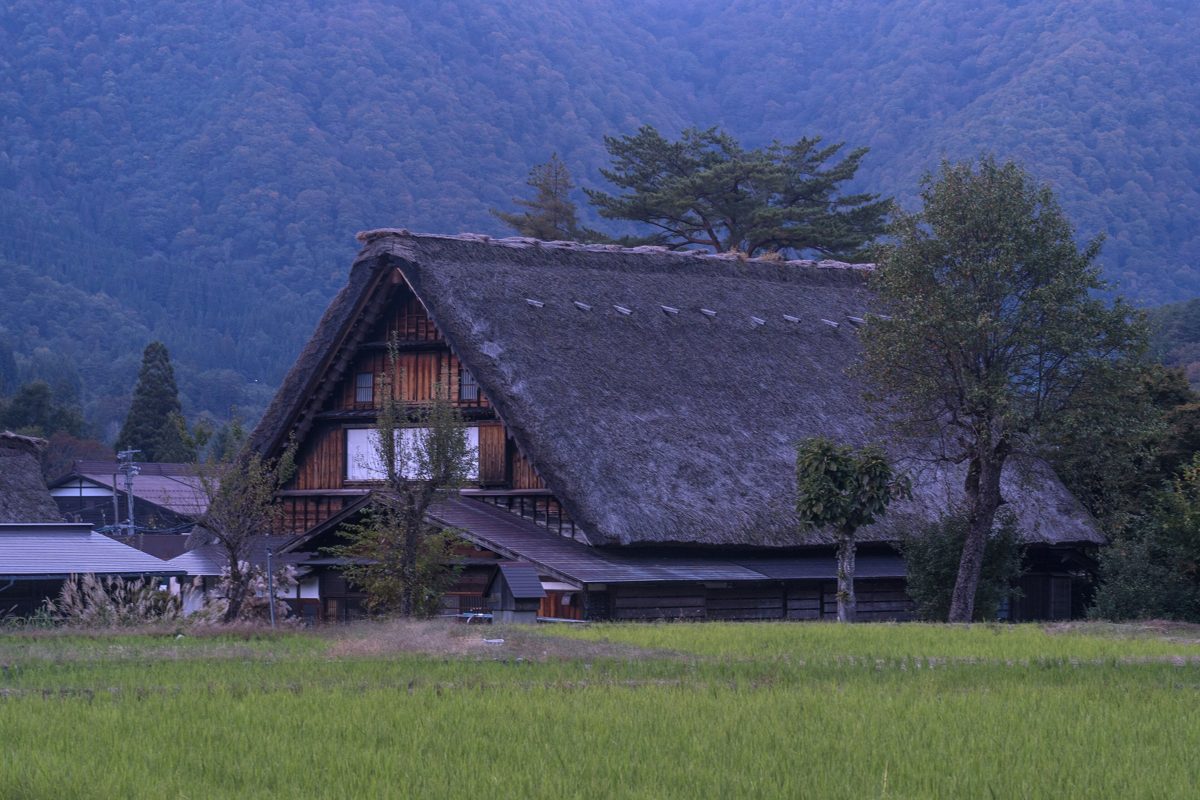
By bus
There is no train to Shirakawa-go. The association says it is about 1 hour 20 minutes by express bus from Kanazawa or Toyama stations and about 50 minutes from Takayama. Nohi Bus charges 2,800 yen one way from Takayama, 2,800 yen to Kanazawa Station and 2,400 yen to Toyama Station; some buses need booking, and it warns of delays of two hours or more from parking queues, snow or road closures. From the Takayama Nohi Bus Center, the services that need no booking leave at 8:50, 10:50, 11:50, 13:50, 14:50 and 17:50. Reserved seats can be booked online, or by phone with the Nohi Bus Reservation Center on (0577) 32-1688 from 9:00 to 17:00; children under 6 ride free unless they take a seat. From Komatsu Airport, a limousine bus reaches Kanazawa Station in about 40 minutes, and from Toyama Airport a bus reaches Toyama Station in about 20 minutes. Nohi Bus says the village has 114 thatched gassho houses. Our Takayama map covers the bus in detail.
By car, and the winter rule
Iccha (December to the end of February) and Nodaniya, Bunroku and Isaburo (December to March) take guests arriving by public transport only in winter, because snow closes their parking, and the inns say there is no parking for overnight stays in or around the village. The village’s Seseragi Park lot charges 2,000 yen for a car and opens 8:00 to 17:00. Koemon and Kanjya say to tell the guard at the village entrance that you are staying, since cars are restricted during the day. The association asks drivers to use studless winter tires. Visitors who are not staying are asked to tour the village between 8:00 and 17:00.
Luggage
Iccha keeps bags from 10:00 before check-in and until 12:00 after checkout, and Kidoya from 9:00 and until 17:00; Wadaya cannot keep bags after checkout. Coin lockers at the Shirakawago Bus Terminal cost 500 yen for small and medium and 1,000 yen for large, from 8:00 to 17:00.
Where the Shirakawa-go English and Japanese pages differ
The association’s English pages lag behind the Japanese ones in places that matter to a booking. Read the Japanese page too, with a translation app if needed.
| Point | English pages | Japanese pages |
|---|---|---|
| Arrival day in Japan | Asks you not to stay that night | Not mentioned |
| Phone bookings at Kidoya, Furusato | Phone number only | Asks you not to book by phone |
| Nodaniya, Furusato meals | Not mentioned | Room only |
| Kanjya check-in | From 13:00 | From 14:00 |
| Nodaniya times | Check-in to 17:00, out by 9:00 | Check-in to 18:00, out by 10:00 |
| Luggage at the association | Bus terminal lockers | Also kept by the association, same day only |
Compared on October 8, 2026.
The 2027 Shirakawa-go light-up and farmhouse stays
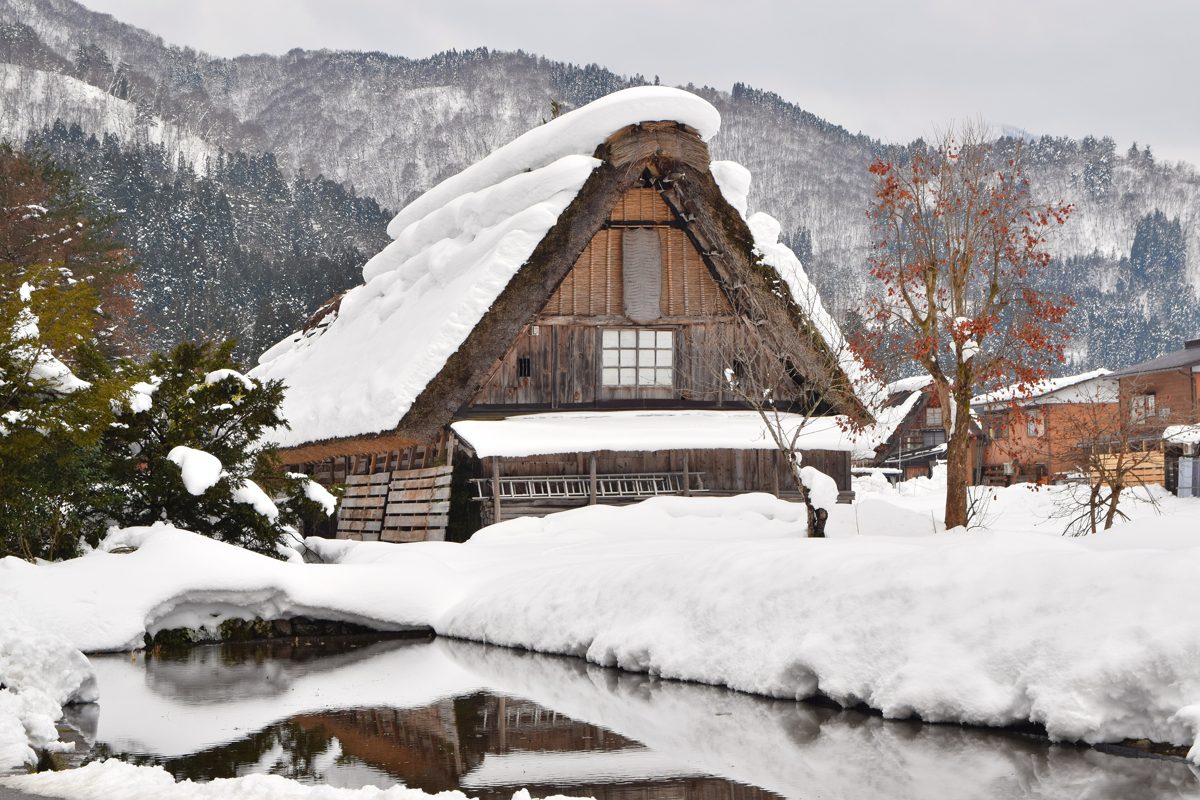
The winter light-up runs on January 11, 17, 24 and 31, 2027, from 17:30 to 19:30. Visitors who arrive without an advance reservation cannot take part, and daytime visitors on regular buses must arrive by 15:20. The only ways to get an observation deck ticket are a stay in the village on a plan that includes one, or a tour. There is no regular bus back after the event.
The association’s English FAQ still says the light-up is held in January and February every year; for 2027 it is the four January dates above. Some inns on the lottery list accept a single guest on certain dates only, so read the list before you apply.
Frequently asked questions
How do I book a farmhouse stay in Shirakawa-go?
Can I stay in Shirakawa-go on the day I arrive in Japan?
What time must I arrive at a Shirakawa-go farmhouse inn?
Can children stay in Shirakawa-go farmhouses?
Do Shirakawa-go farmhouse inns have hot springs?
Can I drive to a Shirakawa-go farmhouse in winter?
How do I get a room for the Shirakawa-go light-up?
What is the cancellation fee for Shirakawa-go farmhouse inns?
Bottom line (2026): Book a Shirakawa-go farmhouse stay on the tourist association’s site, not for your arrival day, and check your inn’s deadlines: dinner can stop from 18:00 and bookings can be canceled after 20:00. Many inns take no children or one night only, several have shower only, and the light-up lottery closes October 31.
Sources
Every fact on this page is from official pages: the Shirakawa-go Tourist Association (home, places to stay, FAQ, terms, access, light-up, stay lottery) and each inn’s plan on its booking system, Koemon, Shirakawago no Yu and Nohi Bus. All were read on October 8, 2026. Rules change by inn and season; read your plan before you pay.
Some links on this page may be affiliate links, which means we may earn a commission if you book or buy through them — at no extra cost to you. See our affiliate disclosure.
Tokyo to Osaka, Tokyo to Kyushu, Tokyo to Hokkaido — day by day — plus seven places most visitors never reach.
- 12 pages, 80 photographs, every stop linked to its guide
- Every price and opening hour read from the official page
- Re-issued monthly, so it does not go stale in your inbox
Free. One email a month, plus the rare change that matters. Unsubscribe with one click in any email. By subscribing you agree to our privacy policy.