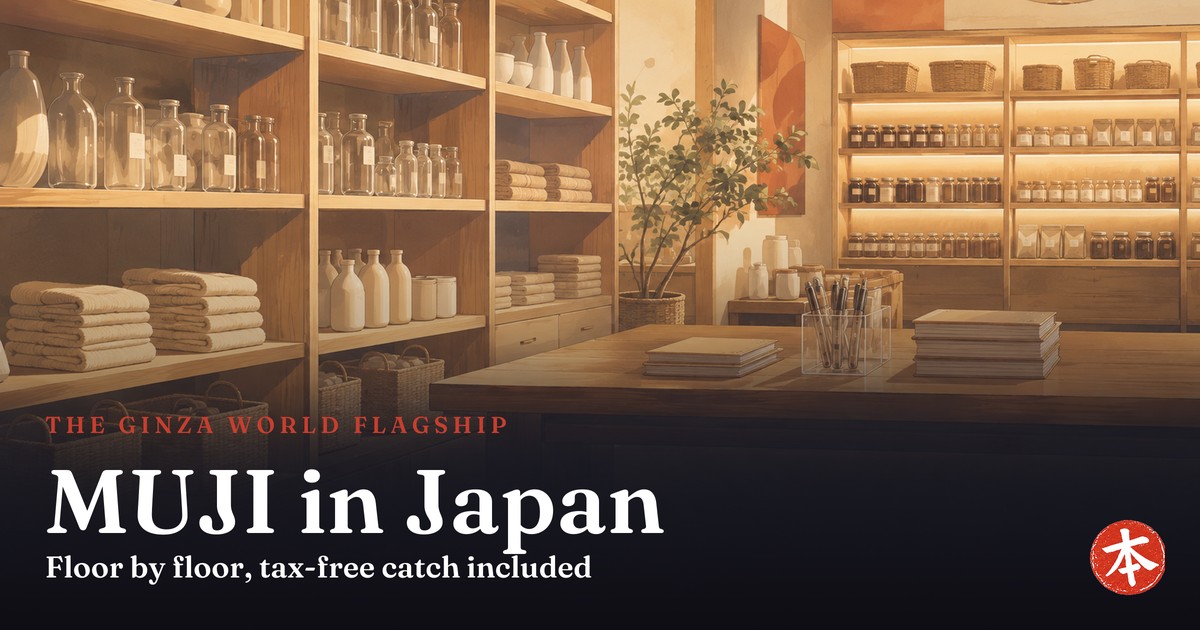
The MUJI you know abroad is an edit. The original — 無印良品, "no-brand quality goods" — is an everyday Japanese retailer whose home stores run deeper in every direction, and whose Ginza world flagship stacks about 7,000 products across six floors, with a diner in the basement, a gallery upstairs, and a hotel made entirely of MUJI on top. For the souvenir categories MUJI owns — stationery, skincare, food — this is the version worth flying for.
This guide walks the flagship floor by floor from official sources, then covers the fine print that changed recently: the tax-free rules (and the member-points catch), and the app situation, which most English guides describe as it existed before September 2025.
🚨 Traveling after October 2026? Japan's tax-free system changes on November 1, 2026. Instead of the tax being taken off at the register, you will pay the full price in store and claim the consumption tax back at customs when you leave, within 90 days of purchase — the retailer refunds it after that check. Until October 31, 2026 the system described here still applies. Our tax-free shopping guide has the detail.
MUJI in Japan at a glance
| The flagship | MUJI Ginza world flagship — Ginza 3-3-5, 3 min from Ginza Sta. B4 exit, ~7,000 products over 6 floors + basement diner + hotel |
|---|---|
| Tax-free (official FAQ) | ¥5,000–¥500,000 before tax, same store, same day, entry within 6 months — 🚨 not at every store, and using it cancels member-program benefits |
| 🚨 The app | "MUJI passport" is gone — replaced September 2025 by the MUJI GOOD PROGRAM (points, email signup) in the renamed MUJI app |
| Only-in-Japan services | Embroidery studio (select stores; Ginza 2F), ReMUJI re-dyed clothing, ATELIER MUJI gallery (free), MUJI Diner, MUJI HOTEL |
| Payment | Varies by store (official FAQ) — the hotel officially takes cards, Alipay and WeChat Pay |
| Buy | Stationery, skincare, MUJI to GO travel gear, socks — and the food walls that never leave Japan |
A walkthrough of the Ginza flagship — the scale is the point:
The Ginza world flagship, floor by floor
Where should you actually spend your time?
From the official floor guide: B1 is the MUJI Diner (below). Floor 1 is the food-and-coffee engine — fresh produce, the packaged-food walls, a bakery, and MUJI Coffee, which officially roasts in-store. Floor 2 holds womenswear, the experimental MUJI Labo line, kids' clothes with the embroidery studio, and ReMUJI — garments collected through the brand's recycling program, re-dyed in Japan (mostly deep indigo) and sold as one-off pieces; a genuinely unique souvenir rack. Floor 3: health & beauty plus menswear. Floor 4 is the traveler's floor — stationery, MUJI to GO travel goods, the Found MUJI curation corner and the Open MUJI event space. Floor 5: furniture and the interior-consultation desk. Floor 6: MUJI BOOKS, a salon café, and the ATELIER MUJI design gallery — officially free to enter, and reliably the calmest room in Ginza.
Eating and sleeping in the brand
The basement MUJI Diner runs an official "world's everyday food" concept — country-themed menus rotating by period, set-meal lunches 11:00–14:00, à la carte dinners 17:00–22:00. Note the official status line most guides miss: the Japanese restaurant WA currently serves no dinner, and its breakfast is for hotel guests only. Upstairs, MUJI HOTEL GINZA is the brand as a bedroom — 79 rooms, check-in 15:00 / check-out 11:00, cards and Alipay/WeChat officially accepted, and the smallest room category an officially stated 2.1 meters wide. It books out well ahead.
Tax-free at MUJI: the points catch
What exactly are the official conditions?
The official FAQ sets the frame: ¥5,000 to ¥500,000 before tax, receipts combinable within the same store on the same day only, passport with entry authorization within six months. Two rules guides skip: tax-free runs only at listed stores (there's an official eligible-store page — don't assume a small branch participates), and the official kicker: a tax-free purchase is excluded from all member-program benefits — no points, no member discounts, officially stated. For a visitor the practical read: take the tax discount, skip the app. The national scheme's mechanics and its late-2026 changes live in our tax-free guide.
(For the rules from November 1, 2026: our free Japan tax refund checker tells you which system applies to your purchase date, gives an estimated refund for one receipt, and shows your deadline and where to do the customs check.)
The app your guidebook mentions no longer exists
So should a tourist bother with the MUJI app?
English guides still say "download MUJI passport for mile rewards." Officially outdated twice over: on September 9, 2025, MUJI replaced the MUJI Mile system with the point-based MUJI GOOD PROGRAM, and the app itself is now simply the MUJI app (old installs migrate by update; registration is by email). Points accrue from purchases and even recycling participation — but recall the section above: member benefits and tax-free are mutually exclusive per purchase, which for most short-stay visitors settles the question of whether to bother.
Where MUJI fits in the Ginza shopping crawl
Ginza — of all places — is Tokyo's best budget-to-quality shopping walk: Daiso's global flagship for ¥110 volume, Loft (and the stationery specialists) for design-forward gifts, Uniqlo's two flagships for wardrobe restock, and MUJI as the quiet-quality anchor — all within a few blocks. Do MUJI's floor 4 and floor 1 even on a tight schedule: stationery and food are the two categories where the Japan-only depth is unmissable.
FAQ
What’s special about MUJI in Japan compared to MUJI abroad?
Where is the biggest MUJI in Tokyo?
Is MUJI tax-free for tourists?
Do I need the MUJI passport app?
Can I get something embroidered at MUJI?
What should I eat at the MUJI flagship?
What is MUJI HOTEL GINZA like?
What’s actually worth buying at MUJI in Japan?
How does MUJI compare with Daiso and Loft for souvenirs?
Bottom line (2026) — MUJI’s Ginza world flagship stacks six floors, a diner, a hotel and roughly 7,000 products — nothing like the edit sold abroad. Tax-free runs ¥5,000–500,000 pre-tax, same-store same-day, and using it cancels member points. WA’s dinner service is suspended, and the MUJI GOOD PROGRAM changed on September 9, 2025. The embroidery studio and ReMUJI area are on-site at the flagship.
Sources
Flagship address, access, floor-by-floor lineup, MUJI Diner concept and hours, WA's suspended dinner service, ReMUJI description, embroidery studio location and the ~7,000-product figure: MUJI's official Ginza special site and MUJI HOTEL GINZA facility pages. Tax-free conditions and the member-benefit exclusion, the MUJI GOOD PROGRAM change (September 9, 2025), embroidery service rules and the payment-varies-by-store policy: the official MUJI FAQ. Hotel terms (check-in/out, payment including Alipay/WeChat, room count and dimensions): the official hotel policy pages. The Ikebukuro embroidery-service termination: that store's official notice. All read August 10, 2026. Retail-floor hours and product prices are deliberately absent — the main MUJI site blocked automated reading, and we don't print unverified numbers. The embedded video is by its creator — a flagship tour we found genuinely useful.
Tokyo to Osaka, Tokyo to Kyushu, Tokyo to Hokkaido — day by day — plus seven places most visitors never reach.
- 12 pages, 80 photographs, every stop linked to its guide
- Every price and opening hour read from the official page
- Re-issued monthly, so it does not go stale in your inbox
Free. One email a month, plus the rare change that matters. Unsubscribe with one click in any email. By subscribing you agree to our privacy policy.