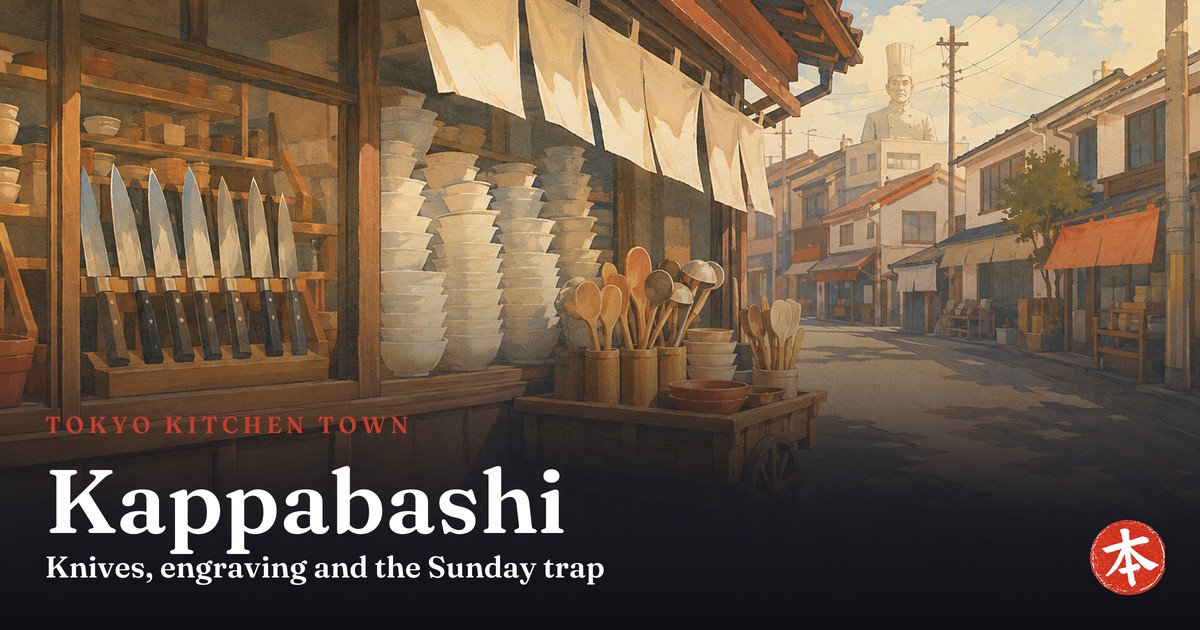
Kappabashi is the street where Japan's restaurants shop — roughly 170 stores along 800 meters between Ueno and Asakusa selling hand-forged knives, ramen pots, lacquerware, noren curtains and the eerily perfect plastic food you see in restaurant windows. For a traveler who cooks, it's the best souvenir street in Tokyo. And it runs on restaurant-supplier hours, which is exactly where visitors get burned: most shops close around 5 p.m., and about 70% rest on Sundays — official association figures, with famous exceptions we'll name.
This guide covers the knife shops worth your money (and the free engraving), the food-sample workshop's new 2026 rules, what's actually true about tax-free and cash, and how to get your new blade home legally.
🚨 Traveling after October 2026? Japan's tax-free system changes on November 1, 2026. Instead of the tax being taken off at the register, you will pay the full price in store and claim the consumption tax back at customs when you leave, within 90 days of purchase — the retailer refunds it after that check. Until October 31, 2026 the system described here still applies. Our tax-free shopping guide has the detail.
Kappabashi at a glance
| What it is | Tokyo's restaurant-supply street — ~170 shops over ~800 m, roots in the early 1910s |
|---|---|
| Where | Between Ueno and Asakusa. Tawaramachi Station (Ginza line) 5 min · Tsukuba Express Asakusa 5 min · ~10 min walk from Senso-ji |
| 🚨 Hours | Officially "roughly 10:00–17:00" for most shops — this is a morning-to-afternoon street |
| 🚨 Sundays | ~70% of shops closed (official FAQ) — but Kama-asa, Majimaya and Ganso Sample officially open |
| Buy | Chef's knives (free name engraving at Kamata), fake-food samples, baking molds, lacquerware, noren, ramen bowls |
| Retail welcome? | Yes — the association's FAQ: nearly every shop sells to individuals, no trade license needed |
| Knives & flights | Checked baggage only (transport ministry's official rule) |
| Festival | Kappabashi Dogu Matsuri: October 6–12, 2026 (official) |
What the street actually looks like, shop by shop — kitchenware, knives and the fake-food windows:
What exactly is Kappabashi?
A supply chain you're allowed to walk into. The street grew from used-tool dealers who set up along a now-vanished canal in the early 1910s, then boomed as a restaurant-equipment district after the Great Kanto Earthquake. Today it outfits Japan's restaurants with everything except the food — and the association's own FAQ is clear that nearly every shop happily sells single items to individuals. As for the name: even the association hedges between two official origin stories — a rain-cape (kappa) drying legend and the water-imp kappa of folklore. The street chose the imp as its mascot; you'll see him everywhere.
When should you go?
Weekday mornings are the street at full strength. The official guidance — most shops roughly 10:00–17:00, with about 70% closed Sundays and holidays — makes Kappabashi a bad fit for a Sunday-evening plan and a perfect fit for a morning paired with Asakusa (ten minutes on foot from Senso-ji, and our street-food guide covers what to eat around there). The famous exceptions, from each shop's official pages: Kama-asa opens daily (11:00–17:30, closed only at New Year), Majimaya bakes on Sundays too (10:00–17:00), and Ganso Sample runs daily (10:00–17:30). One planning footnote: the Dogu Matsuri festival, October 6–12, 2026, is the street's sale week — great deals, peak crowds.
The knives: where to buy, and the engraving ritual
Kamata Hakensha — the engraving specialists
A fourth-generation blade shop where the move is: choose your knife, then have your name hand-carved into the blade for free while you wait — the shop's official signature service. Hours run 10:00–18:00 (irregular holidays), later than most of the street, and its official listing notes a tax-free counter and card payments. One internet landmine we have to flag: the shop's real site lives at www.kap-kam.com — the bare domain without "www" currently serves a completely unrelated farm business, and guides linking it send readers to the wrong company.
Kama-asa — the 1908 institution
The street's most polished stop: knives and charcoal cookware since 1908, a bilingual Japanese-English site, and branches in Paris and Brooklyn — which tells you how far its reputation carries. Official practicals: 11:00–17:30, open daily except New Year (note the late open — "arrive at 9 a.m." advice fails here), payment by cash, cards and e-money, and free engraving officially offered on knives ordered via its online shop — ask in store for counter purchases. Its official site currently carries two useful notices: a warning about fake copycat websites (buy only via kama-asa.co.jp), and a FedEx overseas-shipping delay for August 7–16, 2026.
What buying a first knife at Kamata actually feels like — the advice, the handling, the engraving:
Getting a blade home
The rule is official and simple: Japan's transport ministry table (updated April 2026, English version included) marks knives prohibited in carry-on, permitted in checked baggage. Shops wrap blades for transit — keep the wrapping on until you're home. Traveling carry-on-only, or buying more than your suitcase allows? Kama-asa's official FAQ invites overseas-shipping inquiries; otherwise, buy on your last Tokyo day and check the bag.
The fake food: workshop rules changed in 2026
Can you make your own food sample?
The plastic-food windows are Kappabashi's other pilgrimage, and Ganso Shokuhin Sample-ya is the name everyone knows. Browsing the shop is free (daily 10:00–17:30) and the sample magnets and keychains are the street's best small gifts. The famous make-your-own workshop — you craft tempura and lettuce from hot wax — now runs: ¥3,300 per person (official price since September 2025), about 40 minutes, ages 6+, reservation required via the official booking site, and — new from July 1, 2026 — spectators pay ¥500 too. The official site is honest that sessions run in Japanese and asks non-Japanese speakers to bring an interpreter; the craft itself is visual enough that many visitors manage happily by watching.
Beyond knives: what else deserves suitcase space
Baking and wagashi molds at Majimaya — cast forms for taiyaki, castella and seasonal sweets you won't find outside Japan (officially open Sundays, weekdays from 9:30). Tableware in restaurant quantities at Niimi, the corner giant under the chef's head statue (weekdays and Saturdays 10:00–17:45, closed Sundays — and officially card-friendly, UnionPay included). Plus noren curtains, lacquer bowls, bamboo steamers, and the wall of ramen pots that makes every cook briefly consider a restaurant career. If your list is more "cheap fun" than "chef-grade," Don Quijote covers the novelty end — Kappabashi is where the real tools live.
Tax-free, cash and cards: the honest version
Tax-free is per-shop here, not street-wide — there's no association program, so look for the sticker or ask (Kamata officially advertises a tax-free counter; Kama-asa's site is silent on it). How Japan's tax-free system itself works — thresholds, passports, the late-2026 changes — is in our tax-free shopping guide. On payment: the "old-school street, bring cash" advice is stale for the major shops — Kamata, Kama-asa and Niimi all officially list credit cards, and Kama-asa adds e-payments. Smaller single-craft shops are unverified, so some cash in pocket is still smart.
Getting there
Official access, two ways: Tawaramachi Station (Ginza line) or Tsukuba Express Asakusa Station, each about five minutes on foot. From Senso-ji it's roughly a ten-minute walk west — which is why the classic plan is Asakusa sights in the early morning, Kappabashi when the shutters roll up at ten. Look for the giant chef's head on the Niimi building at the street's southern end; that's your landmark.
(Bought the knife? Learn what it's for — our Tokyo cooking-class guide compares the English-friendly schools where you'll actually use one.)
FAQ
Is Kappabashi worth visiting if I don’t cook?
Is Kappabashi open on Sundays?
What time does Kappabashi close?
Where should I buy a knife in Kappabashi?
Can I get my name engraved on a knife?
Can I take a Japanese knife on the plane?
How does the food sample workshop work?
Is Kappabashi tax-free? Can I pay by card?
When is the Kappabashi Dogu Matsuri festival?
Bottom line (2026) — Kappabashi is roughly 170 restaurant-supply shops on one 800-meter street between Ueno and Asakusa, selling chef’s knives with free hand-carved engraving and fake-food workshop kits. Most shops close around 5 p.m., and about 70% rest on Sundays — though the famous ones mostly don’t.
Sources
Street facts (shop count, length, history, access, hours guidance, the ~70% Sunday figure, retail-welcome policy, festival dates): the Kappabashi street association's official site, including its August 7, 2026 operating-status notice and the official 41st Dogu Matsuri announcement. Shop specifics: the official pages of Kamata Hakensha (hours, free hand-carved engraving, tax-free listing), Kama-asa (hours, daily opening, payments, online engraving, the fake-site warning and August 2026 FedEx notice), Niimi and Majimaya (hours), and Ganso Shokuhin Sample-ya (workshop price, reservation system, the July 2026 spectator fee, interpreter policy). Knife transport: Japan's Ministry of Land, Infrastructure, Transport and Tourism official dangerous-goods table (April 2026 revision, English PDF). All checked August 10, 2026. The embedded videos are by their creators — street and shopping walkthroughs we found genuinely useful.
Tokyo to Osaka, Tokyo to Kyushu, Tokyo to Hokkaido — day by day — plus seven places most visitors never reach.
- 12 pages, 80 photographs, every stop linked to its guide
- Every price and opening hour read from the official page
- Re-issued monthly, so it does not go stale in your inbox
Free. One email a month, plus the rare change that matters. Unsubscribe with one click in any email. By subscribing you agree to our privacy policy.