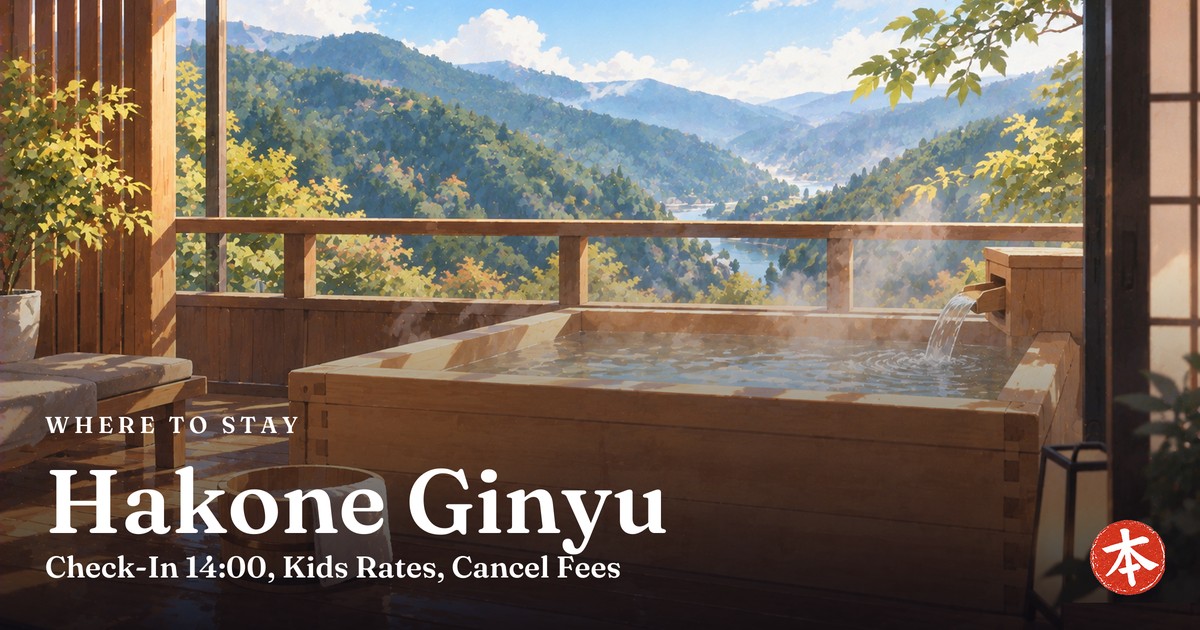
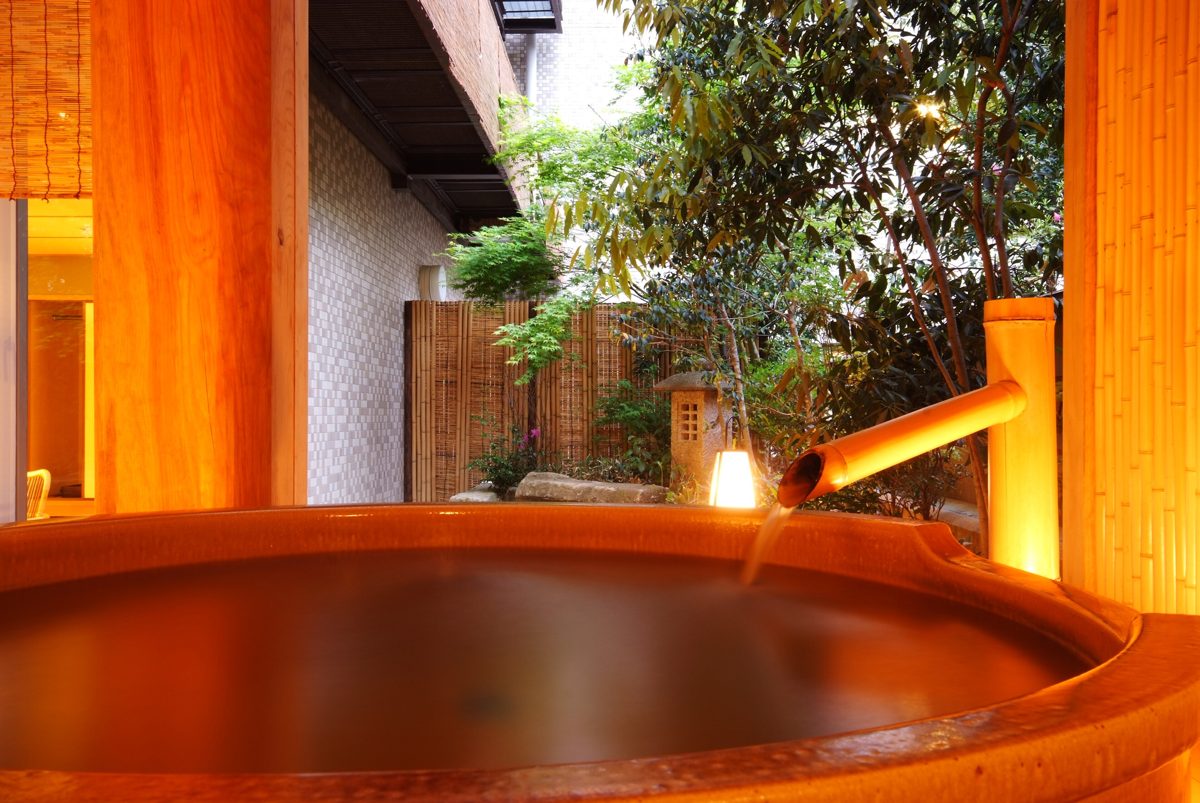
Hakone Ginyu is a 20-room ryokan on the hillside at Miyanoshita, the old hot-spring town on the Hakone Tozan line, and it is built on one promise: every room has its own open-air bath on a terrace over the Hayakawa valley, and both meals come to the room. The corridors are tatami, so you walk them in tabi socks. The rules under the calm are a 14:00 check-in and 11:00 checkout, cancellation fees from three days out, child rates that split by school grade, and a day spa that admits no one without a treatment.
Everything below is from the official English site: the top and reservation pages, the bath, spa, cuisine, facility, guest-room and access pages, and a 2020 notice on cancellations. Room rates are not here; the child, spa and bath prices the ryokan publishes are.
Hakone Ginyu at a glance
| Item | Official rule |
|---|---|
| Check-in / check-out | 14:00 / 11:00. |
| Cancellation | 3-2 days before 30%, day before 50%, same day 100%. |
| Rates | Per person with two meals, incl. service charge, tax and bath tax; five seasonal tiers; New Year surcharge. |
| Children | Preschool free (meal 5,500 yen, bedding 4,400 yen optional); grades 1-4 50%; grade 5+ 70%. |
| Rooms | 20, all with open-air bath, terrace and dining room. 17 Japanese, 3 Western. |
| Meals | In the room: kaiseki from 18:00, breakfast at 8:00 or 9:30. |
| Public baths | Two, swapped by sex at 22:00; sauna; open to 10:30. |
| Day spa | Treatment guests only, 10:00-20:00; bath add-on 1,650 yen + 50 tax; overnight guests 1,100 yen off courses. |
| Booking window | One year ahead from 9:00; New Year from Sept 1, 10:00. |
| Cards | Visa, Mastercard, JCB, Amex, Diners, UC, DC. |
Official site, read September 16, 2026.
What is Hakone Ginyu, and which floor should I book?
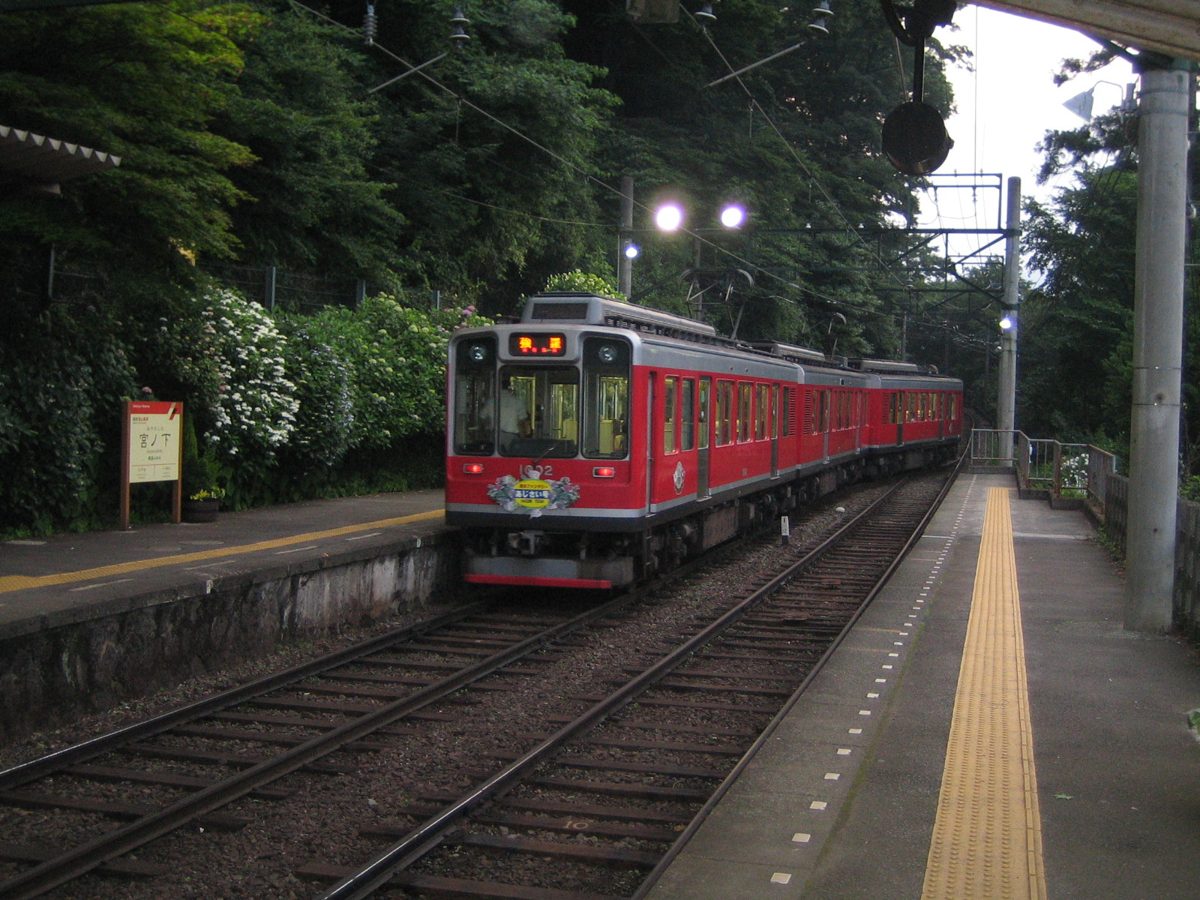
A modern ryokan built down a slope above the river at Miyanoshita, a minute from the bus stop and a short walk from the 1878 Fujiya Hotel that gives the town its air. Its emblem is the phrase kacho fugetsu, the beauties of nature, written in oracle-bone script, and the design follows: natural materials, low light, tatami everywhere. The four floors are room types. Kaze on the 4th floor is a single Japanese-style room with the top view. Hoshi on the 3rd has Japanese and Western rooms and the only maisonette, whose living room opens to the sky on the 4th. Sora on the 2nd is the entry tier, closest to the forest and best in fresh-green and autumn-leaf seasons. Tsuki on the 1st has the largest terraces and open-air baths with a jacuzzi function. Western rooms have a queen bed and take a third guest on an extra bed.
What is in a room?
Entrance, the main room (10 tatami mats in the Hoshi Japanese room), a separate dining room with a sunken table or low chairs, a mini-kitchen and sink, toilet, a shower booth, and the terrace with the open-air bath and sofas. Amenities run to shampoo, treatment, body soap and scrub, cleansing foam, lotions and an all-in-one gel, with a bathrobe, yukata and samue. Wired LAN in every room; wireless around the 5th-floor lobby.
Why tabi socks?
Because the corridors are tatami too, and the ryokan asks you to walk them in the white tabi it provides rather than slippers. It is the detail guests remember, and the reason the building is quiet.
Check-in at 14:00, meals in the room
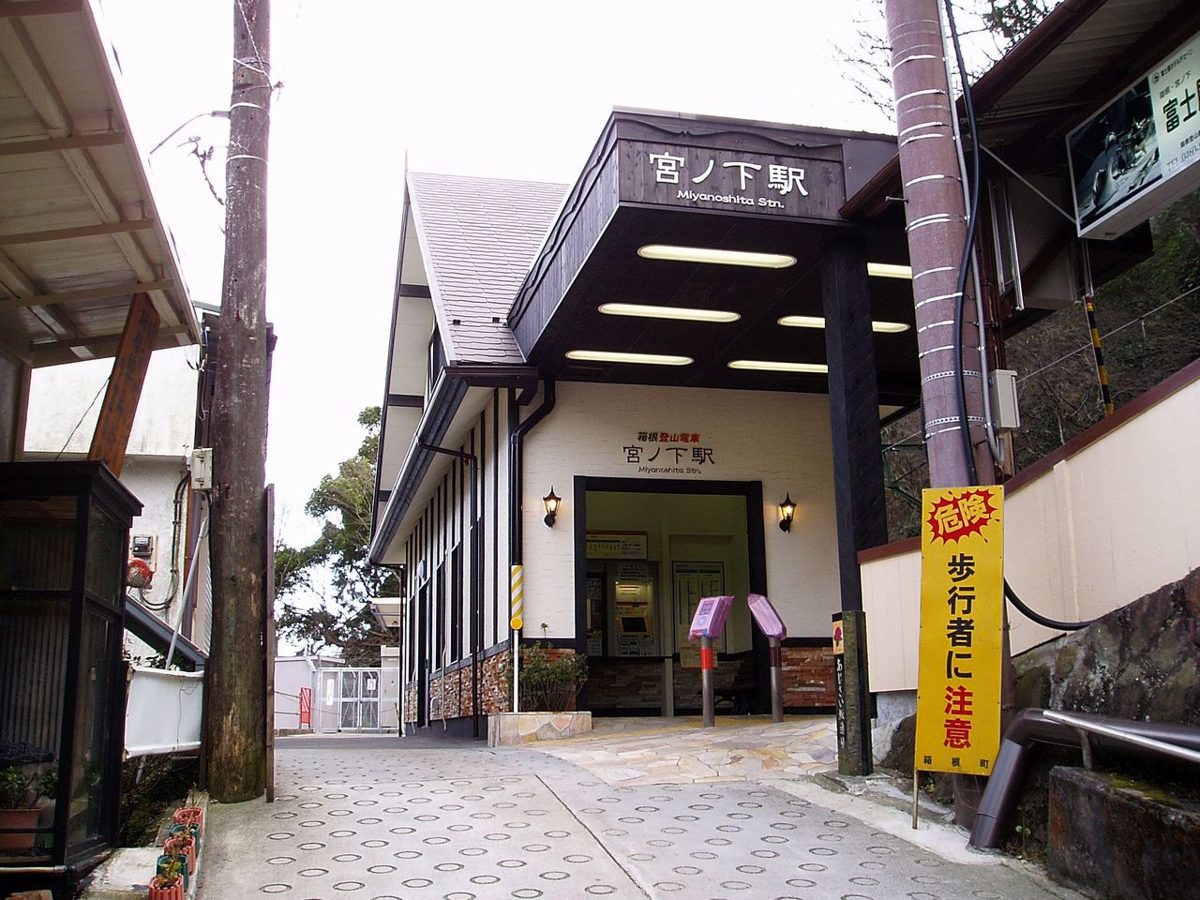
What are the hours?
Check-in 14:00, checkout 11:00, an hour earlier in and later out than many ryokan, which the all-room-bath design rewards. The lounge Ginyu Shijin on the top floor serves drinks 16:00 to 18:00 and 20:30 to midnight, and the bar runs from 19:30 to 22:00.
How does dinner work?
A monthly changing kaiseki course carried to your dining room by your attendant, from 18:00, and breakfast likewise at 8:00 or 9:30. The hospitality page explains the point: the attendant watches your pace so you never wait or feel rushed. Groups who want to eat together can use a 41.5-mat private dining space with four booths, and there is a teppanyaki counter, Yuan, for dinner. The ryokan also offers a light meal after dinner and, on request, sets pieces such as candles for a proposal or a cake for an anniversary.
How far ahead can I book?
Up to one year to the day, with bookings opening at 9:00. The New Year nights of December 31 to January 3 are the exception: they open at 10:00 on September 1 each year and carry a surcharge on the seasonal rate. Rates are quoted per person for one night with two meals and include the service charge, consumption tax and bath tax.
Cancellation: 30 percent from three days out
| When you cancel | Fee |
|---|---|
| 4 days before or earlier | None |
| 3 to 2 days before | 30% |
| Day before | 50% |
| Day of stay | 100% |
Official reservation page, read September 16, 2026.
What if I fall ill?
A notice the ryokan posted in July 2020 says that cancellations for poor health are accepted free by phone until 18:00 the day before, for guests who booked directly; bookings through agencies and booking sites follow those companies’ rules. The notice is still linked from the top page but is five years old, so confirm it when you call. A ryokan of this size buys ingredients for a fixed number of dinners, which is why the fee starts earlier than at a hotel chain; Konansou on Lake Kawaguchiko starts a week out.
Children: free in preschool, then 50 or 70 percent
| Child | Rule (official rate list) |
|---|---|
| Preschool age | Stay free. Children’s meal 5,500 yen and bedding 4,400 yen if wanted. |
| Elementary grades 1 to 4 | 50% of the room rate. |
| Elementary grade 5 and up | 70% of the room rate. |
| Equipment | Children’s tableware, toothbrush, yukata and towels provided. |
Official Hakone Ginyu child rates, read September 16, 2026. The page does not state the age at which a child becomes an adult.
Is it a family ryokan?
The Japanese-style and maisonette rooms are described for families and small groups, and the children’s kit is real, but the tone is adult: private baths, candlelit proposals, a bar. A family with a preschooler pays only for the child’s meal and futon; from elementary school the half or seventy-percent rate applies to a two-meal ryokan price. Our ryokan guide explains how per-person, two-meal pricing works.
The baths: two bathhouses and 20 private ones
When are the public baths open?
The two bathhouses, Tsuki-shiro and Tsuki-ne, each have a stone tub, an open-air bath and a low-temperature sauna, and they swap by sex at 22:00: Tsuki-shiro is men’s from 14:00 to 22:00 and women’s from 22:00 to 10:30 the next morning; Tsuki-ne is the mirror image. Both are placed so the Hakone range fills the horizon, the “infinity bath” the site advertises. The spring is a weakly alkaline one listed for skin, joints, muscle pain and fatigue.
Are tattoos allowed?
The site does not say. With an open-air bath on your own terrace the public baths are optional, which makes Ginyu one of the easier Hakone stays for a tattooed guest; ask before relying on the bathhouses. Our tattoos and onsen guide has the general rules.
Ginyu Spa: treatments, a day plan and the private night
Can I use the spa as a day visitor?
Only with a treatment. The spa pavilion, reached through a “forest hallway”, opens 10:00 to 20:00 with last admission at 18:00 to treatment customers; its own free-flowing private open-air bath is free to them for 30 minutes by reservation, and a soak in the ryokan’s baths can be added for 1,650 yen plus 50 yen bath tax. Bathing alone is not sold. A spa-and-lunch plan runs 10:15 to 13:30 with a 90-minute treatment and a soba lunch, and a morning discount takes 10 percent off a treatment starting between 10:00 and noon, one pair a day.
What do overnight guests get?
1,100 yen off every spa course, the same 30-minute private bath with a treatment, and the option of Private Night Ginyu: one couple a day may reserve the whole pavilion from 21:00 to 23:00 after the salon closes, which the ryokan pitches for weddings, anniversaries and proposals. Two single treatment rooms and one pair room mean couples can be treated together.
What is the spa’s cancellation rule?
Free until 21:00 the day before, 50 percent after that, and 100 percent once the reserved time has passed. Bathing spots for treatment guests vary by time and conditions on the day. There is also a free morning yoga session on Thursdays from 7:00 to 7:30.
Getting there, parking and payment
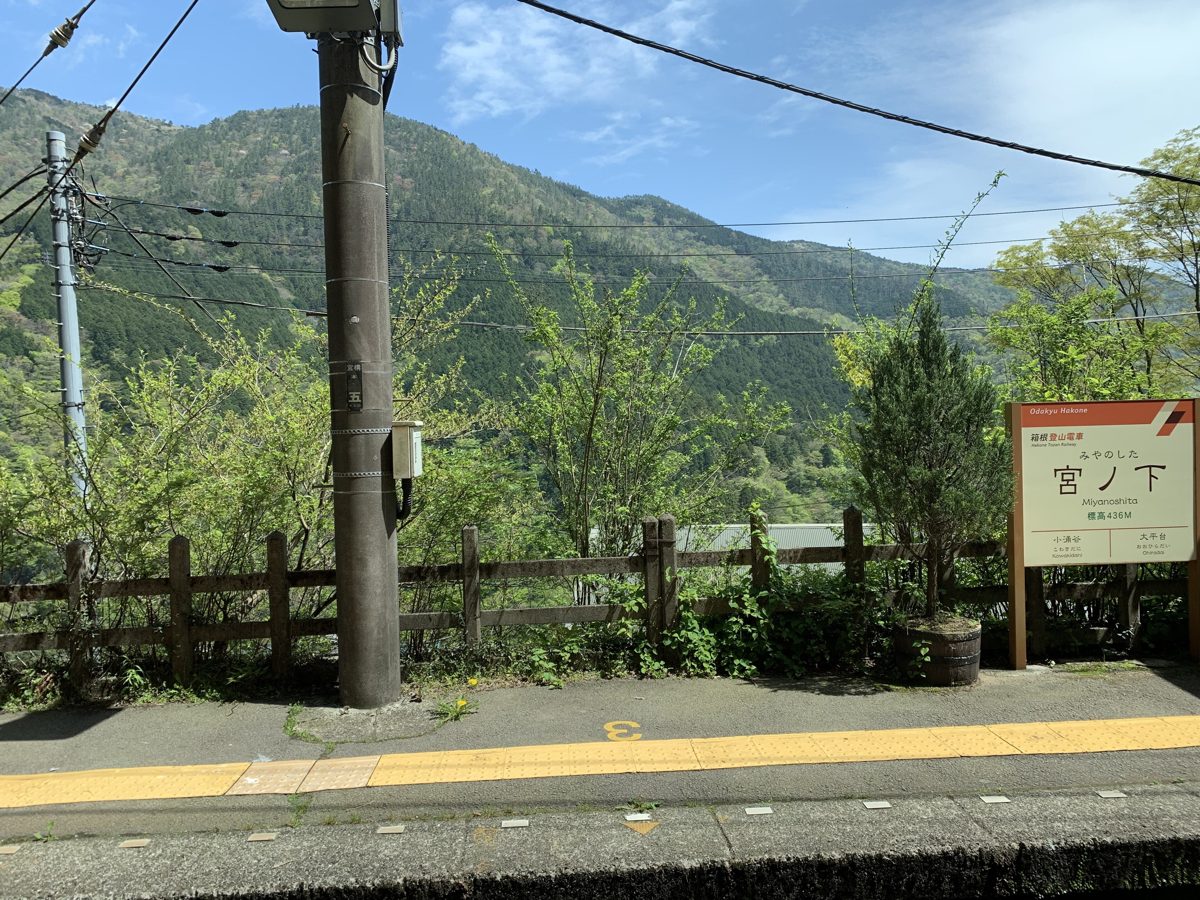
From Odawara Station (east exit) the Hakone Tozan bus takes about 30 minutes to Miyanoshita; from Hakone-Yumoto Station about 15. The ryokan is a one-minute walk from the stop. Drivers enter the car park from Route 1 down a steep slope the site warns about. Cards accepted are Visa, Mastercard, JCB, American Express, Diners, UC and DC. Sending a suitcase ahead is the easy way to arrive by bus; our luggage forwarding guide has the counters, and our Hakone map shows where Miyanoshita sits on the loop.
What is Miyanoshita like?
The ryokan’s own Hakone page tells the story: a spring found under the Kumano shrine in the Muromachi period, a therapeutic bath town in the Edo period, then the foreign resort that grew up around the Fujiya Hotel after 1878. The old streetscape survives around the station and the shopping street, and the page lists a shrine known as a power spot for money and marriage a few minutes away. It is a quieter base than Hakone-Yumoto, with the Tozan railway at the door.
What do I need to bring?
Very little. The room amenity list covers shampoo, treatment, body soap and scrub, cleansing foam, two lotions, an all-in-one gel, bath and face towels, and a bathrobe, yukata and samue to wear around the building; children get their own yukata, towels, tableware and toothbrush. Bring tabi if you own them, though the ryokan provides them.
Is the ryokan accessible?
Partly. The facility page says wheelchair-accessible rooms are available on request and lists barrier-free features, but the building steps down a hillside and the tatami corridors are walked in socks, so ask about the specific room before booking. Foreign-language support is listed on the reservation page.
Who Hakone Ginyu is for
Couples who want a private open-air bath and meals in the room without leaving the building, and anyone marking an occasion. It works for families who can absorb the two-meal child rates. It is the wrong place for a bath-only day trip, and its three-day cancellation window suits firm plans.
Frequently asked questions
What time is check-in and check-out at Hakone Ginyu?
What is the cancellation fee?
How are children charged?
Does every room have an open-air bath?
When can I use the public baths?
Can I visit the spa without staying?
Is there a private evening at the spa?
How do I get there?
Bottom line (2026). Check in from 14:00, out by 11:00; every one of the 20 rooms has its own open-air bath and both meals arrive in the room; cancel four days out to pay nothing, then 30, 50 and 100 percent; preschoolers stay free but a child’s meal is 5,500 yen, and elementary children pay 50 or 70 percent; and the day spa takes no one without a treatment.
Sources
Rules and figures are from Hakone Ginyu’s official English site (hakoneginyu.co.jp/en): the top page, the rates and reservations page (reservation), and the bath, spa, cuisine, facility, guest-room, hospitality, bar and access pages, plus the July 2020 notice on infection measures and cancellations, all read on September 16, 2026.
Some links on this page may be affiliate links, which means we may earn a commission if you book or buy through them — at no extra cost to you. See our affiliate disclosure.
Tokyo to Osaka, Tokyo to Kyushu, Tokyo to Hokkaido — day by day — plus seven places most visitors never reach.
- 12 pages, 80 photographs, every stop linked to its guide
- Every price and opening hour read from the official page
- Re-issued monthly, so it does not go stale in your inbox
Free. One email a month, plus the rare change that matters. Unsubscribe with one click in any email. By subscribing you agree to our privacy policy.