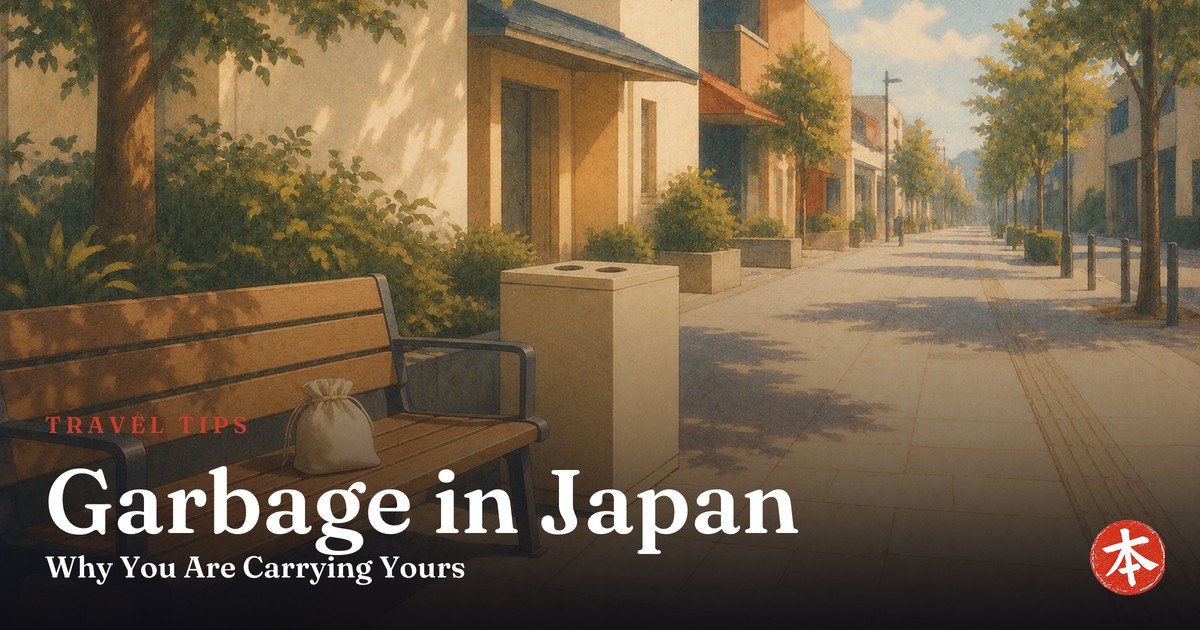
Every visitor works this out within a day: there is nowhere to put anything. You buy something from a stall, you eat it, and then you are carrying a wrapper through one of the cleanest cities on earth, looking for a bin that does not appear.
The explanation that circulates online is a single historical event. We are not going to repeat it, because we cannot source it from the statute and we did not verify it elsewhere. What we can show you is something more useful: Japanese law splits all waste into two categories and assigns them along different lines of responsibility — and once you see that split, the missing bin stops being a mystery.
The split: industrial waste, and everything else
The act defines its two main categories in an order that tells you which one it cares about.
| Category | How the act defines it |
|---|---|
| Industrial waste | Waste arising from business activity of listed kinds — ash, sludge, waste oil, waste acid, waste alkali, waste plastics and others specified by cabinet order — plus imported waste |
| General waste | 🚨 Waste other than industrial waste |
The second category is defined by subtraction
That is not a summary. The provision reads, in full, that general waste means waste other than industrial waste. There is no positive definition of household rubbish in this act — it is whatever is left after the industrial category has taken what it takes.
And the same object can land on either side
This is the part with practical consequences. The industrial category turns on whether the waste arose from business activity, not on what the object is. So an identical plastic container can be one category when it comes out of a household and potentially another when it comes out of a business, and the handling regimes that follow are different. The law is sorting by origin, not by material.
Why that split shows up on the street
This was made by a Japanese language school for people who have just moved here, which makes it the right level of explanation: burnable, non-burnable, recyclable, and what goes in which bag. Slow, clear Japanese with the categories drawn as icons — and the icons are the same ones printed on the bins you will be standing in front of.
A public bin is not a neutral hole in the ground. It is a collection point whose contents somebody has to handle, under a system that assigns responsibility precisely and separates the streams before they mix.
We are not going to say that a convenience store's bins are legally only for its own customers, or that putting your rubbish in one is prohibited. That is a question about a particular business's arrangements, not about this statute, and we did not verify it. Plenty of businesses put bins outside precisely so that people can use them.
What the statute establishes is narrower and firmer: waste from business activity is its own legal category with its own handling regime. Everything downstream of that is a matter for the business and the municipality.
Which is also why the answer is municipal
Sorting categories, collection days, bag requirements — none of that is in the national statute, and it varies from city to city. This is genuinely one of those areas where advice written for one place can be wrong a train ride away, and where guides that confidently describe “the Japanese sorting system” are describing one municipality and calling it a country. We are not doing that here.
The rule addressed to you personally
Most of the act governs businesses, municipalities and licensed operators. Two provisions are written to catch everyone, and they use the same construction we have found across Japanese statutes: no person shall.
| Provision | What it says |
|---|---|
| Discarding | 🚨 No person shall discard waste carelessly |
| Incineration | 🚨 No person shall incinerate waste, except by the listed methods |
The littering rule has no business-only limitation
It is one line, and its subject is any person. Whatever the practical likelihood of a visitor being pursued over a dropped wrapper, the rule is not framed as an industrial-dumping provision that happens to be worded broadly. It reaches the person holding the wrapper, which puts it in the same family as the pedestrian rules in our guide to walking in Japan.
And burning is prohibited with narrow exceptions
The act permits incineration only in listed cases: incineration carried out in accordance with the applicable waste handling standards; incineration carried out under other legislation or a disposition based on it; and incineration that is unavoidable for public benefit or by social custom, or whose effect on the surrounding living environment is minor, as specified by cabinet order.
That third exception is the interesting one, and we are not going to give you examples of what falls inside it. The specifics are in a cabinet order we did not retrieve, and guessing at which traditional practices qualify would be exactly the kind of confident error this guide exists to avoid.
What the act actually counts as waste
The definition is worth reading because it has a shape test at the end that most summaries drop.
Waste means refuse, bulky refuse, ash, sludge, excreta, waste oil, waste acid, waste alkali, animal carcasses and other filth or unnecessary matter — in solid or liquid form, expressly excluding radioactive material and anything contaminated by it.
Two limits hiding in one sentence
First, gases are not waste under this act. The solid-or-liquid requirement takes them out of the definition entirely, which means air emissions are governed somewhere else. Second, radioactive material is carved out — also handled under separate legislation. A statute that looks like it covers everything discarded actually has two large exclusions written into its first definition.
And there is a hazardous tier above it
The act defines specially controlled general waste as general waste with explosive, toxic or infectious properties, or others that may harm human health or the living environment, as specified by cabinet order. There is a parallel tier on the industrial side. So the structure is two columns and two rows — ordinary and hazardous, business-origin and everything else.
What to actually do on a day of sightseeing
The practical answer is unglamorous and it is what residents do.
Receptacles do exist — at many convenience stores, on many station platforms, and beside vending machines for drink containers. The plan that works is not depending on finding one.
Eating on the move is the usual trigger
This is why the advice about eating while walking is more practical than ceremonial. If you finish something at the stall where you bought it, the wrapper usually has somewhere to go right there. Carry it three streets away and it becomes yours for the afternoon — a small consideration worth knowing before a day built around street food.
Why the streets stay clean anyway
The obvious objection is that a country with no bins should be covered in litter, and it plainly is not. Part of that is the prohibition above doing quiet work. Most of it is simply that everyone is already carrying their own — once that is the shared default, a dropped wrapper is conspicuous in a way it never is in a city with a bin on every corner.
It produces a system that looks backwards from outside and works from inside. The absence of infrastructure is doing the job that infrastructure usually does, by pushing the responsibility back to the person holding the object. You are not being inconvenienced by a gap in the system. You have been handed the system.
And the two places that reliably solve it
A coffee shop where you sit down solves it, because you are leaving your cup with the business that served it. So does going back to your accommodation. Between those two, most days sort themselves out — and if you are sending things home at the end of a trip, the packaging that comes off in the process is best dealt with at the hotel rather than at the post office counter.
Deliberately not stated here
This is a guide where what we left out matters more than usual, because the internet is confident about several things this statute does not say:
| What we are not saying | Why |
|---|---|
| 🚨 That bins disappeared because of a specific historical event | A causal claim we cannot source from the statute and did not verify. Widely repeated is not the same as checked. |
| 🚨 That using a shop's bin for your own rubbish is prohibited | A matter for the business, not a rule in this act. |
| Any sorting scheme — burnable, non-burnable, plastics | Municipal ordinance. Differs by city. Not national law. |
| Which practices count as unavoidable by social custom for burning | Cabinet order, not retrieved. We are not guessing at examples. |
| The full list of industrial waste types | Extends into cabinet order, not retrieved. |
| Penalty amounts for illegal dumping | The penalty articles were not retrieved. |
| The recycling statutes for containers, appliances and food waste | Separate laws, not retrieved. |
Japanese waste law FAQ
Why are there so few public bins in Japan?
Is it illegal to drop litter in Japan?
What counts as waste under the act?
What is the difference between industrial waste and general waste?
Does that mean a shop’s bin is not for my rubbish?
Can I burn rubbish in Japan?
Are the sorting rules national?
So what should I actually do with my rubbish?
Bottom line (2026) — Japan's waste act splits everything into industrial waste — waste arising from business activity of listed kinds — and general waste, which it defines simply as waste other than industrial waste. The same object can fall on either side depending on where it came from, and the handling runs on separate tracks. Two rules are addressed to everyone: no person shall discard waste carelessly, and no person shall incinerate waste outside listed exceptions. Waste must be solid or liquid, so gases are outside the act entirely. Sorting rules are municipal, not national. Practical answer: carry a bag.
Sources
This guide was written from the Waste Management and Public Cleansing Act (Act No. 137 of 1970), retrieved in Japanese from the Japanese government legal database on September 1, 2026: its purpose of restraining the generation of waste, ensuring appropriate sorting, storage, collection, transport, recycling and disposal, and keeping the living environment clean, so as to conserve the living environment and improve public health; the definition of waste as refuse, bulky refuse, ash, sludge, excreta, waste oil, waste acid, waste alkali, animal carcasses and other filth or unnecessary matter in solid or liquid form, excluding radioactive material and matter contaminated by it; the definition of general waste as waste other than industrial waste; the definition of industrial waste as waste arising from business activity comprising ash, sludge, waste oil, waste acid, waste alkali, waste plastics and other waste specified by cabinet order, together with imported waste; the definition of specially controlled general waste as general waste having explosive, toxic, infectious or other properties liable to harm human health or the living environment as specified by cabinet order; the prohibition that no person shall discard waste carelessly; the prohibition that no person shall incinerate waste except by incineration in accordance with the applicable handling standards, incineration under other legislation or a disposition based on it, and incineration unavoidable for public benefit or by social custom or having minor effect on the surrounding living environment as specified by cabinet order; and the restrictions on handling designated hazardous waste. Municipal rules and cabinet-order detail are flagged above rather than described. More on how we work: how we research.
Laws change. This reflects the text as it stood on September 1, 2026.
Tokyo to Osaka, Tokyo to Kyushu, Tokyo to Hokkaido — day by day — plus seven places most visitors never reach.
- 12 pages, 80 photographs, every stop linked to its guide
- Every price and opening hour read from the official page
- Re-issued monthly, so it does not go stale in your inbox
Free. One email a month, plus the rare change that matters. Unsubscribe with one click in any email. By subscribing you agree to our privacy policy.