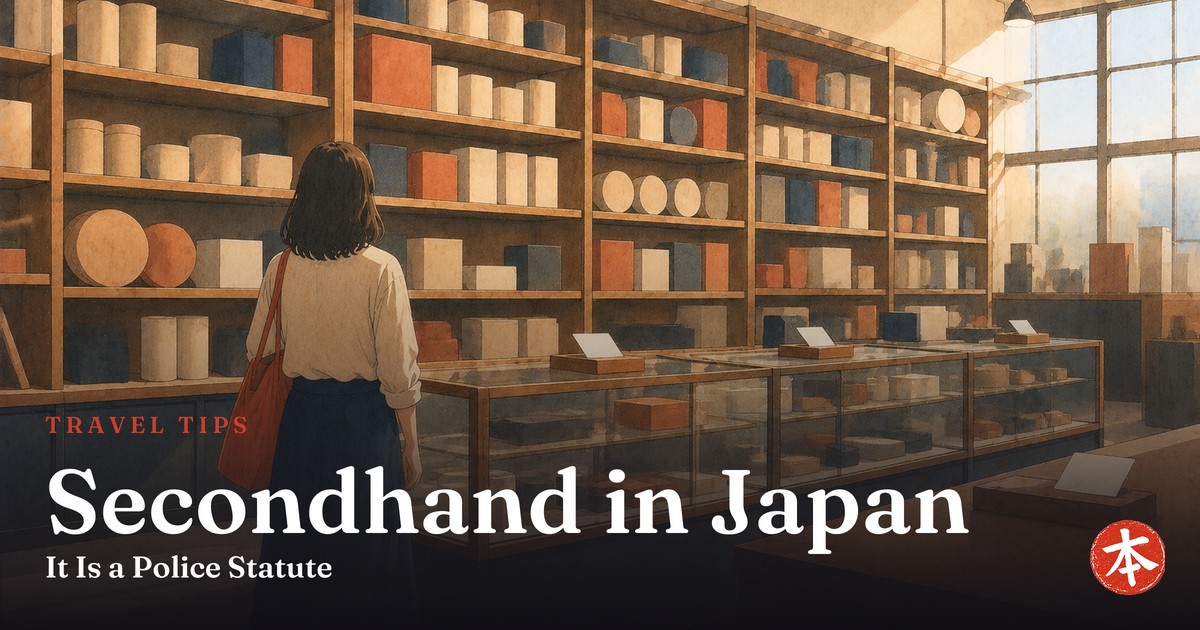
Japan's secondhand market is one of the genuinely great things about shopping here — the condition of the goods, the depth of the stock, the fact that a twenty-year-old camera comes with a grade written on the tag. The usual explanation is cultural: people look after their things.
The other half of the explanation is a statute from 1949, and its opening line has nothing to do with shopping. It is about stolen property. Once you know that, every strange thing about buying and selling used goods in Japan lines up.
It is a police statute, and it says so in the first line
The purpose clause is unusually direct. The act exists to prevent the sale of stolen property and to enable its swift discovery, by regulating the secondhand trade — and thereby to prevent theft and other crimes and to assist the rapid recovery of what was taken.
It is not a consumer protection law. It does not promise you that the item works, that the description is accurate, or that the price is fair. It is a mechanism for making stolen goods difficult to convert into cash — and every obligation in it follows from that one goal.
Which is why the licensing authority is the police
A person intending to run a secondhand dealing business must obtain permission from the prefectural public safety commission — the body that oversees the prefectural police. Not a trade ministry, not a consumer agency. The act then lists the grounds on which permission must be refused, and reading them makes the point better than any summary:
| Permission must be refused where the applicant… |
|---|
| Is bankrupt and has not been discharged |
| Was sentenced to imprisonment, or fined for theft, fraud, embezzlement or handling stolen goods, within the past five years |
| There is reasonable ground to believe may commit violent unlawful acts, collectively or habitually |
| Has been subject to an order or instruction under the anti-organized-crime law within the past three years |
| Has no fixed residence |
The ID check happens when you sell, not when you buy
Someone who buys and resells for a living went and asked the police directly how the identity check is supposed to work, then filmed the answer. Twenty minutes in Japanese — but it is the clearest available account of a rule that looks strange from the customer side and makes complete sense from the counter.
This is the single most useful thing to know, and it catches visitors out in both directions.
The act requires a dealer, when acquiring goods — buying them, taking them in exchange, or accepting them on consignment for sale or exchange — to take measures to confirm that the other party is genuine. The act sets out what those measures can be:
| Acceptable measure | What it means at the counter |
|---|---|
| Confirming the person's address, name, occupation and age | The form you fill in, checked against a document |
| Receiving a signed document stating those four things | A written declaration bearing your signature |
| Receiving them as an electronic record with a certified digital signature | The online-buyback route |
| Equivalent measures specified by national public safety commission rule | A catch-all for methods we did not retrieve |
Note what is being collected
Address, name, occupation and age. Occupation is the one that surprises people, and it is there because the statute is trying to build a picture of who is bringing goods in, not to complete a sales record. This is also why the shop cannot skip it for a low-value item as a courtesy: the duty attaches to the acquisition, not to the amount.
And why buying is anonymous
There is no matching duty when the shop sells to you. The confirmation obligation is written entirely around goods coming in. So walking into a used-camera shop in Akihabara and buying something is exactly as anonymous as buying a new one — while selling that same camera back next week involves a form. It looks inconsistent until you remember what the law is for.
An unused item can still be a secondhand item
The definition has three limbs, and the second one is the one that catches people:
| The category covers… | Example |
|---|---|
| Items that have been used once | The obvious case |
| 🚨 Items not used, but traded for the purpose of use | A sealed, unopened item being resold |
| Either of the above with some degree of repair applied | A refurbished unit |
So a brand-new sealed box on a resale shop shelf is, in law, a secondhand article. The definition is not describing wear — it is describing the moment something entered circulation to be used. That is why shops selling sealed goods operate under the same permission, with the same forms, as shops selling worn ones.
The definition also reaches things you would not call goods
It expressly includes items such as gift certificates, travel tickets and postage stamps, along with similar instruments specified by cabinet order — which is why ticket resale shops sit inside this framework. And it expressly excludes large machinery such as ships, aircraft and machine tools, as specified by cabinet order. Those two lists tell you the boundary was drawn around things that are easy to steal and easy to convert.
Which explains a lot about Japanese resale culture
The reason the used market here feels so institutional — graded condition, printed receipts, a license number displayed on the wall — is that it is not an informal trade that grew up and got tidy. It has been a licensed activity supervised by the police since 1949. The polish is downstream of the paperwork, whether you are in a game shop or a character-goods store handling collectibles.
The stolen-goods notice, and the six-month clock
The head of prefectural police or a police station chief may issue dealers a written notice of stolen goods where necessary. A dealer receiving one must record the date it arrived and keep it for six months.
If the dealer was holding a matching item on the day the notice arrived, or receives a matching item within that period, they must report it to a police officer immediately.
That is a standing search running across every licensed dealer in the prefecture, for half a year after each notice. Combined with the identity check on everything coming in, it means a stolen item passing through a licensed shop leaves both a name and a timestamp.
Records have their own reporting duty
Dealers keep records of transactions, and the act adds an obligation that reveals how seriously those records are taken: if the record book or the electronic record is damaged, lost or destroyed, the dealer must report it immediately to the head of the police station with jurisdiction. Losing your paperwork is itself a reportable event.
And dealer-to-dealer markets are closed
There is a separate rule for secondhand markets — the wholesale venues where dealers trade among themselves. In such a market, goods may only be bought, exchanged, or taken on consignment between dealers. The trade upstream of the shop floor is closed to non-licensees entirely.
What this means if you are shopping or selling
Two practical consequences, and one thing we are not going to guess at.
If you are selling: expect to give address, name, occupation and age, and to show something supporting it. This is not the shop being cautious about a foreign customer — it is a statutory duty that applies to every acquisition it makes.
The thing we are not going to guess at
Whether selling on secondhand apps between individuals ever crosses into licensed activity is a question of interpretation, and it depends on facts and on guidance we did not retrieve. We are not answering it. What is certain is that the shop you walk into is inside the framework, with everything that follows.
What the paperwork buys you as a customer
It is worth naming the side effect, because it is real even though nobody designed it. A trade where every incoming item is logged against a named person, and where the license can be revoked, is a trade with very little room for the casual dishonesty that makes used markets unpleasant elsewhere. Grading is consistent because the shop is a permanent institution, not a stall that can vanish.
So the condition ratings, the printed receipts and the willingness to take something back are not quite the cultural courtesy they look like from outside. They are what a licensed business looks like when the license matters. The consumer benefit is a by-product of the police objective — which is an odd way to arrive at a good used-camera market, but it worked.
And tax-free shopping is a different system entirely
Nothing in this act concerns consumption tax. The duty-free counters and the rules about what you may buy tax-free belong to a separate framework, covered in our guide to tax-free shopping in Japan. It is worth keeping the two apart in your head: one is about tax, this one is about theft.
Deliberately not stated here
The act was our only source. These are gaps rather than estimates:
| What we are not saying | Why |
|---|---|
| Which identity documents a shop will accept | National public safety commission rule, not retrieved. |
| How long transaction records must be kept | We did not confirm the retention period in the text we read. The six-month figure in this guide is for the stolen-goods notice only. |
| Penalty amounts | The penalty articles were not retrieved. |
| What happens to a buyer whose purchase turns out to be stolen | Turns on other law, not retrieved. |
| Where individual app selling crosses into licensed activity | A question of interpretation. Not answered here. |
| Anything about consumption tax or export | Separate statutes. |
Secondhand shopping FAQ
Why do I need ID to sell something secondhand in Japan?
Do I need ID to buy secondhand?
What counts as a secondhand item under Japanese law?
So a brand-new sealed item in a resale shop is legally ‘used’?
Is the shop licensed?
What is the notice the shop keeps for six months?
Does that mean my secondhand purchase could be seized?
Does this apply to selling on apps between individuals?
Bottom line (2026) — the Secondhand Articles Dealer Act is a police statute: its stated purpose is preventing the sale of stolen property and recovering it fast. That is why the license comes from the public safety commission, why the shop must confirm your address, name, occupation and age when it acquires something — and why buying is anonymous. An unused item traded for the purpose of use still counts as secondhand, which is why sealed goods sit in the same shops. And every dealer keeps each police stolen-goods notice for six months, reporting any match immediately.
Sources
This guide was written from the Secondhand Articles Dealer Act (Act No. 108 of 1949), retrieved in Japanese from the Japanese government legal database on September 1, 2026: its purpose of preventing the sale of stolen property, enabling its swift discovery, preventing theft and other crimes and assisting rapid recovery; the definition of a secondhand article as an item used once, an item not used but traded for the purpose of use, or either with some repair applied — expressly including objects of art appreciation, gift certificates, travel tickets, postage stamps and similar instruments specified by cabinet order, and expressly excluding large machinery such as ships, aircraft and machine tools as specified by cabinet order; the requirement of permission from the prefectural public safety commission and the listed grounds for refusal; the rule that in a secondhand market goods may be traded only between dealers; the confirmation duty when acquiring goods, satisfied by confirming address, name, occupation and age, by receiving a signed document stating them, by receiving a certified digitally signed electronic record, or by equivalent measures under national public safety commission rule; the stolen-goods notice that police may issue in writing, the duty to record its arrival date and keep it for six months, and the duty to report a matching item to a police officer immediately; and the duty to report damage, loss or destruction of records to the head of the police station with jurisdiction. More on how we work: how we research.
Laws change. This reflects the text as it stood on September 1, 2026.
Tokyo to Osaka, Tokyo to Kyushu, Tokyo to Hokkaido — day by day — plus seven places most visitors never reach.
- 12 pages, 80 photographs, every stop linked to its guide
- Every price and opening hour read from the official page
- Re-issued monthly, so it does not go stale in your inbox
Free. One email a month, plus the rare change that matters. Unsubscribe with one click in any email. By subscribing you agree to our privacy policy.