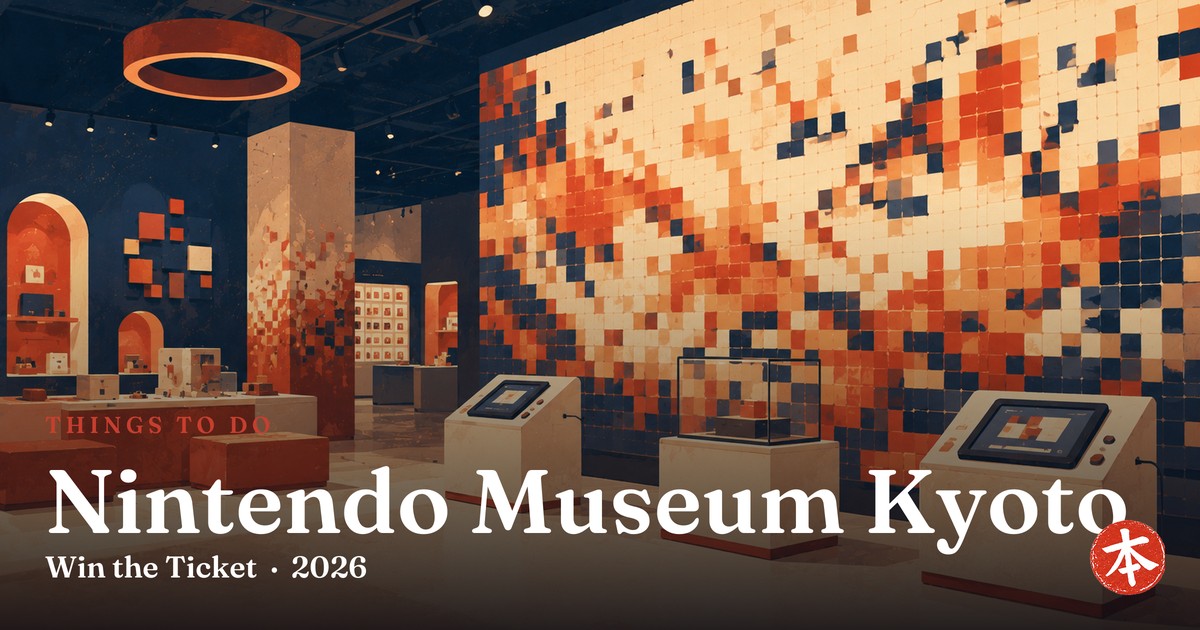
The Nintendo Museum in Kyoto is one of the best things a Nintendo fan can do in Japan — and one of the hardest to actually get into. It opened in October 2024 on the site of a former Nintendo factory in Uji, just south of Kyoto, and demand has been enormous ever since. There are no same-day tickets: every visit is booked in advance, through a lottery.
Two things almost no English guide tells you. First, there’s an official English ticket site, and you can enter the lottery entirely from overseas — no Japanese address, no travel agency. Second, the part that trips foreign visitors up isn’t the lottery, it’s a phone-call verification step after you win. This guide covers both — and the one thing that decides whether your visit is magical or frustrating: how you plan your day.
Everything below is cross-checked from the official Nintendo ticketing and visit pages and multiple first-hand reports by Japanese fans — the ticket timing, the coin system, the model course, the Hanafuda workshops, the Hatena Burger, and the limited merch that sells out by afternoon.
Nintendo Museum at a glance
| What it is | Nintendo’s official museum — a hands-on history from hanafuda cards to the Switch. Opened October 2024 |
|---|---|
| Where | Uji, Kyoto, on Nintendo’s former Ogura factory site — a short train ride from central Kyoto |
| Tickets | Lottery only — no same-day tickets. Apply free (English) at museum-tickets.nintendo.com/en |
| Hours | 10:00–18:00 (some later days); entry in fixed 30-minute time slots |
| Prices | Adults 18+ ¥3,300 / ages 12–17 ¥2,200 / ages 6–11 ¥1,100 / ages 0–5 free |
| Inside | 10 coins per person for hands-on experiences — you can’t buy more, so you can’t do everything |
| Time needed | A full day — fans routinely spend 6+ hours |
Tickets: the lottery, the English site, and the phone call
Let’s be honest up front: getting in is the hardest part of the whole trip. Tickets are sold only through Nintendo’s official lottery — no same-day or gate tickets — and demand hugely exceeds supply, especially on weekend mornings. (For the full step-by-step of applying from overseas and clearing the phone-call verification, see our Nintendo Museum ticket guide.)
How the lottery works
- Apply online with a free Nintendo Account. Applications open about three months ahead, and results come on the afternoon of the 1st of the following month, about two months before your visit. (Example: to visit in July, you apply in April; results arrive on May 1.)
- Enter your full name exactly as it appears on your passport — the museum checks ID at the door, and the name must match.
- Pick a date and a 30-minute entry time slot. If you win, you confirm by paying with a credit card.
The English site & the phone-call verification — the real hurdle
Here’s the under-reported part. You can do all of this from abroad: the official ticket site has an English version (museum-tickets.nintendo.com/en), with no Japanese residency required. But before you can pay, you must complete a phone-call verification — you place a short call to a Japanese number from the phone you registered. You don’t say anything; the call disconnects automatically after about a second. It just proves the number is real. Payment is credit-card only.
Missed the lottery? The backup
Don’t give up if you lose. Unclaimed and canceled tickets are released for direct, first-come purchase about two weeks after results. Japanese visitors report that weekday-afternoon slots are relatively gettable this way, while weekend mornings vanish instantly. Check the ticket site regularly after the announcement.
A Japanese visitor’s rundown of the ticket pitfalls and day-of prep — even without Japanese, it shows what you’re signing up for:
When to book, and how much it costs
The museum runs 10:00–18:00 (with some later days), and there’s genuinely a full day to fill — so the earlier your entry slot, the better. A 14:00 entry leaves you racing the clock. Aim for a morning slot, and if you can, go with at least one other person, so you can split up — one queues for the burger while the other shops.
| Adults (18+) | ¥3,300 |
|---|---|
| Youth (12–17) | ¥2,200 |
| Children (6–11) | ¥1,100 |
| Ages 0–5 | Free |
Prices include tax (as of 2026) and are the same for every time slot — so there’s no reason not to pick the earliest you can get.
The one-day model course (the plan that keeps waits near zero)
This is the single most valuable thing to understand: the hands-on experiences get more crowded as the day goes on, so the winning move is to do them in the opposite order most people do. Here’s the model course Japanese visitors have converged on, for a 10:00 entry.
- 9:40 — arrive (it sometimes opens a few minutes early), stash bags in the free lockers (big enough for suitcases; umbrella stands too).
- 10:00 — enter, and reserve a Hanafuda workshop first at the lobby information counter (first-come, for a slot within 3 hours of your entry).
- 10:10–12:00 — go straight to the hands-on experiences while they’re empty. Skip the 2F exhibits for now.
- ~12:15 — your Hanafuda workshop(s).
- ~13:45 — lunch at Hatena Burger, after the 12:00–15:00 rush.
- 15:00 — photo spots, then the shop.
- 16:00–close — the 2F exhibits, now quiet, at your own pace (tell staff ‘re-entry’ for a quick side route).
The full model course in motion, with the timing logic behind each step:
The coin system and the best experiences
When you enter, your ID card is loaded with 10 coins, and each hands-on experience costs 1–4 coins. You cannot buy more, and unused coins expire the same day — so you physically cannot do everything in one visit. Decide your priorities in advance.
- Busiest — do these first: Zapper & Super Scope SP (4 coins, widely called the best), the Big Controllers (especially the Nintendo 64 one; 2 coins, two-player), Ultra Hand SP (1 coin, great value), and Ultra Machine SP (2 coins, batting).
- Usually quieter: Love Tester SP (two-player), Game & Watch SP, and Nintendo Classics.
- Every experience auto-photographs you and records your score — download the photos free from your account page for 30 days. Everyone but you is auto-blurred, so it’s safe to share.
The Hanafuda workshops (Nintendo’s origin)
Nintendo began in 1889 making hanafuda playing cards, and the museum runs two workshops around them — reserved in person at the lobby counter on the day (first-come, within 3 hours of your entry), and paid separately from admission:
- ‘Play Hanafuda’ (¥500, ~30 min): learn the traditional game on a projection-mapping table — beginner-friendly, no prior knowledge needed (and now seated, not on tatami).
- ‘Make Hanafuda’ (¥2,000, ~60 min): craft your own set with a kit and take it home. Two tips from makers: don’t overload the ink (it bleeds) or the glue (it smears).
Hatena Burger: the only place to eat
The museum’s single café lets you build your own burger from over 270,000 combinations, ordered via a QR code on your phone. The beef patty is thick, and the soft-serve has a cult following. Two things to know: it’s packed 12:00–15:00 (30-minute-plus waits), with last orders at 17:30 — so eat early or late, and split the queue with your group. The wrapper, menu card and cup are yours to keep as souvenirs. Full details — ordering, what to get, dodging the queue — in our Hatena Burger guide.
Shopping at Bonus Stage (and the sell-out problem)
- Tell the exclusives apart by the logo: a gray Nintendo logo means museum-exclusive; a red logo is regular Nintendo Store merch you can buy anytime, anywhere. On site, prioritize the gray ones.
- Big items like the Super Famicom controller cushion (¥13,200) are best bought last — there are no large lockers inside — but the giant plush can sell out by late morning, so judge accordingly. They’ll give you a carry bag for the bulky stuff.
For a first-hand account, Nicol’s Nintendo Museum, Kyoto: A Complete Guide notes that by 2 p.m. most of the plushes had sold out except the N64 one, and that only one of four in the group won the lottery.
Practical tips (read before you go)
- Bring a pass case or lanyard. Your entry card is scanned constantly — every experience and every purchase. People lose the loose card all day; a case saves you (they’re sold inside if you forget).
- Bring a Nintendo 3DS. The museum runs StreetPass, and you can pass a ‘special Mii’ of Nintendo figures (reportedly since spring 2025). Pokémon GO, Pikmin Bloom and My Nintendo also have on-site perks.
- Free Wi-Fi covers the museum (one hour per connection) — set it up while you wait to enter.
- Free lockers (including large) mean you don’t need Kyoto Station coin lockers. Bags get a thorough security check at entry, so bring photo ID that matches your ticket.
- Photography is fine in most areas, but the 2F exhibits and a few spots are no-photo — watch for the signs.
- Nintendo and Pokémon fan? Pair this with our Tokyo Pokémon Centers guide and our PokéPark Kanto guide for the full itinerary.
Getting there
The museum is in Uji, Kyoto, on the site of Nintendo’s former Ogura factory — a short train ride from central Kyoto toward Ogura Station, then a walk. Aim to arrive about 10 minutes before your slot; there’s a small waiting building by the entrance for early arrivals, handy in summer heat or rain.
FAQ
Can I get Nintendo Museum tickets from overseas?
How does the Nintendo Museum ticket lottery work?
How much are Nintendo Museum tickets?
How long do I need at the Nintendo Museum?
What is the coin system at the Nintendo Museum?
Where is the Nintendo Museum and how do I get there?
Bottom line (2026) — The Nintendo Museum in Kyoto is lottery-only, but overseas visitors can enter on the official English site — the real hurdle is a phone-call verification, not the lottery itself. Do the hands-on experiences in the morning before crowds build. Nintendo began in 1889 making hanafuda cards, and two workshops around them are reservation-based.
Sources & further watching
This guide was compiled and cross-checked from the official Nintendo Museum ticketing and visit-flow pages and multiple first-hand visit reports by Japanese creators — their hard-won tips on the coin system, the model course and the merch sell-outs are the backbone of this article:
Prices, lottery timing, hours and merch limits are as of 2026 and can change — always confirm on the official Nintendo Museum site before you plan.
Tokyo to Osaka, Tokyo to Kyushu, Tokyo to Hokkaido — day by day — plus seven places most visitors never reach.
- 12 pages, 80 photographs, every stop linked to its guide
- Every price and opening hour read from the official page
- Re-issued monthly, so it does not go stale in your inbox
Free. One email a month, plus the rare change that matters. Unsubscribe with one click in any email. By subscribing you agree to our privacy policy.