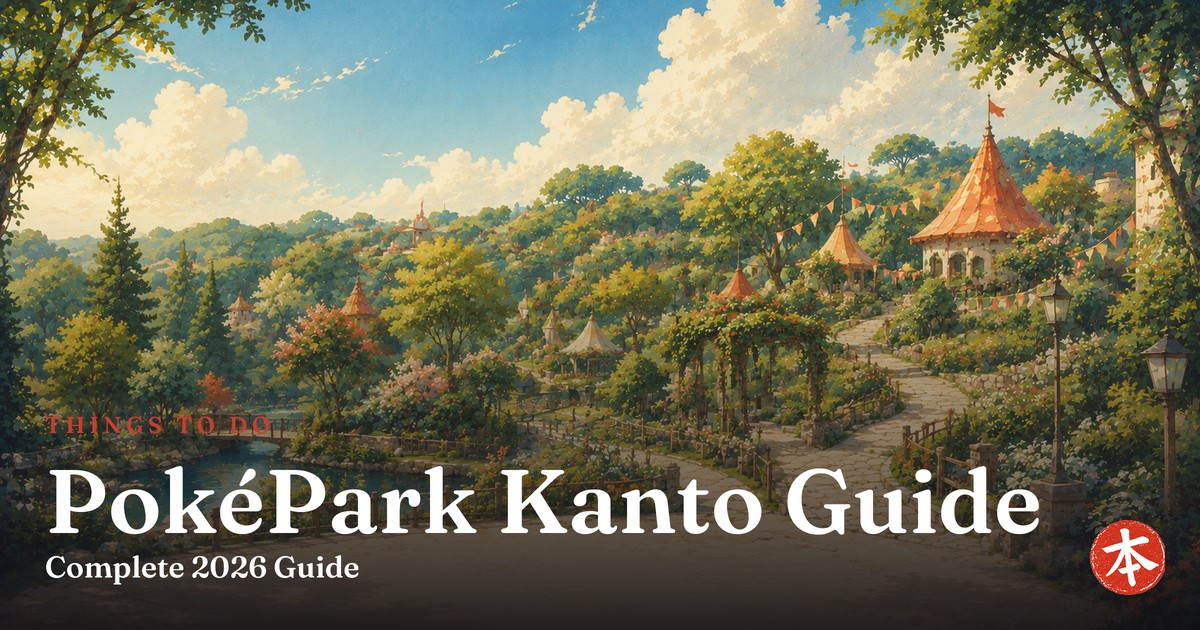
PokéPark Kanto is Japan's first permanent outdoor Pokémon theme park, opened February 2026 inside Yomiuriland on the western edge of Tokyo. It is spectacular — and it is also one of the hardest tickets in Japan right now. Tickets sell out in minutes, key experiences require a same-day in-park reservation race, and almost every piece of reliable information exists only in Japanese.
This guide fixes that — and it's current, which matters more here than almost anywhere: the park's hours, ticket rules and entry system have all changed since opening, and change again in October and November 2026. Everything below is re-checked against the official pages, with Japanese visitors' hard-won tactics layered on top.
PokéPark Kanto at a glance
| What it is | Japan's first permanent Pokémon theme park — a recreated Kanto-region world with a 500m forest trail and a Pokémon town, 600+ Pokémon figures |
|---|---|
| Where | Inside Yomiuriland, Inagi City, Tokyo (about 30–40 min from Shinjuku). Every PokéPark ticket includes Yomiuriland entry |
| 🚨 Hours | Jul–Sep 2026: 12:00–20:00 · from Oct 2026: 11:00–19:00 (official notice; hours vary by date — check the official calendar) |
| Tickets | Advance only, no gate tickets. Overseas visitors: official English site. Japan residents: monthly lottery or daily 20:00 JST first-come drop |
| Prices (official, vary by date) | Town Pass from ¥4,700 · Trainer's Pass from ¥7,900 · Ace Trainer's Pass from ¥14,000 (adults 13+; child and senior tiers exist; under-3s enter the town free) |
| 🚨 Cancellation (new Aug 2026) | Full refund until 18:00 JST the day before — no fee. No changes to purchased tickets; no official resale |
| Time needed | A full day. The Forest alone takes 1–2 hours |
| Payments | 100% cashless — cards, transit IC and QR pay only (official rule) |
| Small kids | Town: yes, stroller-friendly, under-3s free. Forest: children under 5 not allowed (no strollers or baby carriers either) |
What exactly is PokéPark Kanto?
PokéPark Kanto opened on February 5, 2026, as a joint project between The Pokémon Company, Yomiuriland and the Yomiuri Shimbun group. Unlike a pop-up or an indoor attraction, this is a permanent, open-air park built into wooded hills — and the terrain is a real part of the experience.
The park has two main areas. Pokémon Forest is a roughly 500-meter walking trail through actual woodland, recreating Route 1 from the original games, where wild Pokémon appear in the grass, on branches, and around every corner — more than 600 figures in total, many animated or making their in-game cries. Sedge Town (Kayatsuri Town in Japanese — the official English name is Sedge Town) is a Pokémon town square with a Pokémon Center, shops, food stalls, two small rides, shows, a parade and near-constant character greetings.
Japanese fans who grew up with the original 151 describe the Forest as genuinely emotional — the Route 1 theme plays as an orchestral arrangement through the trees, and the level of detail (down to female Pikachu having heart-shaped tails) is the kind of thing that makes grown adults cry. Multiple visitors report exactly that.
Important: the schedule keeps changing (July, then October)
What are the hours right now?
From the official notice: 12:00–20:00 from July through September 2026 (until June it was 10:00–18:00 — many older posts still show that). The evening hours have an upside: the rides and the town lit up after dark are consistently described as magical. A smart plan: spend the morning in Yomiuriland proper — every PokéPark ticket includes it, and the official FAQ confirms Yomiuriland never opens later than PokéPark — then be at PokéPark's entrance well before noon.
What changes in October 2026?
The same official notice announces the next shift: from October 2026 the park runs 11:00–19:00, and the in-park reservation system opens at 10:45 instead of 11:45. It adds, in writing, that all times may change again — and the official FAQ says hours vary by date. If you're visiting in October or later, treat every guide (including this one) as a starting point and check the official calendar for your exact date.
Tickets: the hardest part of the whole trip
Let's be honest up front: getting a ticket is harder than anything inside the park. There are no same-day or gate tickets, everything is sold in advance, ticket payment is credit card only, and demand massively exceeds supply. The good news for overseas readers: you have your own official route that skips the worst of it — full walkthrough in our dedicated PokéPark ticket guide.
Live outside Japan? Use the official English ticket site
The official FAQ tells guests residing outside Japan to buy through a dedicated international ticket site (English only) — no Japanese phone number, no SMS. This is the single most under-reported fact about PokéPark, and it exists precisely because the domestic site officially requires SMS verification with a phone usable in Japan. The official English app can load internationally-purchased tickets and run your reservation entries on the day.
Live in Japan? Lottery first, then the daily 20:00 drop
Lottery (3 months ahead): applications run from the 1st to the 12th of each month for the month three months out, results arrive in the second half of the month, and winners must pay by month-end. Since the August 2026 round, each member can enter up to three times per application period. First-come sales (2 months ahead): tickets for each date go on sale daily at 20:00 Japan time, one day at a time, two months ahead of the visit date — the start time moved from 18:00 in July 2026, and older guides still say 18:00. Popular dates sell out in minutes. The Japanese fans' playbook: register and verify your account in advance, log in 30 minutes early, and wait — the site becomes nearly unreachable right at the hour.
Which pass should you buy?
| Town Pass from ¥4,700 adult / ¥2,800 child | Sedge Town only (no Forest). The right choice for the adult accompanying a toddler, or anyone skipping the hike. Under-3s don't need any ticket for the town |
|---|---|
| Trainer's Pass from ¥7,900 adult / ¥4,700 child | The standard ticket: everything in town + one timed entry to Pokémon Forest. Your Forest slot is fixed at purchase and can't be changed — the whole day gets planned around it |
| Ace Trainer's Pass from ¥14,000 adult / ¥11,000 child | (Some guides call this the Elite Trainers Pass — Ace Trainer's Pass is the official English name.) Unlimited Forest entries, free re-entry everywhere, reserved show seats, one free ride on each attraction with priority lane, an exclusive greeting room, photo service and exclusive merch. Sells out almost instantly |
All three tiers also have senior (65+) and disability pricing, and every price is a "from" figure — the official site sells at date-variable prices. Ages count as of the visit date.
🆕 Can you cancel? (Yes — since August 1, 2026)
New official rule, and a big one: unused tickets can now be canceled on the official site until 18:00 JST the day before your visit, for a full refund with no fee. Two hard edges: a canceled ticket cannot be un-canceled, and purchased tickets still cannot be changed — no date swaps, no upgrades — so fixing a mistake means cancel-and-rebuy into whatever availability exists. There is no official resale system, and the official pages don't say whether canceled inventory returns to sale — Japanese fans watch the site anyway, and so should you if you missed your date.
🆕 Coming November 1: ID checks at the gate
From entry dates of November 1, 2026 onward, the official announcement is blunt: every visitor's details must be registered in advance, staff will check a physical photo ID against the registration at the entrance — passport, residence card, driver's license or My Number card — and no match means no entry, with resold tickets explicitly invalidated. The same change raises the first-come purchase limit from 2 to 6 tickets (Ace Trainer's Pass still max 2). For foreign visitors this is workable — you'll have your passport — but get every traveler's name registered exactly right, because the rules say details can't be changed afterward. Bonus for November planners: Eevee Week runs November 21–26, 2026, with extra Eevee appearances across the park.
Below: a Japanese visitor's detailed preparation guide — even without Japanese, the ticket-site walkthrough from 1:06 and the queue footage give you a feel for what you're up against.
Getting there
Keio line: Keio-Yomiuriland Station, then the 'Sky Shuttle' gondola up the hill — the scenic way in. Odakyu line: Yomiuriland-mae Station, then a bus, roughly 10 minutes to the main gate. Either way you arrive at Yomiuriland's gate first — PokéPark is inside it, about a 10-minute walk from the Sky Gate entrance. Critical detail from visitor reports: the entrance queues split into two separate lines — one for PokéPark ticket holders, one for regular Yomiuriland guests — marked in Japanese. The wrong line costs you minutes at exactly the moment the reservation race begins. Look for PokéPark signage, or show a staff member your ticket QR.
How the park actually works: the reservation race
This is the part nobody warns you about. Your entry ticket alone does not get you into everything. Three of the park's key experiences require a same-day digital reservation (整理券, seiriken) through the official PokéPark app — and they run out fast.
Before you go: two non-negotiables
Download the official PokéPark app and create your account the day before. Load your tickets into the app's My Tickets — you'll be asked for the QR repeatedly all day. (Overseas buyers: the English version of the app reads international-site tickets and handles the reservation entries.)
The three reservations, in priority order
The official list: 1. Pokémon Playhouse (the meet-and-greet house — Fureai House in Japanese; timed entry, first-come). The toughest: visitor reports say slots can vanish within 10 minutes. If you miss it, don't despair — see the next section, seriously. 2. Pokémon Daisuki Shop (the main merch store; timed entry, first-come). On weekends, gone in about 5 minutes. You cannot enter the shop without one. 3. Sedge Gym show (reserved seats — this one is an in-app lottery, with reportedly decent odds). Enter immediately, then forget about it. Official fine print: entries can't be changed or canceled once made, and the two rides are not part of this system at all — they sell timed tickets at the wagon.
The timing, from the official pages: entries open once you're inside Yomiuriland and the clock hits 11:45 (through September 2026; 10:45 from October). Be through Yomiuriland's gate, app open, thumb hovering, a few minutes before. Family tip that saves the day: link everyone's tickets with the app's group function beforehand so one person applies for the whole group — otherwise you race separately and can end up with different slots. Note: the Ace Trainer's Pass cannot join groups.
Pokémon Forest: the main event
The Forest is the reason this park exists. You start at the research lab, receive a field notebook with sketches and hints, and walk out into a full-scale recreation of Route 1 — then deeper: Diglett mounds, a 110-step descent, Rhyhorn charging down a rocky slope (you can sit on one for photos), a dark Rolycoly tunnel, a giant Onix and Steelix in the crags, and a flower garden with Charizard before you emerge into Sedge Town.
Two things Japanese visitors consistently emphasize. First, it's a real hike — proper stairs, slopes and uneven ground. Wear sneakers, use a backpack, skip the sandals. Second, budget more time than the official one-hour estimate. Fans routinely spend two hours or more; one visitor admitted spending a full hour just in the Pikachu & Eevee section.
Forest rules that catch people out
Children under 5 cannot enter. No strollers, no baby carriers — a hard safety rule, with restrictions for pregnant visitors and certain health conditions too. With a Trainer's Pass you enter once, within a 1-hour window of your assigned time, and once you exit you cannot re-enter (that flexibility is exactly what the Ace pass sells). There are no toilets inside the Forest — go before the lab. Really. The 110-step staircase is a no-photography zone. You may gently touch Pokémon in the open areas (not the berries!), and riding the Rhyhorn for photos is officially sanctioned.
Small delights to watch for: Pokémon behavior changes with weather and day of the week (fans report Drifloon appearing on Fridays — a lovely nod to the games), and at least one shiny (a shiny Goomy) is hiding in the park. Bring the field notebook everywhere; it points you to things you'd otherwise walk past.
The Forest section of this walkthrough (from around 28:00) shows the trail, the terrain and the level of detail better than any photo:
Sedge Town: shows, greetings and the Pokémon Center
The town is flat, stroller-friendly, and accessible with every ticket type. The centerpiece is a working Pokémon Center: your group hands a tray of six Poké Balls (satisfyingly heavy — about 1.5kg) to the nurse, the healing machine plays the exact jingle from the games, and on some days there's a birthday version of the ceremony. If you bring your own Pokémon plush — a beloved local custom, see tips below — the staff will 'heal' it for you at the counter.
Characters wander the town almost constantly (that day's roster is announced in the app — Clefairy, Growlithe, Psyduck, Vulpix, Slowpoke, Gengar, Lapras, Dragonite and Blissey have all appeared), and the interactions are unusually generous — hugs, high-fives, no formal queue.
Don't miss
Pika Pika Sparks (the Sedge Gym show, ~25 min): dance, projection mapping and lasers set to EDM arrangements of the game soundtrack. Filming the show is prohibited — there's a designated photo moment at the end. The parade (Pikachu & Eevee Bubble Carnival, twice daily — around 13:20 and 15:55 by visitor reports; check the day's app schedule): free to watch from anywhere, and a few guests get scouted by the dance troupe to join — bring a buddy plush and wave. The battle court at the Gym's 2nd-floor exit: Tyranitar, Garchomp, Gyarados and Raichu mid-battle — easy to miss, consistently described as jaw-dropping. The two rides — the flying Pika Pika Paradise and the Vee Vee Voyage carousel (official English names; older guides write 'Eievui Voyage'): officially ¥1,200 adults (13+) / ¥800 children (3–12), timed tickets sold at the adjacent wagon, no height limits, under-5s ride with a paying 13+ companion. Rarely crowded; the night ride on Pika Pika Paradise is a highlight under the summer evening hours.
Quiet-time hack from Japanese visitors: while everyone gathers for the parade, the Forest, shops and photo spots empty out noticeably. Also: when the Gym isn't running shows, it sometimes opens as a free air-conditioned rest space — staff won't advertise it.
Missed the Playhouse reservation? Here's the truth
The meet-and-greet house (Pokémon Playhouse — Fureai House in Japanese) is the single most oversubscribed thing in the park — and multiple Japanese visitors who failed to get it report the same surprising conclusion: it barely matters. The town greetings are so frequent and generous that one visitor described losing the reservation race, then spending the day hugging and high-fiving Pokémon in the streets anyway, forgetting the disappointment 'within minutes'. Certain Pokémon only appear inside the Playhouse, so it's still worth trying for — but don't let it decide whether the trip was worth it.
Also free, no reservation needed, and genuinely fun: the photo props mission (a wagon hands out Pokémon-card-shaped photo frames — find the day's target Pokémon, photograph it 'inside' the card, show staff, get exclusive stickers), Diglett ring toss (free, unlimited retries, win-or-lose you get a sticker — the 'lose' sticker of Diglett hiding is arguably cuter), and birthday stickers (tell any staff member it's your birthday — the window is six months either side, so effectively everyone qualifies).
Food: what to eat and when
Four main food spots, all takeaway-style: Pikachu's Onigiri shop (rice-ball trays with karaage — the ginger side dish gets rave reviews; trays come in 5 random Pikachu designs), Altaria's Rest Kitchen (baguette sandwiches, chunky soups, a much-loved spinach fried potato), the Eievui Café (latte art, cream buns, ice cream bars), and the Snorlax popcorn stand (BBQ and milk-caramel; the big Snorlax bucket — about ¥4,500 by visitor reports — comes with a Poké-whistle strap and a warning: full of popcorn, the big guy is top-heavy and tips over).
Eat early or late. The lunch rush is intense, popular items sell out (the special drinks at the Friendly Shop were gone by 14:00 on one visit), and — the biggest complaint about the whole park — seating is genuinely scarce. The in-game drinks (Fresh Water, Soda Pop, Lemonade — around ¥200–350 by visitor reports) are at the Friendly Shop, and the themed vending machines around town sell drinks where you pick your label design. One honesty note: the official site publishes no food or drink prices at all — every figure in this section is visitor-reported.
Shopping: the one-checkout rule and the pin badge game
The single most expensive mistake at PokéPark: at the main Daisuki Shop, your park ticket is scanned at the register and each ticket gets exactly ONE checkout. Forget something and you cannot come back through the till. Decide everything, then pay once. (The official rule behind it: purchase-limited items require your ticket QR at the register — so if several of you want per-person limited items, everyone must be present with their own ticket.)
The shop itself needs the app reservation (see above). If you miss it: many hats and headbands are also sold at town wagons, the exclusive paper gift bags are wagon-only anyway, and park-exclusive sweets are also sold at Yomiuriland's shop outside. Monster Ball pin badges (about ¥1,200, visitor-reported — the official site publishes no merch prices): random pins of all original 151 Pokémon; reports say limit 10 per person, with a Premier Ball for buying 10. The magic: staff carry pouches of pins and will trade with you, in-game style, and wagon corkboards display pins other guests traded in. One visitor pulled Mew from 20 balls. Queues hit an hour by afternoon — buy in the morning. Name keyholders (about ¥1,800, wagon-only): engraved Pikachu or Eevee tags, up to 8 characters — order early, collect in the evening.
Want to see the actual shelves? This walkthrough films the entire Daisuki Shop lineup — and this pin-badge unboxing shows exactly how the Monster Ball gacha works (spoiler: they pull Mew on the last one):
Visiting with kids: an honest assessment
PokéPark is wonderful for children — with one enormous caveat you must plan around: the under-5 Forest ban. Kids 5+ who can hike: Trainer's Passes for everyone, do the Forest together — it's the highlight. Toddlers or babies in the group: the clean play is a Town Pass for one parent and the toddler (under-3s enter the town free, officially), Trainer's Passes for the rest — the town is flat, stroller-friendly, and packed with things little kids adore. Parents wanting to swap so both see the Forest: that only really works with Ace Trainer's Passes (unlimited, time-unrestricted Forest entry); with normal passes, the fixed one-hour windows and the 1–2 hour Forest duration make a swap practically impossible. Rides: under-5s need a paying 13+ companion; there are no height limits.
Practical tips (read this the night before)
The park is 100% cashless — the official list runs from Visa and UnionPay through transit IC, iD, QUICPay, WAON, PayPay, WeChat Pay, Alipay and Alipay+. One absurd exception: the park has no lockers (official FAQ) — the coin lockers are on the Yomiuriland side and may want ¥100 coins. Bring a few just for that. No outside food; no selfie sticks; there's a bag check at the town entrance. Battery = lifeline — tickets, reservations and photos all run on your phone; rental chargers are often gone by afternoon, so bring a 10,000mAh power bank. Free Wi-Fi covers the park — look for the official network. Bring a Pokémon plush: the local custom of carrying your 'buddy' unlocks real interactions — the Pokémon Center healing ceremony, parade waves, staff banter, buddy stickers. Any plush from home works, or pick one up beforehand at a Tokyo Pokémon Center (see our guide to Tokyo's Pokémon Centers). Re-entry: same-day re-entry is officially allowed — but for everyone except Ace pass holders, only to the town. Leaving the town mid-day means a hand stamp (a different Pokémon design each day). Pokémon GO players: the park runs GO integration (exclusive raids, dense PokéStops), and Pokémon HOME users can claim a commemorative medal at the entrance — once per day, GPS on, five random designs.
For getting cash in a country that has mostly gone cashless, our cash and ATM guide compares which ATMs take a foreign card and the fees they charge.
(For everything beyond the park — stores, cards, cafés and how they fit one trip — see the complete Pokémon-in-Japan guide.)
Five other Tokyo tickets worth booking before you arrive
If PokéPark taught you anything, it is that the places worth visiting in Tokyo are the ones you have to book in advance. These five run on the same logic — timed entry, dated tickets, and a queue that forms weeks out. Each one has its own guide here.
| Where | Why it is on this list |
|---|---|
| Shibuya Sky | Timed entry, and the sunset slots go first. The same booking behavior as PokéPark, on a smaller scale. |
| teamLab Planets | Date-and-time tickets that sell out on weekends. Worth fixing before you land. |
| Tokyo Skytree | Two decks, two prices, and a cheaper combined option most visitors miss. |
| Sanrio Puroland | Indoor, and the closest thing to PokéPark in feel. Prices move by the day. |
| Tokyo Disney Resort | Variable pricing by date. Worth reading before you pick which day to go. |
FAQ
Do I need a Japanese phone number to buy PokéPark Kanto tickets?
Can I cancel or change a PokéPark ticket?
What are PokéPark Kanto’s opening hours?
What happens at the entrance from November 1, 2026?
Can I visit PokéPark Kanto with a toddler or baby?
Is PokéPark Kanto cash-free?
How long do I need at PokéPark Kanto?
What happens if I don’t win any reservations in the app?
Is PokéPark worth it without the Ace Trainer’s Pass?
Bottom line (2026) — PokéPark Kanto (opened Feb 5, 2026) is Japan’s first permanent outdoor Pokémon theme park, inside Yomiuriland in Inagi, Tokyo — every PokéPark ticket includes Yomiuriland entry. Three passes: Town Pass ¥4,700 (town-only), Trainer’s Pass ¥7,900 (standard; includes one timed Pokémon Forest slot), Ace Trainer’s Pass ¥14,000 (all-access). Advance only — no gate tickets. Overseas visitors buy on the official English site. The in-park app reservation race starts at 11:45 (10:45 from October 2026) for Playhouse, Pokémon Center and shows. Plan a full day.
Sources & further watching
Official facts — ticket types, prices, sale mechanics (lottery windows, the daily 20:00 drop, purchase limits), the August 1 cancellation rule, the November 1 ID-check change, hours (including the October change), reservation-system times, ride prices, payment list, re-entry, Forest age rules and the no-lockers rule — were re-read from the official PokéPark Kanto site, its official announcements of June 26, July 14, July 23 and July 28, 2026, and the official English ticket-info page, on August 6, 2026. The official site publishes no merchandise or food prices and answers no individual goods questions in advance — every price in those sections is from first-hand Japanese visitor reports, and is labeled as such. Crowd timings (sell-out speeds, queue lengths, parade times) are visitor-reported and will drift.
If you understand Japanese (or just want to see the park in motion), these visit reports are excellent — and they deserve the credit for braving the ticket race so the rest of us can learn from it:
All prices, hours and systems described are as of August 2026 and can change — always confirm on the official PokéPark Kanto site before your visit.
Tokyo to Osaka, Tokyo to Kyushu, Tokyo to Hokkaido — day by day — plus seven places most visitors never reach.
- 12 pages, 80 photographs, every stop linked to its guide
- Every price and opening hour read from the official page
- Re-issued monthly, so it does not go stale in your inbox
Free. One email a month, plus the rare change that matters. Unsubscribe with one click in any email. By subscribing you agree to our privacy policy.